A bird-friendly backyard comes down to four things: native plants in layers, clean shallow water, cover and nesting places, and fewer hazards. Get the planting right and the rest follows, because birds go where the insects, seeds and berries are. At Sacred Garden Designs we design water-wise, sustainable landscapes, and a yard that saves water and a yard that feeds birds are the same yard when the plant list is chosen well.
TL;DR
- Plant natives in layers (groundcover, shrubs, small trees, canopy). Insects on native plants feed most nestlings, so gardening for insects is gardening for birds.
- Offer shallow, clean water. Keep a birdbath no deeper than 2 to 3 inches, in the open but near cover, and wash it regularly.
- Leave some mess: seed heads, leaf litter under shrubs, a brush pile and, where safe, dead wood.
- Treat glass, cats and pesticides as part of the design. They cause more losses than most gardeners expect.
- Start small. A single planted corner with water beats a lawn with a feeder.
Table of Contents
- Start with the four needs birds have
- Plant in layers, and make them native
- Birdbath placement and upkeep
- Shelter and nesting: let the yard be a little untidy
- Feeders: helpful, but plants do more
- Make the yard safer for the birds you attract
- A starter plan for a typical yard
- Our view on bird habitat
- Get a design that fits your yard
- FAQ
- Sources
Start with the four needs birds have
Every university extension service says the same thing in slightly different words. Mississippi State Extension lists food, water, shelter and nesting areas as what a yard must supply. Clemson’s Home & Garden Information Center adds space as a fourth component and says all four can be met with layered plantings, from large canopy trees down to shrubs, vines and open ground.
That gives you a simple way to audit your yard. Walk it and ask four questions:
- Where would a bird find food in March, July and November?
- Where does it drink or bathe?
- Where does it hide when a hawk passes?
- Where could it nest?
A typical turf-and-fence yard answers none of them. The fix is rarely a bigger budget. It is a different structure.
Plant in layers, and make them native
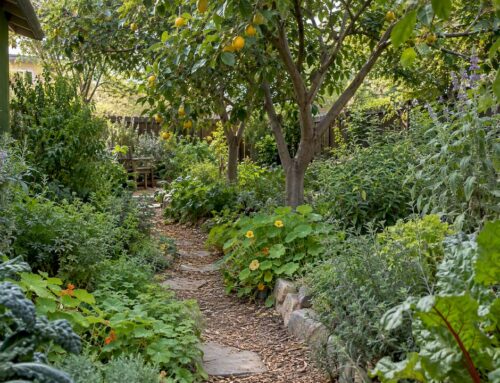
All About Birds, from the Cornell Lab of Ornithology, stresses structural diversity: many birds prefer a mix of vegetation at varying heights, and low plants next to a thicket of shrubs and taller trees give cover and let birds move safely between feeding and shelter. The National Zoo recommends the same approach: plants of varying sizes and growth patterns, with different fruiting and leafing schedules, both evergreen and deciduous.
In practice, think of four tiers:
- Groundcover and grasses. Shelter for ground feeders such as towhees and sparrows.
- Perennials. Seeds, nectar and the insects that visit them.
- Shrubs, large and small. Berries, nesting sites and escape cover.
- Trees. Canopy, nest sites, winter food and shade. See our look at how trees change the climate around a home for the cooling side of the same planting.
Why native plants matter more than fancy ones
The U.S. Fish & Wildlife Service explains that most birds rely on insects, especially caterpillars, to feed their nestlings, and that those insects rely on native plants. A yard of ornamental imports can look green and still be nearly empty of food for a chickadee raising young. The National Zoo makes the same point: native plants draw beneficial insects, a key food source for most birds.
What to plant, by region
“Native” means native to your area, so the right list in Los Angeles is not the right list in Minnesota. Official guides show how much the lists differ:
| Region | Plants the guide names | Source |
|---|---|---|
| Southwest Idaho | Western serviceberry, netleaf hackberry, chokecherry, blue elderberry, snowberry, juniper, buckwheat and aster family plants | U.S. Fish & Wildlife Service, 2024 |
| Minnesota | Columbine and bee balm for hummingbirds; native sunflowers, asters and coneflowers for seed; red-osier dogwood, serviceberry, wild plum and chokecherry for berries | Board of Water and Soil Resources, 2025 |
| Eastern U.S. | Pines, junipers and cedars for shelter; oaks and hickories for food; serviceberry and elderberry in summer; dogwood in fall; American holly, Eastern red cedar, bayberry and sumac in winter | National Zoo |
| Utah | Drought-tolerant natives such as white-tufted evening primrose and desert marigold | Utah State University |
The pattern repeats everywhere. You want something fruiting or seeding in every season, shrubs with berries that ripen at different times, and a mix of conifers and broadleaf plants. Your county extension office or state native plant society will have the list for your ecoregion.
A note for dry-climate yards
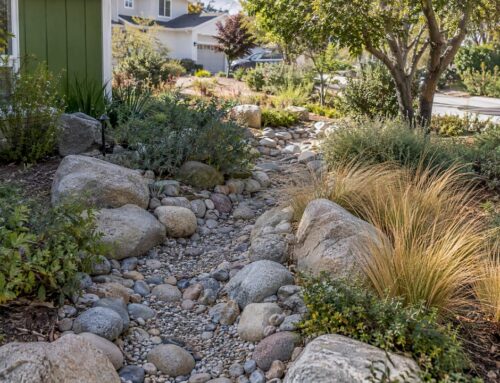
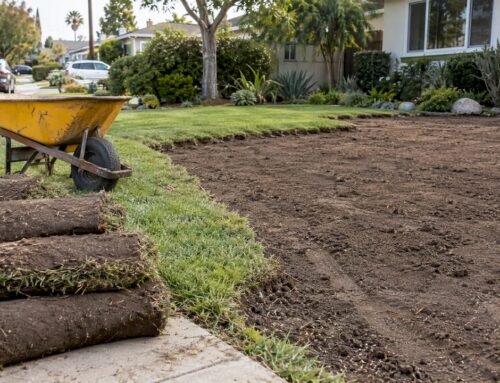
If you garden in a drought-prone area such as Southern California, natives are also your water-saving strategy. Once established, plants adapted to your rainfall need far less irrigation than turf. Our guides on lawn alternatives that cut water use and small-yard drought design show how to swap turf for planting beds without losing usable space. If you have kids or pets, keeping a play patch and converting the rest is the usual compromise.
Birdbath placement and upkeep
Water is often the single fastest upgrade, and the one people get wrong. Texas Parks & Wildlife notes that in hot, dry climates water is often a critical resource, and that water features should be shallow and cleaned regularly to prevent algae and mosquitoes.
Where to put it
UF/IFAS recommends an open spot with some shade, not too close to shrubs where a cat can hide, and ideally near a tree so birds can make a quick getaway. That is the balance: close enough to cover that a wet bird can escape, far enough that nothing can ambush it.
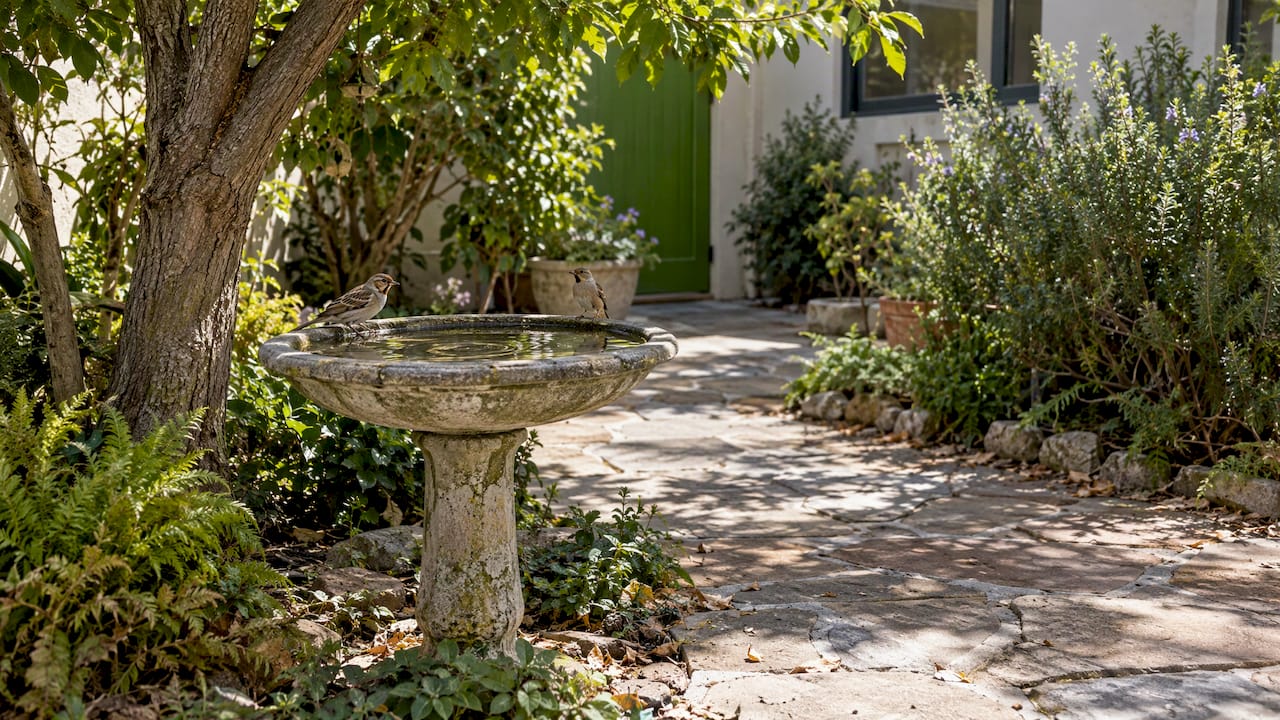
Kansas State University adds that elevated baths are safer because birds can easily escape predators, while ground-level baths near shrubs also serve small animals.
Depth and cleaning
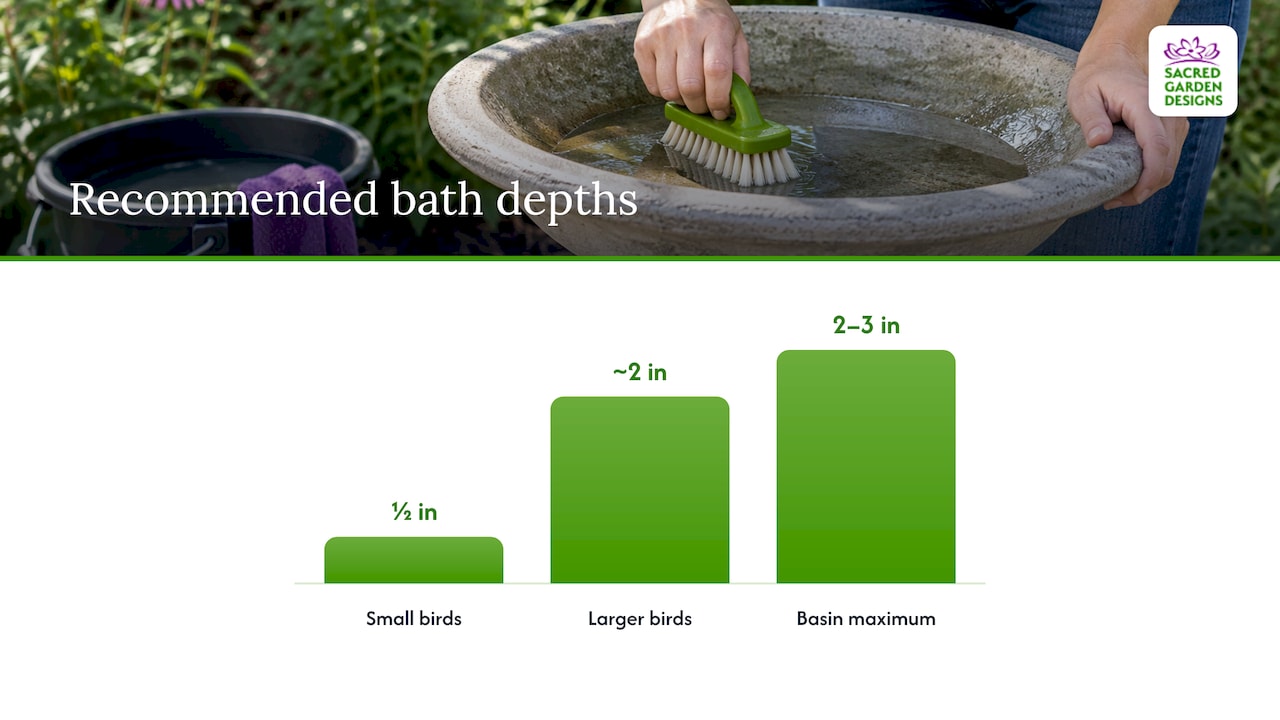
The same Kansas State guide says a bath should be no deeper than 2 to 3 inches with a gradual slope. The New York Botanical Garden notes that smaller birds bathe in about half an inch of water while larger birds prefer around 2 inches. A flat rock or a few stones in a deeper basin gives every size a place to stand.
UF/IFAS researchers have found that diseases can pass between birds at birdbaths, so scrub the basin with soap and water or a solution of 1 part bleach to 10 parts water (soap only for cement baths), and rinse well. In freezing climates, Mississippi State Extension suggests a heater to keep water unfrozen. A weekly scrub in warm weather is a sensible routine, and changing the water often also stops mosquito larvae.
Shelter and nesting: let the yard be a little untidy
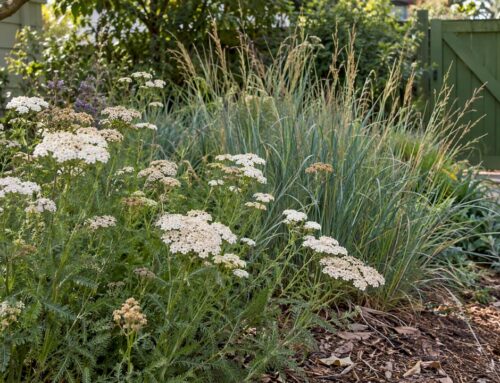
A bird-friendly yard is not a manicured one. All About Birds suggests leaving seed heads standing on purple coneflowers, black-eyed Susans and sunflowers for goldfinches, raking leaves under shrubs to harbor insects, and building brush piles with thicker branches below and thinner ones on top.
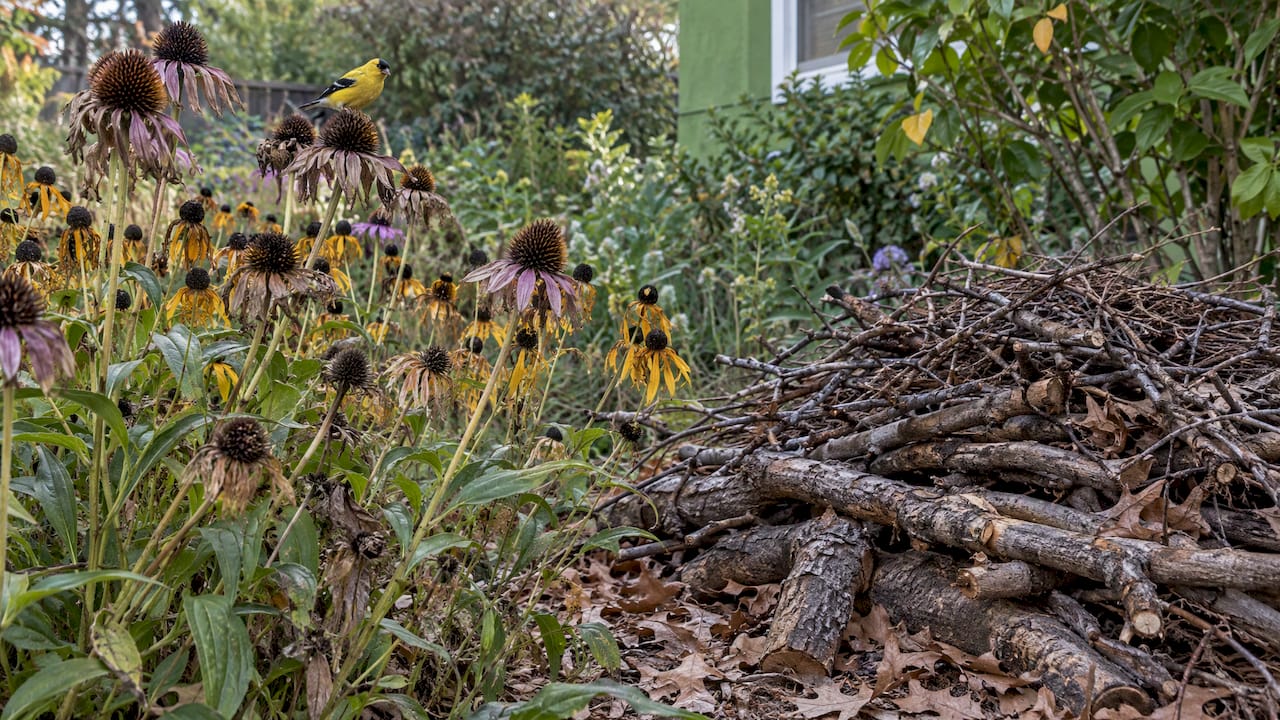
The New York Botanical Garden suggests a loose 6-foot brush pile at the property edge, evergreens on the north side to block cold winds, and perennials and shrubs planted in groups of three, five or seven so they read as habitat rather than single specimens.
Some other choices that help:
- Evergreens for winter cover. Mississippi State’s habitat publication calls evergreens particularly valuable in winter.
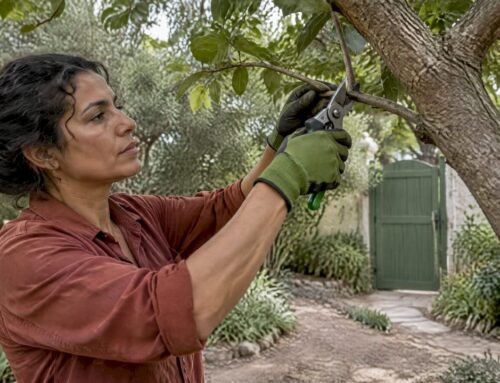
- Dead wood where it is safe. Insects in decaying wood feed woodpeckers, chickadees and nuthatches. A dead tree that could fall on a house or fence needs a professional assessment first, and we can help with expert tree trimming and clean-up when a tree needs work.
- Nest boxes for cavity nesters. The National Zoo lists house wrens, Carolina chickadees, nuthatches, Eastern bluebirds, tufted titmice and woodpeckers among the species that use them. Choose box sizes for the species in your region.
A word on fire safety
If you live in a wildfire-prone area, habitat and defensible space need to be planned together. Brush piles and dense shrubs belong away from the house, and local fire authority rules on clearance distances come first. Our guide to hillside landscaping in Los Angeles covers CAL FIRE-compliant planting on slopes.
Feeders: helpful, but plants do more
A feeder is a fine addition. Black oil sunflower seed in a tube feeder draws everything from chickadees to woodpeckers, and millet draws ground feeders. Mississippi State’s habitat publication points out, though, that natural vegetation is a preferred food source: it avoids the crowding that spreads disease, costs less over time and brings in a wider range of wildlife. Keep feeders close to cover and clean them regularly. If your yard feeds birds through the seasons from plants, the feeder becomes a supplement.
Make the yard safer for the birds you attract
A planted yard draws birds in, so it should not hurt them. Three hazards matter most.
Glass. Birds cannot tell a reflection of sky or leaves from open space. A study by American Bird Conservancy and university partners confirmed that more than one billion birds die each year in the U.S. from building collisions, and found that only 40 percent of injured birds survive even with rehabilitator care. Break up reflections on the outside of the glass with closely spaced dots, film or screens, and keep feeders and baths either within a few feet of the window or well away from it.
Cats. Keeping pets indoors, or in an enclosed outdoor space, protects ground feeders and fledglings. Dense low shrubs close to a birdbath give cats a place to hide, so keep baths in an open spot as the UF/IFAS guidance suggests.
Chemicals. Insecticides remove the caterpillars that nestlings depend on, and rodent poisons can pass up the food chain to hawks and owls. Plant selection and healthy soil do most of the pest control in a native garden.
A starter plan for a typical yard
You do not need to redo everything. Here is a sequence that works for most backyards:
- Pick a corner. Choose the edge nearest the fence or a mature tree, where cover is already close.
- Remove turf in that area and plant three shrubs in a group. Choose berry or seed producers native to your region, with different ripening times.
- Add perennials in front. Choose native seed and nectar plants, with groundcover at the edge.
- Place a shallow bath in sight of the shrubs but at a safe distance from them.
- Leave the fall cleanup half done. Keep seed heads, leaf litter under shrubs and a small brush pile.
- Treat your windows before the first migration season.
- Water efficiently. Drip irrigation reaches new natives at the root and wastes less. Our guide on Los Angeles irrigation rules covers local watering limits, and the garden maintenance schedule helps you time pruning and cleanup around your frost dates.
Our view on bird habitat
Most people ask us which plants to buy. We think the better question is what the yard needs to do. A yard that supports birds is a working landscape: it shades the house, takes up rain, holds a slope and feeds a food web, all at once.
That is how we have approached water-wise design for over 25 years. In Los Angeles, drought and heat have forced the issue, and native and climate-adapted plantings answer the water problem and the habitat problem together. The artistry matters too. A layered planting with a clear path, a sheltered bench and a bath you can see from the kitchen window is a place people use, and a place people use is a place people look after.
Our advice is to design the habitat as part of the whole garden rather than as an add-on. Decide where the cover goes, where the water goes and where you will sit to watch, then choose the plants. Do that and the birds tend to arrive on their own.
Denise Buchanan
Get a design that fits your yard
If you would rather start with a plan than a plant list, our landscape design services are listed at $1,500 for yards under 5,000 sq. ft. and $2,500 for a full landscape design. We design sustainable, water-wise landscapes, and we can also handle installation, irrigation, hardscape and ongoing garden maintenance.

See our landscape design services for what each package covers, or browse everything we offer. If you want to learn the craft yourself, we also run classes and workshops.
FAQ
What will attract birds to your yard?
Provide food, water, shelter and nesting places. Native shrubs, trees and seed-bearing perennials supply food and cover, while a clean, shallow birdbath gives them water. Mississippi State Extension also lists birdhouses for cavity nesters and building overhangs or trees for other species.
Are native plants really better for birds?
Yes, because they support the insects birds need. The Fish & Wildlife Service points out that most birds feed insects, especially caterpillars, to their young, and those insects depend on native plants. Natives from your own region also tend to need less water once established.
How deep should a birdbath be, and where should it go?
Keep it to 2 to 3 inches at the deepest point with a gradual slope, and add a stone for small birds. Put it in an open spot with some shade, close to a tree or shrub for escape but not so close that a cat can hide beside it. Scrub it regularly.
Do I need a feeder to have a bird-friendly backyard?
No. A layered planting of natives provides food through the seasons and avoids the crowding that can spread disease. If you add a feeder, keep it near cover and clean it often.
Sources
- How to Attract More Birds to Your Yard, Mississippi State Extension
- Establishing a Backyard Wildlife Habitat, Mississippi State Extension
- Attracting & Feeding Songbirds, Clemson HGIC
- How to Provide Seeds and Shelter for Backyard Birds, All About Birds
- How to Make Your Home and Yard Bird Friendly, National Zoo
- Native Garden Guide for Homeowners, U.S. Fish & Wildlife Service
- Plants for Birds Guidelines, Minnesota BWSR
- Creating Landscapes for Wildlife, Utah State University
- Habitat Resources, Texas Parks & Wildlife
- Creating an Urban Backyard Wildlife Habitat, Kansas State University
- Gardening for Birds, UF/IFAS Gardening Solutions
- Creating a Bird Garden, New York Botanical Garden
- Building Collisions Kill Over One Billion Birds Annually, American Bird Conservancy