Solar garden lighting has finally caught up to its own marketing. It’s a practical, design-grade option for sunny yards, remote accent spots, and renters who can’t run wire, and 2026’s better panels and lithium batteries have narrowed the gap with wired systems. If you need steady, high-output safety lighting on stairs or a driveway, wired low-voltage still wins. For fast, affordable mood and accent lighting almost anywhere the sun hits, a quality solar fixture is the right call.
TL;DR:
- Solar fixtures generally produce 10 to 50 lumens, which is insufficient for safety-critical areas like stairs or driveways, where wired lighting remains superior.
- High-quality solar lights with lithium batteries and MPPT controllers can last 4 to 5 years and support features like USB-C backup charging, improving longevity and performance.
- Proper placement requires at least 6 to 8 hours of direct sun, and maintaining a consistent warm white color temperature in the 2700K to 3000K range simplifies aesthetic cohesion.
- Combining solar accents with wired fixtures in a layered design improves overall safety, reliability, and visual depth, especially on larger or more complex yards.
- Budgeting for six to eight high-quality fixtures spreads costs evenly, prioritizing design intent over quantity, and considering professional consultation for complex landscapes improves results.
Table of Contents
- Types and Styles of Solar Garden Lighting to Know Before You Shop
- How to Choose and Place Solar Fixtures for a Layered Look
- Solar vs Low-Voltage Wired Landscape Lighting: The Real Trade-Offs
- Keeping Solar Lights Working Through Every Season
- What Professional Designers Actually Do With Solar
- Safety Rules and Local Codes You Shouldn’t Skip
- Connecting Solar Garden Lights to Smart Home Systems
- Reading Your Yard Before You Buy a Single Fixture
- Budget Planning and What You Can Realistically Expect
- The 2026 Shift: Why Solar Finally Deserves a Design Budget, Not Just a Hardware Store Trip
- Consider a Professional Consultation for Your Lighting Project
- Sources
- FAQ
Types and Styles of Solar Garden Lighting to Know Before You Shop
Every solar fixture on the market falls into one of five buckets, and knowing which one you’re buying matters more than the brand on the box.
- Path and stake lights mark walkways and bed edges. They typically put out 10 to 50 lumens per fixture, plenty for wayfinding but not for reading a house number from the street.
- Uplights and spotlights aim upward into trees or against walls, using a mirrored reflector to stretch limited lumens across a bigger visual area.
- Lanterns hang or sit on posts and mimic the warm glow of a traditional fixture, usually with a diffused lens rather than a bare LED point.
- String lights wrap patios, pergolas, and fences with a continuous strand, drawing from one central solar panel and battery pack.
- Decorative orbs and globes work as focal points near seating areas rather than functional light sources.
The gap between a $15 stake light and an $80 one comes down to build quality, not the number of LEDs. Look for a metal or heavy polycarbonate housing over stamped plastic, an IP65 rating or higher for real weather resistance, and a LiFePO4 (lithium iron phosphate) battery instead of the cheaper NiMH cells that fade within a year or two. Fixtures with an MPPT charge controller pull more usable power from the same panel size, and models with USB-C backup charging let you top off the battery on cloudy stretches instead of losing light entirely. Landscape designers note that these upgrades have made solar a legitimate design tool, not just a budget stopgap, when the fixtures are chosen and placed with intention.
How to Choose and Place Solar Fixtures for a Layered Look
Professional lighting designers build a scene in three layers, not one flat wash of light, and the same logic applies whether you’re hiring it out or doing it yourself.
Path lighting guides feet along walkways at ankle height, spaced to avoid a runway effect. Accent lighting highlights a specimen tree, a piece of stonework, or a garden sculpture using uplights or spotlights. Ambient lighting fills in the background glow with lanterns or string lights over a patio or seating nook, giving the whole space depth after dark.
Sun access decides whether any of this actually lights up at night. Fixtures need roughly 6 to 8 hours of direct sun for a full charge, and a panel tucked under a tree canopy will underperform no matter how good the battery is. Space path lights 6 to 10 feet apart depending on the fixture’s throw, and plan to reposition a few stakes seasonally as deciduous trees leaf out or drop cover.
Color temperature matters more than most shoppers realize. Stick to warm white in the 2700K to 3000K range across every fixture in the yard. Mixing a cool 5000K spotlight with warm lanterns makes a garden look like a parking lot, not a retreat.
A quick placement checklist:
- Map your layers first: path, accent, ambient.
- Confirm each fixture’s mounting spot gets 6 to 8 hours of sun.
- Space path lights evenly, then adjust for sightliness.
- Match color temperature across every fixture.
- Angle spotlights to avoid glare into windows or seating.
Pro Tip: Buy one fixture first and live with it for a week before ordering ten more. Sun exposure and glare angles look different at 9 p.m. than they do in the store.
Solar vs Low-Voltage Wired Landscape Lighting: The Real Trade-Offs
Brightness is where the two systems diverge hardest. Consumer solar fixtures typically produce 10 to 50 lumens after a full charge, while low-voltage wired fixtures commonly push a substantially higher level of lumens, and hold that output steadily night after night regardless of the weather three days prior.
- Brightness and consistency: wired wins outright for anywhere you need dependable, strong light, like steps or a front entry.
- Upfront cost: solar is cheaper to buy and needs no trenching or transformer, which is why it pays off fast on accent projects.
- Long-term cost: wired systems last longer per fixture, but solar batteries need periodic replacement, so total cost of ownership evens out over several years.
- Control and zoning: wired setups support timers, dimming, and zoned circuits through a transformer; most solar fixtures only offer an on/off photocell.
- Safety-critical spots: stairs, entry paths, and areas near water should run on wired power, not solar, given the lumen gap.
The practical rule of thumb: use wired for anything safety-related or high-traffic, solar for accents and remote beds where trenching would be a hassle or wreck an established planting, and a hybrid layout when the yard needs both. A wired backbone for high-output zones with solar accents filling in the rest is how a lot of working landscape designers actually spec these projects now.
Keeping Solar Lights Working Through Every Season
Most solar lighting failures trace back to three things: a dirty panel, a dying battery, or a fixture that’s landed in shade it wasn’t in last spring.
Routine upkeep is short. Wipe panels with a damp cloth monthly to clear pollen, dust, and bird droppings that block charging. Clear mulch or overgrown groundcover away from stake lights every few weeks. Check rubber seals on lantern lids and string light connectors for cracking, since a failed seal lets moisture reach the battery compartment.
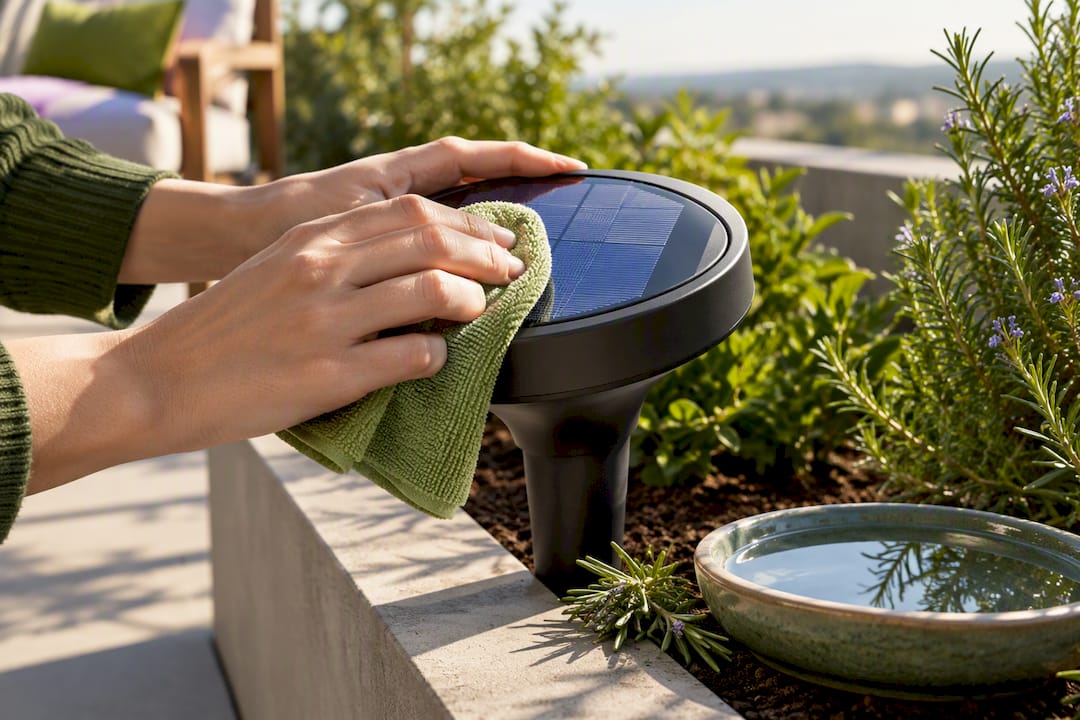
Battery life depends heavily on chemistry. NiMH batteries, still common in budget fixtures, typically need replacing within 1 to 2 years. LiFePO4 batteries in higher-end fixtures often run 4 to 5 years before performance drops noticeably.
On charge and runtime: a fully charged quality fixture with 6 to 8 hours of direct summer sun can run most of the night. Short winter days cut that charging window substantially, which is the single biggest reason solar lights that worked fine in July go dim by December.
When a fixture stops working, run through this order:
- Confirm it’s getting direct sun, not filtered shade from new growth.
- Test the panel output with a multimeter if you’re comfortable doing so.
- Try a USB-C backup charge on fixtures that support it to rule out a dead battery.
- Reseal or replace the fixture if moisture has clearly gotten in.
What Professional Designers Actually Do With Solar
Landscape designers reach for solar fixtures most often on projects where trenching would tear up established beds or run up costs the client didn’t budget for. It’s the practical choice for a side yard accent run or a remote seating area far from any existing electrical line.
On a recent hillside project, the design brief called for path lighting through a slope planted with drought-tolerant natives. Running low-voltage wire would have meant disturbing root zones we’d spent months establishing. A handful of high-quality solar stake lights with LiFePO4 batteries solved it without a single trench.
That pattern shows up across a lot of design-build work:
- Solar accent lighting on remote garden beds where wired runs weren’t cost-effective.
- Hybrid layouts pairing a wired backbone for entry steps with solar fixtures on secondary paths.
- Fewer, better fixtures chosen for cohesive placement rather than a dozen mismatched stakes.
Minimal site disturbance and lower installed cost are the two real selling points, and high-quality solar systems can pay for themselves fairly quickly once you factor out electrician labor and trenching. This section draws on editorial analysis from Denise Buchanan, who covers sustainable landscaping trends for Sacredgardendesigns.
Safety Rules and Local Codes You Shouldn’t Skip
Solar garden lighting mostly sidesteps electrical code because there’s no wiring to inspect, but that doesn’t mean anything goes. Low-voltage solar fixtures run on sealed, self-contained batteries, so they don’t carry the shock risk of wired systems tapped into household current. That’s actually one of solar’s underrated advantages for DIY installs.
Placement still needs care. Keep any fixture with exposed metal stakes away from areas where kids or pets run barefoot, and avoid positioning uplights where the beam shines directly into a neighbor’s window, which is a common source of light-nuisance complaints in denser neighborhoods. Many municipalities and homeowners’ associations regulate outdoor lighting for light trespass and dark-sky considerations, particularly in areas near wildlife habitats or observatories, so check your local zoning rules or HOA guidelines before installing anything permanent or unusually bright.
If a project involves grading, retaining walls, or slope work alongside the lighting, that’s when permits and professional oversight typically become necessary, separate from the lighting itself. Fixtures near water features need an IP68 rating, not just IP65, since submersion resistance is a different standard than splash resistance. And if you’re combining solar lighting with any wired component, like a transformer-fed accent near your solar path lights, that wired portion does fall under standard electrical code and should go through a licensed electrician.
Connecting Solar Garden Lights to Smart Home Systems
Most solar garden fixtures already include a built-in photocell that turns them on at dusk automatically, which is a form of automation on its own. Beyond that basic function, a growing number of models now ship with app control, letting you adjust brightness, set custom on/off schedules, or switch color patterns from your phone rather than relying purely on ambient light sensors.
Full smart home integration, meaning direct connection to platforms like a home automation hub, is still limited on solar fixtures compared to their wired counterparts, since most solar lights communicate over their own dedicated app rather than a shared smart home protocol. If tying garden lighting into a broader smart home routine matters to you, look specifically for fixtures advertising app-based scheduling or pattern switching, since that feature varies significantly between budget and premium models.
The realistic expectation for 2026: treat solar automation as scene control within its own ecosystem rather than a fully unified smart home experience. For homeowners who want garden lighting synced with security cameras, motion-activated flood lights, or a whole-house automation panel, that level of integration is still the domain of wired, low-voltage systems tied into a central controller. A hybrid approach, wired zones for automation-heavy needs and solar for standalone accents, remains the more realistic path than expecting solar alone to run a fully connected yard.
Reading Your Yard Before You Buy a Single Fixture
The single biggest mistake buyers make is purchasing fixtures before walking the yard at the actual times lights will run. Sunlight availability is not a one-time check; a spot that gets full sun in June can sit in near-total shade by September once deciduous trees fill out.
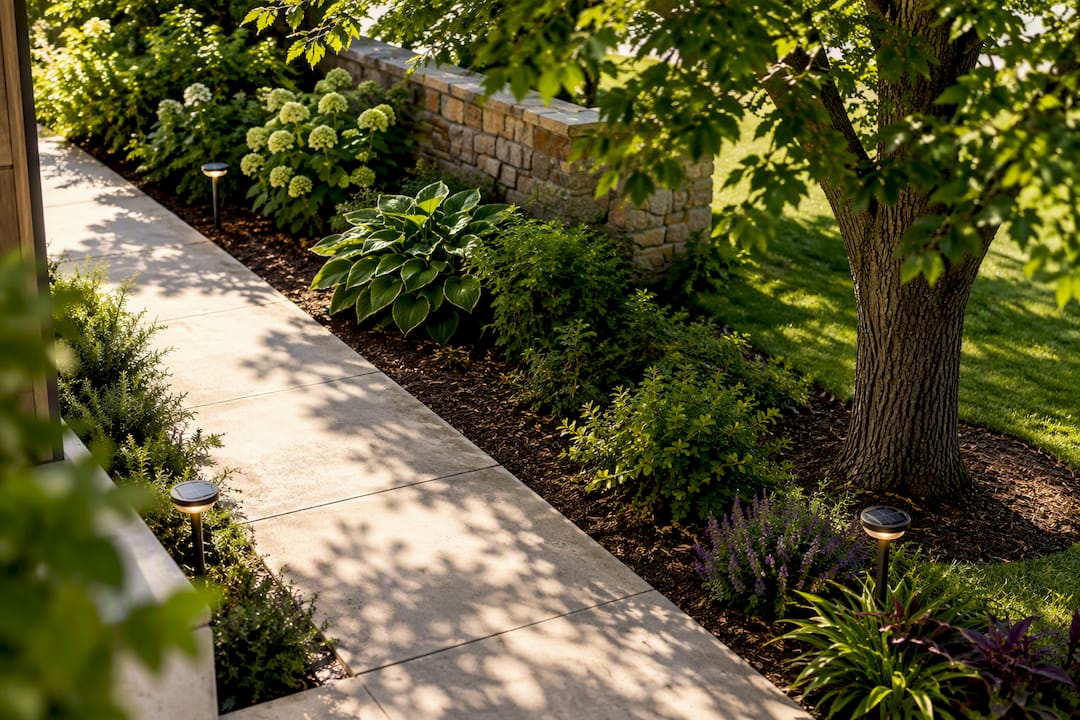
Walk your property in the afternoon, when the sun angle is highest, and note which beds, paths, and walls get consistent direct light versus dappled or full shade. Any spot with less than 6 hours of direct sun is a weak candidate for solar and might be better served by a wired fixture or simply left dark.
Yard size shapes fixture count more than most people plan for. A small urban patio might only need six to eight lanterns and string lights to feel finished, while a quarter-acre backyard with multiple beds could reasonably use 20 or more path and accent fixtures across different zones. Aesthetic goals matter just as much as square footage: a formal, symmetrical front walk calls for evenly spaced, matched path lights, while a naturalistic native garden reads better with fewer, irregularly placed accent lights tucked among plantings rather than a uniform row of stakes.
Take stock of hardscape and architecture too. Stone walls, water features, and mature trees all make strong uplighting subjects, and identifying two or three of these focal points before shopping keeps you from buying more fixtures than the space actually needs.
Budget Planning and What You Can Realistically Expect
A basic four-pack of solar path stakes runs $20 to $40 at most hardware stores, while individually built fixtures with metal housings and lithium batteries can run $30 to $80 each. Lanterns and string light sets typically land in a similar range depending on length and build quality.
Set your expectations around what that money actually buys. Budget fixtures deliver a soft accent glow, not functional task lighting, and their batteries will likely need replacing within two years. Mid-range and premium fixtures with LiFePO4 batteries and better panels cost more upfront but hold performance longer and survive more winters without a noticeable dip in brightness.
Total project cost scales with layout complexity more than fixture price alone. A dozen matched path lights along one walkway is a weekend project under $500. A fully layered yard with path, accent, and ambient lighting across multiple zones, plus a few premium uplights on trees or architecture, can run well past $1,000 in fixtures alone before any professional design or installation labor.
The honest performance ceiling: even excellent solar fixtures won’t match the steady, strong output of wired low-voltage lighting, and no amount of spending changes that physics. What premium solar buys you is reliability and longevity within solar’s own limits, not a leap into wired-level brightness.
The 2026 Shift: Why Solar Finally Deserves a Design Budget, Not Just a Hardware Store Trip
The technology finally justifies treating solar lighting as a design decision rather than an afterthought purchase. LiFePO4 batteries and USB-C backup charging have solved the two biggest complaints homeowners had for a decade: fixtures dying within a season and going dark after a cloudy week. That’s a real shift, not marketing spin.
Where conventional advice still gets it wrong is quantity. Most buying guides push shoppers toward twelve-packs of identical stake lights, when the better outcome comes from fewer, higher-quality fixtures placed with actual intention across layered zones. A dozen mismatched dollar-store stakes lining a walkway reads as clutter after dark, not design.
My advice: budget for six to eight excellent fixtures across your path, accent, and ambient layers before you consider a bigger cheap set. Match color temperature religiously. And don’t treat wired lighting as the enemy. The smartest yards I’ve seen designed use both, solar where flexibility matters, wired where output and reliability can’t be negotiated.
— Denise Buchanan
Consider a Professional Consultation for Your Lighting Project
If your yard involves slopes, mixed hardscape, or a layout where solar alone won’t cut it, a design-build approach solves problems a hardware store trip can’t. Landscape design firms often build sustainable, water-wise landscapes across residential and commercial properties, integrating lighting as one piece of a larger site plan that accounts for sun exposure, irrigation, and long-term plant health together, not as separate afterthoughts.

A professional site assessment identifies exactly where solar performs well, where a wired backbone is worth the investment, and how to layer both into a cohesive plan rather than a scattered collection of stakes. That matters most on properties with complex topography, safety lighting needs near stairs or entries, or projects that combine lighting with irrigation and hardscape work already underway.
For yards under 5,000 square feet, the Landscape Design Services start at $1,500, with full landscape design available at $2,500 for larger or more involved properties. Book an initial consultation through the full services overview to see how a layered lighting plan fits into your broader outdoor space.
Sources
- The 2026 Design Guide of Solar Garden lights : Transforming Landscapes into Nighttime Sanctuaries
- Create Stylish Garden Lighting on a Budget with Solar Lights | Gardening Know How
- Wired vs Solar Landscape Lighting: 7 Costly Solar Flaws
- Solar vs Low Voltage Landscape Lighting (Efficiency, Cost & Brightness Compared)
FAQ
Is Solar Garden Lighting Bright Enough for Safety?
Not usually. Consumer solar fixtures produce 10 to 50 lumens, while low-voltage wired fixtures push past 200 lumens, making wired the better choice for stairs, entries, and other safety-critical spots.
How Long Do Solar Garden Lights Last Each Night?
A fully charged fixture with 6 to 8 hours of direct sun can typically run most of the night in summer. Shorter winter days reduce that charging window significantly, so expect dimmer or shorter runtime through the colder months.
What Color Temperature Should I Choose for Garden Lights?
Stick with warm white in the 2700K to 3000K range across every fixture. Mixing warm and cool white lights in the same yard breaks the cohesive look designers aim for.
Does Sacredgardendesigns Install Solar Garden Lighting?
Sacredgardendesigns designs layered outdoor lighting plans as part of broader landscape projects, including sustainable and water-wise installations. Pricing for full landscape design starts at $2,500, with smaller yards under 5,000 square feet starting at $1,500.
Should I Choose Solar, Wired, or Both?
Choose solar for accents, remote beds, and areas where trenching would disturb established plantings. Choose wired for safety-critical zones like stairs and entries, and consider a hybrid layout when your yard needs both reliable output and flexible accent lighting.