Fire-safe landscaping means shaping the vegetation, surfaces and objects around your house so a wildfire has less to burn and fewer ways to reach the walls. It works by distance: the closer to the house, the fewer fuels you allow. It is also compatible with a water-wise yard, because the same choices that cut fuel (smaller plants, spacing, hardscape, efficient irrigation) cut water use. Our design-build team has spent more than 25 years doing drought-resilient landscapes in Los Angeles and beyond, and this guide covers what the research says and how to apply it.
TL;DR
- All vegetation can burn. What you control is the type, amount and arrangement of fuel, and the biggest gains come from the first 5 feet and the first 30 feet around the house.
- Use three zones: 0 to 5 feet (ember-resistant, no combustible mulch), 5 to 30 feet (lean, spaced and irrigated), 30 to 100 feet (thinned and pruned).
- Placement and upkeep matter as much as the plant list: spacing, pruning up from the ground, and clearing dead material and debris every season.
- Fire-safe and water-wise go together. Group plants by water need, keep turf practical and irrigate deeply and only as needed.
- Rules vary by state and city, so confirm the standard with your local fire department before you plant or remove anything.
Table of Contents
- How landscaping changes what a fire does to your house
- The three zones: what goes where
- Choosing plants for a fire-safe yard
- Spacing: the part most yards get wrong
- Upkeep: a fire-safe yard is a maintained yard
- Fire safety and water conservation work together
- Know your local rules
- Where we come in
- Our perspective
- FAQ
- Sources
How landscaping changes what a fire does to your house
Wildfire reaches houses in three ways: radiant heat, direct flame contact and windblown embers. FEMA’s 2025 homeowner guide defines defensible space as a managed buffer that reduces a structure’s exposure to all three, and says it generally covers vegetation and combustible objects out to 100 feet from the building.
The Texas A&M Forest Service puts the principle plainly: fire-resistant landscaping modifies the vegetation around a home to lower hazardous fuels and break up continuous fuel, so a fire loses intensity as it approaches. No plant is fireproof. The type, quantity and arrangement of what you grow decide how a fire behaves.
That is good news for a homeowner, because arrangement is something you can design. A continuous run of dry grass, shrubs and tree branches acts like a fuse leading to the house. Breaking it into islands, with gaps, hard surfaces and irrigated beds between, takes the fuse away.
The three zones: what goes where
Both FEMA and CAL FIRE divide the property into zones measured from the walls. The numbers match closely, which makes them easy to plan around.
| Zone | Distance from house | Goal |
|---|---|---|
| Zone 0 | 0 to 5 feet | Ember-resistant: no fuel touching or near the structure |
| Zone 1 | 5 to 30 feet | Lean and green: low, spaced, well-maintained plants |
| Zone 2 | 30 to 100 feet or the property line | Reduce fuel continuity and ladder fuels |
FEMA describes Zone 0 as 0 to 5 feet, Zone 1 as 5 to 30 feet and Zone 2 as 30 to 100 feet or more, with fuel-reduction priority dropping as you move away from the home. CAL FIRE’s defensible space guide uses the same three bands.
Zone 0: the first five feet
This is the most important strip you own. Embers land here, collect in corners and ignite whatever is waiting. CAL FIRE advises keeping the first five feet ember-resistant, with hardscape and no combustible mulch, and clearing debris from roofs, gutters, decks, porches and the space beneath structures. It also calls for removing branches within 10 feet of chimneys.
In practice, Zone 0 is a good place for:
- Gravel, pavers, decomposed granite or a concrete band along the foundation.
- A few container plants on a hard surface, well watered and kept small.
- Stone or metal planters instead of wood, and no stored firewood, doormats of coir, or wooden trellises against the wall.
The University of Nevada, Reno Extension keeps wood and other organic mulch out of Zone 0 and suggests limiting mulch elsewhere to planting beds or islands, separated by nonflammable material where possible. If you want to understand which mulches suit a dry-climate yard, our guide to mulch types for drought walks through them.
Zone 1: 5 to 30 feet
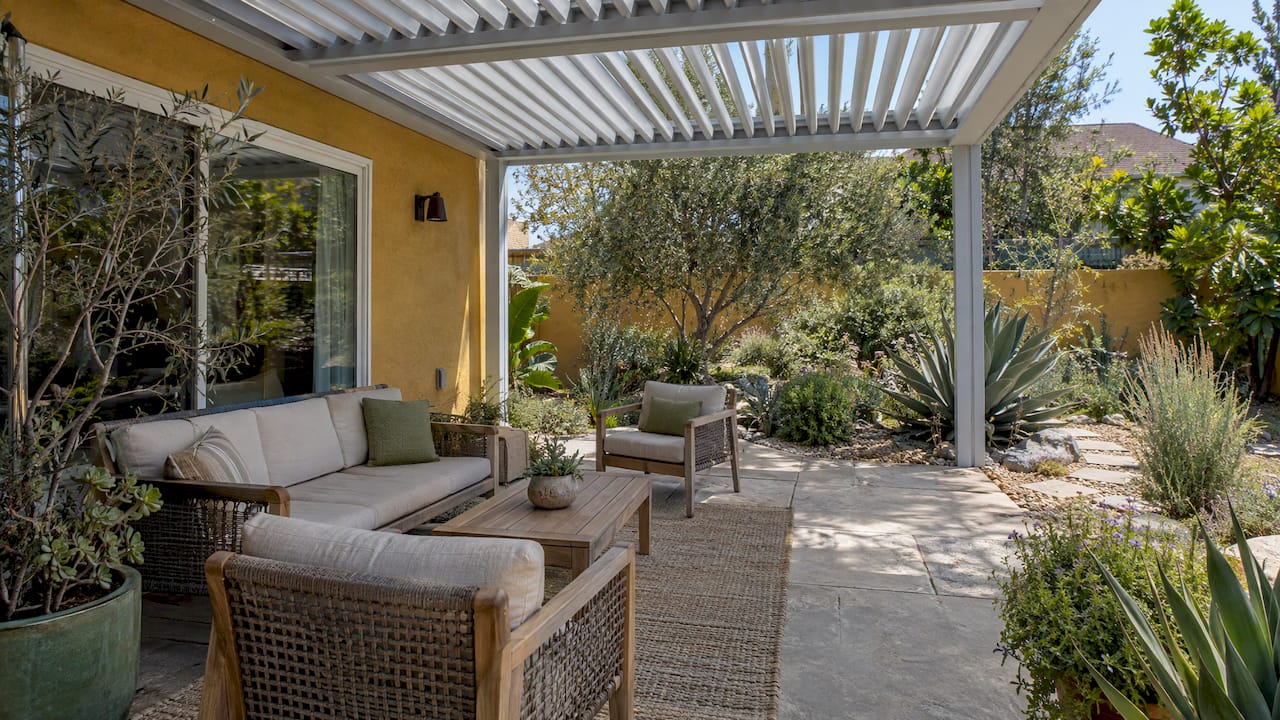
This is where your garden can live, as long as it is lean, spaced and maintained. Think of it as a series of planted islands in a field of paths, patios, gravel, irrigated lawn or other low, non-woody cover. Remove dead material, leave gaps between shrub groups, and keep plants low and tidy. Decks, patios and retaining walls do double duty here: they give you living space and they act as fuel breaks.
Zone 2: 30 to 100 feet
Here the goal is to stop a fire from climbing and running. CAL FIRE advises cutting annual grass to a maximum of four inches in Zone 2, removing dead and dry vegetation and debris, and creating vertical space between vegetation and tree crowns. Large properties can take real work in this zone, which is why many owners hire it out.
Choosing plants for a fire-safe yard
Plant choice matters, but less than most people expect. The University of Nevada, Reno Extension says poor plant placement, not plant species, is the main concern in most cases, with junipers noted as an exception. A fire-friendly plant crammed against a wall is a bigger problem than a good plant set out in the open.
Within that, favor plants with these traits, which the same Nevada guide lists: higher moisture and mineral content, low volatile oils or resins, non-waxy leaves and smaller overall size. Its featured plants also need less water once established.
Some practical rules:
- Skip conifers near the house. The University of Arizona Cooperative Extension recommends minimizing coniferous evergreen shrubs and trees within five feet of structures because their oils, resins and waxes can burn intensely. It also suggests using ornamental grasses sparingly in that area.
- Think mature size. A one-gallon shrub becomes a six-foot mass. Plan spacing for the plant at full size, and choose plants whose long-term pruning needs you can actually keep up with.
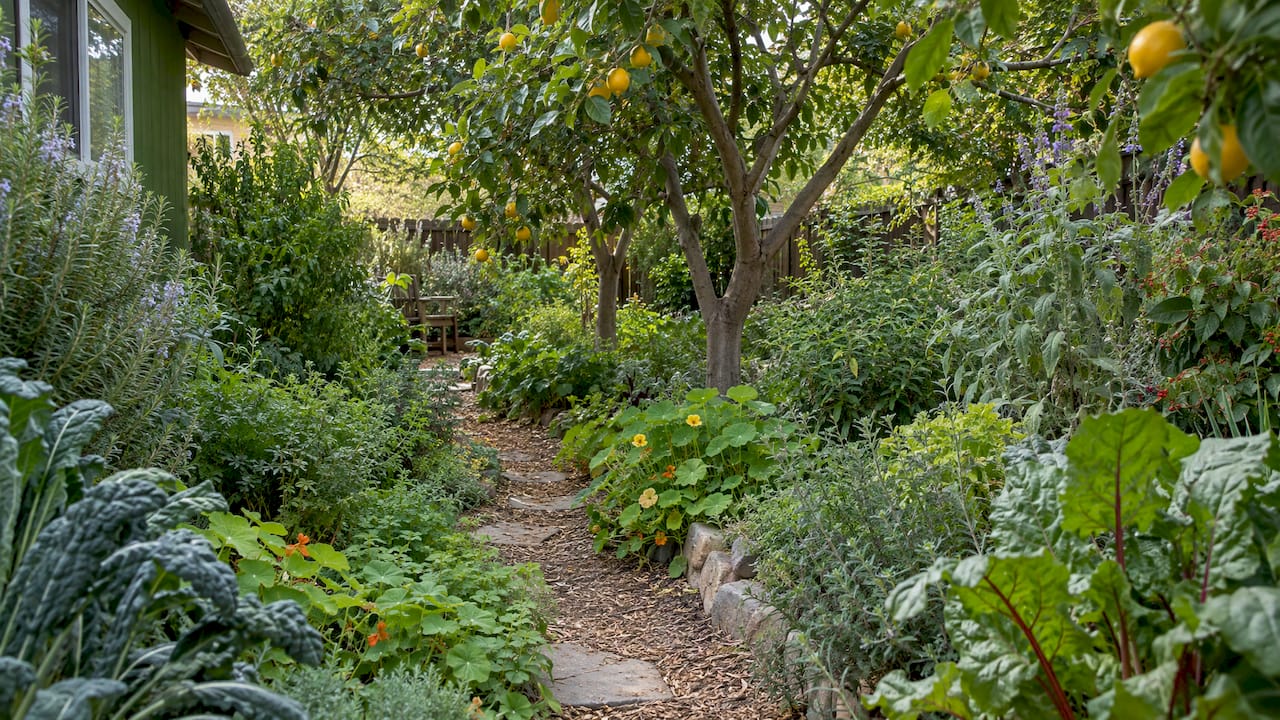
- Lean on slow, moist-leaved natives. A University of California guide notes that many native and California-friendly plants grow slowly and keep high moisture in their leaves and stems on little irrigation.
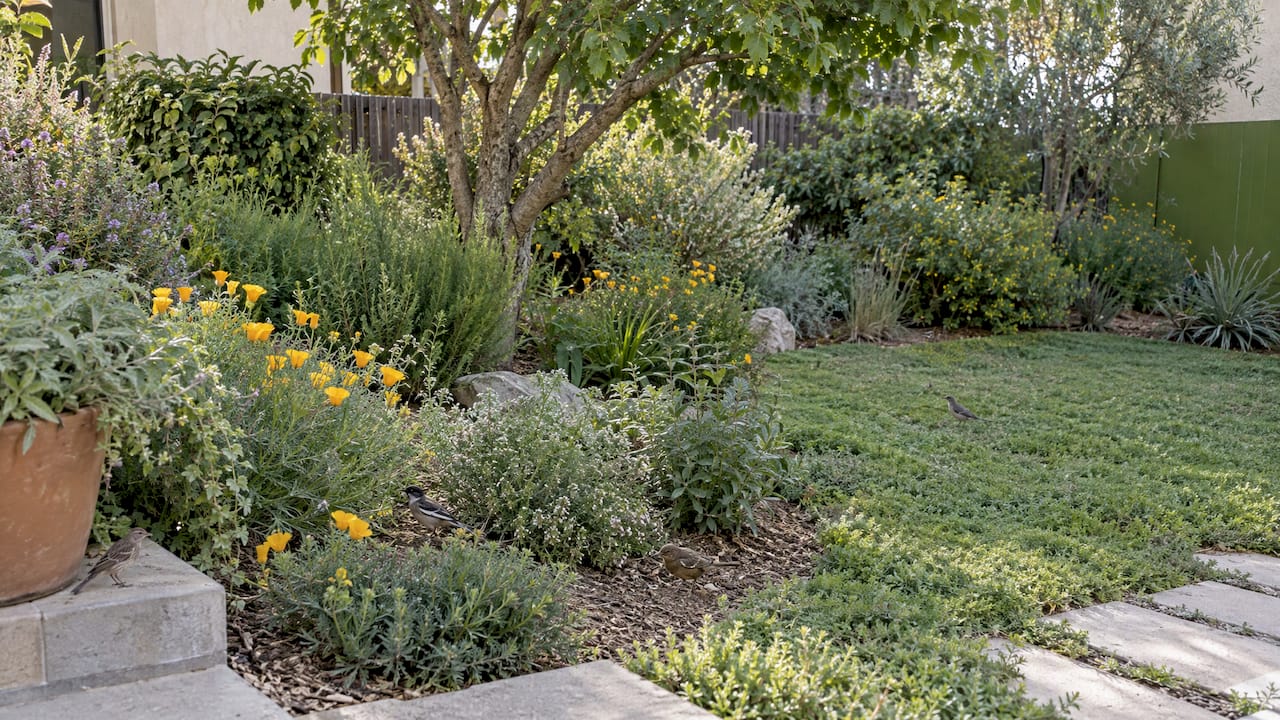
- Cover the ground without a fuse. Low, irrigated groundcovers can replace dry grass. See our guide to drought tolerant groundcovers for layered options.
FEMA adds a caution worth taking seriously: the right plants and maintenance practices depend on your topography, weather and climate, so it recommends consulting local fire departments, universities, fire ecologists or other local specialists. A plant list that suits a Los Angeles hillside will not suit a Florida scrub lot.
Spacing: the part most yards get wrong
Two kinds of spacing break the fuse.
Horizontal spacing means gaps between plants or plant groups, filled with hardscape, gravel or irrigated low cover. FEMA describes mosaic planting, vegetation islands and fuel breaks as ways to reduce vegetation continuity and fire spread while also supporting aesthetics, soil retention, native ecosystems, temperature control and flood control. That is a design brief, not just a safety rule.
Vertical spacing means no ladder from the ground to the canopy. A grass fire becomes a crown fire when shrubs and low branches connect the two. The Texas A&M Forest Service advises removing vegetation under trees and pruning tree limbs up six to ten feet from the ground, so a surface fire cannot reach the crowns. Where trees stand near the house, keep them at least five feet from structures. Healthy trees also resist drought better, which we cover in our guide to drought tree care.
Upkeep: a fire-safe yard is a maintained yard
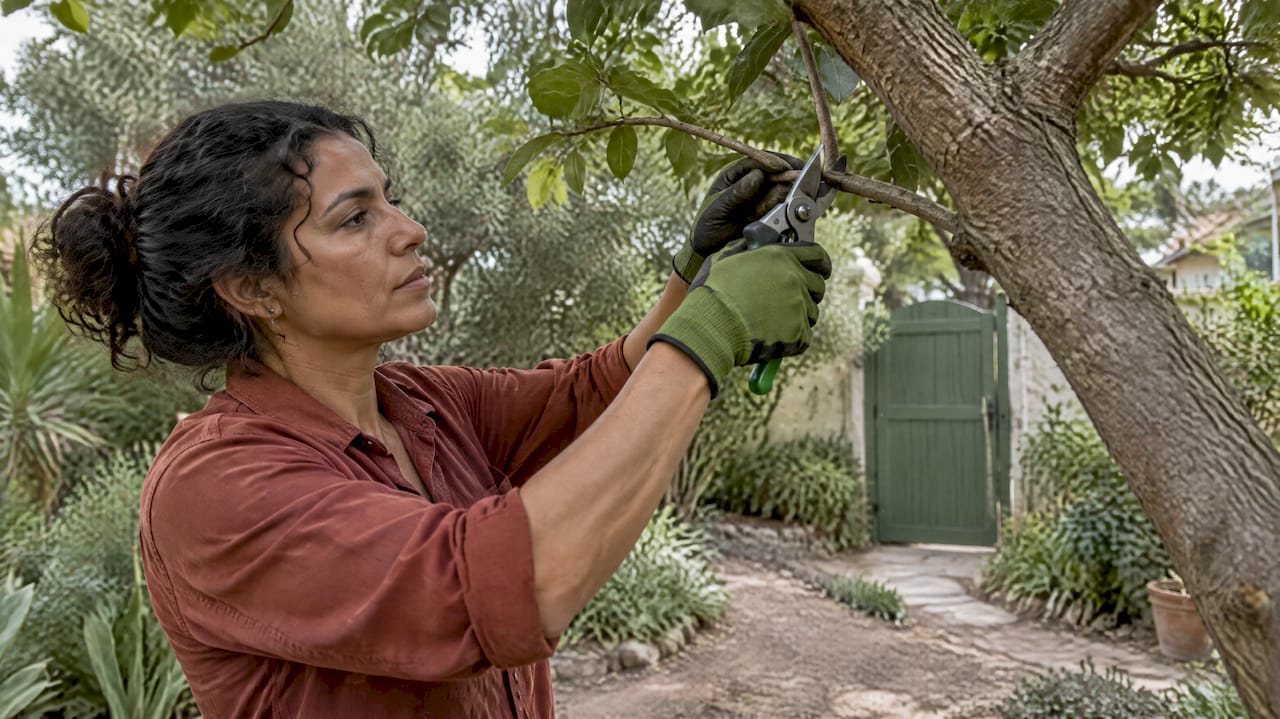
A well-designed landscape fails if it is left to dry out and pile up. The University of Nevada, Reno Extension recommends pruning dead or unhealthy material and routinely removing accumulated leaves and debris. CAL FIRE adds roofs, gutters, decks and the space under structures to the list.
A simple seasonal routine:
- Before fire season: clear roofs and gutters, remove dead branches and plants, cut grass in the outer zone, and move firewood and other stored fuels away from the house.
- During fire season: keep irrigated plants green, rake fallen leaves out of Zone 0 and Zone 1, and keep spaces under decks clear.
- After storms or windy spells: re-check corners, fence lines and the base of walls where debris collects.
- Each year: prune for height and spacing, and replace any plant that has outgrown its spot.
Tree trimming, clean-up and haul-away and recurring garden maintenance are among the services we offer, and they are exactly the tasks that tend to slip when a property is large or steep. Our garden maintenance schedule guide shows how to time these jobs by frost dates rather than fixed calendar days.
Fire safety and water conservation work together
Many homeowners assume a fire-safe yard means a bare, thirsty one, or that a drought-tolerant yard is automatically safe. Neither is true, but the two goals overlap heavily.
The University of Arizona Cooperative Extension says thoughtful defensible-space landscaping can conserve outdoor irrigation water while enhancing living space: use hardscape, irrigated lawns and other fuel breaks, and water plants as needed to keep them green through fire season. A plant that is allowed to go dry and brittle is fuel, even if it is a good species.
The University of California guide for Southern California recommends grouping plants by irrigation needs, using efficient irrigation and scheduling, and limiting turf to practical areas. It also advises watering deeply and only as needed. That is the same logic behind a drip system with separate valves for each planting zone.
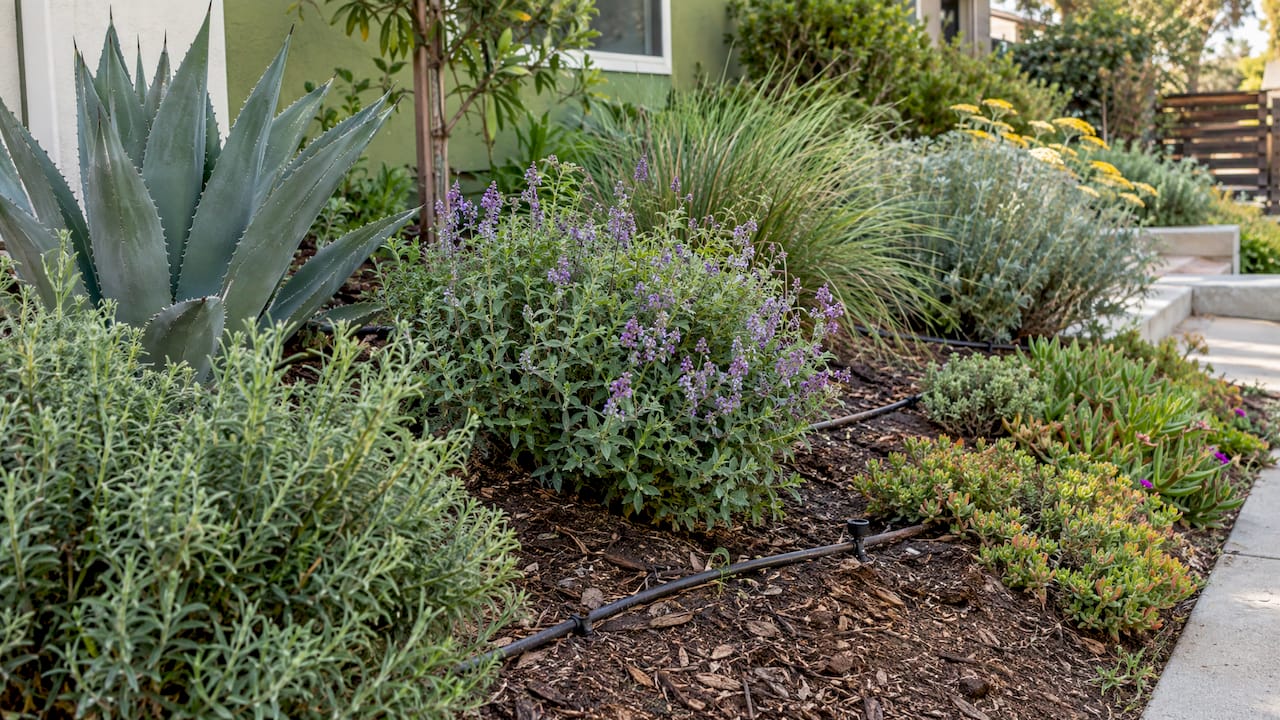
If you are redesigning, start with the layout and irrigation together. Our guide to drought tolerant landscaping shows how a plant-forward design can lower irrigation, and our page on 0 to 100 foot defensible space and water-wise landscaping applies the zones to a drought-conscious yard.
Slopes and hardscape
Steep ground adds two issues: fire runs uphill faster, and bare slopes erode after a burn. Retaining walls, terraces and stable, low-fuel planting can address both. We offer slope stabilization and hardscape construction, including patios, decks, gazebos, fences and retaining walls, and we cover local rules for steep Los Angeles lots in our guide to hillside landscaping in Los Angeles.
Know your local rules
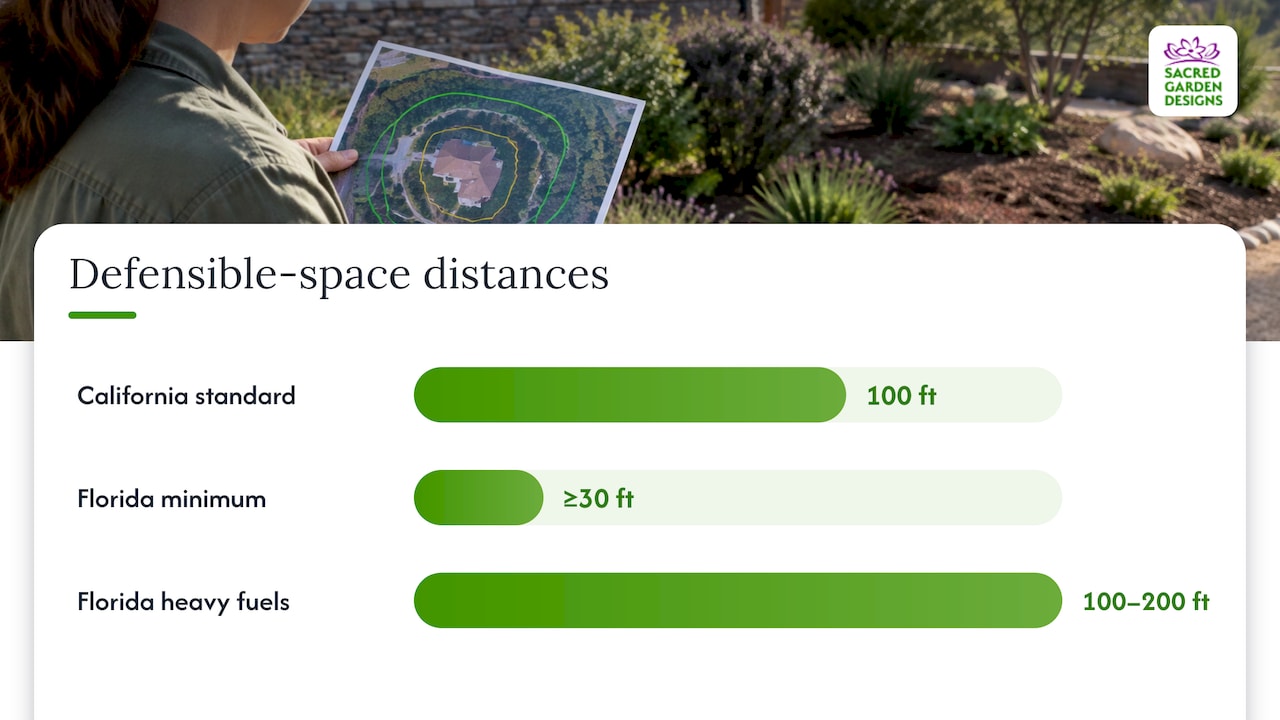
Fire-safe landscaping is not one national standard. FEMA advises homeowners to consult their local fire department, planning department and community organizations, because local ordinances may be stricter or more tailored than general advice.
Examples of how it varies:
- California: CAL FIRE says state law requires 100 feet of defensible space, and local governments may set stricter standards. Check with your local fire department or fire protection district.
- Florida: the state’s Department of Agriculture and Consumer Services says defensible space should extend at least 30 feet, and may extend 100 to 200 feet where a home borders heavy wildland fuels. The area need not be bare of shrubs and trees if it is wisely landscaped.
- California Zone 0: the legislature’s page for SB 326 describes a timeline in which Zone 0 regulations are due by December 31, 2025, and the requirements do not apply to existing structures until December 31, 2028. Confirm the current status with your fire authority before you plan a project.
Insurance and homeowners association requirements can add further conditions, so get your local requirements in writing before design begins.
Where we come in
Fire-safe landscaping is a design problem and a construction problem: zones, plant lists, hardscape, irrigation and slopes all have to fit one site. We are a design-build landscaping company in Los Angeles with more than 25 years of work on drought and climate-driven landscapes, from residential yards to urban parks.
Our published design fees are $1,500 for yards under 5,000 sq. ft. and $2,500 for a full landscape design. Installation, irrigation, hardscape, tree trimming, clean-up and haul-away and maintenance are quoted per project, and an initial landscape consultation is the place to begin. You can see everything on our services page or go straight to landscape design services.
For commercial sites and community spaces, our commercial drought landscaping guide shows how the same principles scale to larger properties.
Our perspective
Twenty-five years of designing for drought has taught us that fire safety and beauty are not opposites. The best fire-safe yards we see are the ones people love to be in: paths, patios and planted islands that look intentional, with room between them.
We start with the house and work outward. The first five feet are hardscape, the next band is lean and well watered, and the outer band is thinned and pruned. Because we design and build, the plant list, the paving, the irrigation and the slope work all come from one plan instead of four separate guesses.
Water is part of that plan. A plant kept healthy with deep, efficient irrigation is safer than one left to dry out, and a layout that groups plants by water need uses far less of it. That is why we treat water-wise design and fire-smart design as a single job.
If your yard needs a fresh look at the zones, start with a consultation and bring your local fire authority’s requirements with you.
Denise Buchanan
FAQ
What is the best fire-safe landscaping for the first five feet?
Use hardscape such as gravel, pavers or concrete, and keep combustible mulch, dead plants and stored fuels out. CAL FIRE advises an ember-resistant first five feet and regular clearing of roofs, gutters, decks and the area beneath structures.
Are there fireproof plants?
No. All vegetation can burn, as the Texas A&M Forest Service explains. What lowers risk is choosing smaller, moisture-rich plants, spacing them, keeping them healthy and keeping dead material cleared.
How far from my house do I need to clear?
It depends on where you live. FEMA’s guide generally describes up to 100 feet, California law requires 100 feet, and Florida’s agency says at least 30 feet. Your local fire department sets the standard that applies to you.
Can I still have a lawn and a garden?
Yes. Irrigated lawn can work as a fuel break, and planted islands with gaps between them are part of the design. The University of Arizona guidance points to irrigated lawns, hardscape and other fuel breaks combined with maintained, watered plants.
Does fire-safe landscaping use more water?
Not necessarily. The same University of Arizona guide says firewise design and plant selection can reduce ignition likelihood and spread while also conserving outdoor irrigation water.
Sources
- Homeowner’s Guide to Reducing Wildfire Risk Through Defensible Space (FEMA, 2025)
- Defensible Space (CAL FIRE)
- Fire Resistant Landscaping (Texas A&M Forest Service)
- Nevada Firescaping (University of Nevada, Reno Extension)
- Firewise Landscapes (University of Arizona Cooperative Extension)
- Southern California Guidebook (UC Agriculture and Natural Resources)
- Create Defensible Space Around Homes (Florida Department of Agriculture and Consumer Services)
- SB 326 Wildfire safety (California Legislature)