Water-wise landscape design means planning a yard around how much water each area really needs, then building soil, plants, hardscape and irrigation to match. Done as a complete plan rather than a few drought-tolerant plants, it gives you a yard that looks full, takes less work and uses far less water. We have designed and built sustainable, water-wise landscapes in Los Angeles and beyond for over 25 years, and a design done up front is what keeps the finished garden on budget and on water target.
TL;DR
- Group plants into hydrozones by water need, so each zone is watered only as much as it requires, not as much as your thirstiest plant.
- Fix the soil and mulch first: 3 to 4 inches of mulch (EPA’s range for most plants) and compost-amended soil do much of the water saving.
- Use drip irrigation in beds and a smart controller with a rain sensor. Both cut waste without changing how the yard looks.
- Keep turf only where you use it. Replace the rest with plants, permeable paving or groundcovers.
- Check local rules and rebates before you design. In Los Angeles, the utility has published turf replacement rebates.
Table of Contents
- What water-wise landscape design actually is
- Step 1: Read the site before you draw anything
- Step 2: Divide the yard into hydrozones
- Step 3: Choose plants for your climate, not a catalog
- Step 4: Decide what to do with the lawn
- Step 5: Build the soil and mulch layer
- Step 6: Design the irrigation, not just the plants
- Step 7: Capture rain and use hardscape wisely
- Step 8: Check local rules first
- Where a designer saves you money and mistakes
- Our perspective
- FAQ
- Sources
What water-wise landscape design actually is
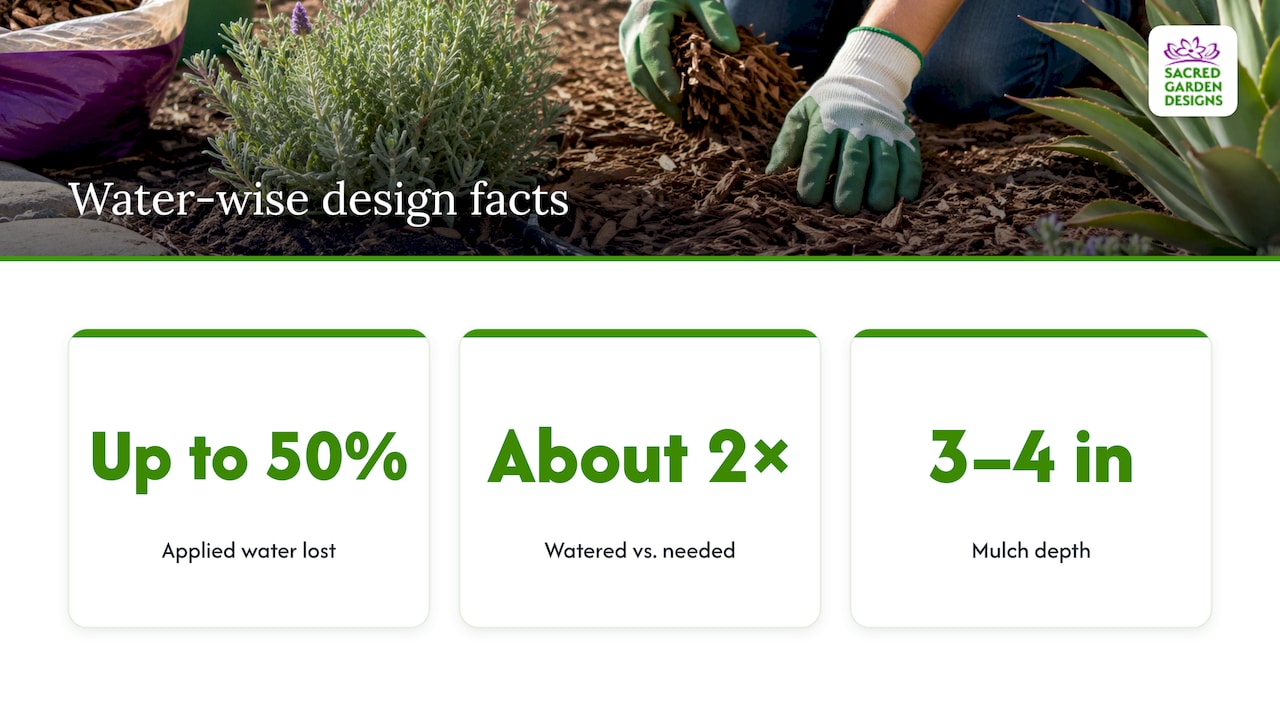
Colorado State University Extension describes water-wise landscaping as planning for water conservation, beauty and usefulness together. Its toolkit is hydrozoning (grouping plants by water need), efficient irrigation, practical turf and non-turf areas, better soil, 3 to 4 inches of mulch and good care habits.
It is not a gravel yard. The same CSU team calls water-wise design “not necessarily anti-turf”: the goal is to match the landscape to how you use the space instead of defaulting to a little-used, high-input lawn as the main feature.
The stakes are real. The EPA says up to 50% of the water applied to lawns and gardens is lost to evaporation, wind, runoff or watering past the root zone. Nebraska’s UNL Water estimates that landscapes are watered about twice as much as needed. Design is where you stop that waste before it starts.
Step 1: Read the site before you draw anything
Start with the site and with what you want from it. CSU Extension’s method is to analyze the site and your goals, then sketch the yard as outdoor rooms using rough bubble drawings. Those bubbles become your hydrozones. Landscape maintenance professionals estimate that 90% of maintenance problems trace back to issues that should have been caught in the site analysis.
Walk the yard at different times of day and note:
- Sun: Utah’s Division of Water Resources counts full sun as six or more hours a day. Hot west walls and shaded north sides need different plants.
- Slope and drainage: Where does water run during a storm, and where does it pond? Steep ground may need terracing or slope stabilization.
- Use: Where do kids play, dogs run, or you sit with coffee? That is where turf or a durable surface earns its place.
- Existing plants and trees: Mature trees are valuable and should be protected in the plan.
Where this goes wrong: people pick plants first and discover afterward that the bed they chose is a heat trap or a drainage sink. Keep a simple garden journal of problems and successes, as CSU recommends.
Step 2: Divide the yard into hydrozones
Hydrozoning is the core idea. Utah State University lays out five zones: Zone 0 gets no irrigation once established, Zone 1 about once a month, Zone 2 twice a month, Zone 3 weekly and Zone 4 twice a week.
Georgia’s Environmental Protection Division offers a handy ratio, the 10/30/60 rule: no more than 10% of the landscape in frequent-water zones, 30% or less in occasional-water zones, and 60% or more in zones that live on rainfall. Georgia is a wetter climate than Southern California, so treat it as a planning ratio and shift the numbers toward drier in an arid region.
Zoning also lets you keep a few favorites. UNL’s Kelly Feehan explains that a few higher-water plants are fine when they share a zone, because that zone is watered to its own need instead of the whole yard being watered to the thirstiest plant.
A workable layout:
- Put the highest-water plants close to the house and patio, where you enjoy them most.
- Move to moderate-water shrubs and perennials in the middle of the yard.
- Let the outer edges and dry corners go to plants that need little or no added water.
- Keep any lawn in a simple, sunny, easy-to-irrigate shape.
Step 3: Choose plants for your climate, not a catalog
The EPA notes that native and regionally appropriate plants, once established, need little water beyond normal rainfall, rarely need fertilizer and resist more pests and diseases. Its WaterSense program has a What to Plant page that sorts recommendations by state.
A few rules that keep plant lists honest:
- Match hardiness zone, sun and mature size. Utah’s homeowner guide recommends using each plant’s water-use classification and grouping plants with similar needs.
- Think about microclimates. Oregon State Extension recommends choosing plants rated a zone or more colder than your official zone in Central Oregon, because of local cold pockets.
- Do not assume native means no water. OSU notes research shows natives are not automatically more water-efficient in well-irrigated landscapes, though they feed pollinators and wildlife. Its advice: if a plant’s home environment cannot be mimicked in your yard, it is probably the wrong plant.
- Plant in odd-numbered groups and avoid rigid geometry. Georgia’s guide suggests bands of low plants to tie taller shrubs together.
For Southern California homeowners, our guides on plant-forward drought tolerant landscaping and layered drought tolerant groundcovers go deeper on specific combinations.
Trees come first in a drought
OSU advises prioritizing trees when water is short, because they take years to replace. Plan irrigation so a tree can be watered deeply even when the beds around it are on a reduced schedule.
Step 4: Decide what to do with the lawn
The EPA recommends placing turf only where it has a practical function. Utah State’s landscape faculty point out that designs lacking a clear list of uses tend to end up covered in water-hungry turf by default, simply because nothing else was assigned to the space.
So give every area a job: a focal point, a gathering space, an activity zone, a path. Lower-water turfgrasses such as turf-type tall fescue or buffalograss suit the areas you do keep, according to UNL.
Utah’s Division of Water Resources reports that efficient sprinkler design, replacing unused lawn such as parkstrips with waterwise plants, and smart controllers can reduce a home’s overall water use by 40%. If you have kids or pets, see how to match lawn alternatives to play, pets and shade, or how to keep a play patch and convert the rest.
Lawn replacement rebates in Los Angeles
In Los Angeles, LADWP publishes a turf replacement rebate of $5 per square foot for residential customers, $6 for commercial and $7 for public agencies, offered with the Metropolitan Water District’s program. Rebate amounts, eligibility and budgets change, and projects generally need approval before work starts, so read the current program page before you demolish a lawn.
Step 5: Build the soil and mulch layer
Soil is where most of the saving is made. Washington State University’s handbook recommends testing for pH, salinity, texture, organic matter and nutrients, then breaking up compaction before planting and top-dressing perennial areas with compost and mulch. DC Water says carefully prepared beds can cut water use by almost half.
Mulch numbers vary by source, so here is the overlap:
| Source | Mulch depth |
|---|---|
| EPA WaterSense | 3 to 4 inches for most plants |
| Oregon State Extension | 2 to 4 inches, never more than 4 |
| DC Water | 2 to 4 inches, out to the dripline |
A safe working range is 2 to 4 inches. Pull organic mulch back a few inches from trunks and stems so they do not rot. The EPA also warns against rock mulch in sunny spots or around plants not adapted to arid climates, since it radiates heat and can scorch foliage. WSU research reports that well-applied mulch can reduce evaporation from soil by as much as 75%.
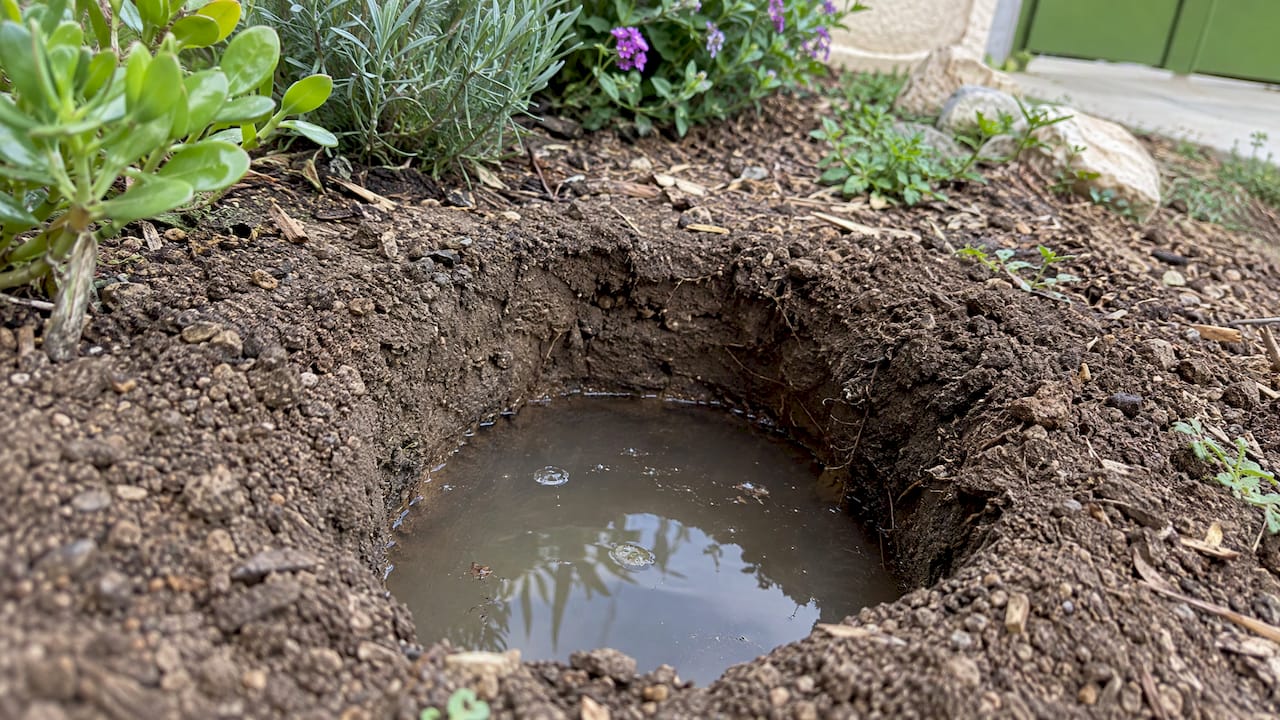
To test drainage the Georgia way, dig a hole 12 to 15 inches deep and fill it with water. If it is still full after 12 hours, drainage is poor and plant choices or grading need to change. That one test saves a lot of dead shrubs.
Step 6: Design the irrigation, not just the plants
A good plant palette on a bad irrigation system still wastes water. The numbers favor drip in planting beds:
- Utah’s guide says drip is 20 to 60% more efficient than sprinklers and should run at 10 to 30 PSI with a pressure-reducing valve.
- The EPA says retrofitting beds with drip or micro-irrigation uses 20 to 50% less water than conventional sprinkler systems, and that one rain-sensor-prevented cycle on a half-acre can save nearly 6,800 gallons.
- California’s Department of Water Resources says drip should be buried under at least 3 inches of mulch.
Where it goes wrong: the same California guidebook warns that very low-flow drip may not register on a standard sprinkler valve, so the system can run continuously and double or triple a water bill. Valves, filters and regulators have to be matched to drip components. This is the kind of detail that gets handled in the irrigation design stage, which is why we design irrigation as part of the landscape plan.
Timing and depth
WSU explains that frequent light watering creates shallow roots prone to stress, while deep, less frequent watering builds deeper, more drought-tolerant roots. OSU suggests deep watering about every 3 to 4 days for established plantings, soaking soil 10 inches or more at the dripline. WSU recommends watering between 6 p.m. and 10 a.m. to limit evaporation, and early morning to reduce mildew.
Los Angeles has its own watering-day and time rules. Our guide to Los Angeles irrigation rules covers odd and even days and the 9 AM to 4 PM restriction. If you grow vegetables, see home vegetable garden irrigation and drip irrigation for raised beds.
Step 7: Capture rain and use hardscape wisely
Hardscape reduces the area that needs water. WSU lists patios, paths and decks as ways to shrink irrigated area. Utah State adds that you can shape the ground to help water soak in, use permeable pavers, gravel or flagstone instead of solid concrete, and build rain gardens fed by downspouts sloped away from the house. Rain barrels and cisterns are an option where local ordinances allow.
On sloped lots, the first job is keeping soil and water in place. Our stormwater management landscaping guide covers features and upkeep. For commercial sites, see commercial drought landscaping.
Step 8: Check local rules first
Water rules differ by city and state. In California, the state’s Model Water Efficient Landscape Ordinance (MWELO) sets requirements for new and rehabilitated landscapes. One county’s published form, for example, requires automatic controllers that use weather or soil-moisture data, rain sensors and pressure regulators for projects under 2,500 square feet, and prohibits turf on slopes steeper than 1:4. Georgia requires rain shut-off sensors on new irrigation systems, and Florida law requires an automatic shutoff device. Ask your city’s water department or building department what applies to your project, and whether a permit or plan review is needed.
Where a designer saves you money and mistakes
Every step above has a point where a good idea turns expensive: a hydrozone map that ignores a hot wall, soil that never drained, a drip system with the wrong valve, a lawn removed without the rebate paperwork. A complete plan puts all of those decisions on paper before anything is dug.
That is the work we do. Sacred Garden Designs offers landscape design services: $1,500 for yards under 5,000 sq. ft. and $2,500 for a full landscape design. We also handle sustainable design and installation, irrigation design and installation, slope stabilization, hardscape and garden maintenance, so the plan and the build stay connected.
If you would rather start with a conversation, an initial landscape consultation is on our services page. For small lots, start with our small backyard drought design plan.
Our perspective
Water-wise design works when it is treated as design first and conservation second. The yards that last are the ones where beauty and water thrift were decided together, on the same page.
After more than 25 years working in Los Angeles drought conditions, our view is that a landscape should be a place people want to be: functional, calm and alive. That is why we combine artistry with environmental consciousness in every project, from backyard gardens to urban parks. A garden that earns daily use is a garden that gets looked after.
We design irrigation, plant palette, soil and hardscape as one system, because each decision changes the others. Our work has been recognized with eight Houzz awards and a Sustainable Business Council nomination, and what matters most to us is the yard our clients live in afterward.
Denise Buchanan
FAQ
What is the 10/30/60 rule for water-wise landscaping?
It is a planning ratio from Georgia’s Environmental Protection Division: no more than 10% of the landscape in frequent-water zones, 30% or less in occasional-water zones and 60% or more in zones that rely on rainfall. Use it as a starting point and adjust to your local climate.
How much water can a water-wise landscape save?
Published figures vary with the starting point. Utah’s Division of Water Resources reports that efficient sprinklers, replacing unused lawn and smart controllers can reduce a home’s overall water use by 40%. The EPA says drip in beds uses 20 to 50% less than conventional sprinklers.
How deep should mulch be?
The EPA recommends 3 to 4 inches for most plants, and Oregon State says never more than 4 inches, since deeper mulch can cut off oxygen to roots. Keep organic mulch a few inches away from trunks and stems.
Does a water-wise yard have to be all native plants?
No. Natives are good for pollinators and wildlife, and regionally adapted plants need little water once established. Hydrozoning also lets you keep some higher-water favorites, as long as they are grouped together and watered to their own need.
Sources
- Water-Wise Landscape Design: Steps, CSU Extension
- Water-Smart Landscapes Start With WaterSense, US EPA
- Water Conserving Landscape Design Principle, UNL Water
- Utah Homeowner Landscape Resources, Utah Division of Water Resources
- Water-wise Landscape Design, Utah State University
- Water-Wise Landscape Guide, Georgia EPD
- Landscaping Tips, US EPA
- Waterwise gardening in Central Oregon, Oregon State University Extension
- Turf Replacement Rebate, LADWP
- Chapter 25: Waterwise Landscaping, Washington State University
- Landscaping and Watering Guide, DC Water
- Drought Tolerant Landscaping for Washington State, WSU Extension
- Water Efficiency Management Guide Landscaping and Irrigation, US EPA
- MWELO Landscape Irrigation Water Budget Overview, California DWR
- MWELO Prescriptive Application, Inyo County