Citrus, avocado, fig, pomegranate, persimmon, jujube, loquat, and low-chill stone fruits are the trees most likely to thrive across Los Angeles. The one rule that separates a thriving orchard from a disappointing one: buy low-chill, region-proven varieties from a nursery that knows your specific microclimate. Before you buy anything, check your neighborhood’s typical chill hours and ask the nursery which cultivars are actually bred for them.
TL;DR:
- Choosing low-chill, region-proven cultivars like Meyer lemon, Satsuma mandarin, or Anna apple ensures reliable fruiting in Los Angeles’ mild winters.
- Nurseries that understand LA’s microclimate can provide specific cultivar and chill-hour information, reducing the risk of planting incompatible trees.
- Drought-tolerant varieties such as fig, pomegranate, persimmon, and jujube thrive with minimal water and are less prone to pests and cold stress.
- Proper site assessment, including microclimate, soil, sun exposure, and water needs, is crucial for the tree’s survival and fruit production.
- Fall planting offers the best chance for roots to establish in cooler, wetter weather, with bare-root options costing less in January.
Table of Contents
- Which Fruit Trees Grow Best in Los Angeles?
- Where Should You Buy Fruit Trees in Los Angeles?
- How Do You Pick the Right Tree for Your Yard?
- When and How Should You Plant Fruit Trees in LA?
- What Are the Best Fruit Trees for Small Yards and Containers?
- What Does a Professional Landscaper Look for Before Planting Fruit Trees?
- What Does It Cost to Buy a Fruit Tree in Los Angeles?
- Why Low-Chill Thinking Should Drive Every Decision
- Get Professional Help Planting Fruit Trees in Los Angeles
- Where to Learn More About Fruit Trees in LA
- Sources
- FAQ
Which Fruit Trees Grow Best in Los Angeles?
Los Angeles gardeners have more good options than most people realize, but not every fruit tree sold at a big warehouse store belongs in an LA backyard. Match the tree to the climate, not the other way around.
Citrus remains popular, but Huanglongbing (HLB), a bacterial disease spread by the Asian citrus psyllid, is pushing many growers toward pest-resistant, drought-tolerant alternatives like pomegranate, fig, and jujube. If you still want citrus, stick with lower-risk choices like Meyer lemon or Satsuma mandarin, and check with your local agricultural commissioner on current quarantine zones before planting.
Avocado trees take patience. Grafted varieties like Hass or Fuerte typically need three to four years before a meaningful harvest, but once established they handle LA’s dry summers well.
Fig trees are some of the toughest fruit trees you can plant here. Black Mission and Brown Turkey both tolerate drought and often produce two crops a year, an early “breba” crop and a main summer crop.
Pomegranate is close to foolproof in Southern California heat. Wonderful, Eversweet, and Parfianka are widely available and need minimal water once established.
Persimmon, jujube, and loquat deserve more attention than they get. All three shrug off heat that would stress a high-chill apple or cherry tree, and none demand much winter cold to set fruit.
Low-chill stone fruits and apples round out the list. Anna and Dorsett Golden apples, along with low-chill peach and plum cultivars, are bred specifically for climates like ours, where winter cold is short and mild.
- Citrus (with disease caveats): Meyer lemon, Satsuma mandarin
- Avocado: Hass, Fuerte
- Fig: Black Mission, Brown Turkey
- Pomegranate: Wonderful, Eversweet, Parfianka
- Persimmon, jujube, loquat
- Low-chill apples: Anna, Dorsett Golden
Where Should You Buy Fruit Trees in Los Angeles?
Local, specialist nurseries tend to stock cultivars actually tested for LA’s climate, while national chains often ship whatever grows well in Michigan or the Pacific Northwest. That mismatch is the single biggest reason backyard fruit trees fail to fruit here.
Before you hand over money, ask the nursery staff these five questions:
- What’s the exact cultivar name, not just the fruit type on the tag?
- How many chill hours does this variety actually need?
- Is it grafted onto dwarf, semi-dwarf, or standard rootstock?
- What’s the return or replacement policy if it fails to establish?
- Do you offer delivery or planting help?
Watch for red flags: generic tags that just say “peach tree” with no cultivar name, staff who can’t answer chill-hour questions, or stock that’s clearly bred for Northern climates. Buying the wrong chill-hour variety is one of the most common and avoidable mistakes new fruit tree owners make. Bare-root trees are usually available only in winter, while container stock is sold year-round at a premium.
Pro Tip: Call your county’s UC Master Gardener program before you buy. Volunteers there can tell you exactly which cultivars perform in your zip code, often for free.
How Do You Pick the Right Tree for Your Yard?
Start with your microclimate. Coastal fog belts near Santa Monica or Venice run cooler and more humid than valley neighborhoods like Woodland Hills or Sylmar, and that difference changes both chill accumulation and ripening speed.
Next, size the tree to your space. Rootstock determines mature height more than the fruit variety does. Dwarf rootstock keeps a tree in the 6 to 10 foot range, ideal for smaller lots, while standard rootstock can reach 20 feet or more.
Water budget matters just as much as space. Fig, pomegranate, and jujube tolerate low irrigation once established, while citrus and stone fruit want consistent moisture, especially in their first two summers.
Finally, check pollination needs. Most fig and citrus varieties are self-fertile, but some apple and plum cultivars need a second compatible tree nearby to set fruit at all.
- Assess your microclimate: coastal, valley, or inland heat
- Match rootstock size to available space
- Rank species by water need before you buy
- Confirm whether the variety is self-fertile or needs a pollinator partner
When and How Should You Plant Fruit Trees in LA?
Fall, roughly October through December, is the best planting window in Southern California, because cooler, wetter weather lets roots establish before summer heat arrives. Bare-root trees, often cheaper and available in a wider range of cultivars, typically show up at nurseries in January.
“Low-chill” refers to chill hours, the cumulative time a tree spends below about 45°F each winter. Most varieties suited to Los Angeles need only 100 to 500 chill hours to set fruit reliably, compared to 800 or more for many Eastern varieties. Plant a high-chill tree here and you’ll get flowers with little or no fruit.
Get the first year right by following these steps in order:
- Water deeply once or twice a week rather than a light daily sprinkle, to encourage roots to grow down instead of sideways.
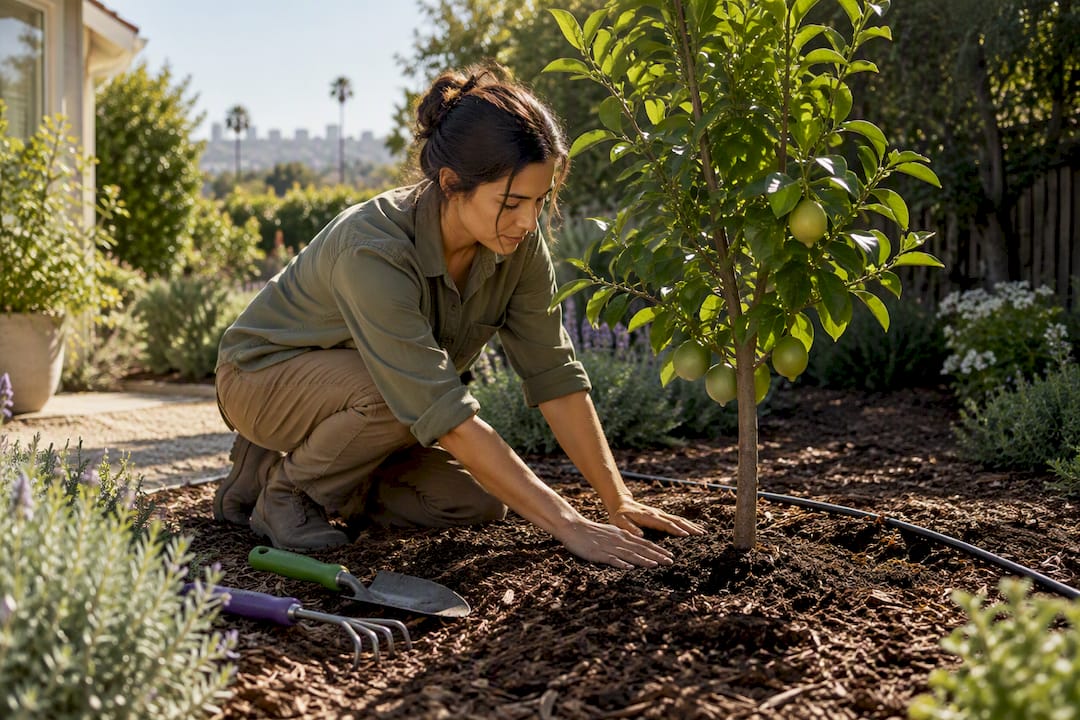
- Apply 3 to 4 inches of mulch around the base, keeping it a few inches clear of the trunk.
- Stake loosely only if the tree can’t stand upright on its own, and remove the stake within a year.
- Skip major pruning in year one beyond removing damaged branches.
- Watch for aphids and scale, and ask a Master Gardener before spraying anything.
What Are the Best Fruit Trees for Small Yards and Containers?
Limited space doesn’t rule out a productive fruit tree. Meyer lemon, dwarf pomegranate, patio fig, ‘Bonanza’ peach, and columnar apple varieties all perform well in containers or tight side yards, and most begin fruiting within two to three years.
- Meyer lemon: fruits within 1 to 2 years, needs a 15 to 25 gallon container minimum
- Dwarf pomegranate: mostly ornamental but many varieties still fruit
- Patio fig: compact growth, tolerates root restriction well
- ‘Bonanza’ peach: bred specifically for container life
Containers of 15 to 25 gallons can sustain productive trees when paired with a well-draining potting mix and regular feeding during the growing season. Repot every two to three years or move the tree in-ground once it outgrows its container, watching for roots circling the pot’s edge as your cue.
What Does a Professional Landscaper Look for Before Planting Fruit Trees?
A professional walks the yard before recommending a single tree, checking sun exposure, soil drainage, and where irrigation lines already run. Grouping plants by water need and using drip irrigation with mulch cuts water use significantly. A water-wise approach is recommended based on sustainable landscaping principles, often highlighted in notable projects.
What Does It Cost to Buy a Fruit Tree in Los Angeles?
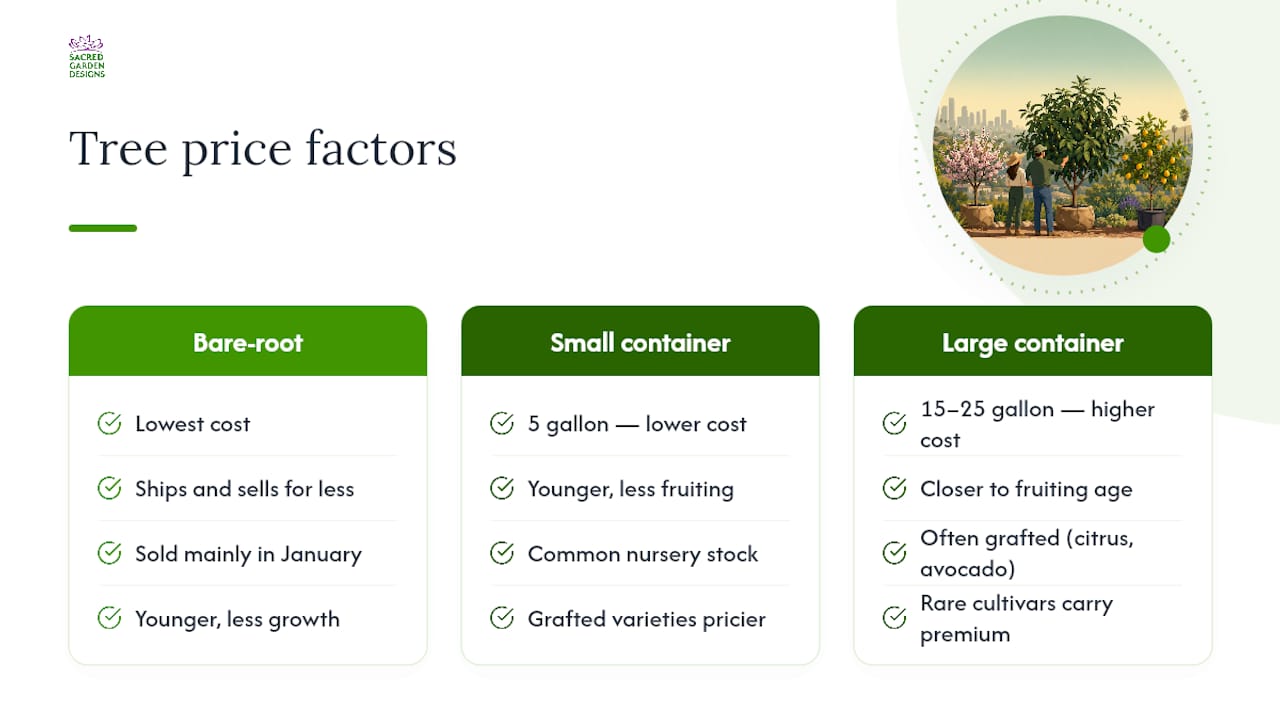
Prices vary widely depending on tree size, cultivar rarity, and whether you’re buying bare-root or container stock. A young bare-root fig or pomegranate at a local nursery often runs cheaper than a mature container specimen, simply because you’re paying less for the years of growth already invested.
Generally, expect small container trees in the 5 gallon range to cost less than larger 15 to 25 gallon stock that’s already a few years into development and closer to fruiting age. Grafted citrus and avocado varieties tend to sit at the higher end of the price range because grafting adds labor and time to production. Specialty or rare cultivars, an unusual persimmon variety or a hard-to-find jujube, often carry a premium simply due to limited availability.
Bare-root season in January can be the most budget-friendly time to buy, since bare-root stock ships and sells for less than container-grown trees of the same age. If a nursery’s price seems unusually low for a large, already-fruiting tree, ask more questions. Sometimes it means the variety is a high-chill mismatch nobody wants, marked down to move it off the lot.
Beyond the tree itself, budget for soil amendments, mulch, stakes if needed, and possibly a drip irrigation add-on if your yard doesn’t already have one. These extras usually add up to a modest fraction of the tree’s own cost, but skipping them is a common reason young trees struggle in their first summer.
Why Low-Chill Thinking Should Drive Every Decision
Most fruit tree advice written for a general American audience assumes a winter that Los Angeles simply doesn’t get. That’s the gap conventional garden advice misses here: a tree that’s a proven performer in Ohio or even Northern California can be a complete dud on a street in Sherman Oaks, not because anyone did anything wrong, but because the tree never got cold enough to know it was time to fruit.
The research backs a simple hierarchy. Chill-hour compatibility comes first, water budget comes second, and fruit flavor preference comes a distant third. Get the order backward, chase the peach variety you loved growing up back East before checking its chill requirement, and you’ll spend three years wondering why it never fruits.
What I’d tell any Los Angeles homeowner standing in a nursery aisle: ask about chill hours before you ask about taste. The tree that’s merely good but reliably fruits beats the “perfect” variety that blooms pretty and produces nothing. That’s not a compromise. It’s just how this climate works.
— Denise Buchanan
Get Professional Help Planting Fruit Trees in Los Angeles
Picking the right cultivar is only half the job. Getting the site prep, irrigation, and placement right is what actually determines whether that tree survives its first summer. Sacredgardendesigns brings 25-plus years of Los Angeles landscape design experience to exactly this problem, matching tree species to your yard’s microclimate and water budget instead of guessing.
A typical consultation starts with a site visit to assess soil, sun exposure, and existing irrigation, followed by a planting plan and an estimate for any drip irrigation work your new trees will need. If you’re planning a full yard redesign around fruit trees, the landscape design service covers yards under 5,000 square feet starting at $1,500, with full landscape design projects starting at $2,500. For irrigation installation, tree planting, or general garden maintenance on an existing yard, the full services overview covers what’s available. Ready to stop guessing which tree fits your yard? Book an initial consultation and get a planting plan built around your actual soil and sun conditions.
Where to Learn More About Fruit Trees in LA
For cultivar-specific and chill-hour guidance, UCANR’s fruit tree resources and your county’s UC Master Gardener program remain the two most reliable references.
Sources
- Alternatives to Citrus in the Fight Against ACP/HLB (UCANR)
- Best fruit trees for Southern California (Food Forward)
- Buy a fruit tree the right way (Greg Alder / Yard Posts)
- Best fruit trees for small yards in California (Garden Truth)
FAQ
What fruit trees grow well in Los Angeles?
Citrus, avocado, fig, pomegranate, persimmon, jujube, loquat, and low-chill stone fruits and apples all perform reliably across Los Angeles. The key is choosing varieties bred for 100 to 500 chill hours rather than high-chill cultivars meant for colder climates.
What fruit is LA known for?
Los Angeles is closely associated with citrus, especially lemons and mandarins, along with avocado thanks to Southern California’s long-running avocado industry. Backyard harvest programs also highlight persimmon and pomegranate as regional standouts.
What is the easiest fruit tree to grow in California?
Fig and pomegranate are widely considered the easiest fruit trees for California yards, since both tolerate drought and poor soil once established. Cultivars like Black Mission fig and Wonderful pomegranate need minimal care beyond deep, infrequent watering.
What is the most famous tree in Los Angeles?
Among fruit trees specifically, avocado holds that reputation given the region’s long history with the fruit. Beyond fruit trees, LA is also famous for its non-fruiting palm trees, though those aren’t relevant to a backyard harvest.
When is the best time to plant fruit trees in Los Angeles?
Fall, from October through December, is the ideal planting window because cooler weather lets roots establish before summer heat sets in. Bare-root trees typically arrive at nurseries in January as a second good planting opportunity.