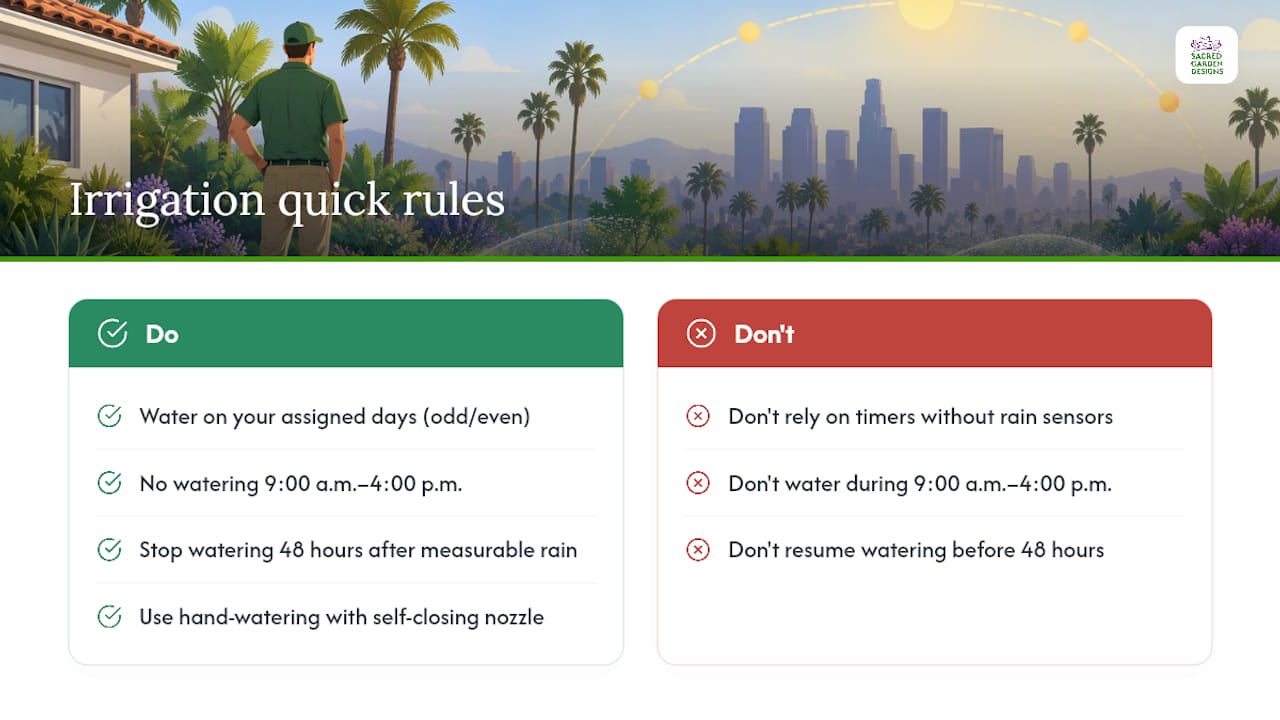
Los Angeles homeowners water on assigned days tied to their street address: odd-numbered addresses irrigate Mondays, Wednesdays, and Fridays; even-numbered addresses irrigate Sundays, Tuesdays, and Thursdays. No outdoor watering is allowed between 9:00 a.m. and 4:00 p.m. any day, and sprinklers must stay off during rain and for 48 hours after it stops. Hand-watering with a shutoff nozzle is fine outside those hours.
TL;DR:
- Rain sensors or weather-based controllers are essential to automatically suspend watering during storms and prevent runoff violations.
- Hand-watering with a self-closing nozzle is allowed anytime outside prohibited hours, and drip systems have no time limits due to their low water application rate.
- Watering days are determined by address: odd addresses water Monday, Wednesday, Friday; even addresses water Sunday, Tuesday, Thursday.
- Violations generally result in warnings first, but repeated offenses can lead to fines of $100 or more, increasing with each violation.
Table of Contents
- Irrigation Schedule Los Angeles: Days, Hours, and the Rain Rule
- How Many Minutes Per Station Does the Ordinance Allow?
- What Do Sample Seasonal Watering Schedules Look Like?
- What Happens if You Don’t Follow the Rules?
- How to Set Up Your System for Automatic Compliance
- Why Compliance and Good Design Go Together
- Get a Compliant Irrigation Plan Built for Your Property
- Where to Verify Current Rules and Water Conditions
- Sources
- FAQ
Irrigation Schedule Los Angeles: Days, Hours, and the Rain Rule
Your address decides your watering days. If the last digit of your street number is odd, LADWP assigns you Monday, Wednesday, and Friday. Even-numbered addresses get Sunday, Tuesday, and Thursday. A property with a fractional or lettered address (like 1234½) follows the digit immediately before the fraction or letter, so 1234½ counts as even.
Regardless of which days you’re assigned, sprinklers cannot run between 9:00 a.m. and 4:00 p.m. That daytime window exists because evaporation losses spike during peak heat, so anything applied then is largely wasted. Exceptions exist for system testing and repairs, emergency use, and supervised watering of sports fields under specific permits.
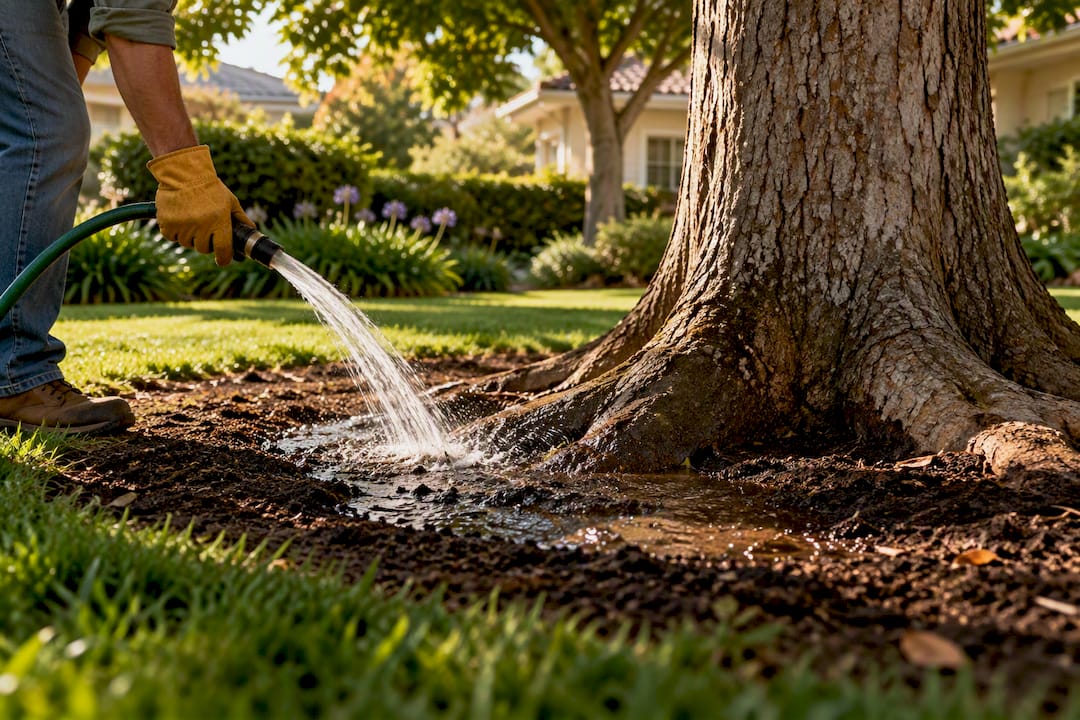
The rain clause trips people up more than any other rule. Once measurable rain falls, irrigation must stop for 48 hours after it clears, even if that 48 hours crosses your normal watering day. A timer that isn’t paired with a rain sensor won’t know the difference and will run anyway. Hand-watering with a hose fitted with a self-closing nozzle is allowed any time outside the prohibited hours, and small food-producing gardens get similar flexibility since crop health depends on more frequent moisture.
How Many Minutes Per Station Does the Ordinance Allow?
Standard spray heads are typically capped at a short duration per station on each assigned watering day. That limit reflects how quickly conventional nozzles apply water faster than most Los Angeles soil can absorb it, which is exactly why runoff down driveways and sidewalks became such a visible problem.
Conserving nozzles, meaning rotors and multi-stream rotary heads that apply water more slowly and evenly, get more room to work. Under Phase 3 guidance, stations fitted with these nozzles can run up to 15 minutes per cycle, with as many as two cycles allowed per watering day. That’s up to 30 minutes total, nearly four times the standard allowance, because the slower application rate means the water actually soaks in instead of sheeting off.
Drip irrigation and low-flow emitters are exempt from minute limits entirely. Since drip systems apply water directly to the root zone at a fraction of a gallon per hour, they don’t create runoff risk the way spray systems do, and the ordinance treats them accordingly.
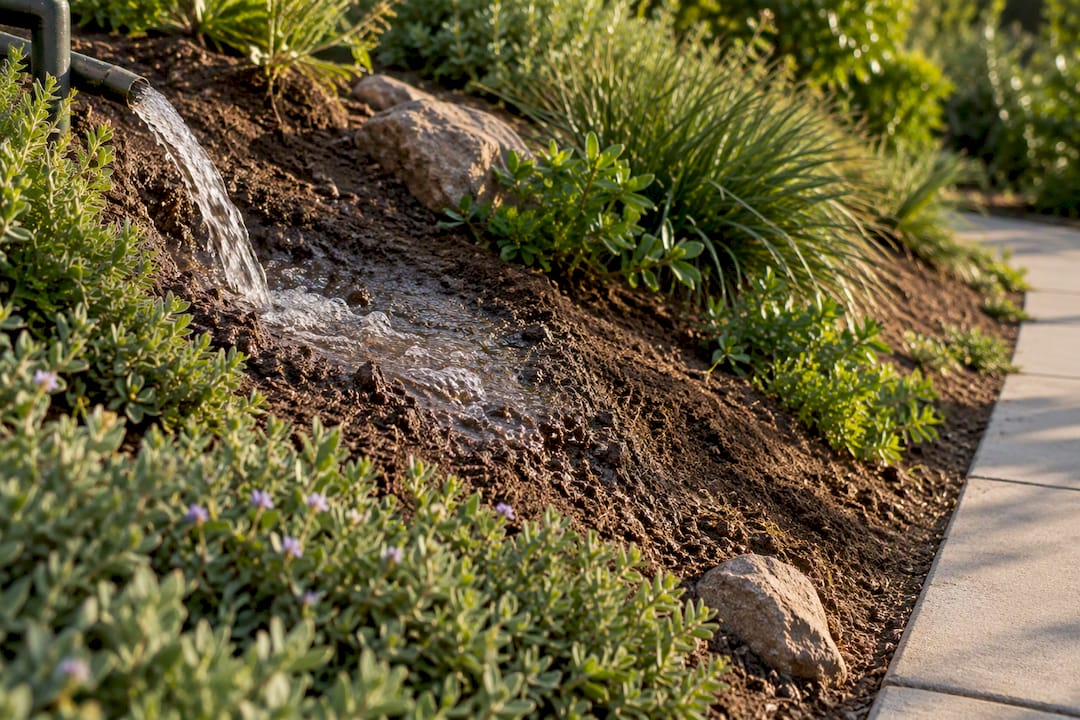
On slopes or heavy clay soil, even the conserving-nozzle allowance can overwhelm what the ground can absorb in one sitting. Splitting your total watering time into two or three shorter start times, sometimes called soak cycles, helps water penetrate between applications instead of running toward the street.
What Do Sample Seasonal Watering Schedules Look Like?
Water needs shift dramatically across the year in Los Angeles, and a schedule that keeps turf green in August will drown it in January. The LADWP-friendly landscaping guide publishes seasonal minute recommendations that fit inside ordinance limits while matching actual plant demand.
Break turf cycles into two shorter start times rather than one long run, especially in summer when the full eight minutes can exceed what compacted soil absorbs at once. Winter numbers assume normal rainfall; a dry stretch means restoring a light supplemental cycle, always outside the 9:00 a.m. to 4:00 p.m. window.
What Happens if You Don’t Follow the Rules?
Enforcement starts with a written warning, not a fine, so a first-time slip rarely costs money. Repeat violations escalate to fines that commonly range from $100 to several hundred dollars, climbing with each subsequent offense.
Properties with unusual needs can request a variance. Large landscapes, active erosion control sites, and properties recovering from fire damage can document their circumstances and apply for a hardship exception rather than simply absorbing fines. Sports fields and large landscapes have a separate path: registering an approved weather-based controller with LADWP and hitting documented monthly-use reduction targets can unlock watering patterns outside the standard odd/even schedule.
How to Set Up Your System for Automatic Compliance
Smart, weather-based controllers take the guesswork out of the rain rule entirely. UC ANR research on smart irrigation confirms these devices adjust schedules to local weather automatically and suspend watering during storms, which removes the single most common compliance mistake: a timer that runs right through a rain event.
Set up your timer in this order:
- Map every station and note its nozzle type (standard spray, rotor, or drip).
- Program minutes per the ordinance limit for that nozzle type.
- Split each station’s total time into two or three shorter start times to prevent runoff.
- Run a manual test cycle and watch for pooling or street runoff.
- Install a rain sensor or weather-based controller so cycles pause automatically after rain.
Once installed, check the system monthly: confirm the rain sensor still trips correctly, walk the yard for leaks or broken heads, and verify nozzle types haven’t been swapped during a repair.
Pro Tip: On slopes or clay soil, run three short soak cycles spaced an hour apart instead of one long cycle. You’ll deliver the same total minutes without a drop reaching the sidewalk.
Why Compliance and Good Design Go Together
Ordinance rules are a floor, not a design plan. Over 25 years of building water-wise landscapes across Los Angeles, we’ve seen that the properties with the fewest violations aren’t the ones watering less. They’re the ones designed so plant selection, irrigation zoning, and controller settings work together from the start. That’s the thinking behind our HGTV feature on “Ground Rules” and our HOUZZ recognition: compliance follows naturally when a landscape is designed for the climate it’s actually in. We also help clients assemble documentation for variance requests when a property genuinely needs one.
Get a Compliant Irrigation Plan Built for Your Property
Guessing at minute limits and rain sensor settings works until it doesn’t. Sacredgardendesigns designs irrigation systems that meet the ordinance by default, so you’re not recalculating cycles every time a phase changes or a controller needs reprogramming.

An initial consultation includes a site audit of your existing zones and nozzle types, a watering plan matched to your specific plants and soil, and a recommendation for the right weather-based controller and rain sensor setup for your property. Our landscape design services start at $1,500 for yards under 5,000 square feet, with full landscape design available at $2,500. If your property also needs slope stabilization, hardscape work, or ongoing maintenance, our full services overview covers irrigation design and installation alongside those options. Homeowners who want to learn the principles themselves can also check our classes and workshops.
Ready to stop guessing at timer settings? Request a consultation through our landscape design services page and get a watering plan built around your actual property.
Where to Verify Current Rules and Water Conditions
Ordinance phases and regional supply conditions shift, so confirm current rules before you finalize a schedule. Check the LADWP ordinance page, the watering guide, the Phase 3 FAQ, and California Water Watch for updates. For deeper how-to guidance, our blog covers water-wise techniques in more detail.
Sources
- Water Conservation & Ordinance – Los Angeles
- Los Angeles Watering Guide – Landscaping
- Phase 3 water restrictions frequently asked questions
- California Water Watch
FAQ
What Are the Current Lawn Watering Days in Los Angeles?
Watering days depend on your street address: odd numbers water Monday, Wednesday, and Friday, while even numbers water Sunday, Tuesday, and Thursday. This applies citywide under the LADWP ordinance, regardless of which phase is currently active.
How Long Should Sprinklers Run per Station?
Standard spray heads are typically limited to eight minutes per station on your assigned watering day, while conserving nozzles like rotors can run up to 15 minutes across two cycles under Phase 3 rules. Drip irrigation and low-flow emitters have no minute cap since they don’t create runoff.
What Do California Sprinkler Laws Actually Require?
State and local rules require avoiding runoff, fixing broken sprinklers promptly, and following prohibited watering hours between 9:00 a.m. and 4:00 p.m. In Los Angeles specifically, that also means honoring the 48 hour rain rule and using a self-closing nozzle for any hand-watering.
Is Los Angeles Facing a Water Shortage in 2026?
Statewide reservoir storage was running around 105% of historical average in mid-2026, but that figure masks real regional swings in local supply. Conservation rules stay in effect regardless, since Los Angeles manages demand year-round rather than only during drought years.
What Happens if I Get Caught Violating the Watering Schedule?
A first violation typically brings a written warning rather than a fine. Repeat violations escalate to fines ranging from roughly $100 to several hundred dollars, with amounts increasing for each additional offense.