To size a solar pump, work out how much water you need per day, divide it by your peak sun hours to get a flow rate, add up the total dynamic head (the height and friction the pump must overcome), then pick a pump whose curve delivers that flow at that head. Size the solar array last, to match the pump. This guide walks through each step with a worked landscape example you can copy with your own numbers.
TL;DR
- Start with water, not watts: daily gallons, divided by peak sun hours, divided by 60, gives the gallons per minute (GPM) the pump must deliver.
- Total dynamic head (TDH) is the pumping lift plus elevation to the tank, pressure at the outlet and pipe friction. Together, flow and TDH are your pump’s duty point.
- Check that your water source can actually supply the flow before you buy anything.
- Size the array to the pump’s power needs at your site’s sun hours, and use storage of about three days of water instead of leaning on batteries.
- Pipe diameter changes friction a lot, so a size up in pipe can let you use a smaller pump.
Table of Contents
- What you need to know before you size anything
- Step 1: Calculate your daily water volume
- Step 2: Convert daily volume to a flow rate
- Step 3: Calculate total dynamic head
- Step 4: Match the pump to flow and head
- Step 5: Size the solar array
- Step 6: Add storage instead of relying on batteries
- Common sizing mistakes
- Our perspective
- Get your system designed for your site
- FAQ
- Sources
What you need to know before you size anything
Every calculation below depends on six inputs. Write them down first:
- Water source and its yield. A well, pond, cistern or stream. If your source recovers at 3 GPM, a pump designed for 8 GPM will pump it dry.
- Daily water demand in gallons, for the hottest, thirstiest part of the season.
- Peak sun hours at your site for the same season.
- Vertical lift from the water surface (while pumping) to where the water ends up.
- Pressure needed at the outlet. Drip, sprinklers and a gravity-fed tank all differ.
- Pipe length, diameter and fittings between the source and the destination.
The USDA describes solar pumps as rated by flow in gpm, lift in feet and power in watts, and notes that the flow a pump must produce depends on how much water you need and how many hours of sunshine you have to run it. That is the whole logic of this guide.
Step 1: Calculate your daily water volume
For a landscape or garden, start from the area and how much water the plants need. A useful conversion: one inch of water over one square foot is about 0.623 gallons. Then allow for system losses. Drip systems are efficient, while overhead spray loses more to wind and evaporation.
Worked example (illustrative numbers): a 4,000 sq ft planted area that needs 0.25 inch per day on a hot summer design day.
- 4,000 sq ft × 0.25 in × 0.623 = about 623 gallons of net demand
- Divide by 0.8 for an assumed 80% application efficiency = about 780 gallons per day
Round up to a design figure you are comfortable with, say 800 gallons per day. If you are watering people or animals as well, add them. Common planning figures for livestock and household use are published in pump-sizing guides, but for a residential landscape, plant demand is usually the driver.
If your garden is a vegetable plot, our guide to home vegetable garden irrigation shows how to turn the weekly inch of water into run times. For the plants themselves, drought tolerant landscaping is the cheapest way to shrink this number before you size a pump at all.
Step 2: Convert daily volume to a flow rate
A solar pump only works while the sun shines, so the daily volume has to be delivered in your peak sun hours, not over 24 hours.
GPM = gallons per day ÷ peak sun hours ÷ 60
NYSERDA’s guide gives the textbook case: 1,500 gallons per day with 5 peak sun hours calls for a pumping rate of 5 gpm.
Continuing our example: 800 gallons ÷ 5 peak sun hours = 160 gallons per hour, and 160 ÷ 60 = about 2.7 GPM.
Which sun-hour number to use
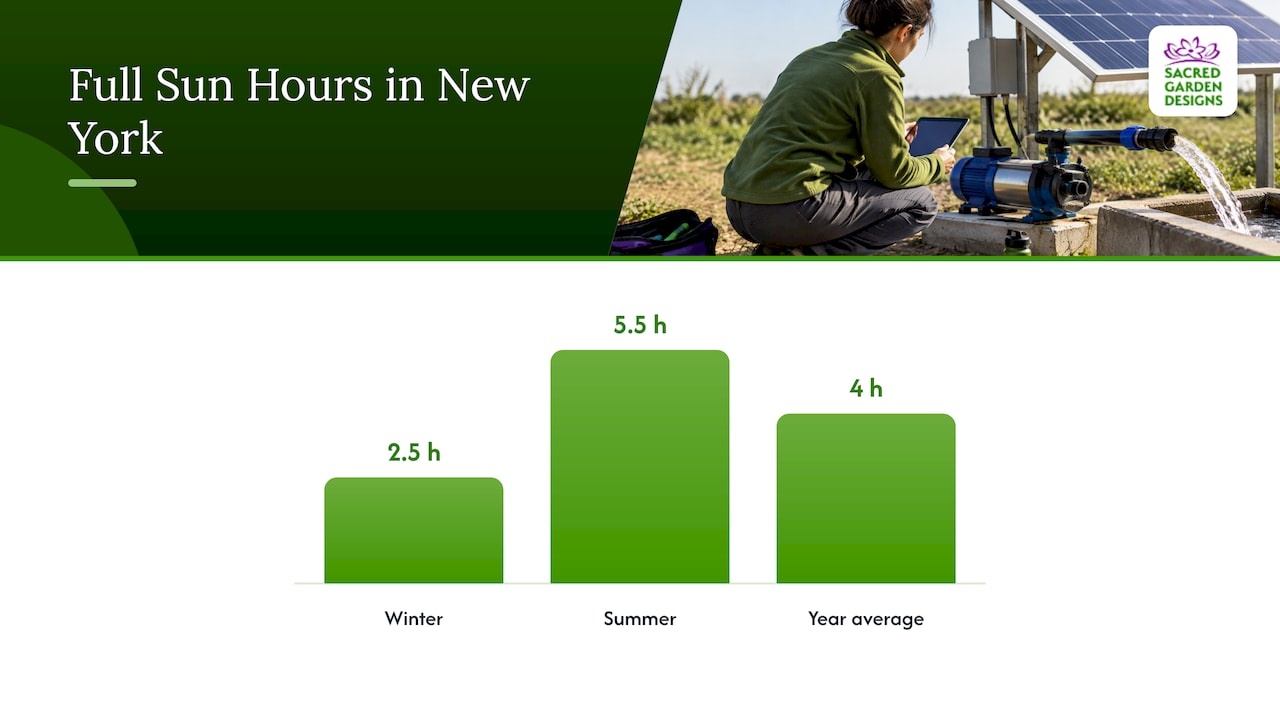
Use the season in which you need the most water, because that is when the system is under the most strain. NYSERDA reports that most of New York State averages 2.5 full sun hours in winter, 5.5 in summer and 4 across the year. Southern California and the desert Southwest generally get more sun than that, but look up your own location’s figure rather than assuming. Gardens that need water in shoulder seasons deserve a more conservative number.
The USDA explains that panels used for pumping are usually set to capture the most energy in summer, when water demand is greatest. That works for irrigation, but it means winter output will be lower, so plan for it if you irrigate year-round.
Does your source keep up?
Compare your design flow with what the source can give. A well that recovers slowly, a small pond or a rain-fed cistern may not sustain 2.7 GPM for five hours. If it can’t, either lower the pumping rate and run the pump longer (which needs a bigger array relative to flow) or add a storage tank that fills more slowly and drains faster.
Step 3: Calculate total dynamic head
Total dynamic head is the one number most people get wrong. The USDA describes it as the amount of elevation and friction the pump has to overcome to deliver the required flow. NYSERDA breaks it down as static lift, the height of the storage tank and friction losses.
In practice, add up these pieces, all in feet of head:
| Component | What it is | Worked example |
|---|---|---|
| Pumping lift | Distance from the water surface, while pumping, to ground level. For a well, include drawdown. | 60 ft |
| Elevation rise | Height from ground to the top of the tank or highest outlet | 15 ft |
| Pressure head | Pressure the outlet needs, converted to feet | 46 ft |
| Friction loss | Loss in pipe, fittings and filters | 10 ft |
| Total dynamic head | Sum of the above | 131 ft |
Pressure converts at 2.31 feet per psi
One psi equals about 2.31 feet of head. A drip system running at 20 psi therefore adds about 46 feet. A 40 psi pressure tank adds roughly 92 feet, which is why pressurizing a tank can matter more than the depth of the well. If water flows from the tank to the plants by gravity, friction applies only to the pipe between the intake and storage, as the USDA’s design guide explains.
Measure from the pumping level, not the wellhead
For wells, use the water level while the pump runs, not the static level when it is idle. A well that pumps below 10 GPM can draw down noticeably, so add that drawdown to your lift.
Friction: where pipe size pays off
Friction loss depends on flow rate and pipe inside diameter. NYSERDA notes that you read it from a friction loss table using pumping rate and pipe inside diameter, giving feet of loss per hundred feet of pipe. Friction rises steeply with flow and falls steeply as the bore gets larger. If your run is long, stepping up one pipe size often saves more head than it costs. For long drip mainlines, a 100-foot flex pipe is a common building block, and checking its inside diameter against your friction table tells you how much head each hundred feet will cost you.
A quick sanity check: add 5 to 10 percent for fittings, filters and valves if you don’t want to count each one.
Step 4: Match the pump to flow and head
You now have a duty point: about 2.7 GPM at 131 ft TDH. Both numbers must be met together. A pump that moves 3 GPM at 30 ft of head will deliver far less at 131 ft.
The USDA says the way to choose is to read pump performance curves and find the pump that delivers your flow at your TDH with the power your array can supply. UVM Extension puts it in four steps: determine flow, determine pressure, select a pump for both, then supply enough PV capacity.
Pump type by head and flow
The USDA notes that positive displacement pumps (helical rotor, piston or diaphragm) suit high head and low flow, while centrifugal pumps suit low head and high flow in surface applications. Our example of modest flow at 131 ft sits in positive displacement territory, or a multistage submersible if you have a deep well. A pond-to-garden transfer at 25 ft of head and 8 GPM would favor a surface centrifugal.
Voltage matters as much as watts
Pump operating voltage varies by brand from 12 to 300 volts. The USDA warns that when supplied voltage falls below the optimum range, production can drop by 20 percent or more. Wire panels in series or parallel to the pump’s specified voltage range, not just to a total wattage.
Step 5: Size the solar array
Pump makers publish the power a pump needs at each flow and head. Use that figure, then check the array against your sun hours. NYSERDA offers a rough check: array wattage multiplied by full sun hours gives daily energy available.
For a sense of scale, the USDA’s example needs a pump to deliver 5 gpm at 200 feet of lift using 450 watts, met by five 100-watt panels wired in parallel. Your numbers will differ, but notice the proportions: a small garden pump needs a handful of panels, not a rooftop array.
A few practical rules:
- Follow the manufacturer’s array range. Underpowering the pump leads to stalling and low output, not just slower pumping.
- Plan for the worst month you irrigate. If winter sun is half of summer sun, the same array delivers about half the water.
- Keep panels shaded-free and tilted for your key season.
- Leave a margin. Dust, heat and wiring lose some output, so a modest oversize beats an exact fit.
Step 6: Add storage instead of relying on batteries
Solar pumps pump when it is sunny and plants drink when they need to, so water storage bridges the gap. NYSERDA says all solar pumping systems use some form of storage, with a rule of thumb of a tank that holds at least three days of water. The USDA’s design guide gives the same three-day figure as a backup for cloudy days.
Virginia Tech Extension adds that storing water, for example in an uphill reservoir, can be more practical than batteries, since you avoid battery operation and maintenance costs. If you do use batteries, NYSERDA says they need a dry, temperature-controlled, vented location.
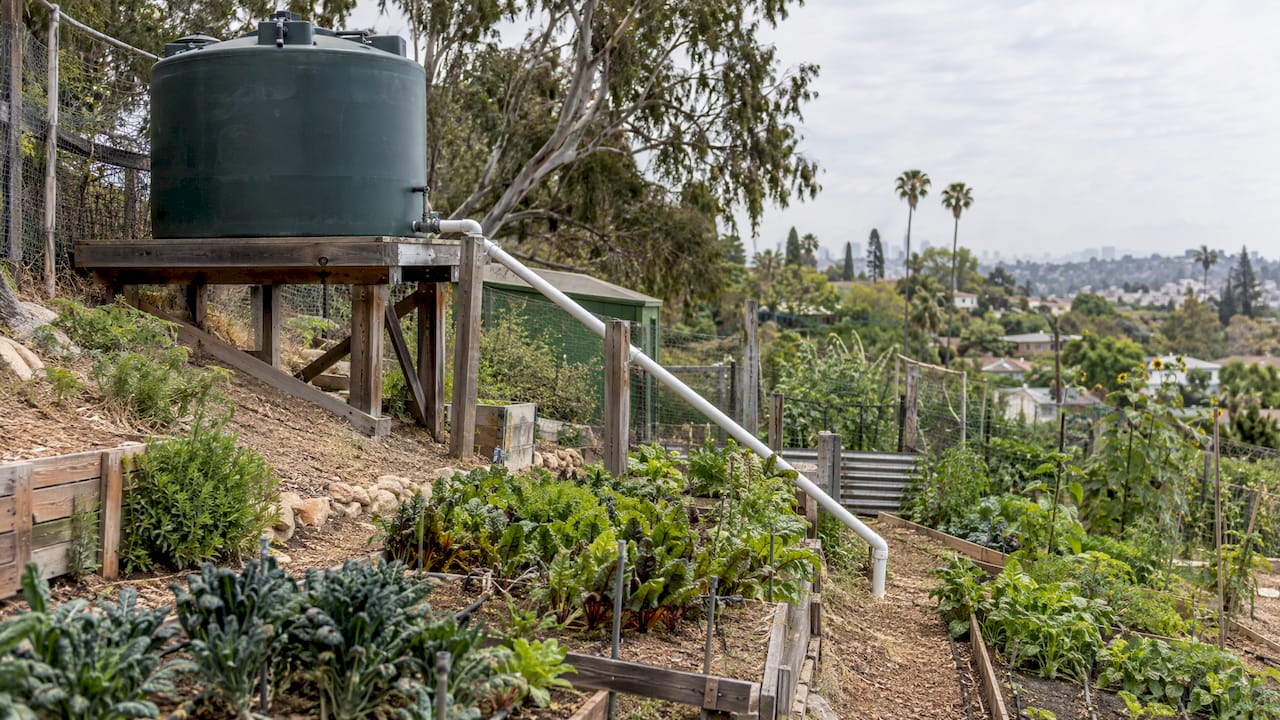
For our 800-gallon example, three days is 2,400 gallons. If your daily demand is much smaller, a tank in the few-hundred-gallon range can work. See our 3 GPM solar irrigation setup with a 275-gallon tank for a home-scale layout.
Common sizing mistakes
- Using 24 hours instead of sun hours when converting gallons per day to GPM. The pump runs maybe five hours, not twenty-four.
- Measuring lift from the wellhead instead of the pumping water level.
- Ignoring pressure head. Drip emitters and sprinklers need pressure, and it counts as feet of lift.
- Forgetting source yield. The best pump can’t move water that isn’t there.
- Undersized pipe. Friction is the cheapest head to remove, and the one most often ignored.
- Sizing for the average month when the pump must handle the peak.
- Choosing on wattage alone. Flow at your head is what counts.
Our perspective
We design water-wise landscapes, and in our experience the best-sized pump is the one you need least. Before we talk about GPM, we look at the plants, the soil and the layout, because every gallon a landscape doesn’t need is a gallon you never have to lift, store or power.
That is why we pair irrigation design with plant selection and drip layout from the start. A well-planned drought-tolerant garden shrinks the daily volume, which shrinks flow, TDH, array and tank all at once.
We also offer solar-powered irrigation kits and irrigation design and installation, so the sizing steps above can be done with you on your site: measuring lift, running the friction numbers and matching the array to your sun hours.
Denise Buchanan
Get your system designed for your site
If you would rather have the numbers worked out for your yard, we offer irrigation design and installation as part of our sustainable landscape services, along with solar-powered irrigation kits. Landscape design is priced at $1,500 for yards under 5,000 sq ft and $2,500 for a full landscape design. See our landscape design services or browse all our services.

If you want to learn the skills yourself, we also run classes and workshops on gardening and water-wise design.
FAQ
How do I calculate GPM for a solar pump?
Divide your daily water need in gallons by the peak sun hours you have, then divide by 60. For 1,000 gallons per day and 5 peak sun hours, that is 200 gallons per hour, or about 3.3 GPM. Use the sun hours for the season you irrigate most.
What is total dynamic head in a solar pump system?
It is the total effort the pump must make, expressed in feet: pumping lift, elevation to the tank or outlet, the pressure the outlet needs and friction in the pipe. Add them all, then read a pump curve at your GPM and that head.
How many solar panels do I need for a water pump?
It depends on the power the pump needs at your flow and head, and on your sun hours. A USDA example for 5 gpm at 200 feet of lift uses 450 watts, met by five 100-watt panels. Always match panel voltage to the pump’s specified range.
Do I need batteries for a solar water pump?
Usually not. Most systems store water in a tank instead, commonly sized for about three days of demand. Tanks avoid the upkeep batteries need, and they supply water on cloudy days.
Does pipe size affect pump size?
Yes. Friction rises quickly with flow and falls as inside diameter increases, so larger pipe lowers total dynamic head. On long runs, that can let you choose a smaller pump and fewer panels.
Sources
- NYSERDA: Guide to Solar-Powered Water Pumping Systems in New York State
- USDA NRCS North Dakota Technical Note 1: Solar-Powered Water Pump Systems for Stockwater
- USDA Washington Engineering Technical Note 15
- USDA: Design of Small Photovoltaic Solar-Powered Water Pump Systems
- UVM Extension: Solar Water Pumping Basics
- Virginia Tech Extension: Considerations for Solar-Powered Water Pumping Systems