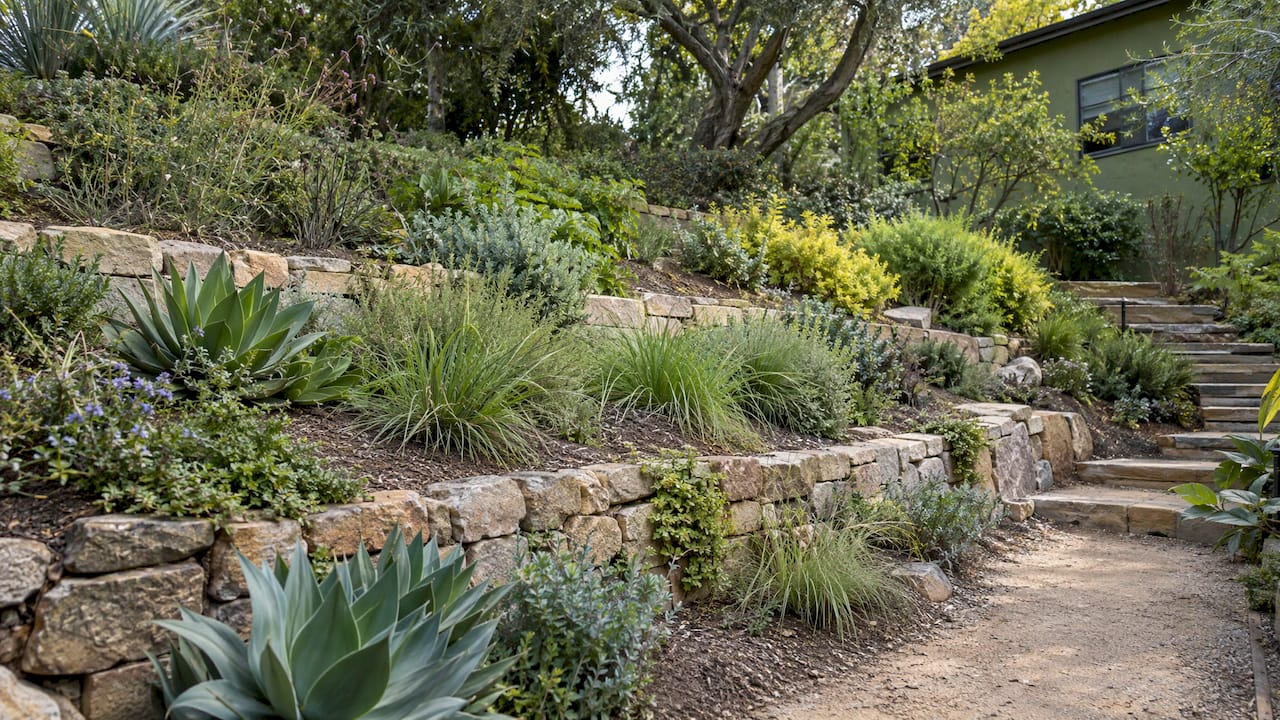
The best alternative to a retaining wall is usually a planted slope: deep-rooted vegetation, mulch and temporary erosion control, with low terraces or drainage features where the grade needs help. It works when the soil is stable. If the ground is sliding or sloughing, a engineered wall is still the right tool. We design and build both at Sacred Garden Designs, so the first job is to read your slope correctly. That decides everything else.
TL;DR
- Planted slopes are the most common wall-free fix. Cities and university extension programs prefer them for steep ground because roots bind soil and slow runoff.
- Terracing, check dams, berms, wattles, coir logs and permanent mats cover the cases where plants alone cannot do the job.
- A wall is the remedy when the soil itself is unstable. Walls of about 4 feet or more generally need a permit and an engineer’s design.
- Bare soil on a slope is the real enemy. Whatever you choose, cover it right away and keep it covered while roots establish.
- A site visit tells you which option fits your soil, grade and drainage before you spend money on materials.
Table of Contents
- First, do you actually need a retaining wall?
- Planted slopes: the most common wall alternative
- Temporary and semi-permanent erosion control
- Terracing: stepped ground without a tall wall
- Water control: the part most slope fixes skip
- What each approach costs
- When a wall is still the right answer
- How to choose: a simple decision path
- Where we come in
- Our perspective
- FAQ
- Sources
First, do you actually need a retaining wall?
A wall holds soil back. That is a job you only need done when the slope tends to slide, collapse or slough. Building America describes retaining walls as permanent barriers that support hillsides where heavy rain could destabilize exposed ground and raise landslide risk. The City of Knoxville’s homeowner guidance says the same thing in practical terms: a retaining wall, crib wall or similar structure may be the remedy when the soil itself is unstable.
Most residential slopes are not in that category. They are stable but bare, or they shed water too fast, or they are simply too steep to mow or walk. For those, the goal is to slow water, bind soil and give the slope a surface that survives rain. A wall is one way to do that, and often the most expensive and permit-heavy way.
Four quick observations help you sort your yard:
- Cracks, scarps or leaning trees and fences. Soil that is actually moving points toward an engineered solution.
- Rills and gullies after rain. Water is the problem, not the soil mass. That is where plants, mulch and drainage shine.
- Steepness. Building America suggests planting vegetation on ground steeper than 25%, and for slopes steeper than 50% it recommends plants that do not require mowing.
- What sits above and below. Driveways, buildings and neighbors’ property change the stakes.
Planted slopes: the most common wall alternative
Vegetation is the natural erosion control. Mississippi State University Extension explains that trees and shrubs create networks of roots and stems that bind soil and slow water. The same source notes that lawn grass binds soil but does not slow runoff well, so heavy rain can wash away turf and roots. A slope of plain turf is not a stabilized slope.
The Knoxville stormwater manual goes further: green methods with permanent vegetation are the preferable means of fixing steep slopes and erosion problems. They capture rainfall and reduce runoff and flooding compared with structural methods such as gabion walls and riprap. Missouri Botanical Garden’s guidance agrees that plants make soil more permeable, which slows runoff and prevents erosion.
What makes a planting work
Plants do not just grow by themselves on disturbed ground. The Knoxville manual says plainly that vegetation needs help to establish on disturbed or steep areas. In practice that means:
- Layers, not one species. Deep-rooted shrubs anchor the soil, groundcovers close the surface and perennials fill the gaps.
- Drought tolerance at the top. UGA Extension advises planting drought-tolerant plants at the top of a slope, because rainwater runs down quickly and the upper zone dries out first. This is also where a water-wise palette pays off.
- Mulch that stays put. The same guide recommends mulch that will not roll downhill, such as shredded bark or leaf mold, rather than loose chips.
- Cover from day one. Missouri Botanical Garden says never to leave steep slopes with bare soil exposed, and recommends biodegradable erosion netting while plants establish.
If you want plant ideas for a drought climate, our guides on stabilizing slopes with plants, groundcovers that hold a hill in Los Angeles and drought tolerant groundcovers go species by species.
Temporary and semi-permanent erosion control
A new planting is most vulnerable in the first season or two, before roots take hold. This is where the following tools earn their place. UGA Extension lists coir logs and straw wattles, strategically placed rocks, boulders or timbers to move water across a slope, and permanent synthetic mats for slopes that cannot be planted.
| Option | What it does | Best for | Watch for |
|---|---|---|---|
| Straw wattles and coir logs | Slow runoff and hold soil until roots secure it | New plantings, moderate slopes | Need correct installation and staking; UC Marin Master Gardeners suggests keeping them in place for the first couple of years |
| Erosion blankets or netting | Cover bare soil while plants establish | Fresh grading, steep planting beds | Biodegradable versions break down as plants take over |
| Mulch | Protects against wind and rain erosion | Gentle to moderate slopes | Choose heavy, interlocking mulch that will not wash downhill |
| Check dams | Slow water in channels | Gullies and swales | Set perpendicular to flow so water goes through or over them, not around |
| Berms | Send surface water around the house | Slopes above a structure | Must be shaped to carry water to a safe outlet |
| Permanent synthetic mats | Hold surface where planting is not possible | Very difficult or shaded sites | Used when vegetation cannot be established |
The Knoxville manual also corrects a common belief. Many homeowners assume rock-based structures such as gabions and riprap need less upkeep. The manual says the opposite: they need frequent inspection for loose stones, vegetation growth and settlement, while green methods are more likely to become stable and self-maintaining.
Terracing: stepped ground without a tall wall
Terracing breaks one long steep slope into a series of flatter planting steps. Each step slows water and gives you usable ground for beds, paths or edible plantings. UGA Extension counts retaining walls and terracing among the ways to secure soil on a slope. Building America also points to terracing or retaining walls as the options to consider for steeper slopes.
Several short, low steps are often easier to permit and plant than one tall wall. Terraces can be edged with stone, boulders or timber, and each level can hold a different planting. UC Marin Master Gardeners notes that terracing for access on steep slopes is best handled by a licensed contractor. That fits how we work: terracing is a design-build job where grade, drainage and planting must be planned together.
Water control: the part most slope fixes skip
Most slope failures are water failures. Planting, terracing and walls all fail if water has nowhere safe to go. Surface drainage with berms or swales, subsurface drainage such as French drains, and clear outlets matter as much as the surface treatment. UC Marin Master Gardeners advises relying on professionals for the correct installation of wattles, French drains and other drainage techniques, and checking local runoff ordinances because they vary by location.
Drainage is also what protects any wall you do build. Our guide on four-part drainage for walls covers new builds and retrofits, and our piece on stormwater management landscaping shows how swales, basins and planting can slow and soak rainfall instead of shedding it.
What each approach costs
Prices vary by region, access and soil, so treat these as published reference points, not quotes.
- Vetiver grass. The vetiver installation guide describes it as a low-cost erosion control technology and claims that, for low to moderate storms, its cost is about one-twentieth of traditional engineered systems. It is a tropical bunchgrass, so check suitability for your climate zone first.
- Hydroseeding. Utah State University’s EcoRestore program says it covers large areas quickly but can have high failure rates and often costs about $2,000 to $4,000 per acre, and it needs machinery access. On a steep residential slope, hand planting with netting is usually more controllable.
- Regrading. A national cost guide puts leveling a yard at $1,500 to $2,600, with an average of $1,800 as of January 2025. Regrading changes where water flows, so it belongs with a drainage plan.
- Erosion control materials. Public agencies publish unit prices for blankets, compost socks, check dams and mulch. Montana’s 2025 erosion and sediment control rate schedule is one example of how those materials are priced per unit.
The cheapest slope plan is rarely the lowest materials bill. It is the plan that keeps soil in place through the first heavy storm, so you do not pay twice.
When a wall is still the right answer
Some slopes need structure. If the soil slides or slumps, if a driveway or building sits close above or below, or if the grade has to change sharply in a short distance, a wall is the proper tool. Walls come with rules:
- Knoxville requires walls with a maximum height of at least 4 feet to be reviewed in a site development permit, and walls must be designed by a professional engineer or other qualified expert.
- The City of Edmonds, Washington, requires a permit for retaining walls of any material unless exempted, and exempts walls four feet or less measured from the finished grade at the exposed toe, subject to conditions. Permitted designs there must carry a state-licensed engineer’s stamp, with a soils report and drainage.
Thresholds differ by city and county, and slopes above a wall or loads from vehicles and buildings can change what is required. Check your local building department before you build, and have a licensed engineer design any wall that needs one. When a project includes one, we coordinate the hardscape and drainage around that engineered design.
Site conditions can also rule out some water-soaking approaches. Missouri Botanical Garden says rainscaping is not recommended over septic systems, in contaminated soils or in karst sinkhole areas, and not within 10 to 20 feet of footings, pavement or buildings, or within 5 feet of the property line. Plan water features and infiltration with those distances in mind.
How to choose: a simple decision path
- Is the soil moving? If yes, get an engineered solution first. Planting follows.
- Is the slope above 50%? Use non-mowed plants, netting and terraces rather than turf.
- Is water the issue? Add berms, swales, check dams or subsurface drainage before anything cosmetic.
- Is it a hillside in Los Angeles County? Fire and water rules shape the plant list and spacing. See our guide to hillside landscaping over 30% in Los Angeles.
- Do you want usable space? Terrace it and plant each step, including edibles, for a garden you can actually walk.
Where we come in
We have designed and built sustainable, water-wise landscapes in Los Angeles and beyond for more than 25 years, and slope stabilization, irrigation design and hardscape construction are part of what we offer. That means one team can read the slope, plan drainage, plant it and, where the site calls for it, build the patio, steps or wall.
Our Landscape Design Services for yards under 5,000 sq. ft. are $1,500, and Full Landscape Design is $2,500. If you want a site walk first, our water wise site analysis and design consultation is the starting point. You can see everything we build on our services page.

Our perspective
A retaining wall is a structure. A planted, drained slope is a system. We tend to prefer the system, because it keeps working as roots deepen and it fits the way we design: artistry and environmental awareness in the same plan.
After more than 25 years of drought-focused work, our view is that slope projects go wrong when someone picks the material before reading the water. We start with where rain lands and where it should leave, then choose plants, terraces, stone or an engineered wall to suit.
That is why our work spans design, irrigation, slope stabilization and hardscape. A yard that holds its hill, uses little water and still feels good to sit in is the outcome we design for.
Denise Buchanan
FAQ
How can I landscape a steep slope without retaining walls?
Cover the soil with layered, deep-rooted plants, heavy mulch and biodegradable netting, then add check dams, wattles or low terraces where water gathers. Building America recommends planting vegetation on slopes steeper than 25%. Keep the slope covered while roots establish.
What is the cheapest alternative to a retaining wall?
Planting is usually the lowest-cost option for stable slopes. Mulch, netting, wattles and vegetation cost far less per square foot than a built structure, and public agencies publish unit prices for these materials. Slopes with active soil movement are the exception and need an engineered fix.
Do I really need a retaining wall?
Only when the soil is unstable or the grade change is too sharp for terraces and planting. Many cities require permits and an engineer’s design for walls around 4 feet and taller, so check your local building department before you start.
Is terracing the same as a retaining wall?
Not exactly. Terracing cuts a slope into level steps, and the steps can be edged with low walls, boulders or timber. Several short steps spread the load and are easier to plant than one tall wall.
Sources
- Erosion Control for Slopes, Stream Banks, and Dunes, Building America
- RH-09 Slope and Streambank Stabilization, City of Knoxville
- Stabilize Steep Slopes, Missouri Botanical Garden
- Meeting the landscape challenges of slopes and hillsides, UGA Extension
- Hillsides, UC Marin Master Gardeners
- Gardening on Steep Slopes, Mississippi State University Extension
- Retaining Walls permit handout, City of Edmonds
- Vetiver Grass Installation Guide
- Hydroseeding, EcoRestore Utah, USU
- Cost to Regrade Yard, Fixr
- Erosion and sediment control rate schedule, Montana DOT