Shade structures such as pergolas, sails and awnings protect you from the sun the day they go up. Trees take years to do the same job, but they cool the air around them, can cut home cooling costs and keep adding value as they grow. For most yards the best answer is both: a structure for the first years and the hottest hours, and well-chosen trees for the long run.
Below, we compare the two on speed, cooling, cost, upkeep and fire safety, then show how to combine them.
TL;DR
- Speed: a structure gives predictable shade right after installation. A planted tree can take 5 to 10 years to shade a patio, and longer for slow hardwoods.
- Cooling: trees shade and also cool the air through evapotranspiration. Well-placed trees can reduce a building’s air-conditioning costs by 20% to 50%.
- Cost: planting a tree is usually the cheaper start, while structures cost more up front and need fabric, hardware or finish upkeep.
- Best result: a hybrid. Use a structure for immediate relief and place trees where they will shade walls and windows as they mature.
- Fire zones: species and distance from the house matter more than the shade itself.
Table of Contents
- How the two kinds of shade differ
- How much cooling and energy savings to expect
- Speed: what you get in year one, five and fifteen
- Cost and upkeep
- Beyond shade: what trees do that structures cannot
- Where to put each: placement that actually works
- Fire-prone areas: choose species and distance carefully
- A simple way to decide
- Our perspective
- Plan your shade with us
- FAQ
- Sources
How the two kinds of shade differ
Trees and structures block the sun in different ways, and the differences show up in timing and flexibility.
A structure is engineered. You choose its size, height and coverage, and it casts the same shade whatever the season. It also blocks direct UV from day one. Canadian municipal shade guidelines describe this contrast: structures offer immediate, predictable protection, while trees need years to mature and their shade shifts with season and leaf density.
A tree is alive. Its shade changes through the year, which is an advantage if you pick a deciduous species. It blocks summer sun and lets winter light through. It also keeps growing, so a small sapling today becomes a canopy that covers far more ground than any pergola.
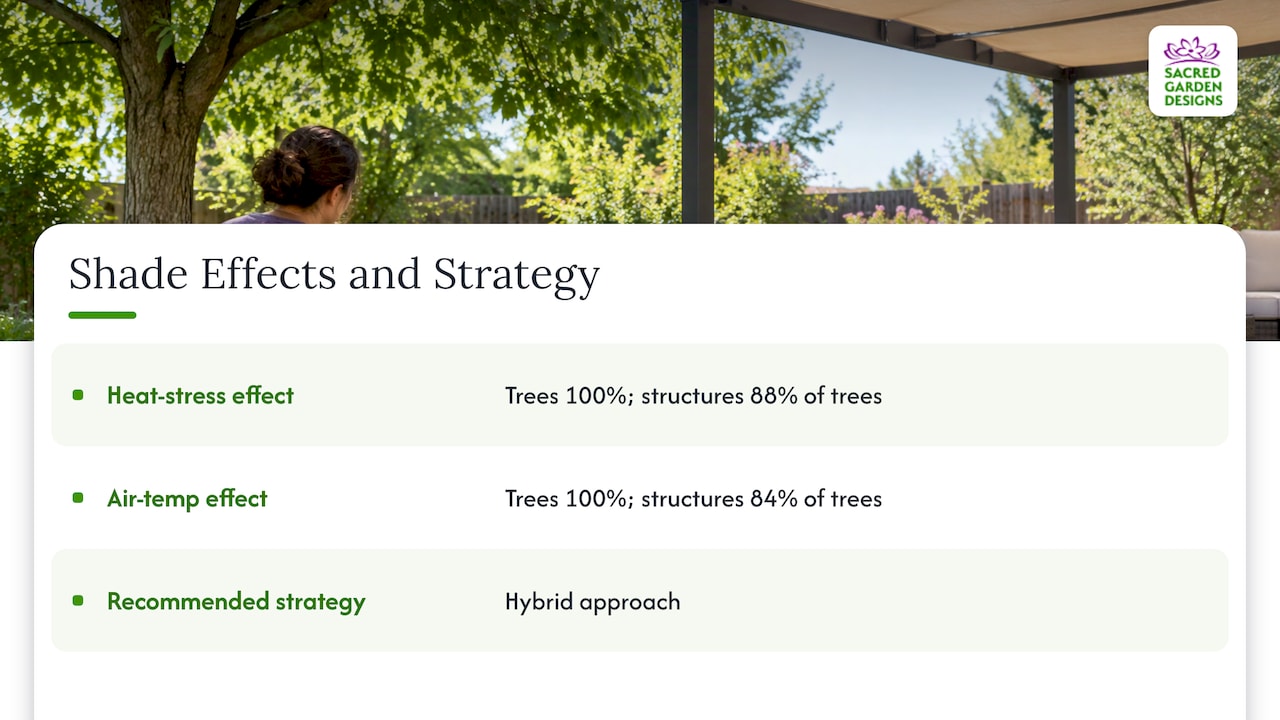
A study from Arizona State University measured comfort under different kinds of city shade. Shade from built forms performed best in that test, but the researchers noted that trees bring co-benefits and should not be abandoned. A South Korean study reached a similar place: structures delivered about 88% of a tree’s heat-stress effect and 84% of its air-temperature effect, and the authors argue that a hybrid approach is the sensible strategy.
That is the honest summary of the research. Structures win on speed and control. Trees win on everything that happens around the shade.
How much cooling and energy savings to expect
Trees cool in two ways: they shade surfaces directly, and they cool the surrounding air as leaves release water vapor. Reviews of the research describe both mechanisms, and report air-conditioning savings of 20% to 50% when trees are suitably placed. The effect on buildings comes mostly from shade.
For a more specific number, a California study modeled three mature trees, two on the west side and one on the east. They reduced annual cooling energy use by 10% to 50%, or 200 to 600 kWh, for an energy-efficient home across the climate zones studied. The same US Forest Service researcher notes that cooling savings exceed any winter heating penalty from south-side shade, except where air conditioning is barely used.
A structure cools differently. It stops sunlight from reaching the people or surface beneath it, so the spot underneath feels cooler. But it does not add moisture to the air, and a roof-like cover over a patio does little for the walls and windows of the house unless it is designed to reach them. Fixed overhead shade is strongest at midday. Scottsdale’s shade guidelines say a fixed horizontal cover may give little or no shade early or late in the day, and recommend vertical elements to block low-angle morning and afternoon sun.
If your main goal is a comfortable seating area this summer, a structure is the direct route. If your goal is a cooler house and a cooler block over the next decade, trees do more. Our own write-up on trees for climate modification goes deeper into the urban heat evidence.
Speed: what you get in year one, five and fifteen
This is where structures are hard to beat.
| Timeframe | Structure | Shade tree |
|---|---|---|
| Week of installation | Full designed coverage | A small sapling with almost no shade |
| Years 1 to 3 | Same coverage, with some fabric or finish upkeep | Light dappled shade, still establishing roots |
| Years 5 to 10 | Same coverage | Often enough canopy to shade a patio |
| Years 15 to 20 | Fabric replaced or refinished as needed | Slower hardwoods such as white oak reach wide shade footprints |
The tree timeline depends on species, soil, irrigation and the size you plant. A larger nursery tree shortens the wait but costs more. If you need shade by next summer, a tree alone will not deliver it.
Cost and upkeep
Trees are usually cheaper to start. NOAA’s summary of nature-based solutions puts tree planting at $13 to $288 per tree, covering plant material and installation tasks, with maintenance materials counted separately. Professional installation of larger specimens costs more, and access, soil preparation and local permit rules all move the price.
Structures cost more at the start, and the price depends heavily on the type: a simple sail is a different project from a custom pergola with a solid roof or motorized louvers. They also have a maintenance rhythm of their own:
- Shade sails and fabric awnings: the fabric breaks down in UV and needs checking, tensioning before windy season, and eventual replacement.
- Pergolas and wood structures: periodic inspection of posts and beams, and refinishing on a schedule.
- Footings: in cold climates, poorly set posts can heave in frost, so foundations must reach below the frost line.
Trees need their own care. Young trees need regular watering, and mature trees need pruning and the occasional health check. In a dry climate, watering is the big task, which is why we wrote a guide to keeping trees alive in dry years. When pruning produces a pile of limbs, it helps to know your tree branch disposal options before the work starts.
Beyond shade: what trees do that structures cannot
A structure shades. A tree does a lot more:
- Urban trees sequester carbon, improve air quality and help reduce stormwater runoff.
- The USDA Forest Service suggests thinking of trees as part of a “treatment train” with ground cover and soil, so the whole planted system retains stormwater, not just the canopy. See our guide to stormwater management landscaping for how that looks in a yard.
- Trees create habitat, hold soil and add a living quality to a space that fabric and lumber do not.
If you plan to pair a patio cover with a cooler house, a reflective roof treatment such as cool roof coatings can work alongside shade, since each reduces heat from a different direction.
Where to put each: placement that actually works
Placement decides whether either option pays off.
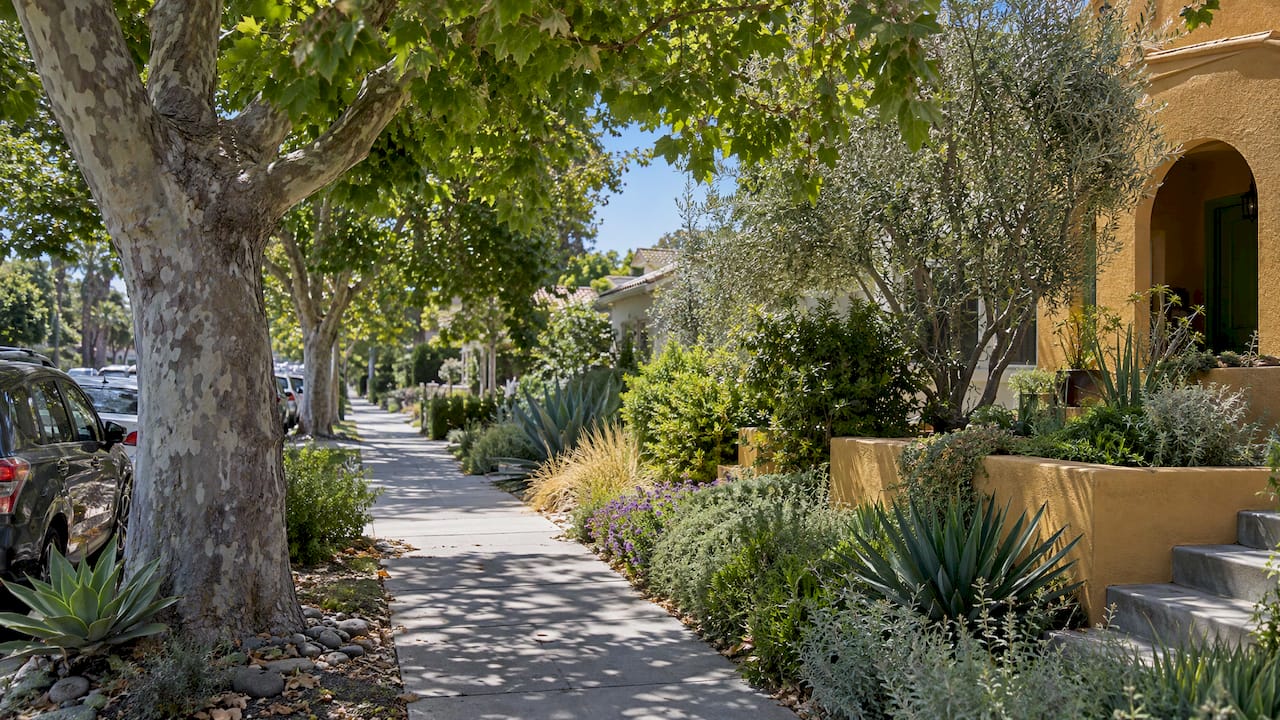
Trees. A Utah State University Extension guide recommends planting deciduous trees so they shade east-facing walls and windows from 7 to 11 a.m., and west-facing surfaces from 3 to 7 p.m., during June through August. It suggests trees with a mature height of at least 25 feet, set 10 to 20 feet east and west of the house, and warns against south and south-southwest placements that shade the house in winter. The EPA makes the same point: deciduous trees on the west side, with branches high enough to keep views and breezes.
Structures. The Scottsdale guidelines focus on the hours between 10 a.m. and 4 p.m., and combine horizontal cover for midday with vertical elements for morning and late-afternoon sun. They also set a goal of at least 50% shade over hardscape, using a mix of mature trees and structures. That target is a handy rule for any patio or play area.
Fire-prone areas: choose species and distance carefully
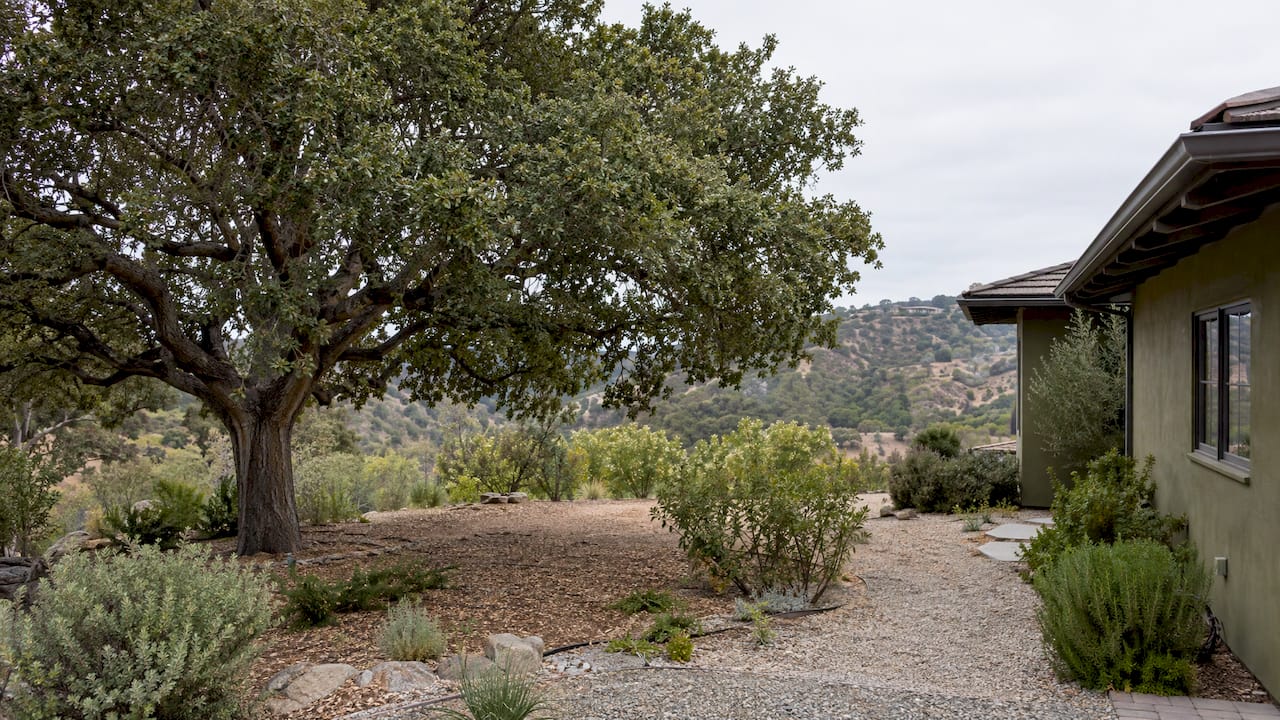
In wildfire country, shade is not only about comfort. Trees near the house can add fuel, and an overhead wood structure attached to the home is part of the same equation. In the Bay Area, tree guidance warns that highly resinous conifers such as eucalyptus and pine increase defensible-space hazards near structures, and lists coast live oak, California buckeye and coast redwood as safer choices. Soil, sun, water availability, mature size and irrigation needs belong on the same checklist.
Treat your local fire agency’s defensible-space rules as the final word on spacing and pruning. For design ideas that fit those rules, see our guides to 0 to 100 ft defensible space and firewise landscaping plants.
A simple way to decide
Ask four questions.
- When do you need shade? If it is this summer, start with a structure. If you can wait, start with trees.
- What are you trying to cool? A seating area points to a structure. A hot west wall or bedroom points to trees.
- How much water and care can you give? Young trees need steady irrigation. Structures need almost no water but regular inspection.
- What does your climate and fire zone allow? Check species lists, setbacks and local permit rules before you buy anything.
Most homeowners end up with a layered plan. A modest structure covers the patio now. Two or three well-placed trees go on the west and east sides. Under and around them, shade-tolerant planting fills in. Our guides to best shade trees for small yards in Los Angeles, dry shade plants and drought-tolerant groundcovers cover what to plant once the shade arrives.
Our perspective
We have designed and built landscapes for more than 25 years, and we rarely tell a client to choose one or the other. Shade structures solve a problem that trees cannot: the first five to ten years. A well-designed pergola, sail or patio cover turns an unusable, sun-baked yard into a place people actually sit in, right away.
Trees solve the problem that structures cannot: the long game. They cool the air, shade walls, handle water and make a yard feel alive. In a drought-prone region, the key is choosing species that suit your soil, your water budget and your fire zone, then irrigating them efficiently while they establish.
That is why our design process starts with the sun path on your site. We map where the afternoon heat hits, place structures where they help most, plant trees where they will shade the house as they mature, and use water-wise irrigation so the trees thrive. The result is shade that works on day one and gets better every year.
Denise Buchanan
Plan your shade with us
If you are weighing a structure, trees or a mix, our landscape design service maps the sun, the heat and the water on your property and gives you a plan you can build in stages. We publish the price: $1,500 for yards under 5,000 sq. ft., and $2,500 for a full landscape design. We also handle installation, including patios, decks and irrigation, and tree trimming and garden maintenance afterward.
See the landscape design services page for what is included, or browse everything we do on our services page.
FAQ
Are artificial or real trees better for the environment?
Real trees. They sequester carbon, improve air quality, reduce stormwater runoff and cool the air through evapotranspiration. A shade structure provides shade only. If you want the environmental benefits, plant trees and use a structure to cover the years while they grow.
Which tree gives the most shade?
Broad, dense-canopied deciduous trees give the most summer shade, and they let winter sun through. The right species depends on your region, soil, water and fire zone. In Los Angeles, our guide to shade trees for small yards is a good starting point.
Are there artificial trees for outside?
There are decorative artificial trees, but they do not shade or cool a home. For outdoor shade, people use pergolas, shade sails, awnings and umbrella-style canopies. These give reliable protection from direct sun from the day they go up.
How long until a planted tree shades my patio?
A US comparison puts it at about 5 to 10 years for a canopy broad enough to shade a patio, and 15 to 20 years for slower hardwoods such as white oak. Planting a larger tree can shorten the wait. A temporary or permanent structure fills the gap.
Sources
- Toronto Shade Guidelines
- Pergola vs. planting a shade tree
- ASU: Do trees provide the best shade for urban environments?
- What we know and don’t know about the cooling benefits of urban trees
- Potential of Tree Shade for Reducing Residential Energy Use
- Comparative analysis of urban heat stress mitigation
- Scottsdale shade structure guidelines
- NOAA nature-based solutions installation and maintenance costs
- Leveraging urban tree canopies for community resilience
- Urban forest systems and green stormwater infrastructure
- Planting trees for energy conservation
- EPA: Reducing urban heat islands, trees and vegetation
- Bay Area Tree Owner’s Guide
- Tree branch disposal options
- Cool roof coatings