Grading a yard for drainage means reshaping the soil so water runs away from your house instead of pooling against it. The target most guidance agrees on is a steady fall away from the foundation for the first 10 feet, measured before you move any dirt. Getting that slope right is simple on paper. Getting it right around patios, downspouts, utility lines, neighbors’ property and local code is where most projects go wrong, and where a design-led approach pays for itself.
TL;DR
- Water should always have a clear path away from the house. Guidance ranges from a minimum of 0.5 inch of drop per foot to 1 inch per foot, for at least the first 10 feet.
- Measure first: two stakes, a string and a line level tell you your current slope in minutes.
- Use a silt and clay mix for fill, not sand, and re-seed or plant bare soil right away so it doesn’t erode.
- If water still collects after regrading, the fix is usually a swale, French drain or dry well, not more dirt.
- Check your local building or stormwater office before moving soil. Rules on slope and permits differ by county and state.
Table of Contents
- What grading does and how to tell your yard needs it
- The numbers: what slope and how far
- Step 1: Find out what you have now
- Step 2: Work out why the water is there
- Step 3: Regrade the yard
- When grading alone is not enough
- Permits and local rules
- What it costs
- Where we come in
- Our perspective: drain the water, then put it to work
- FAQ
- Sources
What grading does and how to tell your yard needs it
Grading reshapes the ground so that rain and irrigation water flow away from the home rather than collecting near the foundation. This Old House notes that pooling water, muddy patches and soil buildup after rain reveal low spots. The reason it matters is moisture. The U.S. Department of Energy’s building science education site explains that building materials left damp or saturated for long periods will eventually fail, which is why the site should drain on all sides.
Signs your grade needs attention:
- Standing pools of water after rain. Fairfax County’s Soil and Water Conservation District says wet areas that persist several days after rain or snow are commonly caused by low spots or depressions, or by poor infiltration from compacted soil, high clay content or shallow bedrock.
- Mildew, algae or plant growth on pavement or on the home’s side wall, and visible soil erosion, are on the list of drainage warning signs published by Orange County’s H2OC stormwater program.
- Water running toward the building instead of away from it. Reduce Flood Risk suggests walking the yard a few hours after a rainstorm to look for exactly this.
Grades that once worked also drift. The same source lists soil settlement, landscaping changes, a new fence or pool, faulty gutters and downspouts, and building additions as common reasons a lot’s grade stops doing its job over time.
The numbers: what slope and how far
Sources differ a little, and the differences are worth understanding before you pick a target. Here is what the published guidance says.
| Source | Slope away from the house | Distance |
|---|---|---|
| U.S. Department of Energy building science site | Minimum 0.5 inch per foot | 10 feet |
| Milwaukee Metropolitan Sewerage District | 1 inch per foot | First 5 to 10 feet |
| Family Handyman | At least 1 inch per foot | At least 10 feet beyond the foundation |
| This Old House | About 5%, roughly a 6-inch drop | Over 10 feet |
| Orange County, CA site grading policy | 5% under the 2022 California Building Code, 2% minimum where climate or soil conditions warrant | Minimum 10 feet |
A quick translation: 1 inch per foot is about an 8% slope, and 6 inches over 10 feet is 5%. Aim for the steeper end of your local requirement when you have room, because settling will eat some of it over the years.
Three other details from the same sources are easy to miss:
- At least 4 inches of foundation should remain visible above the soil, and soil or plants shouldn’t touch siding or wood, according to MMSD.
- Patios, walks and driveways within 10 feet of the foundation should slope away at 2% for 10 feet or to the edge of the surface, per the 2009, 2012 and 2015 International Residential Code as summarized by the EPA/ENERGY STAR Building America Solution Center. Where space limits the slope, swales or drains take over.
- Don’t overshoot. Delaware’s environmental agency gives an ideal yard slope of 5% to 25% and warns that steeper grades can lead to erosion.
If your house has a crawlspace, there is one more rule. Reduce Flood Risk cautions that you must not backfill against the crawlspace wall, so the crawlspace floor doesn’t end up below the level of the fill.
Step 1: Find out what you have now
Before buying a yard of soil, measure. The method from This Old House is simple:
- Drive a stake next to the foundation and tie a string to it at ground level.
- Place a second stake 100 inches away from the first.
- Pull the string level between the two stakes (a line level hangs on the string).
- Measure the height of the string above the ground at the far stake.
- Divide that height by 100. A 6-inch gap means a 6% slope.
Repeat in several places around the house, not just the side where you see the problem. A yard can slope correctly on three sides and fail on the fourth. A variation from Family Handyman uses a stake at least 10 feet out, and tells you to move dirt until the surface is an equal distance from the string along the slope.
Where it goes wrong: a string that sags, a line level read at the wrong angle, or measuring only where the ground is already tidy. Take readings at the lowest point near the house too, because that is where water will head first.
Step 2: Work out why the water is there
Not every wet spot is a grading problem. WSU Extension advises first determining whether a wet area comes from natural saturation, faulty drainage or runoff from hard surfaces before choosing a fix. Check the simple things:
- Do downspouts dump at the foundation? Family Handyman suggests extending them at least 6 feet from the house.
- Is a neighbor’s yard, a driveway or a roof sending runoff onto your lot?
- Is the soil compacted or heavy clay, so water can’t soak in?
If the cause is a gutter or a compacted lawn, regrading alone won’t solve it. Name the cause first and the right fix becomes obvious.
Step 3: Regrade the yard
Once you know your slope and your cause, the work follows a pattern, drawn from the This Old House and Family Handyman guides:
- Check obstacles. Call your local utility locating service before digging, and note sprinkler lines, drains, roots and any buried cables.
- Lower the high areas and fill the low spots. Move soil from where it builds up near the house to where it is needed. Removing soil a few feet from the foundation can also steepen the slope, as long as the ground beyond drops enough for water to keep flowing away.
- Build the slope in layers. Add soil in thin lifts and compact each one. The DOE building science page describes capping the top layer with 2 to 4 inches of silty clay and tamping it to prevent settling.
- Check the line again. Re-run the string test and confirm the slope is consistent, with no flat spots or small dams that hold water.
- Cover bare soil. Delaware’s guide recommends planting grass or native plants on newly exposed soil to stabilize the graded lawn.
- Test with rain. Walk the yard after the next storm and see where water travels.
The common failure is consistency. As This Old House puts it, the key is that water always moves away from the foundation, so a perfect 10 feet followed by a depression at 12 feet only moves the pond.
Which soil to use
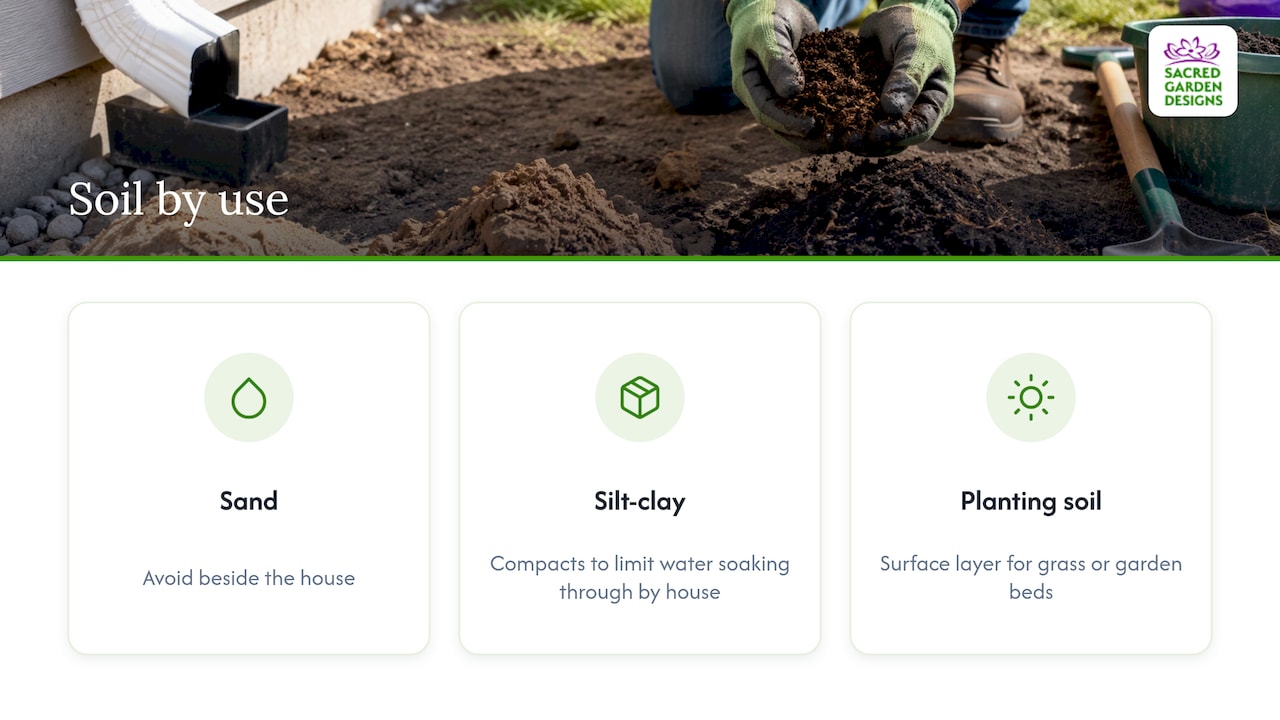
Family Handyman’s experts recommend avoiding sandy soil and using a mixture of silt and clay, which compacts enough to keep water from soaking through right next to the house. Save good planting soil for the surface layer where grass or garden beds will go.
When grading alone is not enough
Sometimes the lot doesn’t have room for a proper slope, or water still collects after regrading. This Old House says French drains, catch basins or retaining walls may help, and that grading works best combined with them. Here is how the options fit:
- Swale. A shallow, planted channel that guides water along. The EPA/ENERGY STAR Building America guide gives a 3-to-1 width-to-height ratio and a longitudinal slope of 2% to 4%, noting that slopes under 2% can pool and slopes over 4% can erode.
- French drain. A perforated pipe wrapped in rock and landscape fabric that carries water to a lower part of the site, a dry well or the stormwater sewer. The same guide notes that many communities have ordinances requiring stormwater to be handled on site, so where the pipe ends matters.
- Dry well. For bigger drainage problems, Family Handyman’s expert says a French drain or dry well may be needed.
- Retaining wall drainage. If your problem sits behind a wall, grade alone won’t fix it. Our guide to four-part drainage for retaining walls covers it.
For a broader look at features that keep rain on your property and out of trouble, see our guide to stormwater management landscaping. If your problem is a hillside rather than a flat lot, plants that stabilize slopes in 2 to 4 months are part of the answer.
Permits and local rules
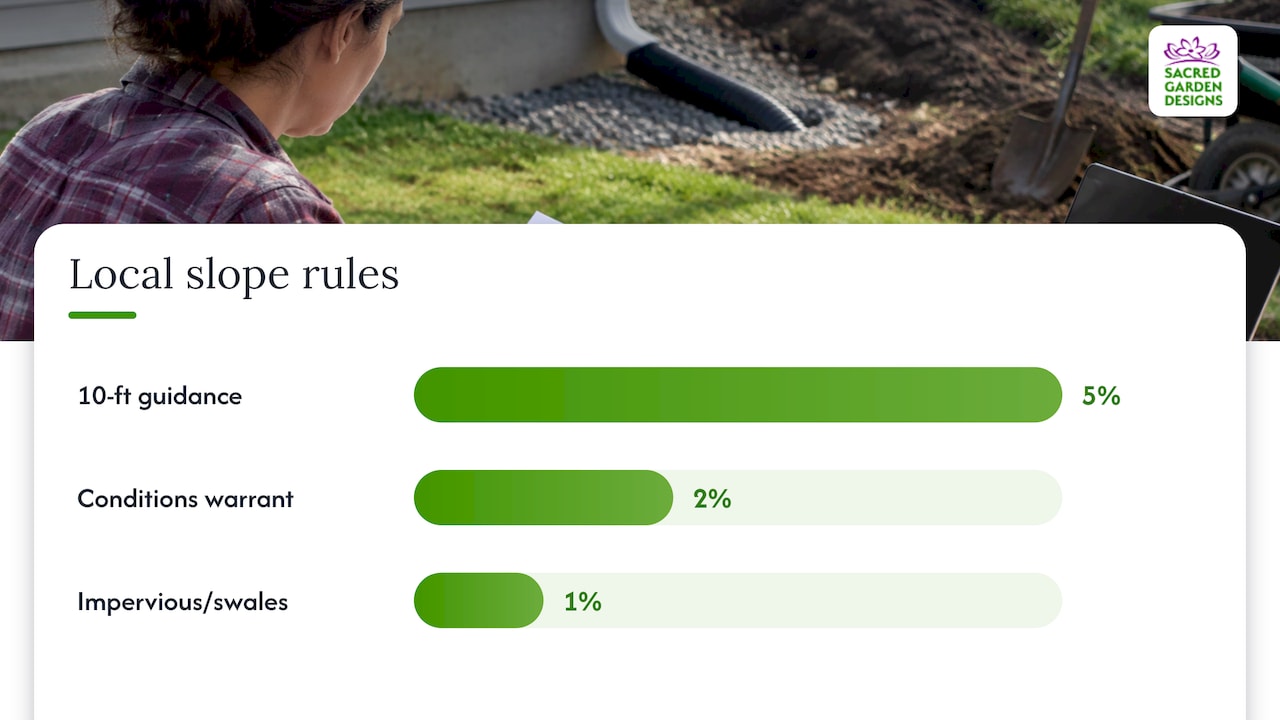
The slope numbers above are guidance. Your local code is the rule. Orange County, California, for example, updated its site grading policy in November 2024. It cites a 5% slope for 10 feet under the 2022 California Building Code, allows 2% where conditions warrant it, and permits 1% for impervious surfaces and certain swales only with specified geotechnical conditions, area drains and engineer verification. A yard in another county may sit under different numbers.
What to do before you dig:
- Contact your local floodplain management or building department. Reduce Flood Risk advises asking about stormwater infrastructure, local codes and the permits needed before regrading.
- Do not send water onto a neighbor. Delaware’s guide states that grading should not cause flooding on neighboring properties, and it points to city or county offices for building permits and flood ordinances, with state permits where coastal or wetland areas apply.
- If you have a slope, retaining wall or work near the foundation, ask whether an engineer’s sign-off is needed.
What it costs
Costs depend on the square footage regraded, how much soil moves, whether drainage lines already exist, equipment access and local permit fees, so any single national number would mislead you. The fair way to budget is to get a site-specific plan first, then price the work against it. A plan also stops you from paying for grading that a drain or downspout extension would have solved. Our design fees are published: $1,500 for yards under 5,000 sq. ft. and $2,500 for a full landscape design.
Where we come in
Grading is one part of a drainage plan, and it works best when the slope, the planting, the paving and the irrigation are designed together. Our team handles sustainable landscape design and installation, irrigation design, slope stabilization, patios and hardscape, and clean-up and haul-away. We begin with an initial landscape consultation and, if you want a full plan, our landscape design services are priced at $1,500 for yards under 5,000 sq. ft. and $2,500 for a full landscape design.

If you want to learn the craft yourself, we also run classes and workshops on gardening and landscape topics.
Our perspective: drain the water, then put it to work
After more than 25 years of designing water-wise landscapes in Los Angeles, we look at drainage differently from a pure excavation job. Water that leaves your yard in a pipe is water you’ve lost. Water that leaves the foundation zone and lands in a planted swale, a rain garden or a permeable patio is water that feeds your garden.
That is why we treat grading as a design decision. The slope near the house protects the structure. The slope beyond it shapes where the water goes next, which plants thrive there, and how much irrigation the rest of the yard needs. In a region with both drought and heavy storms, a yard should be ready for both.
We also think of drainage as part of the landscape’s look. A well-shaped swale with the right plants can be the most beautiful part of a yard, and a retaining wall with proper drainage behind it lasts longer. Our approach combines artistry with environmental consciousness, and drainage is where that pays off in a way you can see after the first rain.
Denise Buchanan
FAQ
Can I grade my backyard myself?
Yes, for a small area, if you measure first, check for utilities and know your local rules. The string-and-stake method gives you the slope, and the work is moving and compacting soil in thin layers. Bigger lots, work close to the foundation, or any case where water has nowhere to go are better planned by a designer.
What kind of dirt should I use to regrade?
Use a mixture of silt and clay near the house rather than sand, because it compacts and resists water soaking through, as Family Handyman’s experts advise. Put planting soil on top where you want grass or beds.
Do I need a permit to regrade my yard?
Often you do, especially near the foundation, in flood zones or where an engineer’s verification applies. Rules come from your city or county, so call the building or floodplain management office before work starts, as Reduce Flood Risk recommends.
How far from the house should the slope extend?
At least 10 feet in most guidance. MMSD says all water falling within 10 feet of the house should have a clear path away without ponding. If your lot can’t give you 10 feet, a swale or drain takes over.
What if water still pools after regrading?
Look at the cause again: downspouts, runoff from paving or neighbors, compacted clay. A swale, French drain or dry well can then carry the water away, and the design should also decide where it ends up.
Sources
- Yard Grading 101: Everything you need to know, This Old House
- Wet Yard: Solving Drainage Problems, Fairfax County Soil and Water Conservation District
- Yard Drainage: Everything You Need to Know, H2OC
- Improve lot grading, Reduce Flood Risk
- Site is Excavated: Final Grade is Sloped Away from Home, U.S. Department of Energy
- Proper Grading Around Your Home, MMSD
- How to Grade a Yard for Proper Drainage, Family Handyman
- Grade Lawn Away from Structure, Delaware DNREC
- Swales, Drains, and Site Grading for Stormwater Control, Building America Solution Center
- Patio Slabs, Porch Slabs, Walkways, and Driveways Slope Away from House, Building America Solution Center
- Site Grading for Drainage Around Building policy, Orange County Public Works
- Dealing with Wet Spots in the Yard and Garden, WSU Extension