The best firewise plants are low, moist, non-resinous and well spaced. They also go in the right zone around your house. No plant is fireproof, so where you put a plant and how you maintain it matter as much as which species you pick. Below you will find the traits to look for, named examples with published flammability ratings, the plants to keep away from your walls, and a zone-by-zone planting plan.
TL;DR
- Embers, not walls of flame, ignite most homes. Fire safety guidance puts it at 60 to 90% of wildfire home ignitions, so keep the first 5 feet around the house free of flammable plants and mulch.
- Choose plants with high moisture, no strong resinous smell and little dead material. In the closest zones, keep them under 18 inches tall.
- Drought tolerant does not mean fire safe. Sage, pine and juniper are common examples of oily, resinous plants to keep away from the house.
- Spacing, pruning and debris removal decide whether a good plant stays good. Maintenance is half the job.
Table of Contents
- Why plant choice is only part of the answer
- What makes a plant less flammable
- Using flammability ratings
- Go native, with a plan
- Plants to keep away from the house
- A zone-by-zone planting plan
- Maintenance is the other half
- Our perspective
- Plan it with us
- FAQ
- Sources
Why plant choice is only part of the answer
A “fire-resistant plant list” is a starting point, not a guarantee. UC Cooperative Extension stresses that fire-resistant plants are not fireproof, and that a firewise landscape takes more than choosing the right species.
The reason is fuel continuity. A fire moves through a yard by jumping from plant to plant, and from the ground up into tree canopies. Montana guidance on ignition-resistant construction describes the goal as reducing fuel both horizontally, between plants, and vertically, through ladder fuels. A well-chosen shrub that sits under a tree and collects dead needles can become a ladder. A mediocre plant, isolated on bare gravel and kept clean, may pose little risk.
This also means a firewise yard does not have to be a barren one. The same guidance describes islands of vegetation separated by non-combustible paths, patios and stone walls. That is good garden design as well as good fire design.
What makes a plant less flammable
You can judge most plants with a few observations. The Idaho Firewise guide lists the attributes that raise flammability: high oil or resin content, low moisture content, tall and open growth, fine twiggy stems and high water needs. Low flammability goes with the opposite: high moisture, succulent tissue and compact growth.
In practice, check for these things:
- Moisture in the leaves. Fleshy, supple leaves that hold water are better than dry, papery or leathery ones.
- No aromatic or resinous smell. Crush a leaf. If it smells strongly of oil or pitch, think twice near the house.
- Little dead wood. Plants that shed or accumulate dry material need constant cleanup. Colorado State University Extension lists low accumulation of dead, dry material as one of the traits to look for.
- Compact, low form. Low plants give fire less height to climb.
Drought tolerant is not the same as fire safe
This is the most common mistake we see in water-wise yards. According to the same Colorado State University Extension fact sheet, some drought-tolerant plants resist fire because they store water internally, while others carry volatile oils that make them very flammable. Your plant palette needs to pass both tests: low water use and low flammability.
Using flammability ratings
Some regional guides score plants numerically. Idaho Firewise uses a scale from 0 (most flammable) to 10 (least flammable). For zones 1 and 2, within 30 feet of the home, the guide recommends planting only species that score 8, 9 or 10.
Colorado State University Extension publishes a table of native, low-water plants with ratings on this scale. A few examples from its tables:
| Plant | Type | Low-flammability rating |
|---|---|---|
| Prickly pear (Opuntia) | Cactus | 10 |
| Yellow stonecrop (Sedum lanceolatum) | Groundcover, about 0.5 ft | 10 |
| Front Range beardtongue (Penstemon virens) | Flower, about 0.5 ft | 8 |
| Cheyenne mock orange (Philadelphus lewisii) | Shrub, 2 to 3 ft | 8 |
| Smooth sumac (Rhus glabra) | Shrub, 3 to 5 ft | 8 |
| Aspen (Populus tremuloides) | Tree, 8 to 25 ft | 8 |
Two cautions apply. These ratings come from a Colorado list for specific elevations, so they do not transfer to a Southern California canyon. Use them as an example of how scoring works, then check your own state or county extension office for a list written for your climate. Also, a rating assumes the plant is healthy and maintained. A drought-stressed, unpruned plant is not the plant that was rated.
Go native, with a plan
Generic lists have a limit. Landscape designer Cassy Aoyagi argues in a Loyola Marymount University piece on fire-retardant plants that authentic native plant communities hold up better over the long term than lists of exotics. Natives evolved with local fire and flood cycles. She notes that native sumac may lose its foliage in a fire, but its deep roots stay in place and help hold slopes against later erosion. Shallow-rooted ornamental grasses such as pennisetum and pampas grass, by contrast, can act as kindling.
Deep roots matter on hillsides especially. A Tulare County fire-resistive plant guide points to deep-rooted native trees and shrubs as natural slope stabilizers, with roots that can reach more than 15 feet into the soil. If your lot has a grade, read our guide to stabilizing slopes with plants before you choose.
Plants to keep away from the house
Some plants are best kept out of the zones closest to the structure:
- Conifers and other resinous evergreens. Idaho Firewise discourages coniferous evergreen shrubs and trees in the immediate zones because of their resins and oils.
- Junipers. A Utah State-style brochure on firewise landscaping is not needed to see this one: junipers are on nearly every avoid list, and the guidance above explains why.
- Ornamental grasses with dry, fine stems. Pennisetum and pampas grass are the examples Aoyagi calls out.
- Sage and other volatile-oil shrubs. Fragrant, oily foliage is the signal.
- Anything holding dead material. Old, woody shrubs with dead interior stems are a hazard no matter the species.
One regional nuance: a UC native plant guide recommends avoiding resinous trees and shrubs near structures, and it names succulents and irises as good, fire-resistant choices if kept watered.
A zone-by-zone planting plan
The USDA Forest Service describes a fire-resistive landscape as concentric zones around a structure, with the strongest resistance closest to it. The goal is to disrupt continuous fuel patterns so flames slow down. Here is how that looks in practice.
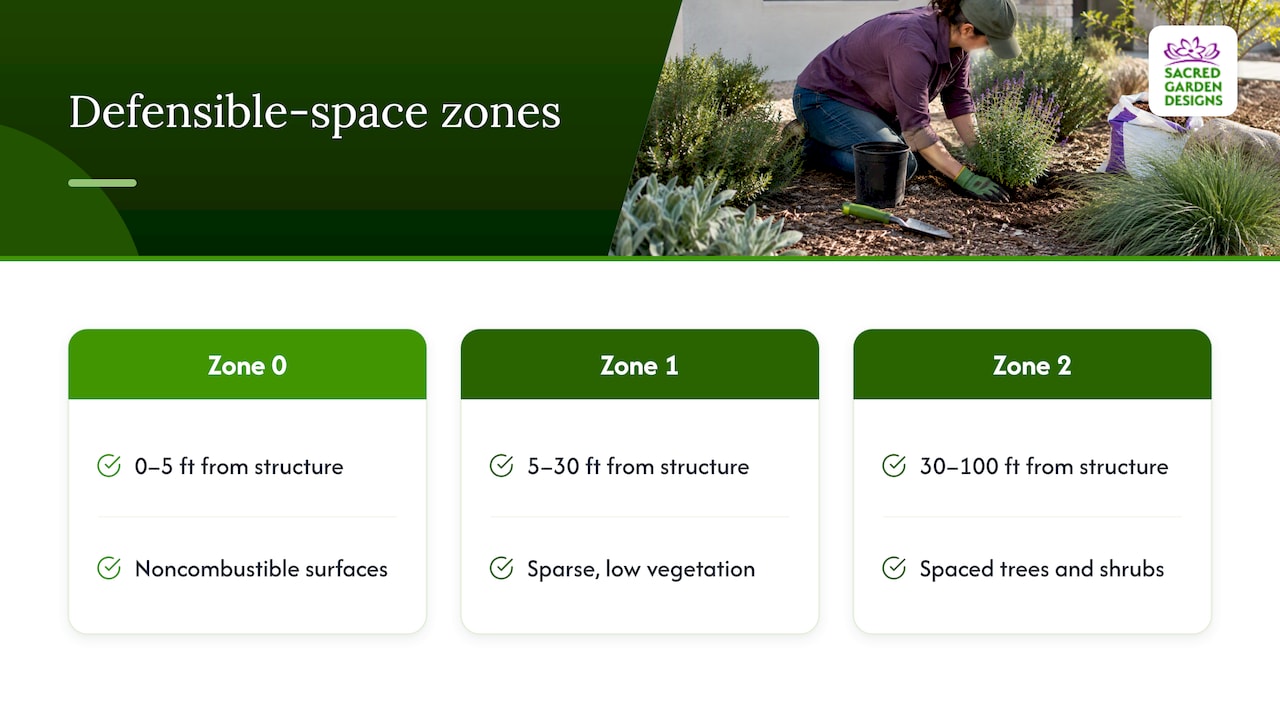
Zone 0: the first 5 feet
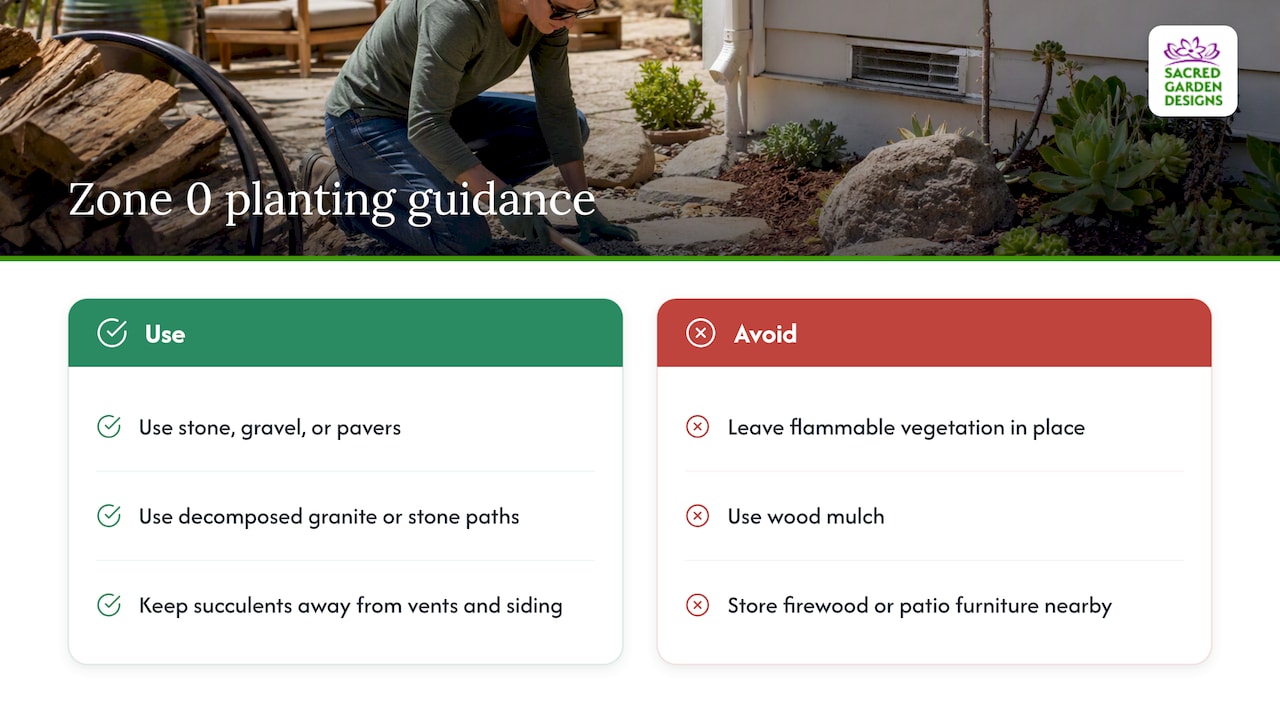
The Washoe County defensible space guide calls for stone, gravel or pavers here, and for removing flammable vegetation, wood mulch and stored combustibles such as firewood and patio furniture. Ashland, Oregon says the same for the first 5 to 10 feet, and includes decks and outbuildings.
If you live in California, this zone is becoming a legal matter. The Board of Forestry and Fire Protection says state law (AB 3074 and SB 504) requires it to establish an ember-resistant zone in the first 5 feet around a structure, known as Zone 0. Rulemaking was being developed through a special advisory committee, so check the Board’s page and your local fire authority for the current requirements before you build.
What to put here: pavers, decomposed granite, gravel, a stone path, a few pots of succulents kept away from vents and siding. If you are planning a patio, our guide to decomposed granite patio edging covers a durable build.
Zone 1: 5 to 30 feet
This is the lean, clean and green zone. Keep vegetation sparse, remove dead material and leaf litter, and favor high-moisture, low-growing plants. The Washoe County guide suggests irrigated, non-resinous plants under 18 inches tall where you do plant, arranged as discontinuous islands. Think of the plants in the table above, or the local equivalents of low succulents, bulbs, irises and flowering perennials, set in beds that gravel paths or walls separate from one another.
Trees can stay if you manage them. Prune lower limbs so fire cannot climb from the ground into the canopy, and keep shrubs from growing up under them.
Zone 2: 30 to 100 feet
Here you can use larger shrubs and trees, spaced so that crowns do not form a continuous bridge. Thin out dense growth, clear dead wood and keep grass short. In Los Angeles, brush clearance can reach further than 100 feet. We cover brush clearance requirements in Los Angeles separately, and our 0 to 100 ft defensible space guide walks through each band.
Maintenance is the other half
UC Cooperative Extension and the Montana guidance agree on a point many homeowners miss: a perfect plant list fails without upkeep. Plan on these habits:
- Remove dead growth from shrubs, perennials and groundcovers every season.
- Rake leaf litter and needles out of beds, gutters and the base of walls.
- Prune lower tree limbs and keep shrubs from touching them.
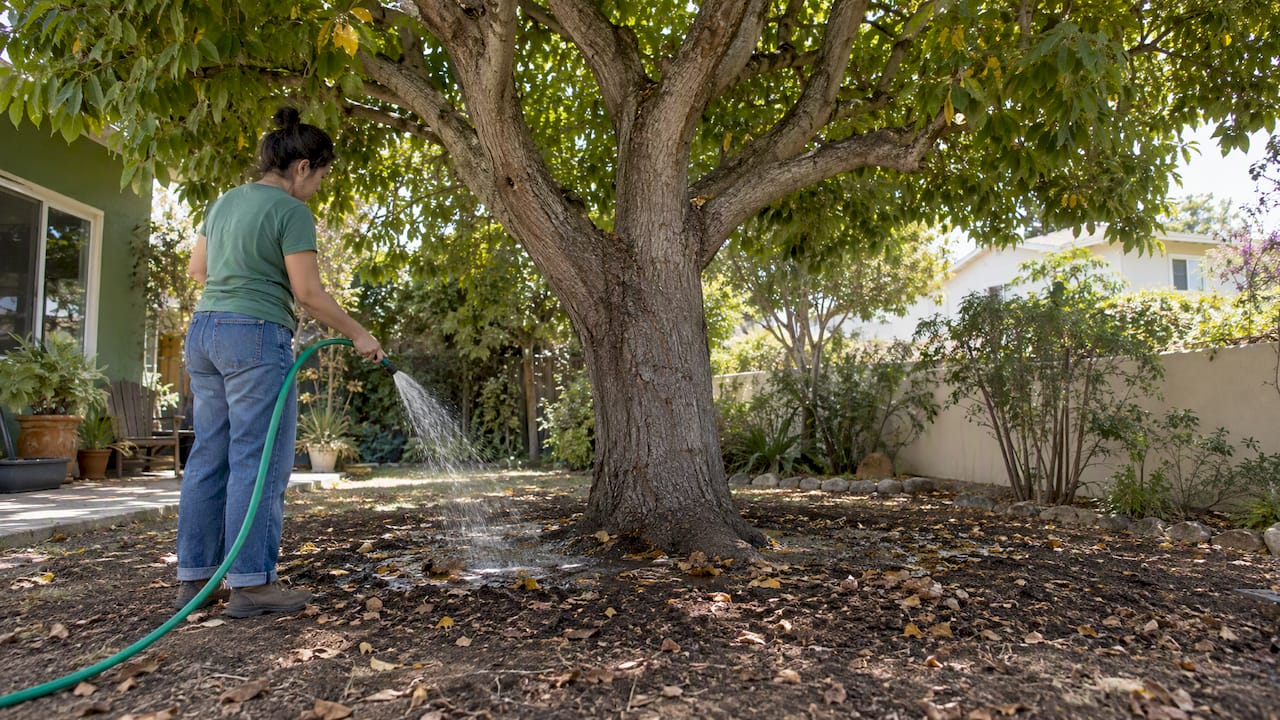
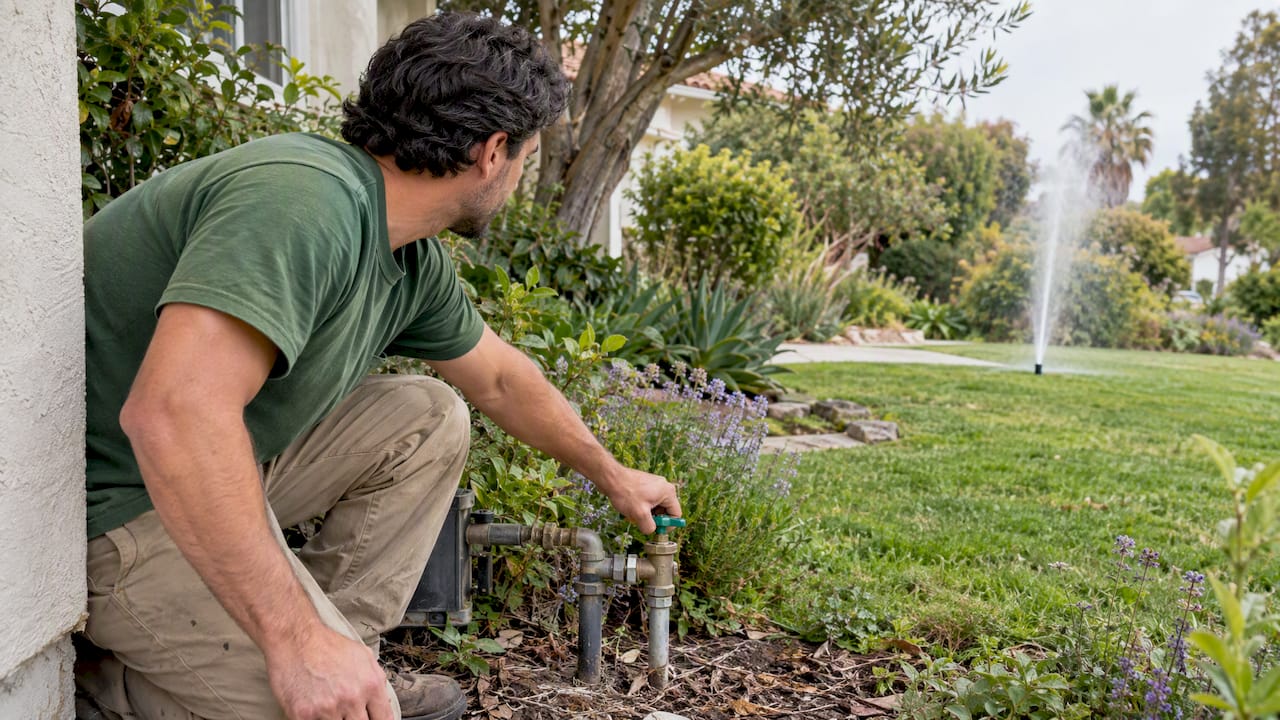
- Water on schedule. Moisture in the plant is what makes it resistant. Drought stress undoes the rating. In Los Angeles, our irrigation schedule guide explains the watering rules, and deep root watering keeps plants healthy without waste.
- Move firewood, furniture and trash bins away from the house.
A good rhythm helps. Our garden maintenance schedule is built around frost dates rather than fixed calendar days.
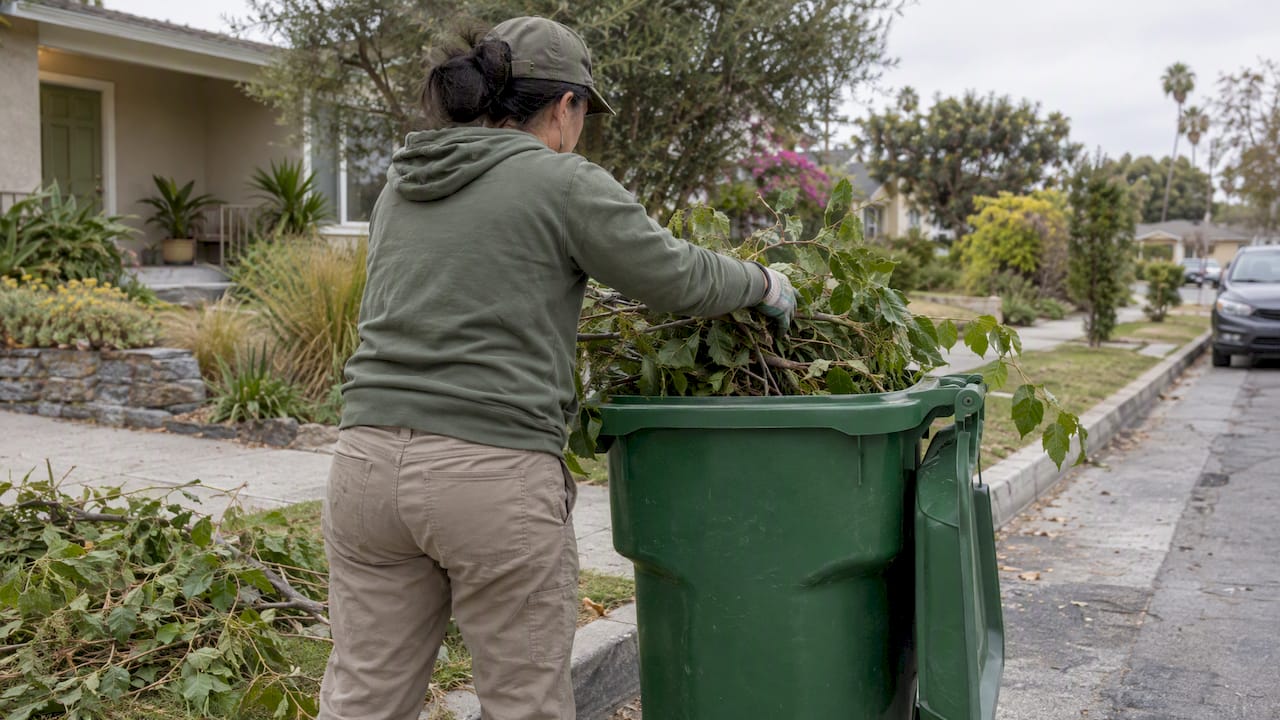
For larger jobs, such as overgrown lots, dead brush piles or heavy debris, hiring a crew makes sense. Services like land clearing and debris removal cover selective clearing and hauling that reduce wildfire fuels in the yard. In Los Angeles, see our guide to yard waste disposal options for where the cuttings can legally go.
Our perspective
We have designed water-wise landscapes in Los Angeles for more than 25 years, and the fire conversation has changed what we draw. Ten years ago, clients asked us for drought-tolerant plants. Now they ask whether those plants will burn.
Our view is simple. Start from the structure and work outward. The first 5 feet should be hardscape. The next 25 should be low, irrigated and broken into islands. Beyond that, use native plant communities suited to your slope and soil, because deep roots and local adaptation give you resilience after a fire as well as before it. Treat any plant list, including ours, as a shortlist to verify with your local fire authority and extension office, since ratings differ by region.
We also push back on the idea that safety means ugliness. Stone walls, gravel paths, patios and dry creek beds are some of the best features in a garden. They are also the firebreaks.
— Denise Buchanan
Plan it with us
If you want a plant palette and layout drawn for your own lot, our design team can do it. Landscape design for yards under 5,000 sq. ft. is $1,500, and full landscape design is $2,500, as published on our landscape design services page. We also handle irrigation, hardscape, slope work, tree trimming, clean-up and haul-away and garden maintenance. See everything on our services page, or start with an initial landscape consultation.
FAQ
What are the best firewise plants for near a house?
Low, high-moisture, non-resinous plants such as succulents, stonecrops and irises, kept irrigated and under about 18 inches tall in the closest zones. Beyond the first 5 feet, choose from a regional list, since ratings depend on climate. Ask your county extension office or fire authority for the list that fits your area.
Are drought-tolerant plants automatically fire resistant?
No. Some store water and resist fire, while others, like sage and many conifers, carry oils that burn hot. Check each plant for moisture, scent and dead-material buildup before you choose it.
Can I plant anything within 5 feet of my house?
The safest approach is nothing flammable: use stone, gravel or pavers, and remove wood mulch and stored combustibles. California is establishing a formal Zone 0 rule, so check the Board of Forestry page and your local fire department for current requirements.
Is firescaping the same as firewise landscaping?
The terms are used for the same idea: shaping plants, spacing and hardscape to slow fire and resist embers. The practice combines plant selection, zones, and regular maintenance.
Sources
- Living with Fire Defensible Space Guide, Washoe County
- Design Your Landscape to Defend Your Home, Idaho Firewise
- Firewise Plant Materials, Colorado State University Extension
- Firewise: Fire Resistant Plants, UC Cooperative Extension
- Ignition Resistant Construction, Jefferson County, MT
- Wildfire Resistant Plants, Loyola Marymount University
- Landscaping with California Native Plants, UC
- Protecting and landscaping homes in the wildland/urban interface, USDA Forest Service
- Landscaping in the Immediate Zone, Ashland, OR
- Defensible Space Zones 0, 1 and 2, California Board of Forestry