To care for a tree in a drought, water it deeply and rarely instead of lightly and often. Aim the water at the dripline and soak the soil 12 to 18 inches down. Water early in the morning, keep mulch off the trunk, and skip fertilizer and heavy pruning until the rain returns. A tree can take years to recover from a dry season, and a mature tree can be lost in one, so the effort is worth it.
This guide covers how much water, how often, how to tell whether a tree is thirsty, and which well-meant habits do harm.
TL;DR
- Soak the soil 12 to 18 inches deep at the dripline, not at the trunk. Mature trees need this about every 3 to 4 weeks in extended dry spells, according to La Verne, California.
- Newly planted and young trees need 5 to 15 gallons once or twice a week to establish roots.
- Check the soil with a screwdriver before you water, and water before 9 a.m. to cut evaporation.
- Do not fertilize, and do not prune live branches during a severe drought.
- Keep mulch off the trunk, and check local watering rules first. Where rules are strict, prioritize trees over lawn.
Table of Contents
- Why mature trees still need help in a drought
- Signs your tree is drought stressed
- How much water, and how often
- Follow local watering rules, and put trees first
- Mulch: your best ally, if you apply it right
- What not to do during a drought
- Newly planted trees: the first three years
- A simple weekly routine
- Design a yard that needs less rescue
- Our perspective
- Get a plan for your trees and yard
- FAQ
- Sources
Why mature trees still need help in a drought
Many homeowners assume an old tree can look after itself. Extension specialists at the University of Florida say that extended droughts can cause decline and death in young and mature trees, and that even trees over a hundred years old can decline. The same source notes that thinning and leaf drop tend to begin at the top center of the canopy.
The damage is slow and hard to see. By the time the crown looks sparse, the roots have often been short of water for weeks or months. That is why a watering plan beats a rescue plan.
The outlook matters too. NOAA’s seasonal assessment, summarized in an August 2026 report, says drought is likely to persist or develop across the Southern Plains and High Plains through late October 2026. Trees that go into winter stressed carry that stress into next spring, so fall watering counts.
Signs your tree is drought stressed
Look at the tree every week in dry spells. The Alabama Cooperative Extension System lists the stages you will see:
- Temporary wilting. Leaves droop in the afternoon and recover overnight. This is an early warning.
- Permanent wilting. Leaves are still limp in the early morning. Water now.
- Yellowing or early fall color. The tree is shedding leaves it cannot support.
- Leaf scorch. Edges turn brown and crisp.
- Leaf drop from the top and branch tips. The tree is cutting its losses.
- Bark cracks. Seen in prolonged droughts, especially on thin-barked species.
The Illinois Department of Natural Resources adds a sparse canopy of small, off-color leaves to the list.
Can a dehydrated tree be saved?
Often, yes, if enough living tissue remains. Start deep watering at once and hold off on any pruning or feeding. A tree with green tissue under the bark of a twig and some live buds has a chance. A tree with brittle, dry twigs throughout and no buds is much harder to save. If the tree is large or near your house, have a certified arborist look at it before you decide to keep it or remove it.
How much water, and how often
There is no single schedule that fits every yard, because soil, species, age and heat all change the answer. These figures from the city of La Verne, California give a sound starting point:
| Tree type | Amount and depth | Frequency |
|---|---|---|
| Newly planted or young (0 to 3 years) | 5 to 15 gallons per watering | 1 to 2 times per week |
| Established, mature | Soak soil 12 to 18 inches deep | Every 3 to 4 weeks in extended dry periods |
Source: City of La Verne, Caring for Your Trees During a Drought.
Two habits make these numbers work.
Water at the dripline, not the trunk. The roots that take up water spread out to and beyond the edge of the canopy. Water poured at the trunk mostly soaks roots that do little drinking and can keep bark too wet.
Go slow. Fast water runs off, especially on slopes and compacted clay. A soaker hose, drip emitters, or a hose at a trickle lets water sink in. We cover tools and a simple sizing rule in our guide to deep root watering, which uses a gallons-per-inch-of-trunk approach.
Use the screwdriver test before you water
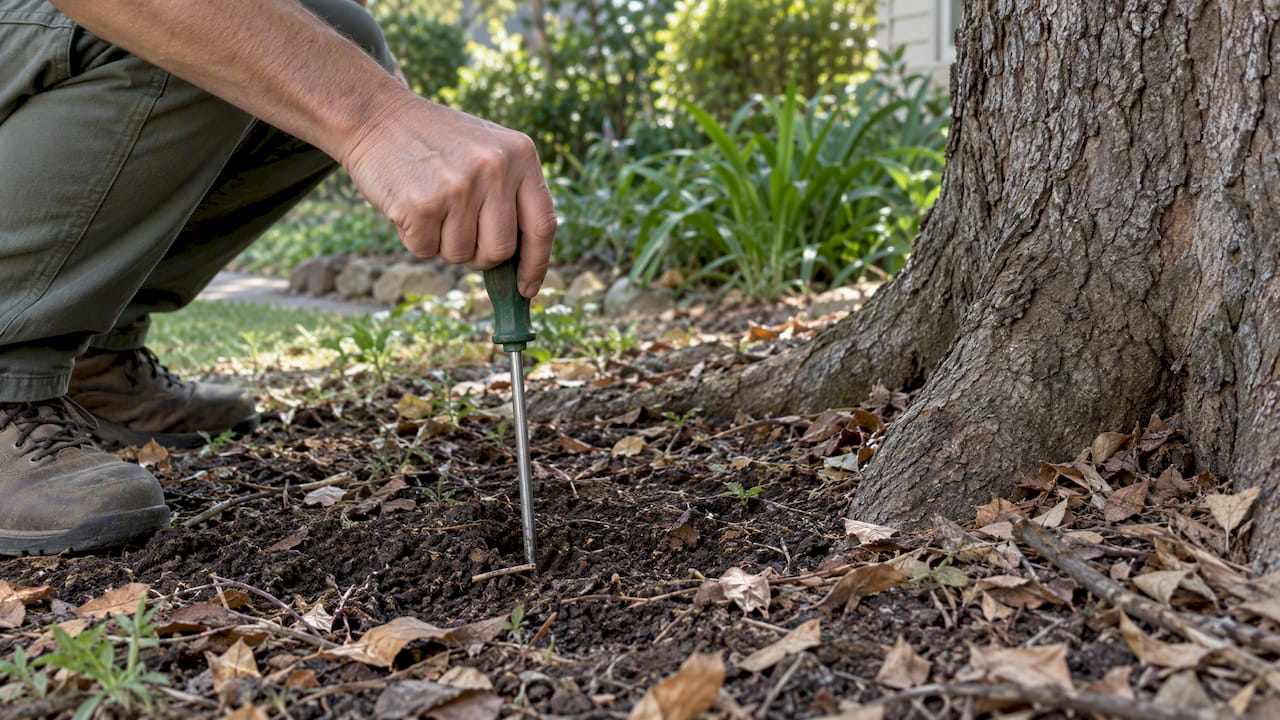
Texas A&M Forest Service describes a low-tech check: push a long screwdriver into the soil. If it slides in easily to 6 to 12 inches, the soil still has moisture. If it resists, the soil is dry and it is time to water. The method is explained on its page about watering trees during drought. It beats a calendar, since a cool week or a rain shower can push the next watering back.
Time of day
Water early, ideally before 9 a.m., to lose less to evaporation. The Texas A&M page says you can water at any time, but that you should avoid the hottest part of the day if you can. Late evening is workable, though foliage that stays wet overnight can invite disease on some species.
Follow local watering rules, and put trees first
Restrictions vary by city, so check your water provider before you set a timer. In Los Angeles, for example, LADWP’s ordinance limits outdoor watering to three days a week, by address: odd numbers on Monday, Wednesday and Friday, even numbers on Sunday, Tuesday and Thursday. All outdoor watering is banned from 9 a.m. to 4 p.m. Runoff onto streets and driveways is not allowed. Hand watering with a self-closing nozzle is allowed any day, before 9 a.m. or after 4 p.m.
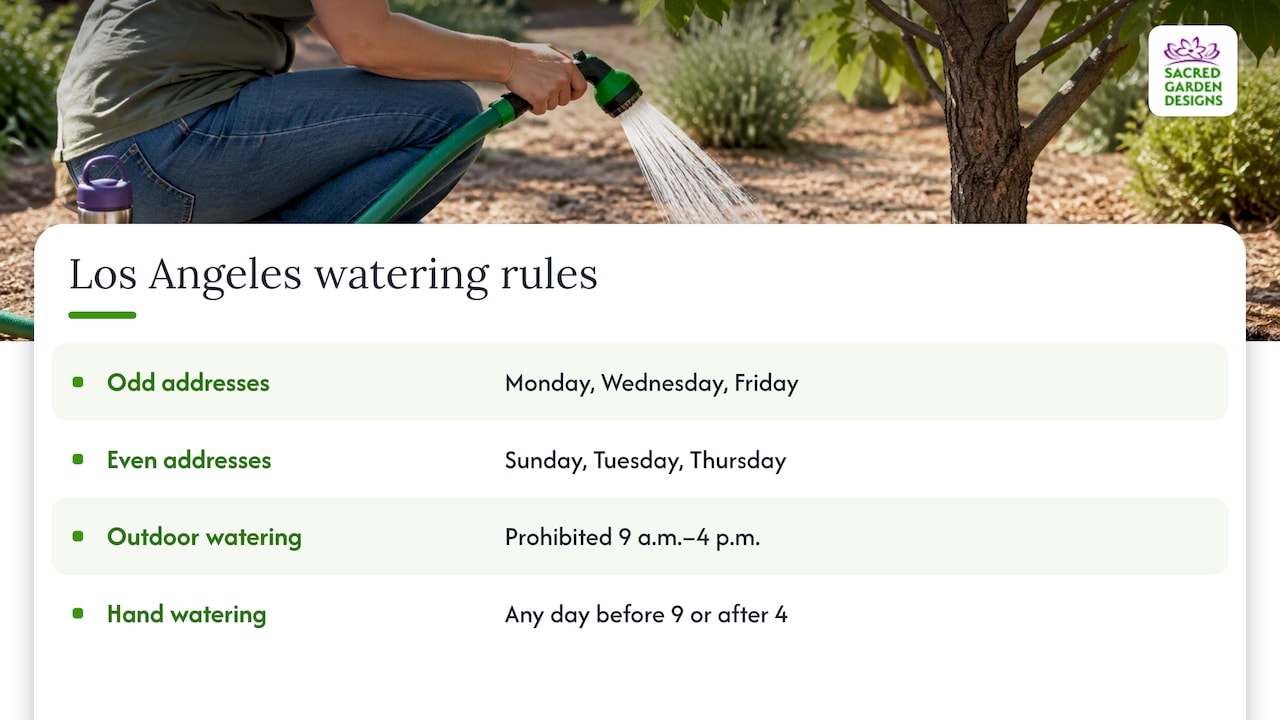
Those rules are specific to Los Angeles. Other cities have different days and hours. Our page on Los Angeles irrigation schedules walks through how to fit a program inside them.
A good rule when water is tight: give up the lawn before the tree. Grass comes back in a season. A mature tree takes decades. Texas A&M notes that established trees are a high-value investment in a community and deserve priority for supplemental water even during restrictions. If a hose is off limits on your watering day, drip lines on a timer are often the way to meet both the rules and the tree’s needs.
Watering the right way also means cutting waste elsewhere. If you want to see how design choices lower overall demand, these water conservation design tips show how efficiency can be planned in from the start, which frees up supply for the trees that matter most.
Mulch: your best ally, if you apply it right
Mulch slows evaporation, keeps roots cooler and builds soil. La Verne’s checklist recommends a layer of organic mulch about 2 to 4 inches deep. The pitfall is thickness and placement. A deep, matted layer can shed light rain and irrigation, and mulch piled against the trunk holds moisture on the bark. La Verne advises keeping a 4 to 6 inch gap of bare soil between mulch and trunk, and checking soil moisture before you water.
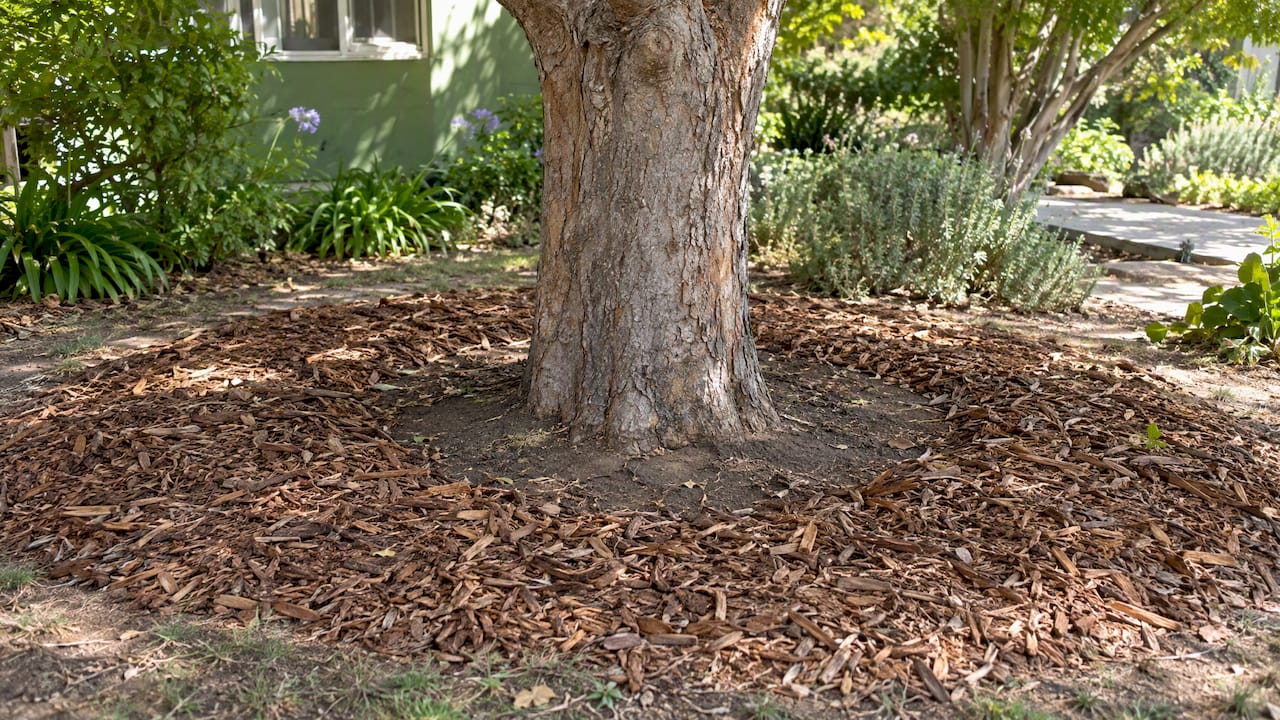
To choose between wood chips, shredded bark and other materials, see our comparison of mulch types for drought.
What not to do during a drought
Do not fertilize
Forestry experts at Texas A&M advise against fertilizing in drought. The tree has to spend water and energy to process nutrients, and fertilizer salts can pull moisture away from the roots. Wait until the tree has had normal moisture for a season.
Do not prune live branches
The Virginia Department of Forestry’s tree care guidance says arborists discourage pruning live branches in severe drought. Pruning removes living tissue, makes the tree spend energy on wound healing, and cuts the leaf area it needs to rebuild. Dead, broken or hazardous limbs are the exception: they can come out at any time, and a limb that threatens your roof or a walkway should be handled by a qualified arborist. When conditions ease, our notes on when and how to prune cover timing.
Do not water shallowly and often
A daily sprinkle wets the top inch and trains roots toward the surface, where they dry out first. The deep, infrequent soak is what builds drought resilience.
Do not disturb the root zone
Trenching, grade changes, or paving over the roots add to the stress a tree is already under. If you plan a patio or retaining wall, plan around the canopy edge.
Newly planted trees: the first three years
Young trees have small root systems and no reserves. La Verne’s 5 to 15 gallons once or twice a week is the target for trees up to three years old. Build a shallow basin around the planting area to hold water, and check that it drains within a few hours instead of sitting for a day.
If you must plant during a dry year, fall is gentler than summer for most regions. Pick species suited to your climate and water supply. For shaded, dry corners under existing trees, see our list of dry shade plants that coexist with tree roots without demanding much extra water.
A simple weekly routine
- Walk the yard. Check the top of each canopy and the leaf edges for the signs above.
- Run the screwdriver test at the dripline of each tree, 6 to 12 inches deep.
- Water only if the soil is dry. Soak slowly at the dripline, early in the morning, inside any local rules.
- Check the mulch. Keep it 2 to 4 inches deep and clear of the trunk by 4 to 6 inches.
- Note what you see. A photo each week of the crown makes slow changes easier to spot.
- Call an arborist if more than a small part of the canopy has dropped leaves, bark is splitting, or you see sudden dieback.
Design a yard that needs less rescue
The best drought tree care starts before the drought. Trees compete with lawn for water, and lawn usually wins at the surface. Replacing turf under and around trees with deep-rooted, low-water plantings reduces that competition. Our guides to drought tolerant landscaping and lawn alternatives show how homeowners cut irrigation while keeping a yard that works for pets, kids and shade.
Trees are also worth protecting for what they do for a neighborhood. We summarize the evidence in trees for climate modification, including how canopy lowers urban heat.
Our perspective
For more than 25 years we have designed landscapes in Los Angeles and beyond where water is the limiting factor, and the same pattern shows up on nearly every site. The tree is rarely the problem. The irrigation is. A spray zone built for lawn waters the grass every few days and barely wets the soil under the canopy, so the tree gets either too little or the wrong kind of water.
We think of the tree as the anchor of the plan, and everything else is arranged around its needs. That means drip or bubbler lines at the dripline on their own valve, a measured mulch layer, and groundcovers that do not compete with the roots. It also means setting a deep-soak schedule that fits local watering days, so you stay within the rules and the tree still gets what it needs.
If you take one idea from this article, let it be this: check the soil, not the calendar. A screwdriver and ten minutes a week will save more trees than any product.
— Denise Buchanan
Get a plan for your trees and yard
If your trees are struggling, or you want an irrigation layout that serves them properly, we can help. Sacred Garden Designs offers an initial landscape consultation, irrigation design and installation, expert tree trimming, garden maintenance and slope stabilization. See everything on our services page.
If you want a full plan for your yard, our landscape design services are priced at $1,500 for yards under 5,000 sq. ft. and $2,500 for a full landscape design, both one-off fees.
FAQ
How often should I water a tree during a drought?
Mature trees generally need a deep soak every 3 to 4 weeks in extended dry periods, while young trees up to 3 years old need 5 to 15 gallons once or twice a week, per La Verne’s guidance. Use the screwdriver test to confirm the soil is dry before each watering. Hot, sandy or sloped sites may need water sooner.
What is the best time of day to water trees?
Early morning, before 9 a.m., loses the least water to evaporation. Late evening works if you must, but avoid the hottest part of the day. Always check your city’s rules first, since many limit hours and days.
Should I prune or fertilize a drought-stressed tree?
No, not unless a limb is dead or dangerous. Pruning live branches removes leaf area the tree needs, and fertilizer forces it to use water and energy it cannot spare. Wait until normal rainfall or steady irrigation returns.
Do mature trees need water if they look fine?
Yes, in a long drought. Water stress is often invisible until it is advanced, and the first sign is usually thinning at the top center of the canopy. A deep soak every few weeks can prevent decline that is hard to reverse.
Sources
- Caring for Your Trees During a Drought, City of La Verne, CA
- Watering Trees During Drought, Texas A&M Forest Service
- Drought and Landscape Trees, Alabama Cooperative Extension System
- Watering Trees, Illinois Department of Natural Resources
- Tree Care, Virginia Department of Forestry
- Water Conservation & Ordinance, LADWP
- NOAA outlook keeps much of U.S. tilted toward heat through October