A resilient city is an outcome, not a purchase: institutional leadership, prioritized investment, and integrated green and gray infrastructure working together against both sudden shocks and slow-building stresses. Three priorities matter most right now: build cross-department coordination that outlasts election cycles, direct funding toward projects with the highest combined impact and equity value, and blend nature-based systems with engineered infrastructure rather than choosing one over the other. Frameworks, financing tools, and real examples follow below.
TL;DR:
- Cross-department coordination and leadership roles, such as a Chief Resilience Officer, are critical for sustained resilience efforts beyond political cycles.
- Investing in a mix of gray infrastructure retrofits, nature-based solutions, and smart land use reduces exposure to shocks and long-term stresses efficiently.
- Resilience funding should prioritize existing revenue tools, municipal borrowing, and low-cost solutions, with cities mainstreaming resilience into routine capital plans.
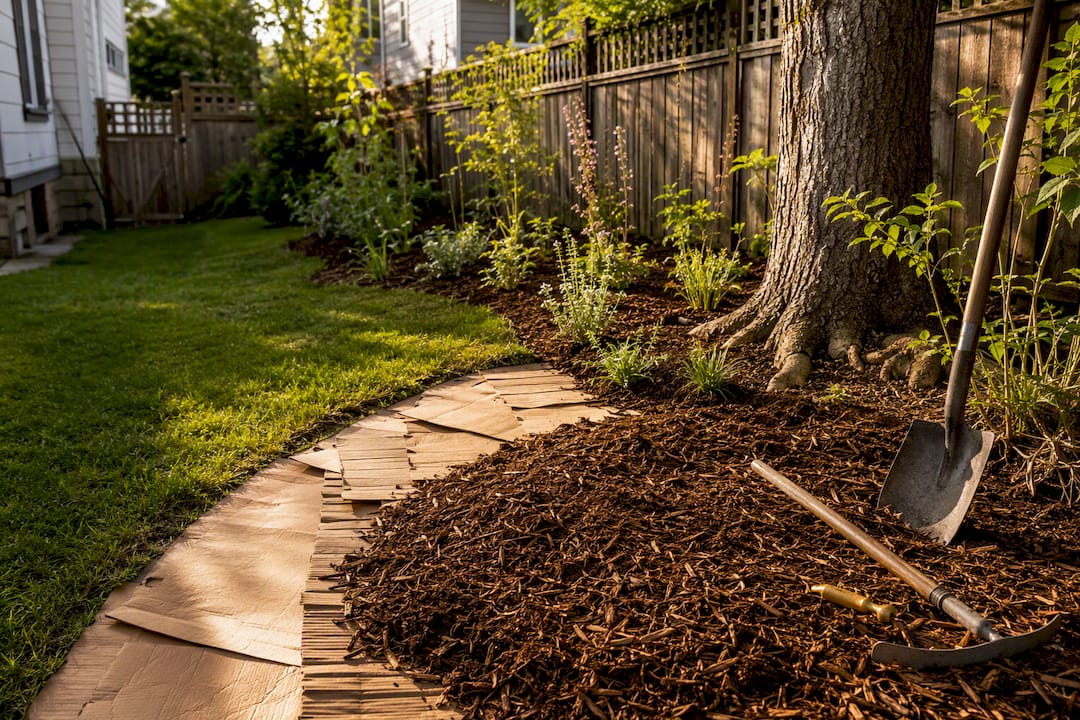
- Small pilot projects like rain gardens and permeable paving provide quick, visible benefits that help build political support for larger infrastructure investments.
- Tracking concrete outcomes such as recovery time, service continuity, and equitable benefits is key for guiding resilience projects and justifying continued investment.
Table of Contents
- What defines a resilient city and which frameworks practitioners use
- Infrastructure, nature-based solutions, and land use that reduce exposure
- Funding, financing, and efficiency strategies for resilient investment
- Case studies showing different resilience pathways
- A monthly checklist for planners ready to act
- What landscape design practice teaches about urban resilience
- A landscape partner for resilience-focused projects
- Sources
- FAQ
What defines a resilient city and which frameworks practitioners use
Resilience describes a city’s capacity to keep functioning, and to recover quickly, when hit by acute shocks like floods or heat waves and chronic stresses like aging pipes or entrenched inequality. Practitioners at the Resilient Cities Network describe resilience as something built through leadership and cross-silo capacity, not something a city buys off a shelf. That framing matters because it shifts attention from single infrastructure fixes toward institutional habits: budget rules, planning processes, and who has authority to act during a crisis.
Chronic stresses deserve equal billing with dramatic events. Practitioner guidance consistently notes that resilience outcomes depend on addressing inequality and deferred maintenance alongside storms and floods, since the two compound each other when a shock hits an already-strained system.
Common indicators practitioners track include:
- Time to restore critical services after a disruption
- Share of population within walking distance of green space or cooling centers
- Percentage of infrastructure assets past their design life
- Number of departments with a formal role in resilience planning
Infrastructure, nature-based solutions, and land use that reduce exposure
Technical strategy splits into a few connected categories, and the strongest city plans treat them as one system rather than a menu of separate projects.
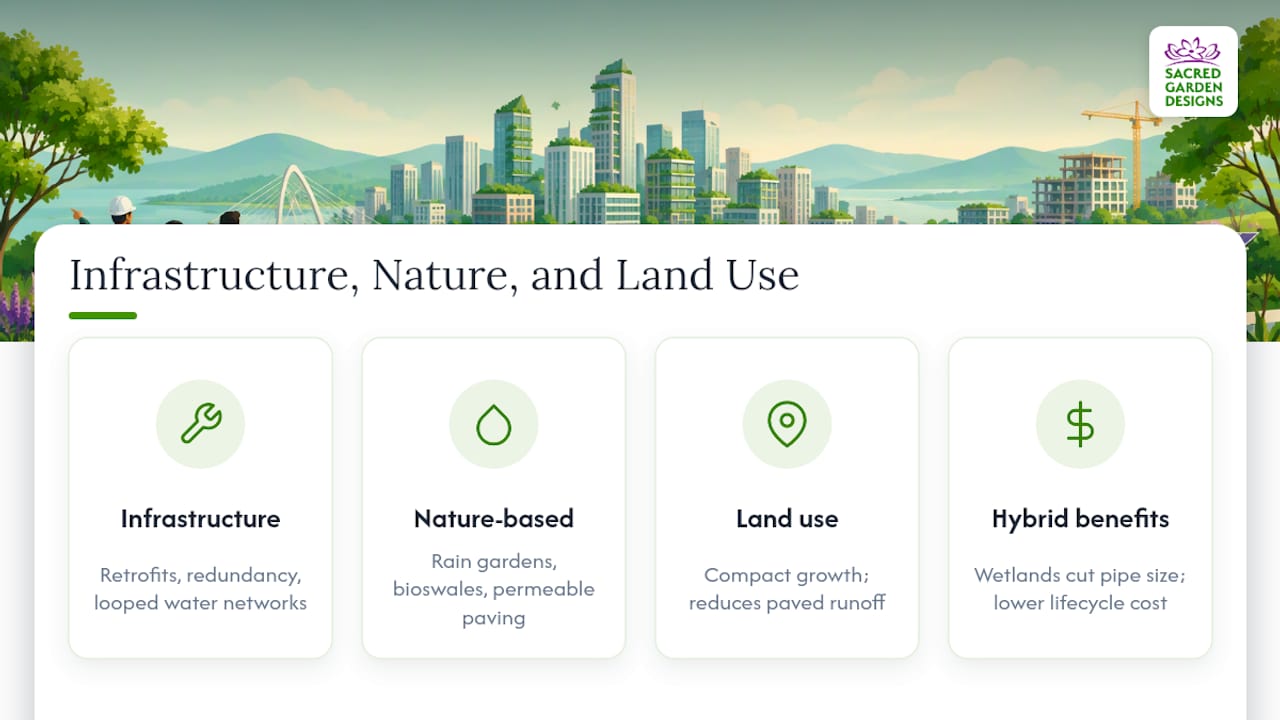
Infrastructure resilience starts with retrofits and redundancy: reinforcing bridges, adding backup power to water treatment plants, and building looped rather than single-point water networks so one failure does not cascade. Maintenance budgets often get cut first when city finances tighten, which is precisely backward since deferred maintenance is what turns a manageable storm into a multi-week outage.
Nature-based solutions add capacity where gray infrastructure alone falls short. Rain gardens, bioswales, and permeable paving absorb stormwater at the source, while tree canopy lowers surface temperatures in neighborhoods that lack shade. A partner resource on stormwater studies walks through how engineers scope drainage and permeable-surface projects, useful groundwork before committing capital.
Land use and transport choices shape long-term exposure: compact growth patterns keep development out of floodplains and reduce the paved surface area that generates runoff. Building-level measures, such as reflective roofing and passive cooling design, cut heat risk for residents without new infrastructure.
Hybrid green and gray systems tend to lower lifecycle costs, since a well-placed wetland can reduce the size, and expense, of the pipe network built to handle the same storm.
Pro Tip: Pilot a nature-based intervention on one block before scaling citywide. Small, visible wins build the political support larger infrastructure budgets need.
Funding, financing, and efficiency strategies for resilient investment
Money is the recurring bottleneck. The World Bank estimates that resilient and low-carbon urban investments in low- and middle-income countries will require between $256 billion and $821 billion annually through 2050, a range equal to a small single-digit percentage of GDP in those countries. The same World Bank analysis argues that climate investments should be treated as core urban investments, funded through better municipal finance rather than as a separate, optional category.
That guidance breaks into three levers: funding through own-source revenues, user fees, and land value capture; financing through municipal borrowing, blended finance, and green bonds; and efficiency gained by improving spatial coordination and prioritizing lower-cost transport and nature-based flood solutions over expensive engineered alternatives. Cities that mainstream resilience into routine capital planning, rather than chasing separate climate grants, tend to unlock funding faster and face less implementation friction.
Governance ties the financial pieces together. Cities with a Chief Resilience Officer or an equivalent standing leadership role are more likely to see resilience strategies actually implemented, since that role survives political turnover and keeps departments coordinated.
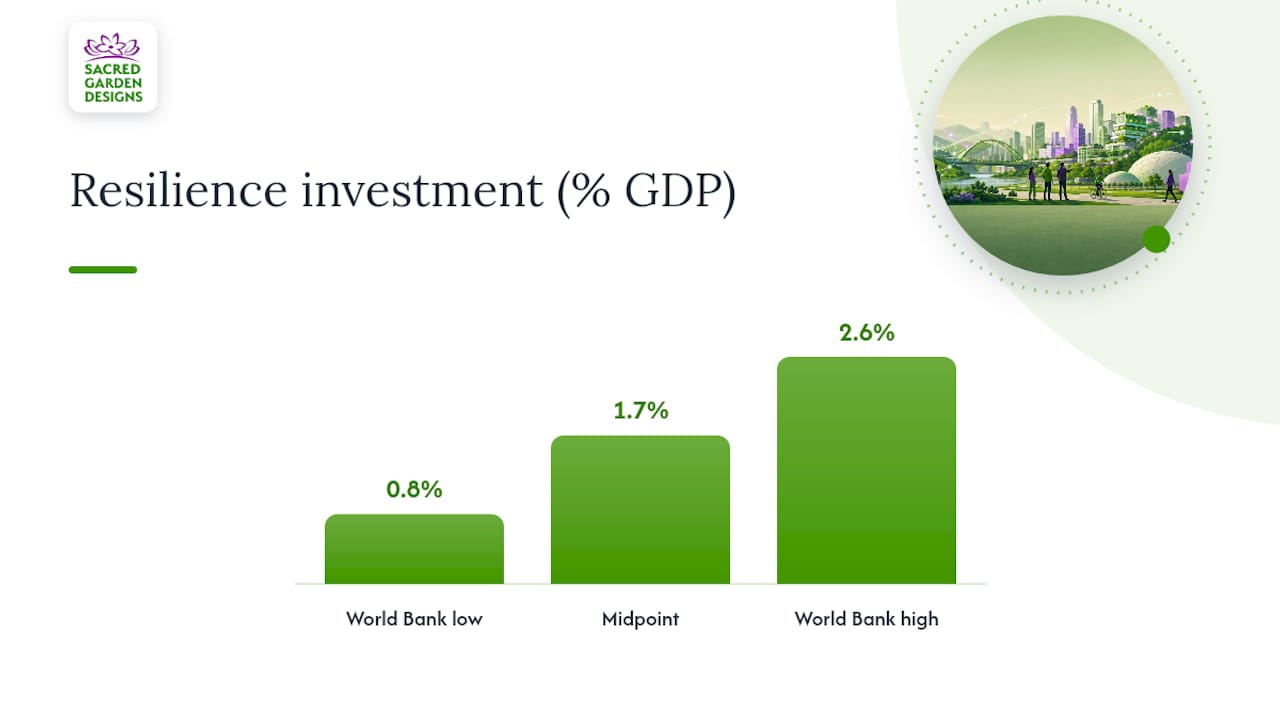
Roughly 0.8% to 2.6% of GDP in annual investment is what the World Bank projects low- and middle-income countries need for resilient, low-carbon urbanization through 2050, a scale that makes resilience a mainstream budget item rather than a side project.
A short checklist for evaluating a proposed project:
- Does it strengthen a core service (water, power, transport) rather than duplicate it?
- Can it draw on existing revenue tools, like land value capture, before new borrowing?
- Does it score well on impact, feasibility, and equity when weighted together?
- Is there a named owner accountable for its outcome past the current budget cycle?
Case studies showing different resilience pathways
Different cities reach resilience through different combinations of governance, finance, and technical design.
- Network-supported coordination: Cities affiliated with the Resilient Cities Network, the successor to the Rockefeller Foundation’s 100 Resilient Cities initiative, used a dedicated resilience leadership role to align departments and attract outside funding for infrastructure upgrades, a governance-first pathway.
- Landscape-led stormwater management: Cities that paired rain gardens and bioswales with zoning changes reduced localized flooding cheaply, using nature-based design as the primary lever rather than new pipes.
- Engineered retrofit with measurable outcomes: Cities that reinforced water and power systems against outages tracked recovery time as their core metric, using measurable service continuity to justify continued capital spending.
The lesson across all three: the mechanism differs, but each pathway paired a clear governance owner with a financing tool suited to the project’s scale, and each tracked a concrete outcome rather than treating the project as complete once built.
A monthly checklist for planners ready to act
Momentum starts with small, visible steps rather than a citywide overhaul.
- Run a risk audit identifying the three infrastructure systems most likely to fail under stress.
- Form a cross-department task force with named leads from planning, public works, and finance.
- Launch one small pilot, a rain garden, a retrofit, or a coordination drill, within 90 days.
- Protect existing maintenance budgets before approving new capital projects.
- Score candidate projects on impact, feasibility, and equity, then sequence the highest scorers first.
Monitoring should stay simple: track service continuity during disruptions, time to recovery, and whether benefits reach lower-income neighborhoods as reliably as wealthier ones.
Pro Tip: Trees, permeable paving, and small-scale irrigation upgrades deliver visible cooling and drainage benefits within a single growing season, making them useful early wins while larger infrastructure financing gets arranged.
What landscape design practice teaches about urban resilience
Sustainable landscaping lowers surface temperatures and slows stormwater runoff at the neighborhood scale, benefits that compound when paired with community stewardship rather than left to a single planting event. Projects that last require binding maintenance commitments: a rain garden without an accountable caretaker degrades within a few seasons, undoing the resilience gain it was built to provide.
— Denise Buchanan
A landscape partner for resilience-focused projects
Municipal pilots and community resilience projects often need a design and installation partner who understands water-wise planting, irrigation efficiency, and slope stabilization at the neighborhood level. Sacred Garden Designs offers sustainable landscape design and installation, irrigation system design, slope stabilization, and workshops for community groups building local maintenance capacity.

Readers exploring implementation support for a resilience pilot can review current landscape design services to scope a project.
Sources
- Banking on Cities: Investing in Resilient and Low-Carbon Urbanization
- Banking on Cities (detailed report/workbook)
- City Resilience Framework (Resilient Cities Network)
FAQ
What is a resilient city?
A resilient city is one that keeps essential services running, and recovers quickly, when it faces both sudden shocks like floods and ongoing stresses like aging infrastructure or inequality. The Resilient Cities Network frames this as an outcome built through leadership and coordinated action, not a single infrastructure project.
What was the 100 Resilient Cities program?
100 Resilient Cities was a Rockefeller Foundation initiative that funded Chief Resilience Officer positions and planning support in member cities to build institutional capacity for resilience work. Its approach and network continue through the Resilient Cities Network, which carries forward similar city-support work.
Can you name cities recognized for resilience work?
Cities affiliated with the Resilient Cities Network and the earlier 100 Resilient Cities program have pursued resilience strategies ranging from stormwater-focused nature-based design to engineered infrastructure retrofits. Specific outcomes vary by city and are documented through the network’s own case materials rather than a single ranked list.
What are the core pillars of urban resilience?
Definitions vary across frameworks, but a common version groups resilience into institutional capacity, infrastructure and ecosystems, economic and social systems, and leadership and strategy. The City Resilience Framework organizes these dimensions around outcomes a city needs to withstand shocks and stresses together.
How much investment do resilient cities need?
The World Bank estimates that low- and middle-income countries will need $256 billion to $821 billion annually through 2050 for resilient, low-carbon urban investment, roughly 0.8% to 2.6% of GDP. That estimate covers infrastructure, planning, and municipal finance improvements together rather than any single project category.