The right slope erosion control method depends on how steep the ground is. Plants and mulch handle gentle grades, blankets and mats bridge the gap on steeper ones, and terraces or retaining walls take over where the grade is too steep for roots alone. The lasting fix is a combination: living roots, a covered soil surface and a plan for where the water goes. We design and build exactly that kind of system, from planting to slope stabilization and retaining walls, so you get one coordinated solution instead of a patchwork.
TL;DR
- Measure your slope first. Under 33% (about 3:1), plants and mulch have a good chance of controlling runoff; from 33% to 50%, add blankets or mats until roots establish.
- Above 50% (2:1), the grade needs terraces or retaining walls to flatten it into planting areas.
- Bare soil is the real enemy. Raindrop impact and concentrated runoff do most of the damage, so cover the surface and control where water flows.
- Walls 4 feet or taller generally need a professional engineer’s design and a permit in many jurisdictions. Check with your local building department.
- Combining deep-rooted plants, mulch, drainage and, where needed, structure gives the longest-lasting result.
Table of Contents
- Why slopes erode
- Step 1: Measure your slope
- Step 2: Match the method to the steepness
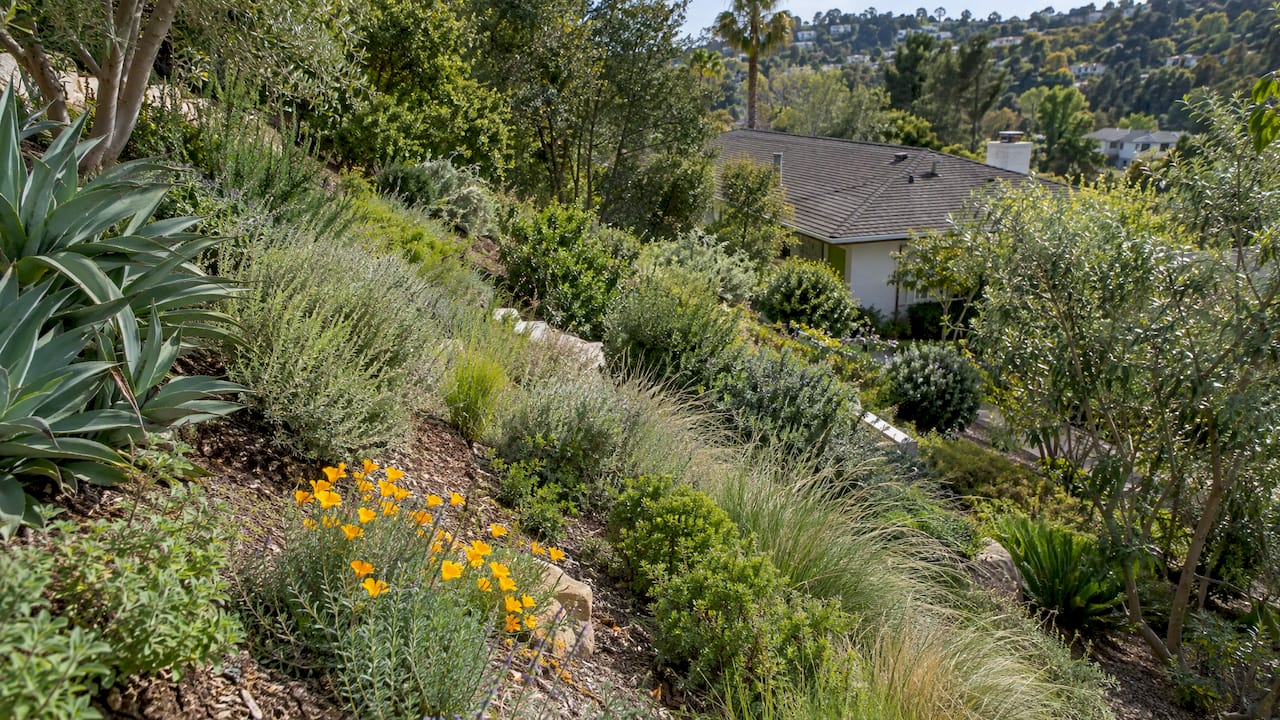
- Plants: the foundation of lasting control
- Mulch: protection while roots catch up
- Blankets, mats and wattles: the middle ground
- Terraces and retaining walls for steep grades
- Steer the water, not just the soil
- Green or gray: what lasts
- A worked example
- Perspective: why the whole system beats a single fix
- Plan your slope with us
- FAQ
- Sources
Why slopes erode
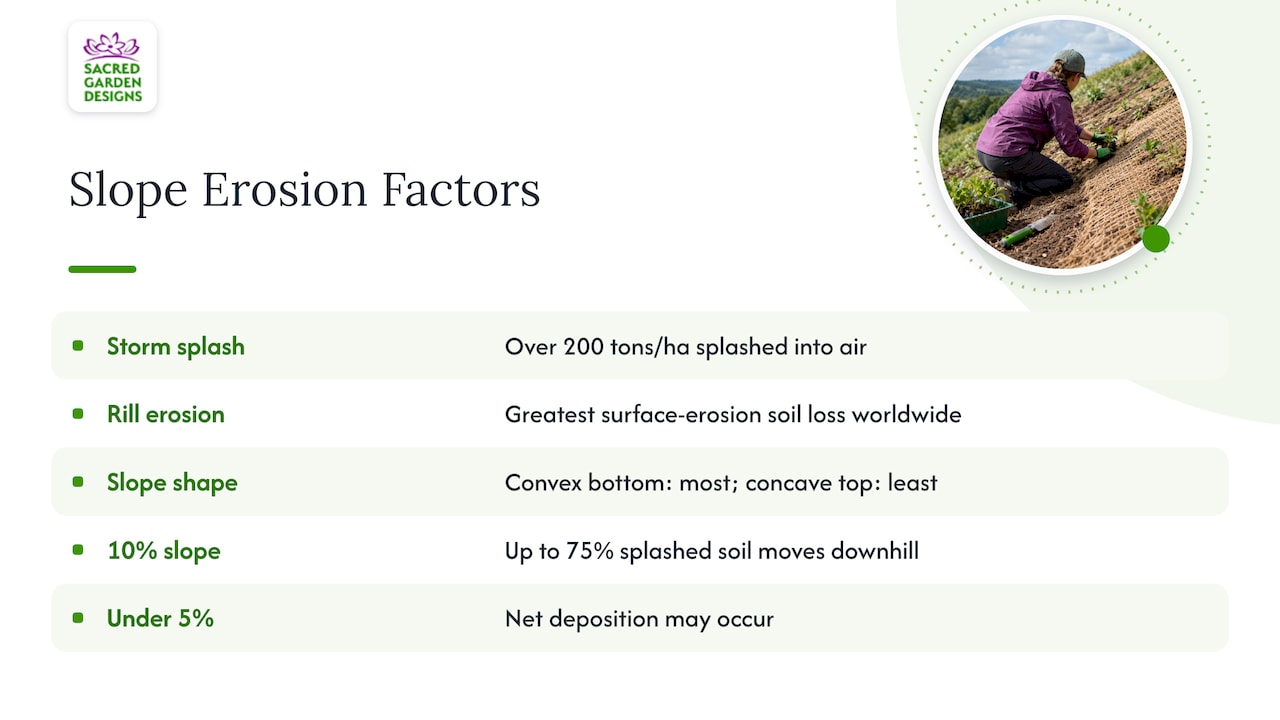
Erosion on a slope starts with rain hitting bare soil. USDA Forest Service research explains that on sparsely vegetated ground, a large storm can splash more than 200 tons of soil per hectare into the air (a hectare is about 2.5 acres). On a slope, the splashed particles travel downhill. The same research notes that rill erosion, the small channels that form when runoff concentrates, is the form of surface erosion responsible for the greatest soil loss worldwide.
Steepness and length both matter. USDA Agricultural Research Service documentation for the Revised Universal Soil Loss Equation says that erosion increases with slope steepness, and that soil loss is greatest on convex slopes that steepen toward the bottom and least on concave slopes that are steep at the top. In plain terms: a hill that bulges outward and gets steeper near the base is the one most likely to lose soil, because water keeps gathering speed and volume as it runs.
Length works through that same gathering effect. Rill erosion grows downslope as runoff accumulates, while raindrop impact is spread evenly. A long slope with no breaks gives water room to build up force. That is why so many fixes, from terraces to wattles to staggered plantings, work by breaking the slope into shorter runs.
A Forest Service review also gives a useful sense of scale. On a 10 percent slope, up to 75 percent of rain-splashed soil can move downhill, while very gentle slopes under 5 percent can see net deposition rather than loss. Even a modest grade moves soil once the surface is bare.
Step 1: Measure your slope
Every guideline below is written in percent or in a ratio, so you need one of the two.
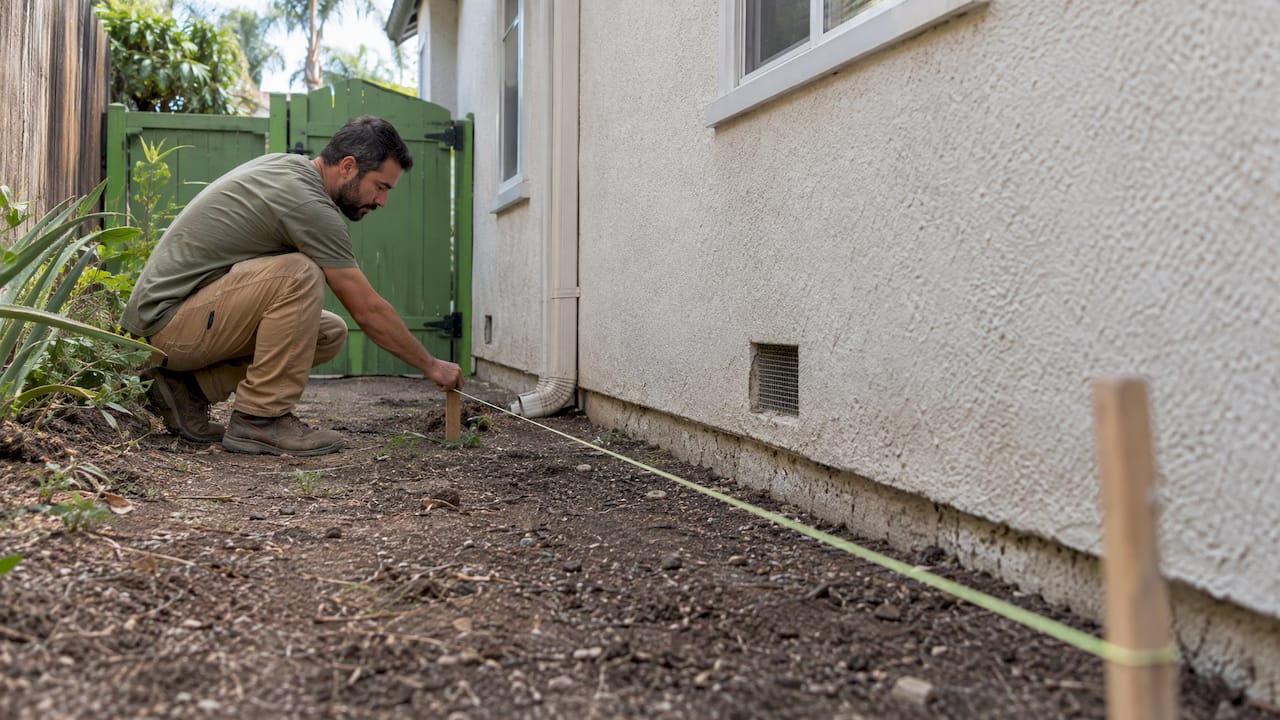
- Drive a stake at the top and the bottom of the slope, or pick two points along the steepest stretch.
- Measure the horizontal distance between them and the vertical drop.
- Divide the drop by the horizontal distance and multiply by 100. A 3-foot drop over 10 feet of run is 30%.
- For a ratio, divide run by rise: 10 feet of run over a 3-foot drop is roughly 3:1.
A 33% slope is about 3:1, and a 50% slope is 2:1 (two feet across for every foot of drop). Measure several spots, because a hill that looks uniform often has one steeper section where the trouble starts.
Step 2: Match the method to the steepness
This table summarizes the ranges used by university extension and government guidance.
| Slope | What usually works | Source basis |
|---|---|---|
| Under 33% (about 3:1) | Plants and mulch | UC Division of Agriculture and Natural Resources |
| 33% to 50% | Plants plus erosion control blankets, coconut-fiber mats or jute netting until roots establish | Lake Tahoe BMP Home Landscaping Guide |
| Over 50% (steeper than 2:1) | Terraces or retaining walls to reduce the gradient | Lake Tahoe BMP Home Landscaping Guide |
The Building America Solution Center guide adds a safety note: it advises planting vegetation on ground sloping more than 25%, using plants that need no mowing on slopes steeper than 2:1, and it flags that mowing may be unsafe on slopes steeper than 2:1. If you have a lawn on a grade like that, it is worth rethinking the surface entirely.
These are starting points. Soil type, rainfall, sun exposure and what is above the slope all shift the answer. A slope that has just lost its vegetation to a tree fall, a cleared lot or a fire needs more protection than one with established cover. UC Master Gardener guidance also notes that wildfires make hillsides less stable, especially before heavy rain.
Plants: the foundation of lasting control
Roots hold soil, and leaves take the force out of raindrops. The Minnesota Stormwater Manual reports that vegetative cover can reduce erosion by up to 99 percent, which is why plants anchor nearly every serious slope plan.
How you plant matters as much as what you plant:
- Mix species. UC ANR notes that a combination of plant species is more effective than a single species for erosion control.
- Stagger heights and leaf types. UGA Extension explains that leaves at different heights intercept raindrops and reduce their impact on the soil.
- Start small on steep ground. UC ANR recommends plugs or 4-inch pots on steep hillsides, and UGA notes that transplants give faster coverage with less soil disturbance than seed.
- Plant the top of the slope. Capturing rainfall at the crest means less water arrives at the steep part.
- Stagger rather than line up. Planting in straight rows down the hill can create channels. Offset placement slows drainage.
In dry climates such as Southern California, drought-tolerant groundcovers and shrubs do this job without a heavy watering load. Our guides on slope groundcover that holds the hill and on stabilizing slopes with plants in 2 to 4 months go into plant choices and timing, and our overview of drought-tolerant groundcovers covers layered options for the wider yard.
Mulch: protection while roots catch up
Mulch shields bare soil from raindrops and slows runoff. The Kentucky Energy and Environment Cabinet’s guidance says seeding and mulching provide the best and cheapest slope protection on many slopes. Mulch choice is a design decision, though:
- Light materials wash away. UC ANR advises heavier mulch because straw, small bark and cocoa hulls wash away with rain.
- Snohomish County, Washington says wood chip mulch is generally best for slopes because it is less easily washed away. UGA Extension likewise points to coarse natural mulch such as shredded bark.
- Do not overdo the depth. The same Snohomish County guidance warns that saturated mulch can become heavy enough to contribute to slope failure, so stay within the recommended thickness.
- Mulch matters most when conditions are poor for germination. The Minnesota manual lists midsummer, early winter, cut slopes and south-facing exposures.
For newly seeded ground, the Building America guide describes seeding with annual ryegrass or barley under 2 to 4 inches of straw, using 2 to 3 bales per 1,000 square feet.
Blankets, mats and wattles: the middle ground
Once a slope passes about 33%, loose mulch struggles to stay put. Erosion control blankets and turf reinforcement mats pin the surface in place. The Lake Tahoe guide names coconut-fiber blankets and jute netting as materials to hold the soil while plants establish, and the Kentucky guidance says blankets or mats are needed on most slopes steeper than 3:1.
Coir logs and straw wattles are rolled tubes staked across the slope. UGA Extension explains that, set at different levels, they capture water and release it slowly into plant root zones. UC ANR suggests using temporary wattles for the first couple of years after installation, which is about how long it takes plantings to knit together.
Terraces and retaining walls for steep grades
When the slope is too steep for plants and blankets alone, the answer is to change the shape of the hill. Terraces cut level steps across the slope. The USDA Natural Resources Conservation Service says terraces work by shortening the runoff flow path, which controls sheet and rill erosion and stops gullies from forming. In that guidance, terraces are most effective on slopes of 2 to 18 percent, and steeper ground may need excessive earthwork between terraces. For steep residential hillsides, that is where retaining walls come in.
UC Master Gardeners explain that terraces are secured by retaining walls or stacked rock, slow water and create maintenance paths. They also need upkeep: debris and sediment must be cleared so water cannot seep through and erode the terrace.
Two points to plan for:
- Height and permits. The City of Knoxville’s stormwater guidance states that retaining walls at least 4 feet high must be designed by a professional engineer and reviewed under a permit. Rules vary by city and county, so confirm the threshold with your local building department before you build.
- Drainage behind the wall. A wall holds back soil and water. Without a way for water to leave, pressure builds. Our guide to wall drainage for new builds and retrofits covers the four parts that keep a wall from failing.
For steeper residential hillsides in Los Angeles, where fire-safety and water-efficiency rules also apply, see our guide to hillside landscaping on slopes over 30%.
Steer the water, not just the soil
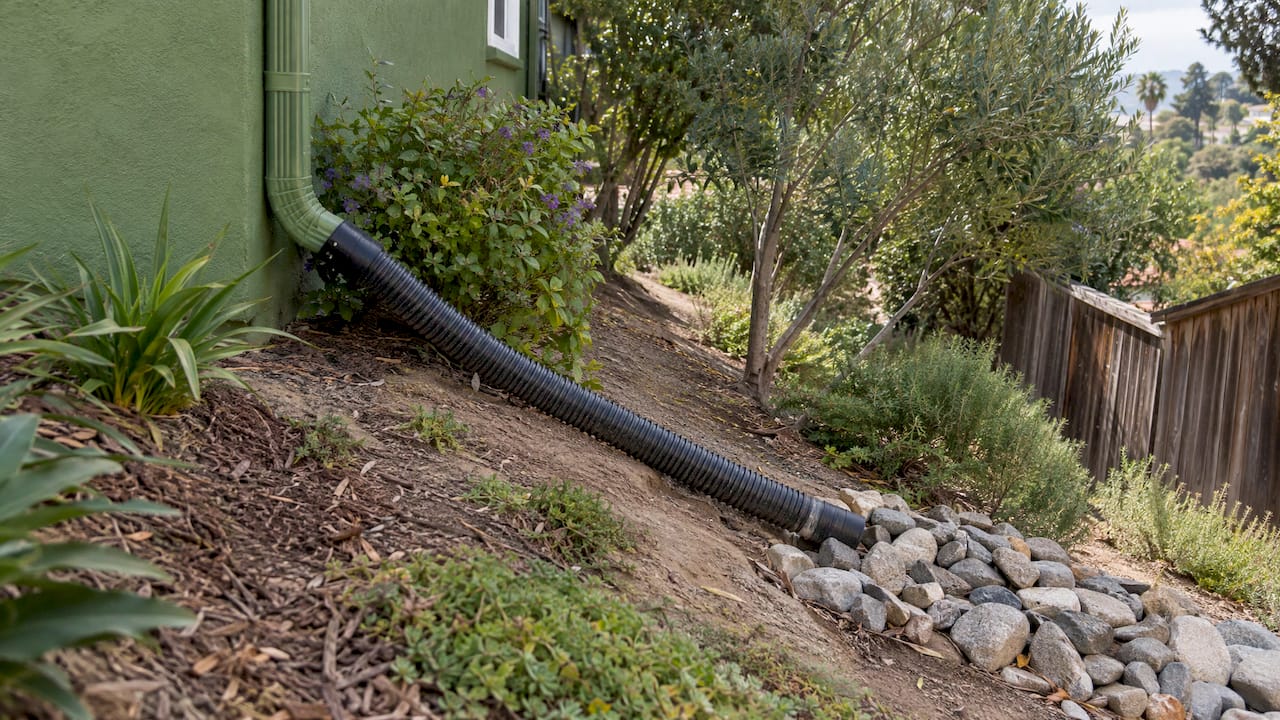
Slope erosion control is half soil and half water. Whatever arrives from above, from roofs, patios and the neighbor’s yard, will find the easiest path down. UC ANR recommends berms to send surface water around the house, and the Building America guide suggests downspout extenders to carry roof water past bare soil, with rocks at drainage outlets to dissipate the flow’s energy.
Irrigation can also cause erosion if it is applied too fast. UC ANR advises placing drip emitters on the uphill side of each plant, with a small carved basin, so water soaks into the root zone instead of running downhill. For larger sites, our page on stormwater management landscaping explains how features such as swales and basins capture and slow runoff.
Green or gray: what lasts
It is tempting to solve a slope with stone. Gabions (wire baskets of rock) and riprap (loose rock) have their place, but the City of Knoxville’s guidance points out that green methods with permanent vegetation are preferable because they capture rainfall, reduce runoff and are usually more durable. It also corrects a common assumption: stone structures do not necessarily need less maintenance, since they need inspection for loose stones, vegetation trimming and settlement. The Minnesota manual adds that rock is generally not suitable where appearance matters, such as residential areas.
The practical result is a hybrid. Use structure where the grade demands it, and plant everything else densely.
A worked example
Imagine a backyard hillside with a 4-foot drop over 10 feet of run. That is a 40% slope, or 2.5:1, inside the range where plants alone are not enough.
- Divert the water above. A berm or swale at the crest sends roof and yard runoff around the slope. Downspouts are extended past the bare ground.
- Cover the surface. Jute netting or coconut-fiber blanket goes over the soil, pinned down.
- Plant in layers. Small plants in staggered positions: groundcovers, low shrubs and a few taller accents, each with a small basin and drip emitter on the uphill side.
- Add wattles. Temporary straw wattles or coir logs across the slope break its length for the first two years.
- Mulch heavy. Shredded bark between plants, kept within the recommended thickness.
- Check after storms. Look for new rills, exposed roots or slumping and fix them early.
If the lower section were steeper than 50%, or if a wall of 4 feet or more were needed, step 3 would be preceded by engineered terracing.
Perspective: why the whole system beats a single fix
Over 25 years of working on hillsides, we have learned that a slope fails where the plan stops. A beautiful planting with no drainage above it will slump. A strong wall with no water path behind it will lean. Bare soil with a single layer of mulch will rill at the first heavy storm.
That is why we design slopes as systems. Drought-adapted plants do the long-term work with their roots. Mulch and blankets protect the surface while those roots grow in. Irrigation is designed so water soaks in rather than runs off, and hardscape such as retaining walls is added only where the grade calls for it. Slope stabilization, irrigation design, hardscape and planting under one roof means the pieces are built to work together.
We believe a sustainable landscape should be beautiful and functional at the same time. A hillside that holds its soil through a drought year and a wet one is the most practical garden you can own.
Denise Buchanan
Plan your slope with us
If your slope is steeper than you are comfortable planting on, or you want the plan, the plants and the structure to fit together, we can help. Our services include slope stabilization, irrigation design and installation, hardscape construction such as retaining walls, and sustainable landscape design and installation.
Our landscape design services are $1,500 for yards under 5,000 square feet and $2,500 for a full landscape design. See the landscape design services page for details, or browse everything we offer on our services page.

If you want to talk through your hillside first, we also offer an initial landscape consultation, listed with our other services.
FAQ
What is the best way to control erosion on a slope?
The best way is a combination matched to your steepness. Under about 33%, plants and mulch usually do the job. Between 33% and 50%, add blankets, coir mats or jute netting until roots establish, and above 50%, use terraces or retaining walls. In every case, manage the water coming from above.
What plants are best for erosion control on a hillside?
Choose a mix of species with different heights and leaf types, so the canopy breaks up raindrops and the roots hold the soil at several depths. Start with small plants such as plugs or 4-inch pots on steep ground. In dry climates, drought-adapted groundcovers and shrubs let you stabilize the hill without heavy watering.
Is mulch enough to stop slope erosion?
On gentle slopes, mulch combined with plants can be enough. Use a heavier material such as shredded bark or wood chips, since light straw and small bark wash away, and keep it within the recommended thickness. On steeper slopes, mulch should sit under or alongside a blanket, mat or wattles.
When do I need a retaining wall?
A retaining wall is generally the answer when a slope is steeper than about 50% and plants and mats cannot hold it. Walls 4 feet or taller commonly need a professional engineer’s design and a permit, so check your local requirements before you build. Proper drainage behind the wall is essential.
Sources
- Soil erosion and sediment production on watersheds (USDA Forest Service, 2013)
- Revised Universal Soil Loss Equation 1.06 description (USDA ARS)
- Soil erosion in humid regions: a review (USDA Forest Service, 2015)
- Prevent Soil Erosion (UC ANR, 2010)
- Erosion Control for Slopes, Stream Banks, and Dunes (Building America Solution Center)
- Kentucky Erosion Prevention and Sediment Control: Protect Slopes
- Erosion prevention practices: natural and synthetic mulches (Minnesota Stormwater Manual)
- Mulch (Snohomish County)
- Home Landscaping Guide for Lake Tahoe and Vicinity
- Chapter 8 Terraces (USDA NRCS)
- Slope and Streambank Stabilization, RH-09 (City of Knoxville)
- Meeting the landscape challenges of slopes and hillsides (UGA Extension)
- Keeping your Hill in Place (UC Master Gardener, Contra Costa County)
- Hillsides (UC ANR)