Succulents work in Los Angeles when you get three things right: well-draining soil, morning sun with afternoon shade, and a watering schedule that changes with the seasons. LA County backs up the switch financially, offering a $1-per-square-foot rebate for qualifying lawn-to-drought-tolerant conversions between 500 and 5,000 square feet. Follow UC Master Gardener guidance on sun exposure, and a succulent bed can outlast a lawn while using a fraction of the water.
TL;DR:
- Succulents need well-draining soil, appropriate sun exposure, and seasonally adjusted watering schedules to thrive in Los Angeles.
- Choosing the right species depends on microclimate; for example, Agave attenuata tolerates inland heat, while Dudleya is suited for coastal areas.
- Proper planting procedures involve using pumice-based soil, avoiding overwatering, and giving plants time to adapt to full sun after initial shaded placement.
- Replacing lawns with succulents can qualify for LA County rebates of $1 per square foot, provided the project size is between 500 and 5,000 square feet.
- For hillside or complex landscapes, professional design, drainage, and irrigation expertise substantially reduce failure risks compared to DIY efforts.
Table of Contents
- Best Succulents for Los Angeles Yards and What They’re Good For
- How to Plant Succulents So They Actually Survive in LA
- Watering Schedules That Match LA’s Actual Weather
- Fire-Wise Planting Rules for Yards Near Structures
- Local Rebates, Resources, and Where to Learn More
- Propagating Succulents That Actually Take Root in LA’s Climate
- Landscaping Ideas That Boost Curb Appeal With Succulents
- Expert Perspective: When Design Skill Beats DIY Guesswork
- Get Professional Help From Sacred Garden Designs
- Where to Learn More
- Sources
- FAQ
Best Succulents for Los Angeles Yards and What They’re Good For
Not every succulent suits every yard. Your microclimate matters: a coastal lot in Playa del Rey handles fog and salt air differently than a sun-baked slope in the San Fernando Valley. Here’s a working shortlist organized by job, not just by looks.
- Echeveria (rosette varieties like Echeveria elegans): best for containers and focal points, tops out around 6 to 12 inches, wants morning sun with afternoon shade, and is a summer grower that goes semi-dormant in winter.
- Agave attenuata (“Foxtail Agave”): a soft-leafed focal agave without sharp spines, grows 3 to 5 feet wide, tolerates part shade better than most agaves, and handles inland heat.
- Sedum (stonecrop varieties): ideal sunny groundcover, spreads low and fast, tolerant of poor soil, and thrives with full sun to light afternoon shade.
- Dudleya (California native, “liveforever”): built for coastal cliffs and rocky slopes, prefers to stay dry in summer, and is a winter grower, meaning it wants water in the cooler months, not July.
- Aloe vera and Aloe striata: strong container or border choices, want full morning sun, tolerate light frost, and stay evergreen year round.
- Graptopetalum (Ghost Plant): a fast-spreading groundcover for slopes, handles both sun and part shade, and roots easily from dropped leaves.
- Senecio mandraliscae (Blue Chalksticks): trailing groundcover for erosion control on banks, full sun to part shade, spreads aggressively in a good way.
- Crassula ovata (Jade Plant): a woody, long-lived shrub for structure near patios, tolerates a wide range of light, and can eventually reach 4 to 6 feet.
Most of these are widely stocked at nurseries across the United States, but availability shifts seasonally. Dudleya, being a native, is worth seeking out specifically for hillside or coastal restoration projects rather than assuming any garden center carries it year-round.
How to Plant Succulents So They Actually Survive in LA
Bad drainage kills more succulents in Los Angeles than heat, frost, or neglect combined. The fix starts with the soil mix, not the plant.
Pumice beats perlite for long-term structure since it doesn’t float or break down, though either works for a starter bed. Skip anything labeled “moisture control,” which is built for the opposite job.
Siting rules matter almost as much as soil. Morning sun with afternoon shade is the safest default for most of LA’s inland neighborhoods, where afternoon heat can scorch leaves. Coastal yards in Santa Monica or Venice can usually handle more direct afternoon sun since onshore breezes keep leaf temperatures down.
For containers, terracotta beats glazed ceramic because it wicks moisture out through the walls, drying the root zone faster. Since most succulent roots stay shallow, a pot only 6 to 8 inches deep is often plenty, even for a plant that looks top-heavy.
- Prepare the bed or container with your amended mix, and confirm the container has a drainage hole.
- If planting cuttings, let them callus for 2 to 5 days in a shaded, dry spot before putting them in soil.
- Plant shallow. Bury only enough of the stem or root ball to hold the plant upright.
- Water lightly right after planting, just enough to settle the soil, not soak it.
- Mulch with decomposed granite or fine gravel to keep crowns dry and reduce rot risk.
Pro Tip: Nursery succulents are usually grown under shade cloth, so moving one straight into a full-sun LA yard can scorch it within days. Give new plants a week in dappled or filtered light before exposing them to full sun, especially in summer.
Watering Schedules That Match LA’s Actual Weather
Succulents split into two camps, and mixing them up is the fastest way to kill a plant. Summer growers like Echeveria and Sedum are active from spring through fall and go dormant in winter, needing far less water once temperatures drop. Winter growers like Dudleya and many Aeoniums do the opposite: they grow through the cool, wet months and want to stay mostly dry all summer.
A simple soil check beats any fixed calendar. Push a finger or a wooden skewer two inches into the soil; if it comes out with damp soil clinging to it, hold off watering.
- In a typical LA summer, watering every 10 to 14 days is common for in-ground summer growers, adjusted for rainfall and pot size.
- During heat waves above 105°F, a light extra watering can prevent stress, but don’t compensate by soaking the roots.
- Winter growers usually want water every 2 to 3 weeks once the rainy season arrives, tapering off as summer approaches.
- Skip fertilizer entirely in winter dormancy, and feed lightly with a diluted, low-nitrogen formula once or twice during active growth.
Succulents are drought-tolerant, not drought-proof. UC ANR research points to overwatering, not underwatering, as the single most common cause of failure in home gardens. Watch for mushy, translucent leaves (overwatering) versus wrinkled, deflated leaves (underwatering) as your two main warning signs. Mealybugs and root mealybugs are the most frequent pest issue in LA gardens; a cotton swab dipped in isopropyl alcohol handles small infestations without chemical spray.
Fire-Wise Planting Rules for Yards Near Structures
If your succulent bed sits within 10 feet of a house, fence, or deck, treat that zone differently. LA County fire guidelines call for low-density, herbaceous plantings under roughly 3 feet tall in that closest zone, avoiding tall woody succulents against walls or windows.
- Keep large agaves and tree-form Aeoniums at least 10 feet from structures rather than as foundation plants.
- Mass low groundcovers like Sedum or Senecio close to the house instead of single tall specimens.
- Space plantings so mature growth doesn’t touch or overlap, which breaks up potential fuel ladders.
- Prune dead leaves and flower stalks regularly since dried plant material burns easily, succulent or not.
- Check your property against local fuel-modification maps before finalizing a planting plan near a hillside.
Local Rebates, Resources, and Where to Learn More
Converting a section of lawn to succulents can qualify for LA County’s grass-replacement rebate: $1 per square foot for projects between 500 and 5,000 square feet, paid out after completion within a six-month window.
- Measure your lawn area first to confirm it falls inside the 500 to 5,000 square foot eligibility range.
- Review the LA County drought-tolerant plant handbook for region-specific palettes before buying plants.
- Visit the Arboretum’s Inter-City Cactus and Succulent Show & Sale to see mature specimens and buy region-adapted stock.
- Grouping plants by water needs rather than by looks alone simplifies irrigation zones later.
Propagating Succulents That Actually Take Root in LA’s Climate
Spring and early fall are the best windows for propagation here, when temperatures sit in the 60s and 70s rather than summer’s dry heat or winter’s cooler, wetter stretch. Leaf and stem cuttings both work, but timing them to mild weather cuts rot risk substantially.
Take a leaf cutting by twisting it gently from the stem so the base comes away clean. Let it sit on a dry paper towel or tray, out of direct sun, for 3 to 7 days until the cut end calluses over and forms a dry seal. Skipping this step is the most common propagation mistake; planting a fresh, uncallused cutting into damp soil almost always causes rot before roots form.
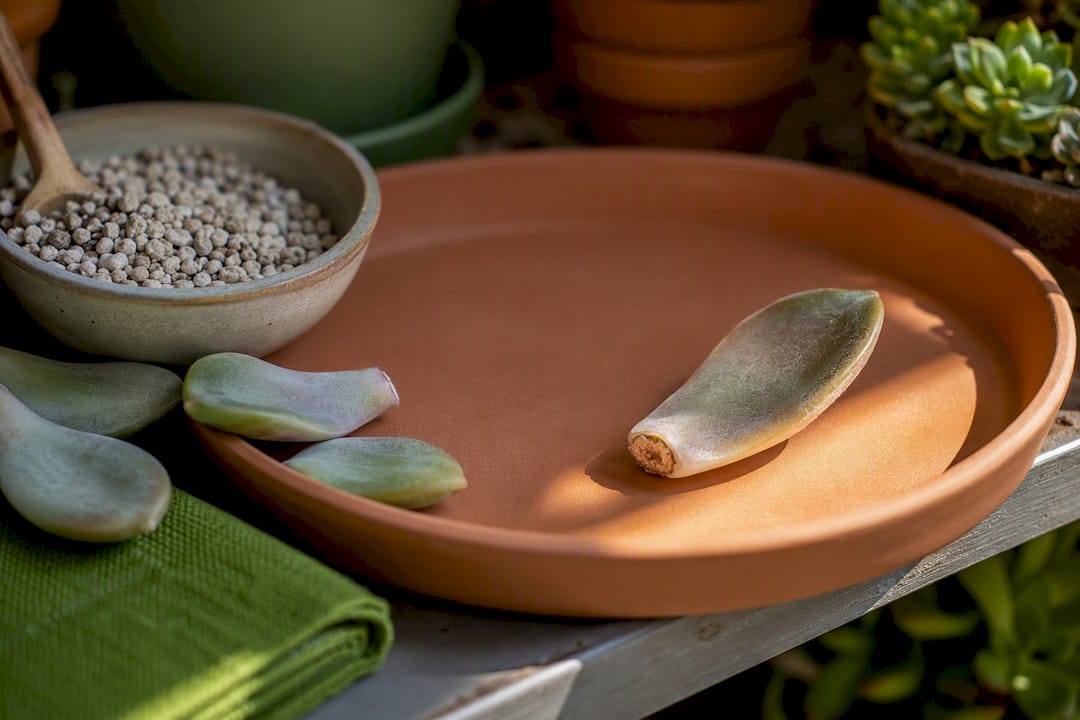
Once callused, lay the leaf on top of a well-draining mix rather than burying it. Mist lightly every few days instead of watering on a schedule. Roots and a tiny new rosette typically appear within 2 to 6 weeks, faster in warm weather, slower in cool months.
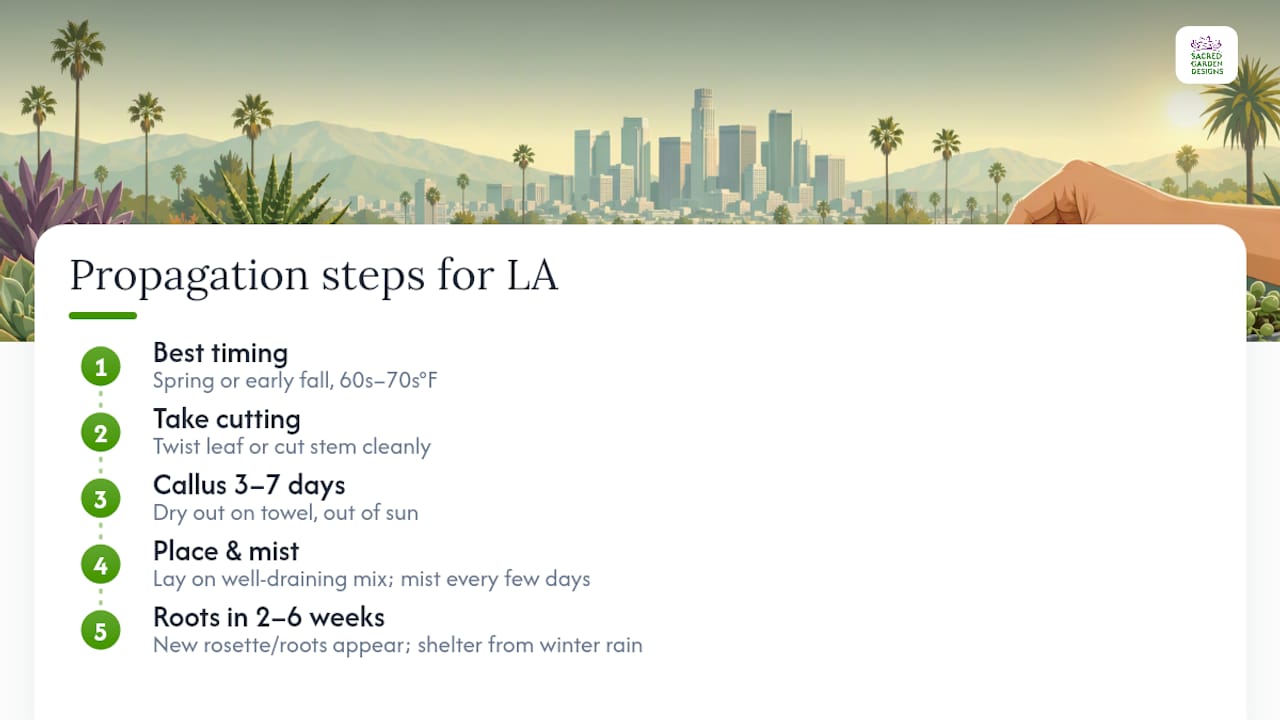
Stem cuttings, useful for leggy Echeveria or Aeonium, follow the same callusing rule but can be planted upright about an inch deep once the cut end has dried. Los Angeles’s low summer humidity is actually an advantage here since it speeds callusing and reduces fungal issues that plague propagation in wetter climates. The main local risk is winter rain: cuttings left outside during a wet spell can rot before they root, so bring propagation trays under an eave or indoors when storms roll through.
Landscaping Ideas That Boost Curb Appeal With Succulents
A succulent front yard reads as intentional, not neglected, when it follows a few basic design moves. Layering height does the most visual work: low groundcovers like Sedum or Senecio spilling over a pathway edge, mid-height Aloe or Agave attenuata as anchors, and one or two larger architectural specimens, like a mature Agave americana, placed where they catch afternoon light.
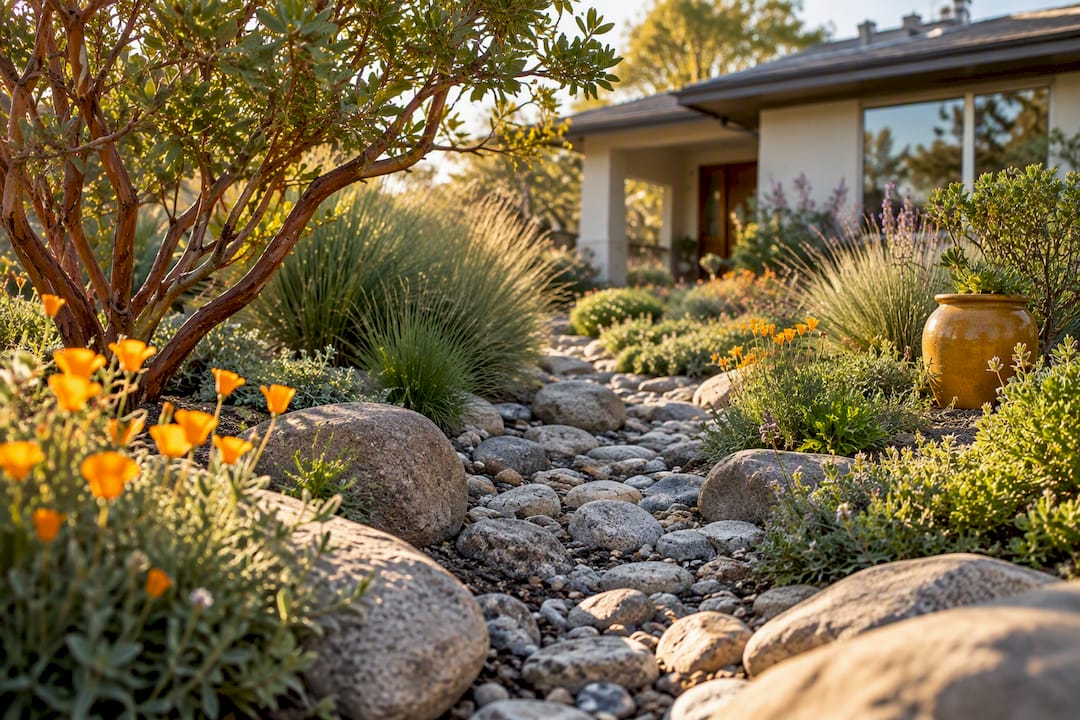
Rock and gravel mulch in warm gray or tan tones make succulent colors pop, especially the blue-greens of Senecio and the purple-blushed rosettes of certain Echeveria varieties. A dry creek bed lined with river rock, planted along the edges with Dudleya or trailing Sedum, solves drainage and adds visual movement to an otherwise flat yard.
For a Los Angeles bungalow or Spanish-style home, terracotta pots clustered near an entry, mixing Echeveria and small Aloe, read as curated rather than sparse. Corner beds and parking strips, historically wasted space in most LA neighborhoods, work well for mass plantings of a single Sedum or Graptopetalum variety, which reads as clean rather than busy from the street. Mixing textures, spiky Agave against rounded Echeveria against trailing Senecio, is what separates a memorable succulent yard from a collection of random pots.
Expert Perspective: When Design Skill Beats DIY Guesswork
Mixing textures and using succulents for slope stabilization takes more than plant knowledge. It takes an eye for scale and drainage engineering. A company with extensive experience in sustainable landscaping has seen where DIY conversions fail: irrigation zoning, slope permits, and plant spacing on steep grades. If your project involves a hillside, a permit, or an irrigation redesign, that’s the point to call a professional rather than guess.
— Denise Buchanan
Get Professional Help From Sacred Garden Designs
Reading plant tags and hoping for the best only gets a Los Angeles yard so far. Experienced professionals bring extensive drought-tolerant design expertise to the same problems this guide covers, including sun mapping, drainage, and slope stability, without the trial and error of a DIY conversion.
If your yard is under 5,000 square feet, the Landscape Design Services package at $1,500 covers a full design tailored to your space. Larger properties, or ones needing irrigation redesign alongside planting, fit better under Sustainable Landscape Design and Installation, which bundles design, irrigation, and installation into one project. Homeowners who want to learn the skills firsthand can join a Sacred Garden class or workshop instead. Whichever path fits, the next step is the same: book an initial landscape consultation and get a plan built around your actual yard, not a generic plant list.
Where to Learn More
- LA County Grass Replacement Program: rebate rules and eligibility.
- UC Master Gardeners succulent guide: regional care basics.
- LA County Drought-Tolerant Garden Handbook: plant lists and design ideas.
- Arboretum succulent show: hands-on buying and learning events.
Sources
- Grass Replacement Program – LA County Public Works
- Succulents – UC Master Gardeners Orange County
- Drought-Tolerant Garden Handbook — Los Angeles County
FAQ
Do Succulents Need Full Sun in Los Angeles?
Most succulents want 4 to 6 hours of daily sun, but morning sun with afternoon shade usually works better than full afternoon exposure in LA’s inland heat. Coastal yards can typically handle more direct afternoon sun.
How Often Should I Water Succulents in an LA Summer?
Every 10 to 14 days is typical for in-ground summer growers, adjusted for pot size and rainfall. Check soil moisture two inches down before watering rather than sticking to a fixed calendar.
Is There a Rebate for Replacing Lawn With Succulents in LA?
Yes. LA County’s grass-replacement program pays $1 per square foot for qualifying projects between 500 and 5,000 square feet, issued after the work is completed within six months.
What Does a Landscape Design Cost With Sacred Garden Designs?
Landscape design for yards under 5,000 square feet is $1,500 through Sacred Garden Designs. Larger or more complex projects, including irrigation and installation, are priced individually.
Which Succulents Work Best Near a House for Fire Safety?
Low, herbaceous succulents under about 3 feet tall, like Sedum or Senecio, fit LA County’s Zone 1 fire guidance for the 10 feet closest to structures. Save tall agaves and woody specimens for farther out in the yard.