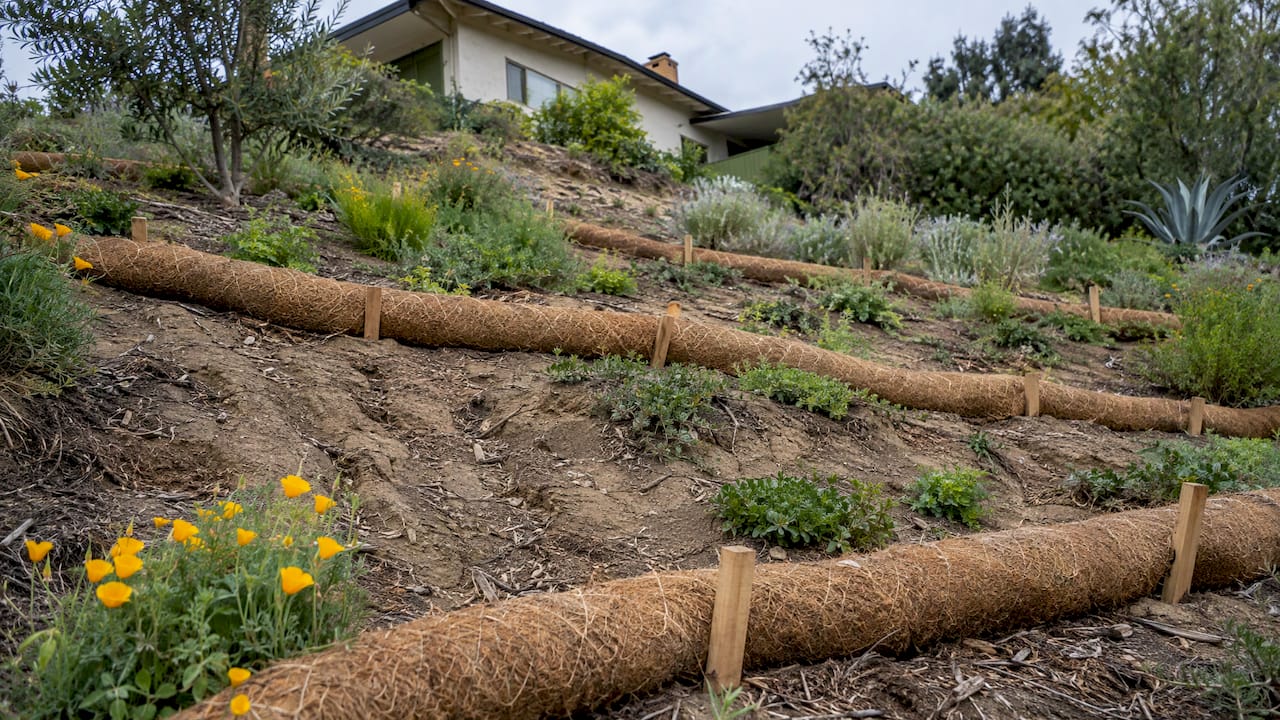
A terraced hillside garden turns one long, fast-draining slope into a staircase of short, level planting beds. Done well, it stops erosion, lets rain soak in instead of racing downhill, and gives you flat ground for flowers, vegetables and seating. Done badly, it fails at the wall, usually because of water that has nowhere to go. This guide covers how to read your slope, size the tiers, build the walls and drainage, and plant for dry conditions. It also shows where a design-build team earns its fee. At Sacred Garden Designs we have spent more than 25 years building water-wise landscapes in Los Angeles and beyond, and the steepest yards are where good design pays back fastest.
TL;DR
- A terrace shortens a long slope into level steps, so water slows down and soaks in rather than running off.
- Keep each bed to about 2 feet high and 5 feet deep, and build from the bottom of the slope up.
- Drainage behind every wall (gravel, fabric, perforated pipe that exits to daylight) matters more than the wall material.
- Walls around 4 feet and taller usually mean permits and an engineer, so check local rules before you dig.
- Plant drought-tolerant species at the top, moisture lovers at the bottom, and choose low-resin plants if you live in fire country.
Table of Contents
- What a terraced hillside garden actually does
- Is your slope a candidate?
- Terraced garden ideas by style and purpose
- How to terrace a slope, step by step
- Retaining walls: materials, height and permits
- Drainage: the part that keeps walls standing
- Planting a terraced hillside
- When to bring in a professional
- Build the terraces with us
- Our view on terraced hillsides
- FAQ
- Sources
What a terraced hillside garden actually does
The USDA Natural Resources Conservation Service describes a terrace as an earth embankment, a channel, or a combination of ridge and channel built across a slope to intercept runoff. In a backyard, that means a long slope is cut into a series of shorter, more level steps. Heavy rain soaks into each bed instead of running off, and flower and vegetable gardening becomes possible on ground that was too steep to work.
Three practical gains follow:
- Erosion control. Short steps slow water, and plant roots hold the soil in place.
- Usable space. Flat beds are easier to plant, mulch, water and harvest. Extension specialists note that terracing creates usable spaces at different levels with easier access for maintenance and irrigation.
- Water savings. Water that stays on your property is water you do not have to buy twice, which matters in drought-prone regions.
Is your slope a candidate?
Start by measuring. Slope is expressed as a percentage: the rise divided by the run, times 100. A hill that climbs 8 feet over a 20-foot run is a 40% slope.
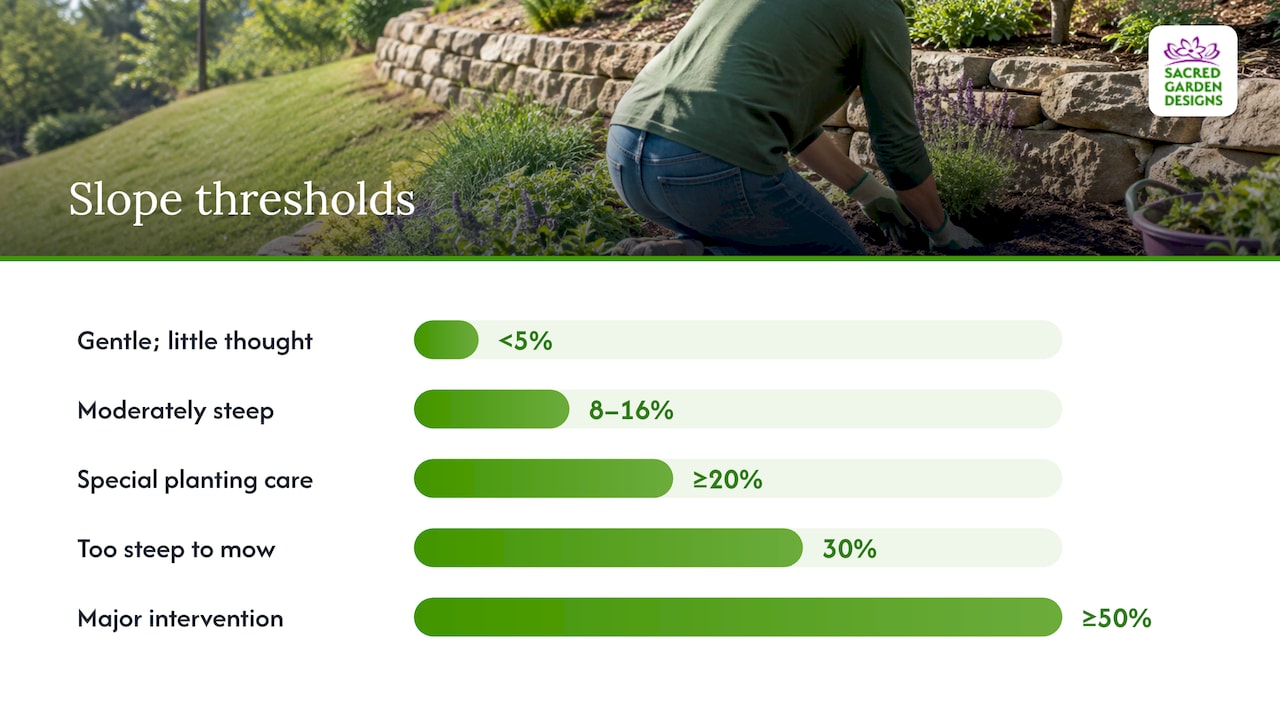
University of Georgia Extension gives gardeners a useful scale. Under 5% is gentle and needs little thought. A slope of 8 to 16% is moderately steep, which makes walking, gardening and holding water harder. At 20% or steeper, planting needs special care, and at 30% the slope is too steep to mow. At 50% or more, plants are unlikely to grow without major intervention.
In practice:
- Under about 20%: planting alone, with mulch and groundcover, can often do the job, and a few low terraces add flat spots.
- 20% to 50%: this is classic terrace territory.
- Over 30% in a fire-prone area: you are dealing with structure, drainage and fire rules together. Our page on hillside landscaping over 30% in Los Angeles shows how those requirements combine in practice.
Walk the slope after a hard rain. Look for gullies, wet spots at the base and places where driveway or downspout water arrives at the top. Mississippi State University Extension warns that unchecked erosion can form gullies that spread with each major rainfall and has been known to undermine house foundations. If you see that, deal with it first.
Terraced garden ideas by style and purpose
Before you pick materials, decide what each level is for. The same slope can become a vegetable garden, a quiet seating area or a pollinator planting.
Formal, informal and stepped
This Old House describes three common approaches: formal terraces with symmetrical layouts and straight lines, informal terraces with curved edges and natural materials, and stepped terraces that follow the land’s natural contours. Formal suits a house with clean architecture. Informal fits native and drought-tolerant planting. Following the contours usually means less soil moved and a more natural result.
Edible terraces
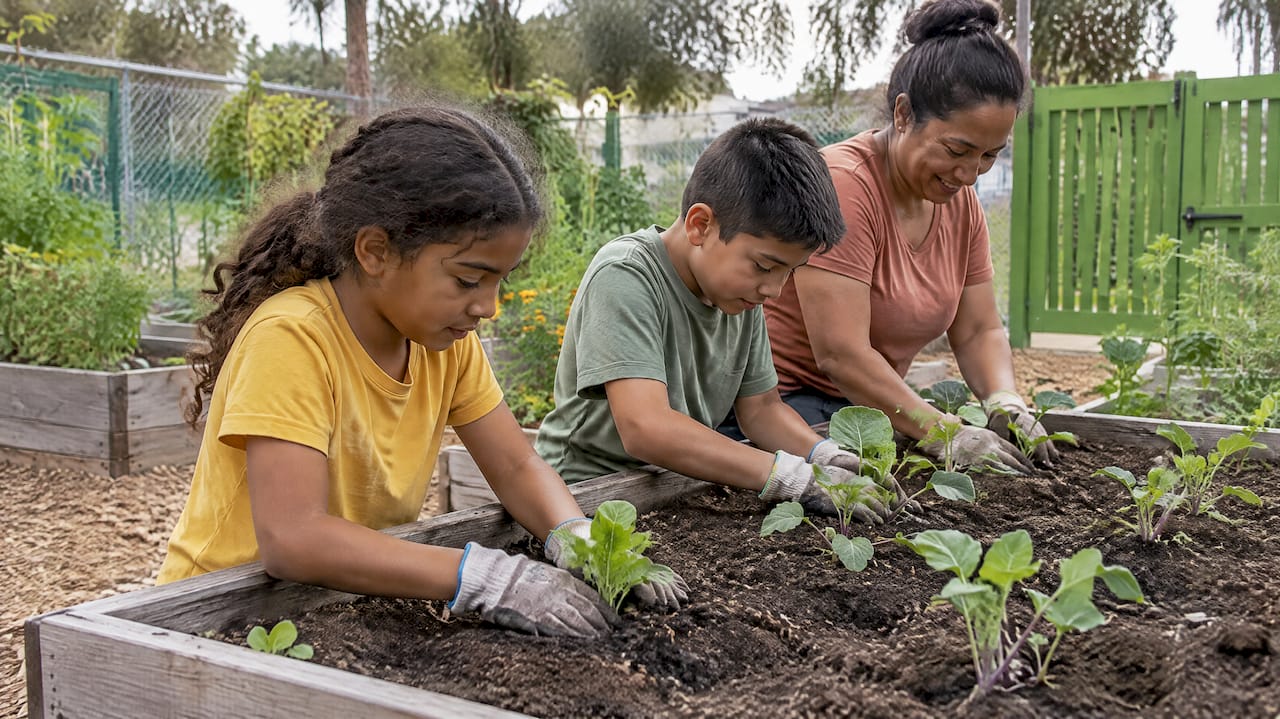
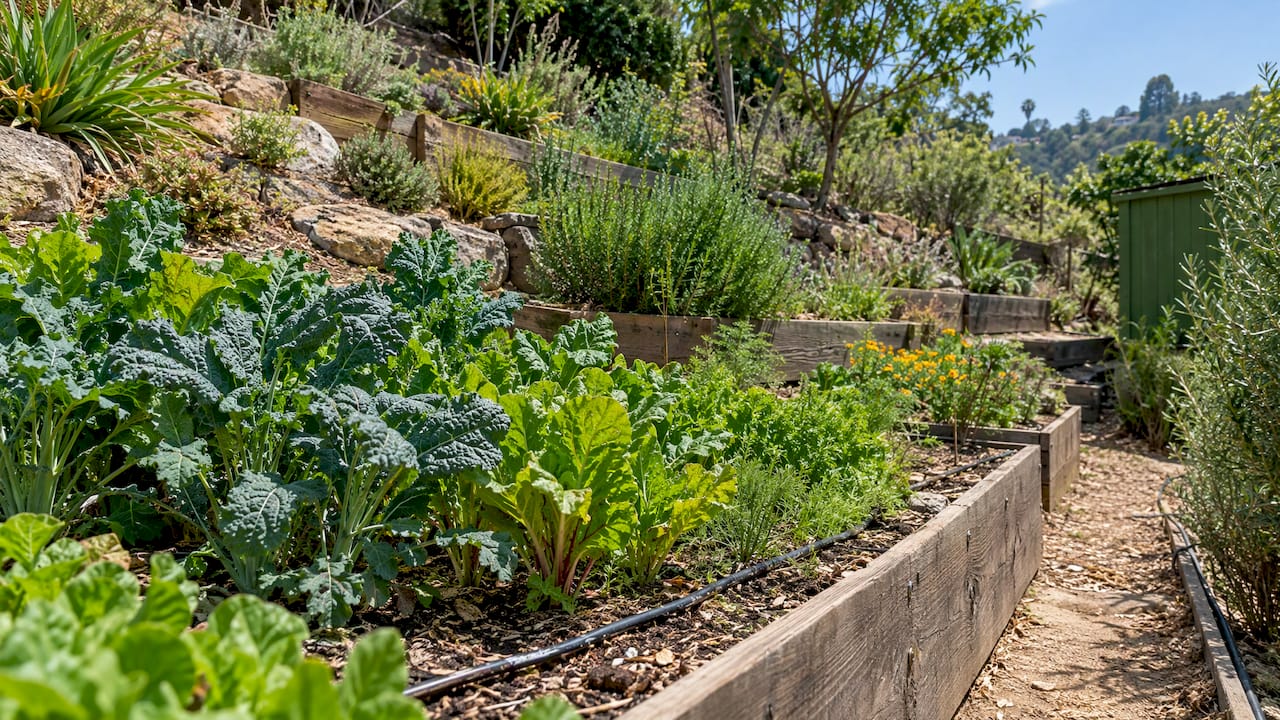
Level, amended beds are ideal for vegetables and herbs. Keep the beds narrow enough to reach across from the path, and put the thirstiest crops on the lower tiers where soil stays wetter. Iowa State Extension notes that soil at the base of a slope is often wetter than soil higher up, and steep slopes are generally drier. Drip lines on each tier keep water where the roots are. Our guide to vegetable garden irrigation covers how much water a bed needs, and the one on drip irrigation for raised beds applies directly to terrace beds.
Stress-relief and sensory terraces
A small bench on the top tier, fragrant herbs along a path edge and a lower bed of grasses that move in the wind make a slope into a place to sit rather than a problem to look at. Because every tier is a separate room, you can give each its own mood: a quiet shade bed, a bright pollinator bed, a gathering patio.
Planting heights and views
Iowa State Extension offers a simple rule. Viewed from below, taller plants go toward the back, higher up the hill, but not so tall that they tower over the garden. Viewed from above, reverse the heights, with shorter plants at the top and taller ones at the bottom so you keep the view.
How to terrace a slope, step by step
The process below follows the NRCS backyard terracing guide, with the places where projects usually go wrong.
1. Locate utilities and check the rules
Call the utility locating service before you dig, and confirm local permit rules for walls (more on that below). Buried lines on a slope are easy to hit when you are cutting into the hill.
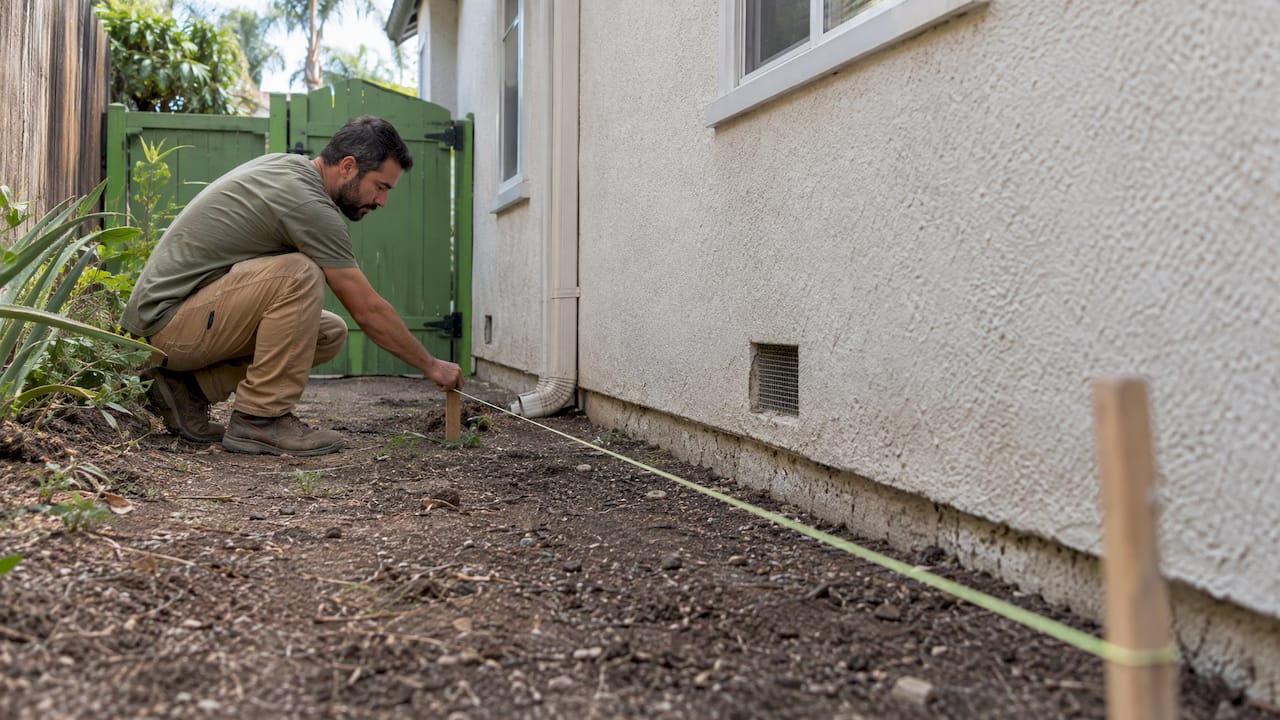
2. Measure rise and run
NRCS gives a clear example: a 20-foot run with an 8-foot rise and 5-foot-wide beds means four beds, each with a 2-foot rise. University of Maryland Extension recommends each terrace be no higher than 2 feet and no longer than 5 feet, with the number of tiers set by the slope. Where it goes wrong: measuring once, at one point, on a slope that changes pitch. Measure along several lines and draw the profile.
3. Plan water first
Iowa State Extension advises redirecting water from driveways and downspouts at the top of the hill with trenches, drainage tile or surface drains, so it does not pour down onto your new beds. Plant along contour lines, run any rows perpendicular to the slope, and stagger plantings so water does not gather and run down the rows. Our page on stormwater management landscaping explains swales, rain gardens and other features that hold water on site.
4. Build from the bottom up
Start at the base. Dig a level, firmly packed trench for the first wall. For low timber walls under 2 feet, NRCS says to bury the timbers about half their thickness, drill holes and spike pipes 18 inches or longer into the ground, and stack tiers with overlapping corners. Then move soil from the back to the front of each bed until it is level. Where it goes wrong: a trench that is not level or not compacted, which shows up a year later as a leaning wall.
5. Install drainage behind every wall
See the next section. This is the step that decides whether the wall lasts.
6. Fill, plant and mulch
Finish by planting and mulching each level. UGA Extension recommends transplants over seed on slopes for faster coverage with less soil disturbance, and a coarse natural mulch such as shredded bark or leaf mold, which will not roll down the slope the way fine mulch does.
Where we take work off your hands
Most homeowners can lay a 1-foot timber step. The harder parts are reading the slope, sizing walls, specifying drainage and tying in irrigation. Sacred Garden Designs offers landscape design services priced at $1,500 for yards under 5,000 sq. ft. and $2,500 for a full landscape design. We also provide sustainable landscape design and installation, irrigation design and installation, slope stabilization and hardscape construction including retaining walls, so the plan and the build can sit with one team.
Retaining walls: materials, height and permits
Choosing a material
NRCS lists treated wood such as landscaping timbers, bricks, rocks, concrete blocks and masonry as terrace materials. Iowa State adds boulders and field stones. For most home gardens the choice comes down to look, budget and wall height:
| Material | Best for | Look |
|---|---|---|
| Landscape timbers | Low beds under about 2 feet | Warm, rustic |
| Interlocking concrete block | Mid-height garden walls | Clean, uniform |
| Natural stone or boulders | Informal, native-style gardens | Organic |
| Masonry or poured concrete | Taller or structural walls | Formal |
Budget varies widely by region and material. As a sense of scale, University of Maryland Extension’s four-tier example with block walls and top-tier drainage was priced at $780 in a 2022 publication, for a do-it-yourself build. Hired installation, larger walls and slopes needing engineering cost considerably more, and a written quote for your site is the only reliable number. If you are weighing options other than a solid wall, see our look at retaining wall alternatives for a sloped yard.
Height and permits
This Old House host Roger Cook calls 4 feet the magic number for wall height: taller walls typically need a permit and a railing in most states, plus contractor equipment and possibly a civil engineer. Mississippi State Extension advises homeowners building their own to keep retaining walls to a foot or two and to consult a landscape architect for larger ones, always checking local ordinances and building codes. Rules differ by city and county, and a wall that holds up a driveway or structure above it is a different case from a garden bed wall. Call your local building department before you start. Spreading the drop across several short tiers, each within a safe height, is one reason terracing works so well on steep ground.
Drainage: the part that keeps walls standing
NRCS warns that the pressure of waterlogged soil behind a wall can be enormous and can make improperly built walls bulge or collapse. This is the most common failure on terraced hillsides, and it is invisible on the day the wall is finished.
This Old House describes the system its crew installs behind terrace walls: a perforated pipe surrounded by 3/4-inch stone, wrapped in filter fabric so soil does not clog the stone and pipe, with the pipe run out to daylight so the force of water running down the hill does not hit the wall.
A good drainage plan includes:
- Clean gravel directly behind the wall rather than the native soil.
- Filter fabric between the gravel and the soil.
- A perforated pipe at the base that slopes to an outlet.
- A route for the outflow that does not erode the next terrace down.
- Surface water diverted away from the top of the wall.
We cover the details in our guide to retaining wall drainage for new builds and retrofits. When you compare bids for a wall, ask what drainage each one includes.
Planting a terraced hillside
Match plants to the tier
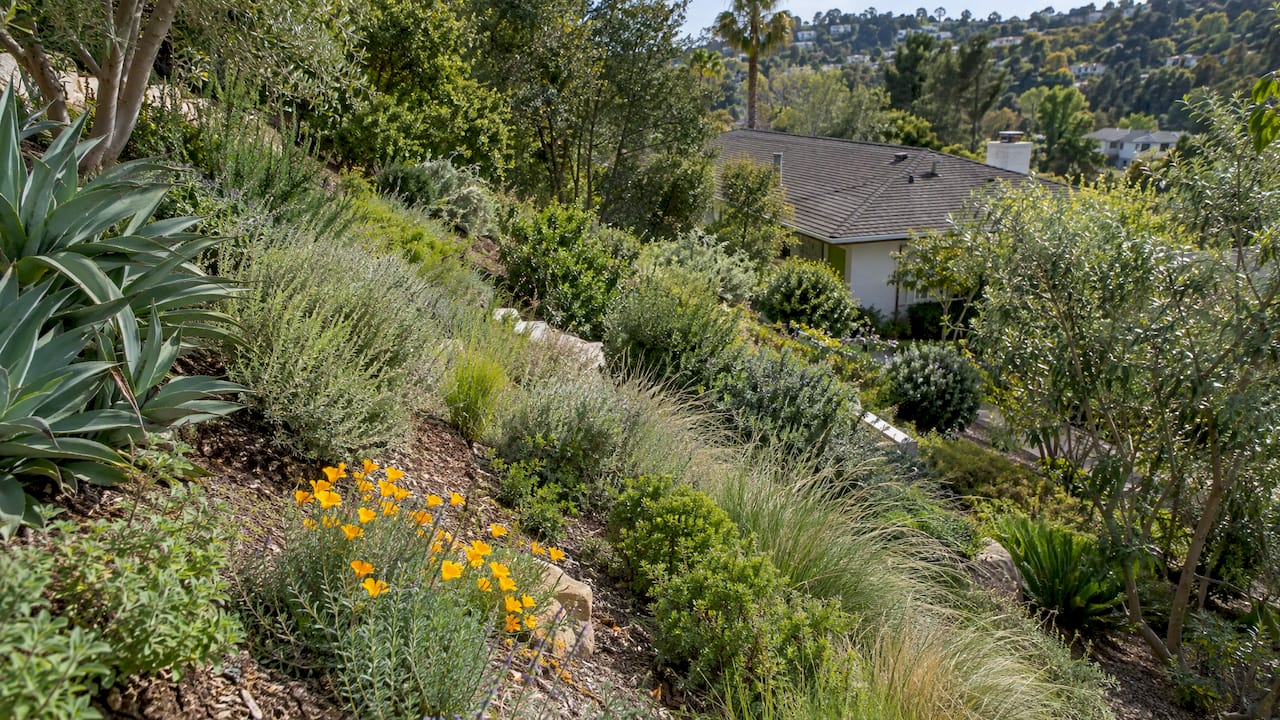
UGA Extension advises that because water runs down slopes quickly, plants at the top should be drought tolerant, with drip irrigation or soaker hoses for establishment and dry spells, while plants at the wet bottom should be adapted to wet soil. That gives a simple tier-by-tier plan: tough, low-water plants at the crest, moderate-water plants in the middle and moisture-tolerant plants and edibles at the base.
Drought-tolerant choices
Plant lists depend on your region, so confirm what is native and hardy near you. Some examples from public guidance:
- Mediterranean climates (California): the Town of Los Altos Hills landscaping guide names slope-suited natives including dwarf coyote bush, Ceanothus, chamise, native bunch grasses, native roses and toyon. It also suggests no more than a third of the landscape in high-water plants, and says fall is the best planting time because the soil is warm, the air is cooler and rain does the watering.
- Eastern and Southern slopes: Mississippi State Extension lists prostrate junipers, ivies, rugosa rose and sedums as drought- and sun-tolerant species that secure steep slopes.
For groundcovers that fill in between terrace walls, see our pages on drought-tolerant groundcovers, slope groundcover in Los Angeles and plants that stabilize slopes in 2 to 4 months. For Southern California specifically, drought-tolerant plants for Los Angeles is a good starting list.
Water efficiently
Extension specialists state that drip irrigation is the most effective way to water plants on slopes efficiently. Put each tier on its own zone, since the top dries faster than the bottom. If you are in Los Angeles, our irrigation schedule guide covers the local watering rules.
Firewise terraces
In wildfire country, terraces can be part of a defensible-space plan because they break up continuous fuel on a slope. The University of California’s fire-resistant plant guidance is clear that no plant is fireproof. Evergreen plants that hold moisture and have watery or milky sap are more fire resistant than resinous plants or plants with volatile oils, and some plants build up dead wood as they mature, which makes them fire prone.
The Los Altos Hills guide cites defensible-space practices worth following on any terrace near a house:
- Remove dead plants regularly.
- Keep trees at least a mature crown width from structures.
- Avoid shrubs under trees that act as fire ladders.
- Do not plant pines, junipers, cypress or eucalyptus near the house because their flammable oils make them burn fast.
Gravel mulch around plants, as Idaho Firewise suggests, also reduces soil water loss. Keep local fire agency guidance on hand, because defensible-space zones and plant rules vary by jurisdiction.
When to bring in a professional
Bring in help when any of these apply:
- The slope is 30% or steeper.
- Walls will be taller than a couple of feet, or approach 4 feet.
- A driveway, patio or building sits above the wall.
- You see gullies, seeps or soil movement.
- The property is in a fire zone with specific landscape rules.
A licensed structural engineer or landscape architect is required where local code says so, and tall walls on slopes often need one. We coordinate the landscape side of those projects: design, drainage, irrigation, planting and construction of retaining walls and patios. Our full list of services includes slope stabilization, tree trimming, clean-up and haul-away and ongoing garden maintenance.
Build the terraces with us
If you would rather have the slope designed and built than spend your weekends on a hillside, Sacred Garden Designs has been creating sustainable, water-wise landscapes for over 25 years, and our work has earned eight Houzz Awards. Start with an initial landscape consultation, or review our landscape design services to see what a design package covers.

If you want to learn to do your own planting, our classes and workshops teach water-wise gardening. You can also start from our home page.
Our view on terraced hillsides
Every hillside tells you where the water wants to go. The best terraced gardens do not fight that. They slow the water, spread it and put it to work.
We design for drought and climate swings first, then for beauty, and on a slope those two goals are the same job. A tier that holds water feeds the roots that hold the soil, and a bed that is easy to reach is a bed that gets cared for. We build walls with the drainage planned from day one, because a handsome wall that fails is the most expensive kind.
We also think a terrace should be a place to be, not just a way to hold dirt. A bench among fragrant herbs, a row of edibles within arm’s reach, a bed of pollinator plants at eye level: those are the details that make people go outside and stay there.
That is why we bring design, irrigation, planting and hardscape construction together. The slope is one system, and it works best when one team looks after all of it.
Denise Buchanan
FAQ
How steep can a slope be for a terraced garden?
Terracing is most useful on slopes of roughly 20% to 50%. Extension guidance describes 30% as too steep to mow and 50% or more as unlikely to support plant growth without major work. On the steepest ground, plan for engineered walls and professional design.
How high should each terrace be?
For garden beds, University of Maryland Extension recommends terraces no higher than 2 feet and no longer than 5 feet, with the number of tiers set by the slope. Staying near that size keeps walls manageable and usually keeps you under permit thresholds.
Do I need a permit to terrace my yard?
Often you do not for low walls, but 4 feet is the commonly cited threshold above which permits, and possibly an engineer, come into play. Local codes differ, and a wall holding up a driveway or structure is treated differently, so call your building department before you start.
What should I plant on a terraced hillside?
Use drought-tolerant plants at the top, moderate plants in the middle and moisture-tolerant plants or edibles at the bottom. Choose natives where you can, add coarse mulch and install drip irrigation on every tier. In fire country, favor moisture-rich plants over resinous ones.
Can I terrace a slope myself?
Low timber or block beds under about 2 feet are a realistic weekend project if you plan drainage and measure carefully. Taller walls, steep slopes and anything near a structure are best designed and built by professionals.
Sources
- USDA NRCS: Texas Conservation in Your Backyard, Terracing
- UGA Extension: Meeting the landscape challenges of slopes and hillsides
- Iowa State Extension: Gardening on Slopes and Hillsides
- University of Maryland Extension: Creating a Tiered Garden
- This Old House: How To Design a Terraced Garden
- Mississippi State University Extension: Gardening on Steep Slopes
- Town of Los Altos Hills: Landscaping Guide
- Water Conservation for Lawn and Landscape: Water Conservation and Slopes
- UC ANR: Fire Resistant Plants, No plant is fireproof