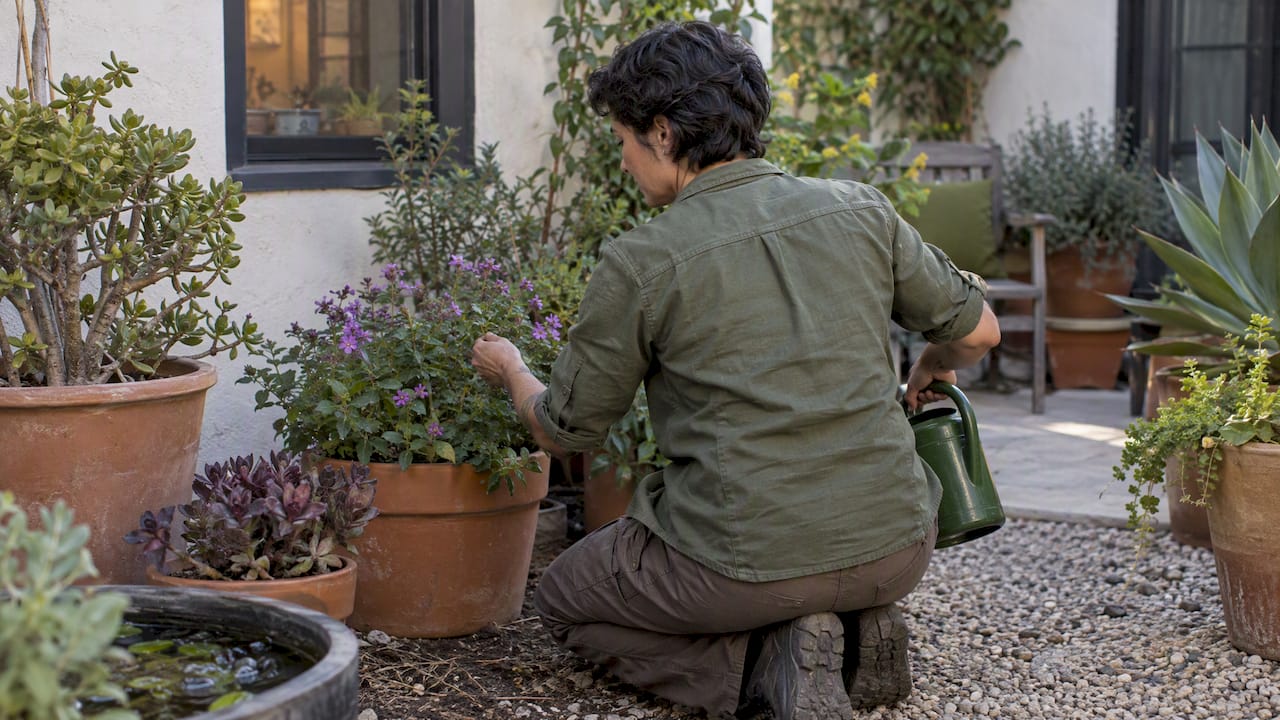
For maximum yield and visual impact in a small outdoor area, prioritize vertical planting, pick correctly sized containers, and limit your palette to three to six compact varieties. Before buying anything, measure your available sun hours, your footprint, and, for balconies, your load limits. These fundamentals come from university extension research and hands-on design experience.
TL;DR:
- Container size should be at least 0.5 to 2 gallons for greens and up to 5 gallons for vegetables like tomatoes, with larger sizes needed for summer crops.
- Use trellises for vining crops, and check weight limits especially on balconies, distributing large pots near load-bearing walls.
- Focus on compact or dwarf varieties labeled as “patio,” “bush,” or “determinate,” and group plants with similar water needs to simplify care.
- Layering plant heights and using fewer, larger pots with a limited color palette can create an illusion of space and improve visual coherence.
- Regular watering, proper drainage, and seasonal soil amendments are essential, with mulching and group plantings reducing maintenance and water loss.
Table of Contents
- 1. A Rules-of-Thumb Framework for Planning a Small Garden Fast
- 2. Exactly How to Size Containers, Choose Materials, and Add Vertical Supports
- 3. What to Plant: Compact Varieties and Smart Pairings
- 4. Layout Tricks That Make a Small Garden Feel Bigger
- 5. Watering, Feeding, and Seasonal Care for Containers
- Our Approach to Sustainable, Water-Wise Small Gardens
- Soil Preparation and Improvement for Container and Small-Space Gardens
- Seasonal Planning and Crop Rotation in Tight Quarters
- Pest and Disease Management in a Small-Space Garden
- Vertical Systems That Go Beyond a Basic Trellis
- Why We Design for Function Before Beauty
- Let Us Help You Design Your Small-Yard Garden
- FAQ
- Sources
1. A Rules-of-Thumb Framework for Planning a Small Garden Fast
A good small garden starts with sequence, not shopping. Decide these five things in order before you touch a trowel.
- Maximize vertical space first. Walls, railings, and fences hold as much growing potential as the ground, and using them frees up floor space for seating or circulation.
- Build layered structure. Combine an evergreen base (shrubs, perennial herbs) with seasonal accents (annual flowers, rotating vegetables) so the space looks full year round.
- Choose one focal point. A single striking container, a small tree, or a trellis draws the eye and keeps the rest of the layout from feeling cluttered.
- Prioritize multifunctional elements. A built-in bench with an integrated planter or a raised bed that doubles as a low wall gives you function and growing space in one footprint.
- Match plant choices to your primary goal. Decide if the space is mainly for food, pollinators, or relaxation, then let that decision filter every plant purchase that follows.
Scale and repetition do more work than variety. Two large, matching pots read as intentional design, while six mismatched small pots read as clutter, even if the total growing volume is similar. If your goal is food production, build around three or four productive plants rather than a dozen token ones. If it is pollinators, repetition of a few bloom types in staggered groups reads better visually and feeds pollinators more reliably than one of everything scattered around.
2. Exactly How to Size Containers, Choose Materials, and Add Vertical Supports
Container volume is the single most common mistake in small-space gardening. Pots that are too small stunt roots, dry out fast, and stress plants in heat. University extension data gives clear minimums: lettuce and radishes can grow in as little as 0.5 to 1 gallon, while tomatoes, peppers, and cucumbers generally need 2 to 5 gallons of soil volume, and larger crops like summer squash need up to 10 gallons.
| Crop | Minimum container volume |
|---|---|
| Lettuce, radishes | 0.5 to 1 gallon |
| Carrots | 2 gallons |
| Bush beans | 2 gallons |
| Tomatoes, peppers, cucumbers | 2 to 5 gallons |
| Eggplant | 5 gallons |
| Summer squash | 10 gallons |
For vertical systems, trellises suit vining crops like cucumbers and pole beans, wall pockets work well for herbs and shallow-rooted greens, and stackable towers fit strawberries or lettuce where floor space is tightest. On balconies, check weight limits before installing anything heavy: a loaded 10-gallon container can weigh dozens of pounds once watered, so distribute large pots near load-bearing walls rather than centering them on open spans. For very large planters, solid foam blocks can fill up to a third of the volume to cut weight while keeping enough soil depth for roots.
Material matters for moisture. Plastic and resin pots hold water longer, which suits forgetful waterers or hot climates, while terracotta breathes better but dries faster and needs more frequent watering. Every container needs drainage holes regardless of material, since waterlogged roots kill plants faster than underwatering does.
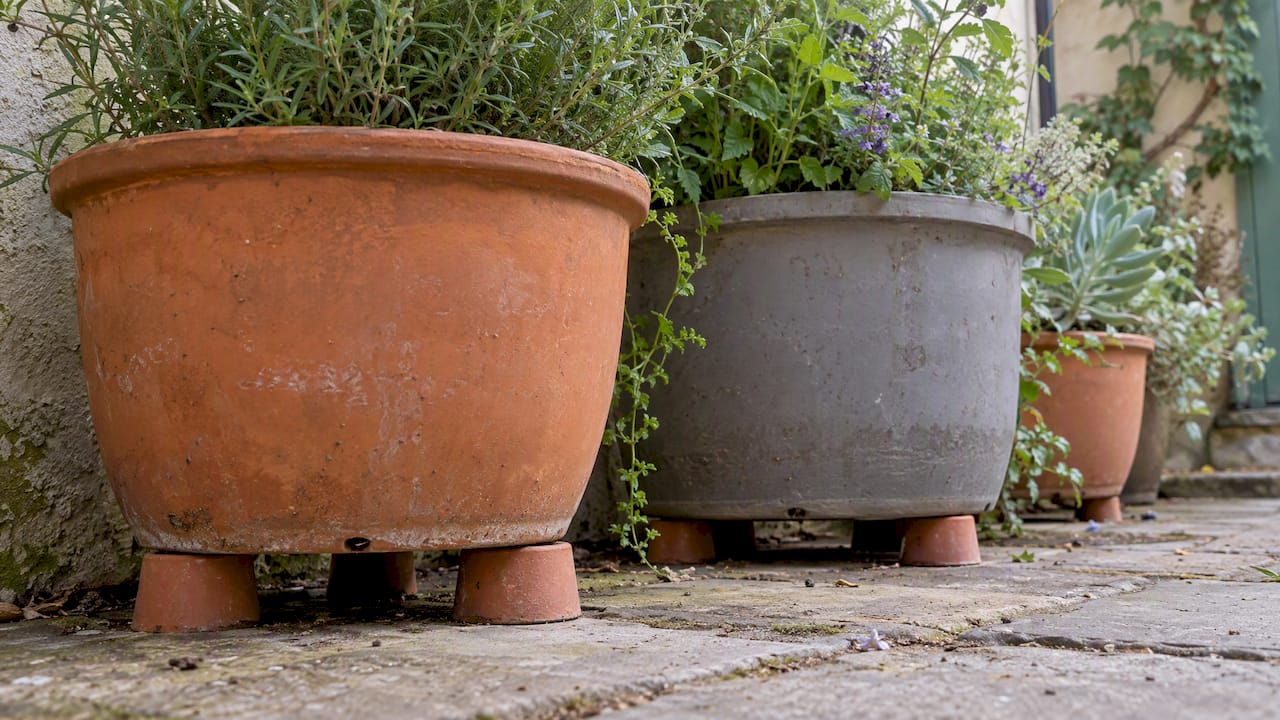
Pro Tip: Elevate every container on pot feet, even indoors, so drainage holes never sit in standing water.
3. What to Plant: Compact Varieties and Smart Pairings
Choosing the right varieties matters more in a small garden than in a large one, since there is no room to hide a plant that outgrows its space. Look for words like “patio,” “bush,” “dwarf,” or “determinate” on seed packets and plant tags.
- Tomatoes: choose determinate or dwarf patio varieties instead of sprawling indeterminate types that need constant pruning.
- Cucumbers and peppers: bush cucumber varieties and compact pepper cultivars perform well in 3- to 5-gallon pots.
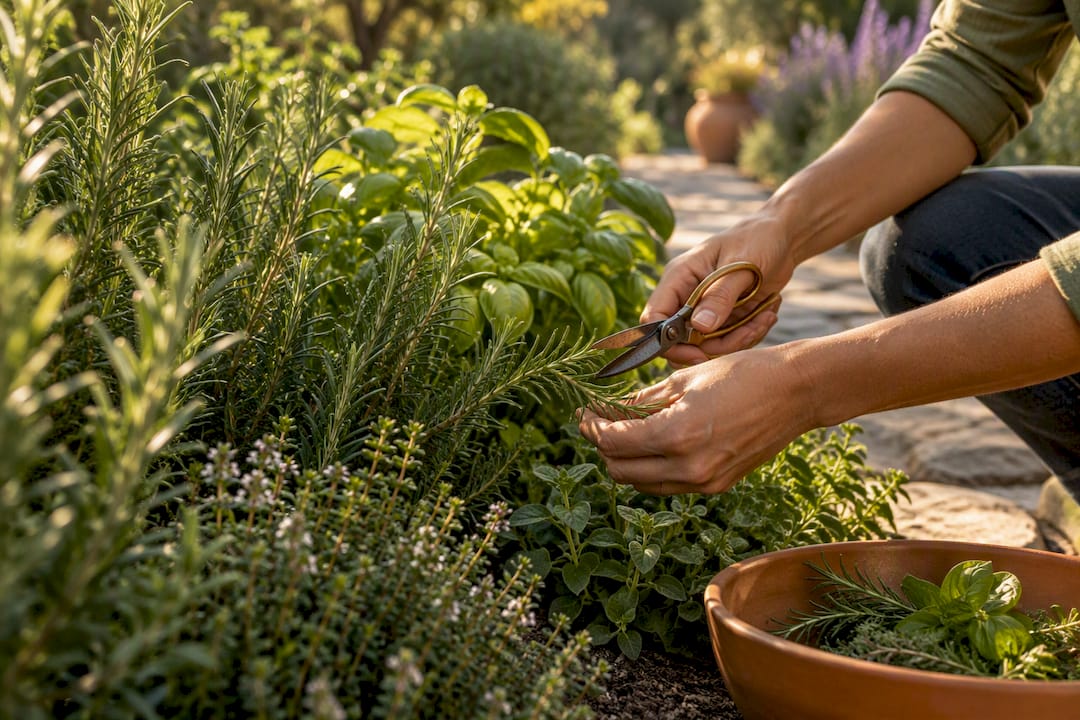
- Low-light spots: lean on leafy greens and herbs like lettuce, spinach, parsley, and chives, which tolerate partial shade better than fruiting crops.
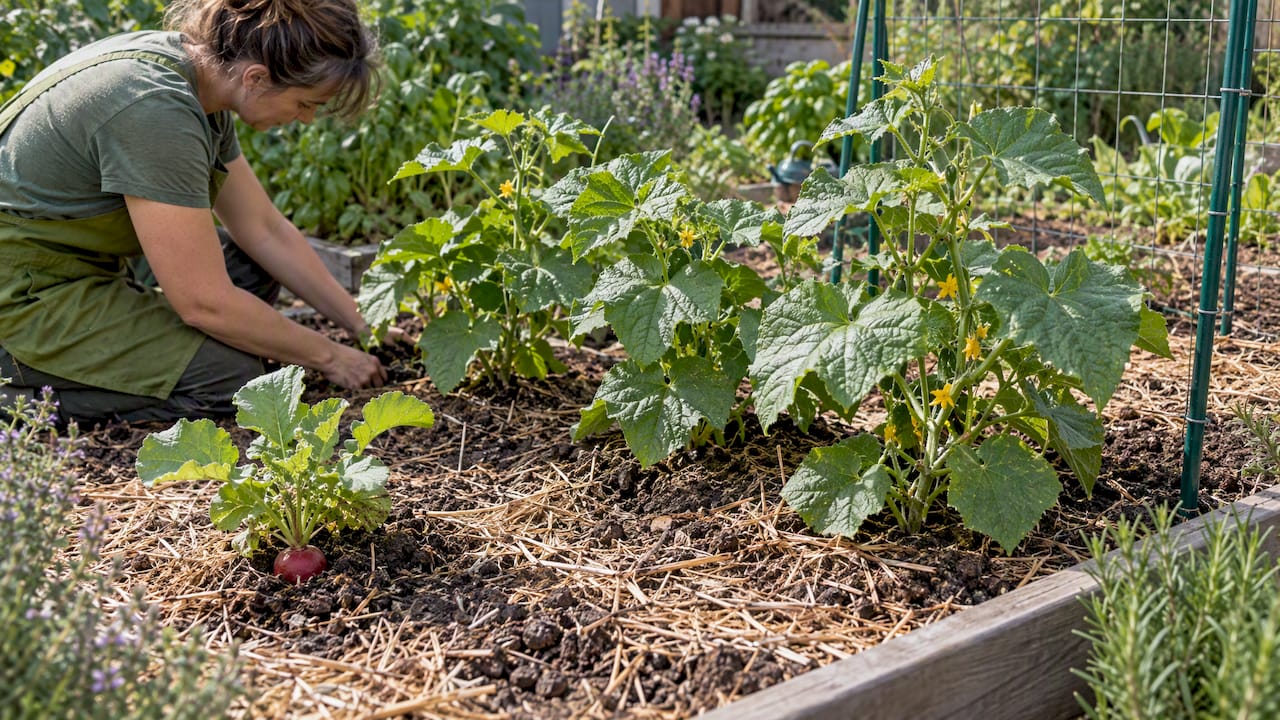
- Vining crops: train cucumbers, pole beans, and small melons up a trellis instead of letting them sprawl across limited floor space.
- Pollinator plants: compact marigolds, dwarf zinnias, and container-friendly lavender attract bees and butterflies even on a balcony, and staggering bloom times extends the nectar supply through the season, according to guidance on balcony pollinator gardens.
A simple pairing rule: one determinate tomato, one basil plant, and one marigold share a container well, since basil is thought to help deter some pests near tomatoes and marigold adds color without competing for root space. For succession planting, swap spent lettuce or radishes for a second round of greens once temperatures shift, keeping containers productive across more of the season.
4. Layout Tricks That Make a Small Garden Feel Bigger
A few deliberate design choices create the illusion of more space without adding a single square foot. Layering plant heights, from low groundcovers to mid-height shrubs to a tall vertical element, creates depth the eye reads as distance.
- Repeat, don’t diversify. Three matching pots of the same plant look curated; three different pots of three different plants look busy.
- Choose fewer, larger pots. A pair of 15-inch statement containers outperforms eight scattered 6-inch pots for visual impact and plant health alike.
- Limit your color palette. Two or three repeating colors, plus a consistent green backbone, reads as designed rather than random.
- Keep circulation clear. Leave at least 30 inches of walking path so the space feels usable, not cramped.
One widely cited design guideline suggests vertical growing can let gardeners productively use as little as 20 to 30 square feet of footprint, turning an unused wall or fence line into real growing area. Add seating only where it does not interrupt the main sightline to your focal point, since a chair placed mid-path makes even a well-planted space feel tight.
5. Watering, Feeding, and Seasonal Care for Containers
Container gardens behave differently from in-ground beds, and watering is the biggest adjustment. Containers dry out fast, often needing water daily or even twice daily during hot or windy stretches, and the material of the pot changes that cadence: plastic and resin retain moisture longer than unglazed terracotta, which needs more frequent attention.
Feeding also differs from garden beds, since nutrients wash out of containers with every watering. A slow-release granular fertilizer worked into the potting mix at planting covers baseline needs, while a diluted liquid feed every two to three weeks during active growth supports heavy feeders like tomatoes and peppers.
Winter care protects your investment in soil and containers. Insulating pots with bubble wrap or a commercial pot jacket, and raising them on feet so drainage holes stay clear of frozen water, measurably improves overwinter survival for plants left outdoors in cold climates.
- Check soil moisture daily in summer by pressing a finger an inch into the mix.
- Inspect leaf undersides weekly for early signs of pests.
- Watch for yellowing lower leaves, a common nutrient-stress signal in containers.
Pro Tip: Group containers by water need so you’re not overwatering drought-tolerant herbs to keep thirsty vegetables alive.
Our Approach to Sustainable, Water-Wise Small Gardens
We design small spaces around the same water-wise principles we apply to full residential landscapes: reduce waste, increase resilience, and keep maintenance realistic for the people living with the space. Micro-irrigation with a smart timer is one of the highest-leverage additions for a small planting area, since it delivers water directly to roots and can be adjusted seasonally without manual guesswork each day.
Design choices also cut maintenance significantly. Grouping plants by water need, using mulch to slow evaporation, and specifying built-in planters that double as seating or screening all reduce the day-to-day work a small garden demands.
If you’re considering a design consultation, three questions are worth asking: What is the maximum container size this space can structurally support? How will irrigation integrate with my layout? What maintenance load should I expect in year one versus year five?
- Micro-irrigation with a timer removes guesswork from daily watering.
- Mulch and grouped plantings reduce water loss and labor.
- Built-in planters combine seating or screening with growing space.
Soil Preparation and Improvement for Container and Small-Space Gardens
Soil is where most small-space gardens succeed or fail quietly, long before a plant ever shows stress. Field soil or dug-up yard dirt compacts in containers and drains poorly, so a quality potting mix formulated for containers is the starting point, not an upgrade. Extension guidance on container gardening basics recommends potting mix specifically because it balances drainage and moisture retention in ways garden soil cannot replicate in a confined pot.
For raised beds or small in-ground plots, amend existing soil with compost each season to rebuild nutrients that container-style intensive planting depletes quickly. A one- to two-inch layer of compost worked into the top few inches before planting restores organic matter without a full soil replacement.
Drainage holes are non-negotiable in every container, and a thin layer of coarse material at the base, rather than the old advice of gravel, helps prevent soil from washing out without creating a perched water table that drowns roots. Matching container size to a plant’s mature root system, as extension sources recommend, also keeps soil volume proportional to what the plant will actually need by midseason, not just at transplant.
Refresh potting mix partially each year rather than reusing it indefinitely, since nutrients deplete and structure breaks down after repeated watering cycles. Mixing in fresh compost or a bagged amendment at the start of each season keeps containers performing closer to their first-year vigor.
Seasonal Planning and Crop Rotation in Tight Quarters
Small spaces benefit enormously from thinking in seasons rather than planting everything once and hoping it lasts. Cool-season crops like lettuce, spinach, and radishes thrive in spring and fall, while warm-season plants like tomatoes and peppers need the heat of summer to produce well. Staggering these across the year keeps containers productive for more months than a single spring planting ever could.
Crop rotation matters even in pots, though the mechanics differ from in-ground beds. Repeating the same crop family in the same container season after season concentrates specific nutrient drains and can build up soilborne issues over time. Swapping plant families, moving from a leafy green to a legume to a fruiting vegetable across a year, helps balance nutrient use and interrupts pest or disease cycles that might otherwise establish themselves in one spot.
Succession planting stretches a small footprint further than any single planting plan. As soon as a quick crop like radishes or lettuce finishes, refresh the container with compost and start the next round rather than leaving soil idle. In a genuinely tight space, this kind of sequencing, two or three plantings per container per year, often produces more total harvest than a single spring planting ever could, simply by using the calendar more fully instead of using more square footage.
Pest and Disease Management in a Small-Space Garden
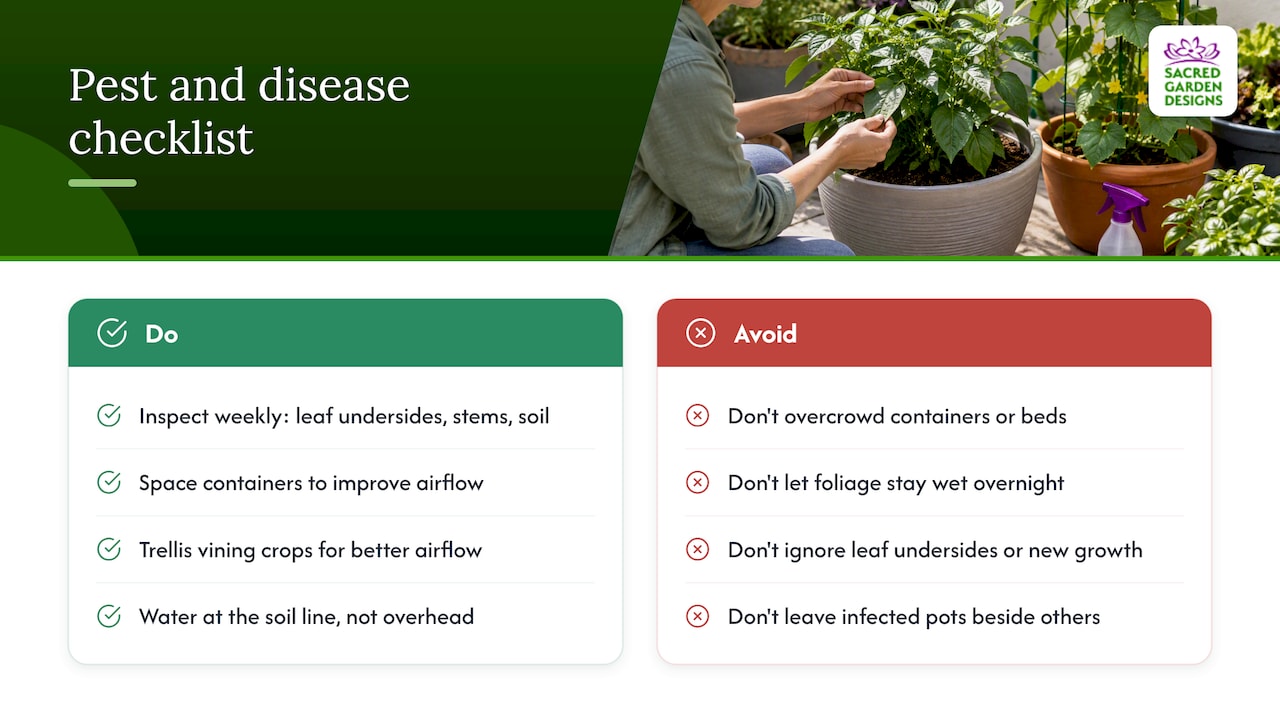
Pests move faster in a small, dense garden than in a sprawling yard, since plants sit closer together and share the same limited air circulation. The upside is that monitoring is also faster: a few minutes checking leaf undersides and stems each week catches most problems before they spread.
Good airflow is the first line of defense. Overcrowded containers trap humidity around leaves, which invites fungal issues like powdery mildew, so spacing plants to allow air movement between pots matters as much as spacing within a single bed. Vertical growing helps here too, since trellised vining crops get better air circulation than the same plants left to sprawl on the ground.
Water at the soil line rather than overhead when possible, since wet foliage overnight is one of the most common triggers for fungal disease in container gardens. A simple weekly inspection routine, checking leaf undersides, the soil surface, and new growth tips, catches aphids, spider mites, and early fungal spots while they are still manageable by hand removal or a targeted insecticidal soap rather than a broader treatment.
Rotating plant families season to season, as covered above, also reduces the buildup of soilborne pests and diseases that can otherwise persist in the same container’s potting mix. When a plant does show consistent stress despite good watering and light, isolating that single container from its neighbors prevents whatever is affecting it from spreading to the rest of a tightly packed layout.
Vertical Systems That Go Beyond a Basic Trellis
A single trellis against a fence is the starting point for vertical gardening, not the ceiling. Wall-mounted modular planting systems let you stack multiple growing pockets across a single vertical run, turning one fence section into the equivalent of several linear feet of bed space. Tiered shelving units serve a similar purpose for pots that don’t climb, letting lettuce, strawberries, and herbs occupy layered levels instead of competing for the same patch of ground.
Arches and arbors add an architectural layer that a flat trellis cannot: they create a planted threshold or focal point while still supporting vining crops like beans or small melons. For balconies and patios, free-standing A-frame trellises work where wall mounting isn’t possible, and they can be repositioned seasonally to chase better sun exposure.
Living walls, built from pocket fabric systems or modular planter grids, represent the most space-efficient option for pure volume of plants per square foot of footprint, though they need more attentive irrigation since individual pockets hold less soil than a standard container. A tool like Veete can help you mock up where a living wall, arbor, or tiered shelf would actually fit and how it will look at mature size before you commit to materials. Whichever system you choose, match the structure’s weight and water needs to what your wall, fence, or balcony railing can actually support over a full growing season.
Why We Design for Function Before Beauty
We have found that the small gardens people actually keep up are the ones built around one or two functions, not everything at once. A planter that doubles as a bench back gets used daily. A collection of twelve unrelated pots usually does not.
Realistic yields matter too. A single determinate tomato in a 5-gallon pot will not feed a family all summer, and setting that expectation early avoids disappointment later. Start by measuring your space and your sun hours, then try one well-sized container or a single wall trellis before expanding further.
— Denise Buchanan
Let Us Help You Design Your Small-Yard Garden
If you would rather start with a plan than trial and error, small yard designs under 5,000 square feet can use the same water-wise principles covered here: correct container sizing, vertical systems matched to your structure, and plant choices suited to your actual sun and space. This approach pairs sustainable installation with practical maintenance planning, so the garden holds up well past its first season.
- Landscape design for small yards: a full plan tailored to footprints under 5,000 square feet.
- Irrigation design and installation: micro-irrigation and smart timers built into your layout from the start.
- Classes and workshops: hands-on sessions if you want to learn the techniques yourself first.
Ready to move from planning to installation? Visit our landscape design services page to see how a small-yard project works from consultation through planting.
FAQ
What are some good gardening options for small spaces?
Vertical trellises, wall-mounted planters, and correctly sized containers are the most practical options, since they let you grow food or flowers without needing ground space. Compact and dwarf plant varieties paired with a few large statement pots typically outperform many small, scattered containers.
What is the 3-5-7 rule in landscaping?
The 3-5 rule is a design guideline suggesting plants and groupings look most balanced in odd numbers, such as clusters of three or five, since odd groupings read as more natural than even ones. It is used as a general visual-balance principle rather than a strict measurement.
What is the 70/30 rule in gardening?
Definitions vary somewhat by source, so treat it as a planning ratio rather than a fixed standard.
What is the 5-4-3-2-1 gardening method?
This is a planting ratio some gardeners use to balance a bed or container by plant role, though exact definitions vary across sources. A common version allocates portions of a planting to structural plants, mid-size fillers, color accents, groundcover, and a single specimen or focal plant, in descending proportion.
How much sun does a small container garden need?
Most warm-season vegetables like tomatoes and peppers need about 6 to 8 hours of direct sun daily, while cool-season greens can perform well with only 3 to 5 hours. South- and west-facing spots typically deliver the most intense light for sun-loving crops.