The best school garden programs start small, put students in charge of real decisions, and tie every bed to something taught in class. A few raised beds or containers, a site with at least six hours of sun and a plan that grows year by year will carry more learning than a big build nobody has time to run. Below are the activities, layouts, crops and roles that make that work, plus the site decisions that decide whether a garden thrives or gets abandoned by spring.
TL;DR
- Start small and add beds each year. USDA’s Farm to School Planning Toolkit recommends growing the program gradually.
- Pick the site first: six or more hours of sun, a nearby water source, good drainage and easy reach from the building.
- Use raised beds or containers when space or soil is limited, and keep beds narrow enough for children to reach the middle.
- Link garden work to math, science, language arts, art and nutrition so teachers can justify the time.
- Let students make design, layout and plant choices, and treat failed crops as lessons.
Table of Contents
- Garden program ideas that fit the school day
- Plan before you plant
- Make it work in a small space
- Easy crops and when to plant them
- Put students in charge
- Connect the garden to the curriculum
- Keep the garden running
- Where we come in
- Our perspective
- FAQ
- Sources
Garden program ideas that fit the school day
A garden program is more than a garden. It is a set of recurring activities that give teachers a reason to walk outside. The ideas below are grouped by the subject they support, so a principal can see where each one fits the curriculum.
Math and science in the beds
Illinois Extension’s classroom gardening page suggests math activities such as measuring plants, practicing fractions, tracking beans up a trellis and mapping the garden to scale. For science it points to exploring organisms, life cycles, pollination and soil structure. Rutgers Cooperative Extension adds identifying shapes, counting, calculating area and linear measurement, and running simple plant experiments.
A practical way to start: give each class one bed and one measurable question. Fourth graders can compare how fast radishes sprout in two soil mixes. Second graders can count seeds per pod and graph the result. Older students can draw the whole garden to scale before a single board is cut, then check their drawing against the finished site.
Language arts, social studies and art
Garden journals are the easiest entry point. Illinois Extension lists writing garden stories and poems, journaling, and designing a story garden under language arts. For social studies it suggests planting a Three Sisters garden and researching the history of the plants. For art, it names plant dyes, seed mosaics and leaf rubbings. Rutgers also mentions songs about plants for music and small builds such as rain gauges and toad houses.
These activities cost little and work in any season. A leaf rubbing needs paper and crayons. A rain gauge turns into a week of data collection, a line graph and a paragraph about what the numbers mean.
Health and nutrition
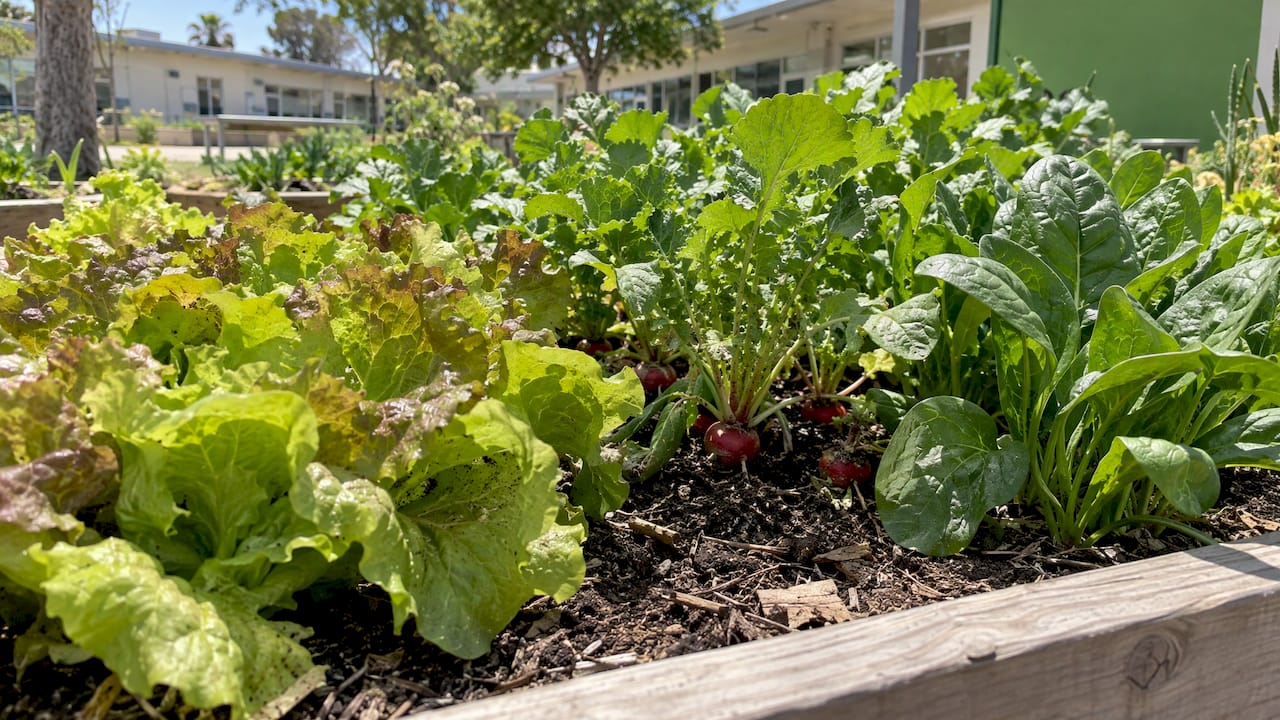
Taste testing and growing a salad garden are the two nutrition ideas Illinois Extension lists. They are also the easiest wins for cafeteria buy-in. A salad bed of lettuce, radishes and spinach, harvested by the same students who planted it, gives children a reason to try something they would skip on a tray. If your school already serves a salad bar, ask the food service team whether a student harvest can appear there once or twice a term.
Edible, pollinator and sensory themes
Once the basics run, themes keep older students engaged. Some that suit most schools:
- Salad and salsa garden: tomatoes, herbs and lettuce that turn into a class recipe.
- Pollinator patch: sunflowers, zinnias and cosmos that draw bees and butterflies for observation logs.
- Three Sisters bed: corn, beans and squash paired with a history lesson.
- Story garden: beds shaped or labeled around a book the class is reading.
- Weather station corner: a rain gauge and thermometer beside the beds feeding a data notebook.
Plan before you plant
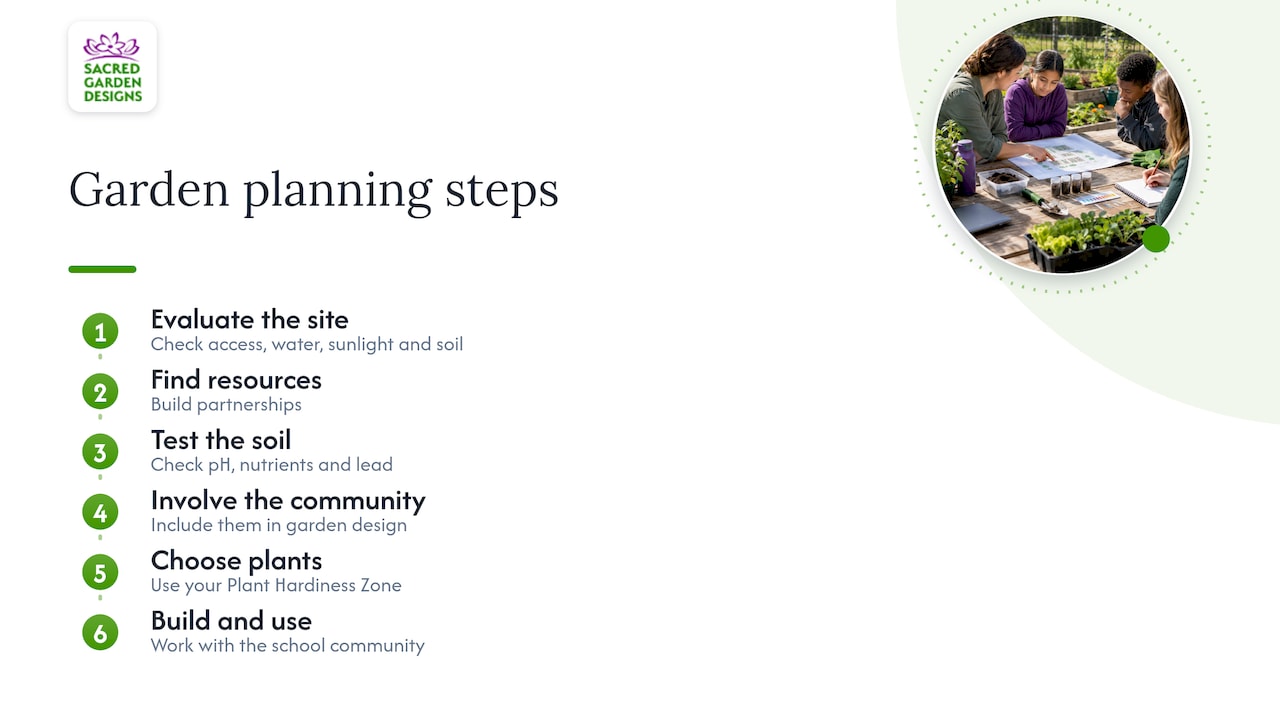
Most failed school gardens fail in the planning stage, not the planting stage. USDA’s Start a School Garden guidance lists six steps: evaluate the space and its access, water, sunlight and soil; find resources and build partnerships; test the soil for pH, nutrients and lead; involve the community in design; choose plants suited to your Plant Hardiness Zone; then build and use the garden with the school community.
The Texas Farm Fresh guide frames the same idea as five stages: Prepare, Design, Communicate, Execute, and Evaluate and Improve. It also says every landscape design project begins with a site analysis. The United States Botanic Garden’s School Garden Guide, produced with city education and garden partners, helps schools start a new garden, maintain an existing one and deliver garden-based instruction.
Choose the site
The USDA toolkit and the Collier Greens manual agree on the site checklist: at least six hours of sun for vegetables, a shade tree or covered space for group meetings, a water source, fencing, good drainage and a spot close to the school building. The USDA toolkit also asks you to consider how many students will work in the garden and at what grade levels, since that decides how many beds and how much path space you need.
Two extra checks save real money. First, the Collier manual advises requesting a survey from the school plant operator before drawing a site plan, so you know where pipes and wires run under the proposed beds. Second, it suggests planting large trees on the north side so they do not shade the vegetables.
Water pooling on the site is the problem schools discover late. If your chosen area stays soggy after rain, read up on how to fix yard drainage problems with grading rules before you place a single bed.
Test the soil
USDA lists testing for pH, nutrients and lead as its own step. For a school, that is not optional paperwork. Children handle the soil and eat what grows in it, so know what is in the ground before deciding between in-ground planting and raised beds filled with purchased soil.
Build partnerships and a budget
The same USDA steps include finding resources and partners. Parents, local extension offices, a master gardener group, a neighborhood business and the school’s facilities staff are all realistic partners. Assign one adult to coordinate and name a backup. A garden that depends on one enthusiastic teacher tends to stall when that teacher moves on.
Make it work in a small space
Little land does not rule out a program. The Collier Greens manual says you do not need much space for a great school garden and that you can adapt the plan to fit. The Nebraska Department of Education’s ECE Garden Guide says most plants need between six and twelve hours of sun a day, and that raised beds and containers can create a productive garden even in small areas.
GrowNYC School Gardens has supported over 900 schools across New York City since 2011, with gardens ranging from pots on a windowsill to outdoor raised beds, indoor grow towers and greenhouses. That range is the lesson: the format matters less than the consistency of use.
Containers, raised beds and indoor options
- Containers: almost anything with drainage holes works. Drainage is the one rule you cannot skip.
- Raised beds over pavement: Oklahoma State University Extension describes building a bed on concrete by layering cardboard and newspaper, then straw, peat moss, wood chips, vegetable scraps and garden soil, which breaks down into usable soil over time.
- Indoor herbs: the Nebraska guide suggests lemon balm or mint, which can grow under fluorescent lighting. Full-sun herbs such as chamomile or cilantro may need supplemental grow lights.
- Wall and vertical growing: a blank wall can hold a surprising amount. Our guide to turning 20 to 30 square feet of wall into a water wise small garden shows how compact planting works.
If you want a tested bed design, our 4×8 raised bed layouts with university-backed specs give you three plans a volunteer crew can copy in a weekend.
Size beds for children
Oklahoma State University Extension recommends beds no more than 4 feet across, or 3 feet for younger children, so a child can reach the halfway point from either side. It recommends aisles of at least 8 feet between beds, which leaves room for a class to gather and for wheelchairs and carts to pass. It also notes that fruiting vegetables need 6 to 8 hours of direct sun.
Easy crops and when to plant them
Choose plants that are safe, hardy, easy to grow and fun. The Kids Gardening Basics Toolkit offers these lists:
| Season | Suggested school garden plants |
|---|---|
| Cool season | Calendulas, dill, lettuce, radishes, pansies, peas, snapdragons, spinach, Swiss chard |
| Warm season | Basil, beans, cosmos, cucumbers, nasturtiums, pumpkins, sunflowers, zinnias |
Timing depends on where you are, and the school calendar adds a wrinkle: many warm-season crops ripen over summer when students are away. Plan fast crops such as radishes and lettuce for spring and fall, and assign summer watering to a volunteer schedule or choose crops that tolerate a gap.
Two examples show how local the dates are. Chicago Public Schools’ planting guides place Chicago in USDA Zone 5b/6a: cool-season crops go in as soon as the soil can be worked, typically early April, and again in mid to late August for a fall harvest, while warm-season crops wait until after the spring last frost, around May 15. In Oklahoma, OSU Extension gives an average first freeze between October 17 and November 15 and a last freeze between March 21 and April 20, varying across the state, and points to the Oklahoma Mesonet for local averages.
The takeaway is to use your own area’s frost dates, not a fixed calendar day. Our garden maintenance schedule built on frost dates walks through how to set the rhythm of planting, watering and cleanup around them.
Put students in charge
Oklahoma State University Extension advises that students take key roles in design, layout and plant selection, with adult guidance, because investment through garden work and harvest builds ownership and interest. Its Extension specialist Shelley Mitchell stresses that students should be in on every decision, and that mistakes make the best lessons: when something fails, ask the students what went wrong and what they would change next time.
Roles that work in practice:
- Garden designers: a student team draws the bed layout and presents it to the class.
- Weather and water monitors: read the rain gauge and decide whether beds need watering.
- Seed librarians: track what was planted, where and when.
- Harvest crew: pick, weigh and record yields.
- Compost captains: collect cafeteria scraps and turn the pile.
Rotate roles each month so every child touches every task, and keep a simple board where students sign up. Pair older and younger classes so the program does not depend on one grade.
Connect the garden to the curriculum
Teachers adopt a garden when it saves them work, not when it adds to the list. Build a one-page map that links each garden task to a standard or unit the teacher already covers. Rutgers’ fact sheet is a good template: science for plant characteristics and experiments, math for area and measurement, language arts for journals, music for plant songs and art for drawings and rubbings.
A sample term plan:
| Month | Garden task | Classroom link |
|---|---|---|
| 1 | Map the site and measure beds | Area, perimeter, scale drawing |
| 2 | Plant cool-season crops | Seed structure, germination |
| 3 | Weekly observation journals | Descriptive writing, graphing |
| 4 | First harvest and taste test | Nutrition, data collection |
| 5 | Compost and soil study | Decomposition, cycles |
Keep the plan flexible. A rained-out week should not break the schedule, so keep an indoor herb or grow-station activity ready for bad weather.
Keep the garden running
Maintenance is where good programs quietly die. A few habits help:
- Name a garden coordinator and a backup before the first planting.
- Put a hose or watering system where the beds are, not across the yard.
- Schedule summer and holiday watering with parent or community volunteers.
- Start small. USDA’s toolkit advises growing the program year by year rather than building everything at once.
- Evaluate at the end of each season, the final stage in the Texas plan, and write down what to change.
Irrigation is the biggest lever. A simple drip line on a timer removes the summer gap. Our guide to drip irrigation for raised beds covers a kit, DIY or pro approach, and the vegetable garden irrigation guide explains how much water vegetables need.
Where we come in
Schools that want more than a few planter boxes, such as a redesigned courtyard, terraced slopes, shaded gathering areas or a campus-wide plan, benefit from a design done up front. Sacred Garden Designs has worked on sustainable, water-wise landscapes for over 25 years, from residential yards to urban parks, and has earned eight Houzz Awards. Our design service starts at $1,500 for yards under 5,000 square feet and $2,500 for a full landscape design, and we also offer irrigation design and installation, slope stabilization, hardscape construction such as patios and decks, tree trimming and garden maintenance. See our landscape design services for details, or read our campus landscaping ideas for what works on real grounds.

We also teach. Our classes and workshops give teachers and parent volunteers a starting point for running garden learning.
Our perspective
A school garden succeeds when it is designed for the people who will use it every week. We have spent over 25 years designing water-wise, sustainable landscapes, and the pattern is consistent: plants chosen for the local climate, a water plan that does not depend on someone remembering, and beds sized for the hands that will work them.
Water is the first decision. A garden that needs constant hand watering will struggle through summer breaks, so we design irrigation and plant selection together. Drought-tolerant structure with edible and pollinator plants gives students real food and wildlife to observe without a daily crisis.
We also believe a garden should be beautiful. When a courtyard looks cared for, students, staff and neighbors treat it that way. Artistry and environmental thinking belong together, and children learn from both.
Denise Buchanan
FAQ
How do I start a school garden program with no budget?
Start with one or two containers or a single raised bed, and build partnerships first. USDA’s steps include finding resources and partners, so ask parents, local extension offices and neighborhood businesses for soil, lumber, seeds and volunteer hours. Add a bed each year as the program proves itself.
What are the easiest plants for a school garden?
The Kids Gardening toolkit lists lettuce, radishes, peas, spinach and Swiss chard for cool seasons, and beans, basil, cucumbers, sunflowers and zinnias for warm seasons. Fast, hardy plants give students quick results and keep interest high.
How big should raised beds be for children?
Oklahoma State University Extension recommends beds no wider than 4 feet, or 3 feet for younger children, so they can reach the middle from either side. It recommends aisles of at least 8 feet between beds so groups and wheelchairs can move through.
Can a school garden work with little outdoor space?
Yes. The Nebraska Department of Education’s guide says raised beds and containers can create a productive garden in small areas, and it suggests indoor herbs under fluorescent lights. GrowNYC supports gardens from windowsill pots to greenhouses.
How do teachers tie the garden to lessons?
Map each garden task to a unit already taught: measuring and area in math, plant life cycles in science, journals in language arts, leaf rubbings in art. Rutgers Cooperative Extension offers examples for each subject.
Sources
- Gardening in the Classroom, Illinois Extension
- Learning Through the Garden, Rutgers Cooperative Extension
- Start a School Garden, USDA
- USDA Farm to School Planning Toolkit
- School Garden Guide, United States Botanic Garden
- Texas Farm Fresh garden planning guide
- Collier Greens Resource Manual
- Nebraska ECE Garden Guide
- GrowNYC School Gardens Handbook
- Plants in the Classroom Quick Start Guide, Oklahoma State University Extension
- Plants in the Classroom Quick Start Guide (print), Oklahoma State University Extension
- Kids Gardening Basics Toolkit
- CPS Garden Planting Guides