An espalier is a fruit tree trained flat against a wall, fence or wire frame, so it gives you fruit from a strip only a foot or two deep. The method works best when you start with the right tree (a dwarf apple or pear is the classic choice), build a sturdy support before planting, and commit to pruning several times a year. Get those three things right and a bare wall becomes a productive, good-looking part of the yard. This guide walks through each one, with the numbers university extension programs publish.
TL;DR
- Apples and pears are the easiest espalier subjects. Peaches, nectarines and figs are harder, so start with the easy ones.
- Pick a spot with at least six hours of sun, good drainage and a support you can reach year-round.
- Build the trellis first: wires about 18 inches apart, standing 4 to 8 inches off the wall.
- Plan on pruning two to four times a year. Espalier saves space, not work.
- Expect a basic framework in three to four years, and fruit on spurs from year two onward.
Table of Contents
- What an espalier actually is
- Which fruit trees espalier best
- Choosing the site
- Pick a form
- Build the support first
- Plant and train, year by year
- Pruning and upkeep through the year
- What to expect
- Our perspective
- Let us plan your espalier wall
- FAQ
- Sources
What an espalier actually is
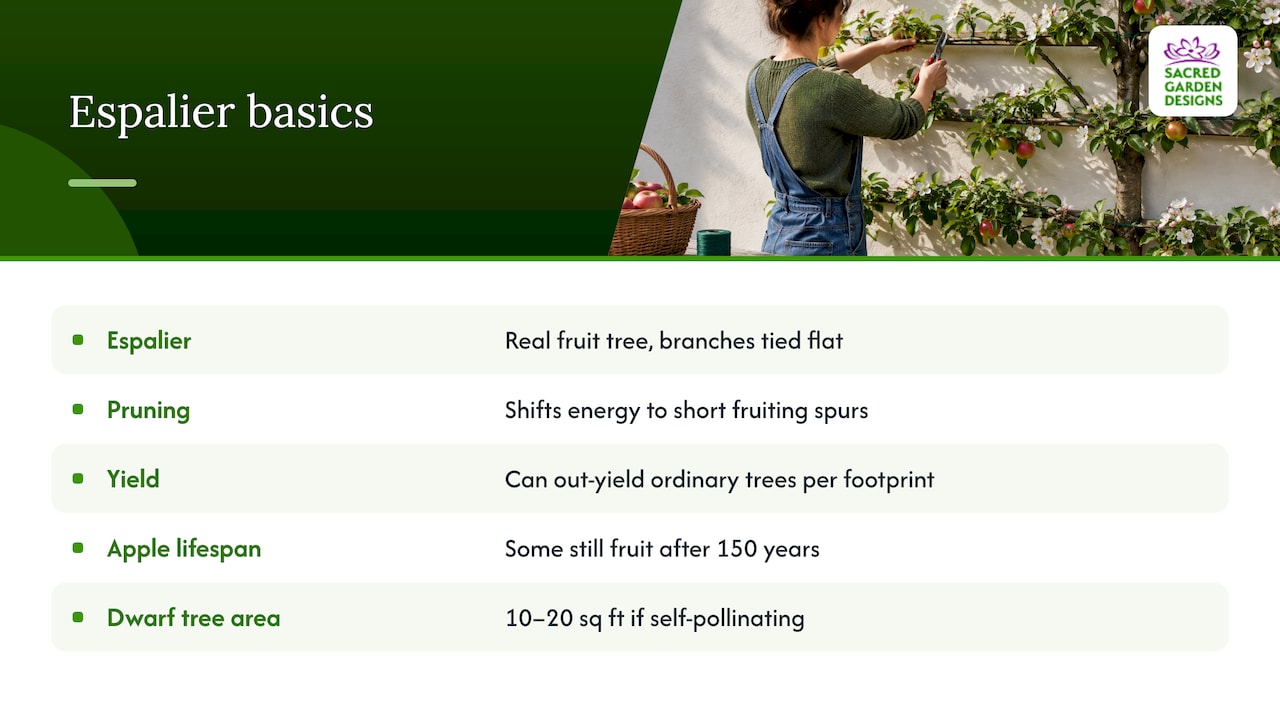
Unlike a vine on a decorative trellis, an espalier is a real fruit tree whose branches are tied to a flat plane and shaped over years. Pruning does the steering. Wisconsin Extension explains that intensive espalier pruning sends energy away from tall vertical growth and into short fruiting spurs, which is why the trees can out-yield ordinary ones for their footprint. The same source notes that some espaliered apple trees are still fruiting after 150 years.
The space savings are real. NC State Extension says a self-pollinating dwarf fruit tree can grow in a 10-to-20-square-foot area, and that cross-pollinating trees need at least twice that. With limited room, it lists espalier trees as one of the options to consider, along with dwarfing rootstock and container trees.
For homeowners with narrow side yards, a sunny block wall or a fence line, that matters. If you are working with a small footprint, our guide to turning 20 to 30 square feet of wall into a water-wise garden shows how much a vertical surface can carry.
Which fruit trees espalier best
The trees that train well have flexible new growth and spurs, the short stubby shoots that bear fruit year after year. Wisconsin Extension says apples and pears are the traditional choices because their spurs live for years and their new growth bends easily. Dwarf cultivars are easier to train than full-size trees.
UC Cooperative Extension ranks species by difficulty in a 2018 workshop handout:
| Difficulty | Trees |
|---|---|
| Easiest | Apple, European pear, Asian pear, citrus, genetic dwarf trees |
| Fairly easy | Apricot, cherry, plum, pluot, pomegranate |
| Most challenging | Peach, nectarine, fig, persimmon |
The hard group bears fruit on long branches or on new shoots, which fights the tight, repeated pruning an espalier needs. A Utah Ask Extension answer advises beginners to avoid peaches, nectarines and nut trees until their skills are solid.
Best apple and pear varieties to start with
OSU Extension’s Erica Chernoh, answering a reader question in 2025, recommends spur-bearing apples on seedling rootstock as ideal, with dwarf rootstock the next best option. They bear on short stems and throw fewer watersprouts, the fast vertical shoots that wreck a flat shape. She names Liberty, Honeycrisp, Braeburn and Golden Delicious as apple varieties that perform well, and Kieffer and Bartlett among European pears. Liberty and Honeycrisp also resist scab, a common apple disease.
Apples and pears need a pollination partner. The same answer says to plant two varieties of each type, or a tree with a grafted pollinizer, and to match their bloom times. Some nurseries sell trees with several varieties already grafted on one trunk, which solves the problem in one wall’s worth of space.
Check your chill hours first
Many fruit trees need a set number of winter hours below 55°F to blossom and fruit properly. UC Marin Master Gardeners warn that if your microclimate does not supply them, the tree may break dormancy late and fail to bloom or fruit well. Ask the nursery to confirm your area meets the requirement. In Southern California, where winters are mild, we have a separate guide to fruit trees for Los Angeles yards with 100 to 500 chill hours. Citrus, which needs no winter chill, is another easy espalier subject, and our note on when to prune citrus covers its timing.
Choosing the site
Site decisions are hard to undo once a tree is trained, so make them before you buy anything.
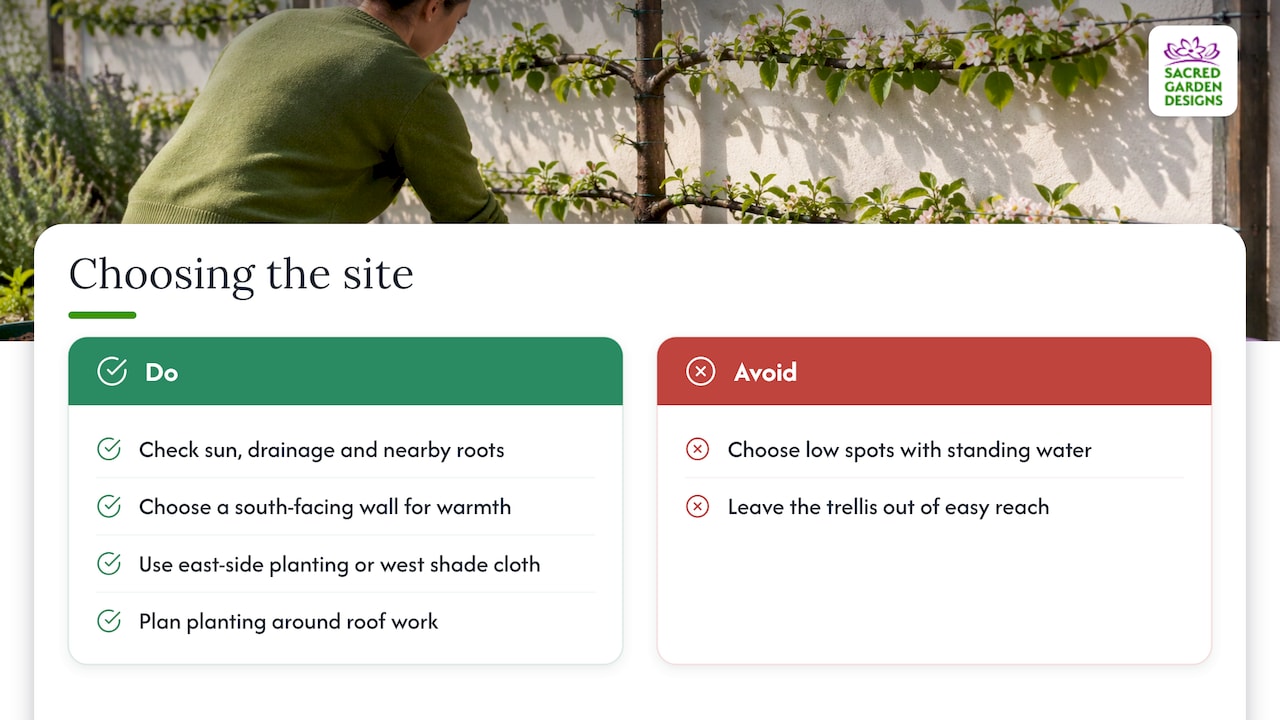
Sun. UC Marin Master Gardeners say to look at sun angle, at least six hours of daily sun, soil drainage and how close other plants’ roots are. NC State adds that standing water in the root zone for two to three days can kill a fruit tree, so skip low spots.
Warmth. A south-facing wall gives a warmer microclimate. The Utah Extension answer says this can let you grow trees that might not normally do well in your hardiness zone.
Too much sun. In hot climates, the narrow canopy lets sun in, but excess sun burns branches and exposed fruit. The UC workshop handout recommends planting on the east side of a building, hanging shade cloth on the west side, and painting south- and west-facing branches with a 50:50 mix of interior white latex paint and water before they sunburn, especially after summer pruning. If you want to shade a hot wall more permanently, see our ideas for water-wise shade structures.
Access. Nebraska Extension says the trellis must be within easy reach for year-round maintenance, and that a poorly maintained espalier is an eyesore. Leave room to stand, reach and carry a ladder.
One practical point for house walls: if the roof is due for work, plan the planting around it, because debris and foot traffic can damage a young tree. These tips on protecting landscaping during roof work are worth reading before the contractors arrive.
Pick a form
Wisconsin Extension lists six traditional patterns: cordon, Palmetto Verrier, fan, candelabra, informal and Belgian fence. Formal, symmetrical designs take much more effort than informal ones. UC Marin Master Gardeners say fruit trees are easiest to train in fans or other patterns that follow their natural growth habit.
For a first project, a horizontal cordon (tiers of level arms) on three or four wires is the standard, and the steps below follow it. Some nurseries sell pre-trained trees with the basic shape already started, which saves the first year or two.
Build the support first
A fruit-laden dwarf tree is heavy, and wind adds load. USU Extension notes that fully dwarf apples can fall over under fruit weight or heavy wind if unsupported. Build the structure before planting.
- Free-standing trellis. UC Marin Master Gardeners recommend metal or rot-resistant wood posts set in concrete, with heavy 12- or 14-gauge wire, eye screws and turnbuckles to keep it taut. OSU Extension suggests posts 8 feet apart with the first wire 18 inches above the ground and typically three more at 18-inch spacing.
- Wall-mounted wires. K-State Extension says on brick, stone or concrete walls you can attach horizontal wires to eyebolts. It recommends leaving 4 to 6 inches between tree and wall for air circulation, less disease and room to tie and prune. UC Marin gives six to eight inches for structures built against a wall.
Wire spacing varies a little by source. UC’s pruning guidelines for arborists describe three to four wires about 1½ to 2 feet apart, and Kentucky’s HO-101 uses wires at 18, 36, 54 and 72 inches. Any of these works. Pick one and keep the tiers even.
Posts in concrete, retaining walls and fence lines are construction work, and we build patios, decks, fences and retaining walls as part of our hardscape services, so the structure that carries your trees can be planned along with the rest of the yard.
Plant and train, year by year
This sequence follows OSU Extension’s beginner guide and the University of Kentucky’s HO-101.
- Buy a young dwarf tree. OSU recommends a 1- or 2-year-old tree, planted in late winter (usually February) in the middle of the trellis. Nebraska Extension adds that the tree should have several well-balanced limbs off the trunk. Where it goes wrong: buying a large, old tree whose branches are already too stiff to bend.
- Make the first cut. UC Fresno Gardening Green says to cut the sapling above the bud where the first branches should begin, 18 to 24 inches from the soil. Kentucky’s guide cuts an unbranched whip just above the highest bud below the lowest wire before spring growth.
- Pick two side branches. Choose two flexible branches and tie one to each side of the lowest wire. Prune out the thick upright leader and other shoots. Where it goes wrong: keeping the leader because it looks strong, which leaves you with a tall tree instead of a flat one.
- Tie loosely, at the right angle. Kentucky’s authors explain that tying shoots nearly horizontal reduces vigor and encourages flower buds, while tying the tip below horizontal stops tip growth and triggers vigorous shoots along the upper side. Tie angle controls where the tree grows. Use ties made of organic fiber that breaks down, which UC Fresno says reduces damage, and tie branches while they are young and soft.
- Remove weak suckers early. Pull weak vertical suckers when small. Leave spurs about every 6 inches and prune them to three leaves during the growing season. Fruit forms on them after two years.
- Add tiers. In years two and three, train two new lateral branches along the next wire up, as OSU describes. Wisconsin Extension says simple designs can have their basic framework set in three or four years, while intricate designs take longer.
- Renew spurs. After about four years, remove spurs along one bottom branch, then alternate sides each year as you move up.
For a stronger expectation of timing, Kentucky says fruit trees should be producing heavily by the end of the fourth season. UC’s backyard orchard guide adds that young trees may not bear much for the first few years, and that apple and pear spurs last 5 to 8 years.
Pruning and upkeep through the year
Pruning is the job. OSU horticulturist Cody Copp says the most important part of growing an espaliered tree is pruning, and that espaliers need pruning several times in a growing season to stay in control.
- Dormant season. Wisconsin Extension says main pruning happens in late winter or early spring when the tree is dormant, or after flowering for spring bloomers. Prune to buds that face the direction you want growth to go.
- Spring and summer. Kentucky’s guide says to cut new growth when it is about two inches long, removing about a quarter of the previous season’s growth. Around August 1, or when new growth reaches 10 to 12 inches, cut it back to two or three buds, repeating a month later if needed. This builds flower buds and keeps growth in bounds. In Fresno, UC says late July or early August is the critical summer pruning window for fruit production.
- Frequency. The UC workshop advises pruning espalier trees two to four times a year, keeping the upper canopy narrow. Once the shape is set, Wisconsin Extension suggests light monthly trimming of stray shoots growing out of the flat plane.
- Stone fruit. UC Fresno says to prune plums, cherries and apricots after harvest and not when rain is forecast, because wet conditions encourage fungal disease. Make thinning cuts just below the branch collar, leaving no stub.
- Light. UC’s arborist guidelines explain that fruit forms on spurs and one-year-old wood that need sunlight, so removing vigorous upright shoots keeps the lower canopy fruiting.
- Protection. Whitewash trunks and main branches with the 50:50 paint mix at the start and after summer pruning, as UC Marin advises. Netting may be needed against birds, insects and small mammals.
If your climate is mild and the seasons are less clear-cut, timing by frost dates works better than a fixed calendar. See our garden maintenance schedule and our guide to tree trimming season in Los Angeles.
An espalier also needs steady water. Drip lines along the base of the wall deliver it without wetting the foliage, and our guide to drip irrigation for raised beds covers the layout principles.
What to expect
Espalier saves ground, simplifies harvest and looks good in winter. It does not save labor. Copp likens it to growing grapes or wisteria correctly: it does not take up much room, but it takes dedication and time, and it is not less work than a regular tree. Treat the monthly and seasonal prune as a standing appointment and the payoff is a tidy, productive wall for decades.
Our perspective
We design yards where every square foot has to earn its place. An espaliered apple or pear on a sunny wall does that: it gives fruit, shade for the wall, structure in winter and a reason to be outside.
What makes it work is planning, not just pruning. The wall’s exposure, the soil, the water source and the support all have to be settled before the tree goes in. When they are, training becomes a calm, repeatable routine.
That is the way we approach water-wise and edible gardens: design the whole space, build what needs building, then keep it going with a simple maintenance rhythm. A trained tree is one of the most satisfying parts of it.
Denise Buchanan
Let us plan your espalier wall
Our landscape design services are published at $1,500 for yards under 5,000 square feet and $2,500 for a full landscape design. A design can place an espalier wall alongside irrigation, paving and planting, and we also offer irrigation design and installation, tree trimming and garden maintenance.

See our landscape design services to get started, or browse the full list of services. If you would rather learn the technique hands-on, we also run classes and workshops.
FAQ
What is the easiest fruit tree to espalier?
Apples and European or Asian pears on dwarf or spur-bearing rootstock. UC Cooperative Extension ranks them, along with citrus, in the easiest group. Choose varieties that suit your chill hours and plant a compatible pollination partner.
How long until an espaliered tree bears fruit?
Spurs begin fruiting about two years after they form, according to OSU Extension. Kentucky’s guide says trees should be producing heavily by the end of the fourth season. Simple frameworks are usually established in three to four years.
How much space does an espalier need?
The depth is small: leave 4 to 8 inches between the branches and a wall for air flow and tying. Along the wall, trellis posts are commonly set about 8 feet apart. Cross-pollinating trees need roughly twice the space of a self-pollinating dwarf, per NC State.
When should I prune an espalier?
Do main pruning in late winter or early spring while the tree is dormant, then prune again in spring and summer to control new growth. Stone fruits are best pruned after harvest and in dry weather. Most espaliers need two to four prunings a year.
Sources
- Espalier, Wisconsin Horticulture Extension
- NC State Extension: Tree Fruit and Nuts
- UC Cooperative Extension: Espalier Training for Fruit Trees
- Ask Extension: Wanting to espalier some fruit trees
- Ask Extension: Best espalier fruit trees in Eugene
- UC Marin Master Gardeners: How to Espalier
- UC Fruit and Nut Tree Pruning Guidelines for Arborists
- OSU Extension: Train fruit trees as espaliers
- University of Kentucky HO-101: Care of Woody Plants
- Roofing landscape protection