The best travel snack pairs protein with fiber or healthy fat, and it survives a suitcase, a hot glove box, or a TSA bin without falling apart. A classic pick: an apple with a single-serve almond butter packet. It travels clean, needs no cooler, and keeps blood sugar steadier than a granola bar loaded with syrup. Once you have that rule down, the rest is just packing logistics, which we cover next.
TL;DR:
- Solid, protein-rich snacks like nuts, seed crackers, and single-serve nut butter packets are best for TSA security and travel safety.
- Perishable items such as yogurt and cheese should be kept cold in an insulated pouch and consumed within a couple of hours or four days when refrigerated.
- For road trips, snacks should be easy to grab with one hand, avoid crumbling or melting, and include whole fruit, nuts, seed crackers, or plant-based jerky.
- When flying, opt for single-serve, shelf-stable items like nuts, protein bars, and dried fruit, and plan to eat or refrigerate items like yogurt and hummus before security.
- Prefabricated plant-based chips from brands like Trinity Chips offer convenient, shelf-stable options that meet nutritional criteria for travel, requiring no refrigeration.
Table of Contents
- What Makes a Snack Actually Good for Travel
- Will the TSA Let You Bring That Snack Through Security?
- What Snacks Travel Best in the Car?
- What Are the Best Snacks to Bring on a Flight?
- How Do You Pack and Portion Snacks So They Stay Fresh?
- Which Make-Ahead Snacks Are Worth the Prep Time?
- How Do You Handle Food Allergies and Restrictions While Traveling
- Where Can You Find Healthy Snacks If You Didn’t Pack Ahead?
- Why This Approach Beats the Usual Travel-Snack Advice
- A Ready-Made Option That Already Fits This Checklist
- Sources
What Makes a Snack Actually Good for Travel
A snack that combines protein, fiber, and a little healthy fat digests slower, which means steadier energy instead of a sugar spike followed by a crash somewhere over Nebraska. That combination matters more on travel days than any other, because you’re sitting still, stressed, and surrounded by vending machines stocked with the opposite of what your body needs.
Shelf-stable options are your foundation. Raw nuts, roasted pumpkin or sunflower seeds, roasted chickpeas, seed crackers, and nut-butter squeeze packets all sit safely at room temperature for days. Look for protein-and-fiber-rich picks like roasted chickpeas over chips. Protein bars work too, but check the label. A bar with 20 grams of added sugar isn’t a health food just because it’s labeled “protein.”
Perishables earn their spot when you’ve got a cooler or a short trip. Hard-boiled eggs, single-serve Greek yogurt cups, and string cheese all deliver real protein, but they need to stay cold and get eaten within a couple of hours at room temperature.
A few easy swaps make a real difference:
- Trade the gas-station candy bar for trail mix with a controlled portion size.
- Swap flavored chips for roasted chickpeas or seed crackers.
- Replace sugary yogurt cups with plain Greek yogurt and your own fruit.
- Choose sparkling water over soda when you need something with flavor.
Will the TSA Let You Bring That Snack Through Security?
Solid foods clear security without much fuss. TSA guidance confirms solid foods are allowed in carry-on bags, while liquids and gels face limits. That means whole fruit, nuts, seed crackers, and protein bars pass through without a second look.
Spreads are the trap. Peanut butter, hummus, and yogurt all count as liquids or gels under TSA rules, and containers over 3.4 ounces (100 ml) get pulled at the checkpoint. TSA explicitly classifies peanut butter as a liquid or gel for screening purposes.
Work around it instead of fighting it:
- Buy single-serve nut butter packets, which sit well under the 3.4 oz limit.
- Pack powdered peanut butter as a solid substitute.
- Choose cheese sticks or nut butter on crackers assembled after security instead.
Keep any cooled items in an insulated pouch and expect a screener to ask you to open it.
What Snacks Travel Best in the Car?
Road trips reward snacks you can grab one-handed without looking down. That rules out anything crumbly, drippy, or prone to a full meltdown on a hot dashboard.
- Whole fruit that doesn’t bruise easily, like apples, oranges, or grapes in a sealed container.
- Pre-portioned nuts or roasted chickpeas in small bags, so nobody’s digging a fist into a family-size tub at 70 miles per hour.
- Seed crackers paired with individually wrapped cheese.
- Plant-based jerky or meat sticks for a protein hit that doesn’t need refrigeration.
- Nut-butter squeeze packets, mess-free and kid-friendly.
Set up a real snack station before you leave: a small soft-sided cooler with an ice pack, a roll of napkins, and a trash bag clipped to the console. Skip anything heavily glazed, saucy, or prone to crumbling into the seat cushions. Chocolate bars and cheese that melts fast belong in the cooler, not the cupholder.
What Are the Best Snacks to Bring on a Flight?
Solid, single-serve items are your safest bet for healthy snacks for flights: a small bag of almonds, seed crackers, a protein bar with a short ingredient list, or a nut-butter squeeze packet. Dried fruit works in small amounts, but portion it out ahead of time since it’s easy to overdo the natural sugar.
Borderline items need a plan. Yogurt and hummus both count as gels under TSA rules, so buy the 4 oz travel-size versions or smaller, or plan to eat them before you reach the checkpoint. A cooler pouch with a small ice pack keeps them safe until then.
- Nuts, seeds, or seed-based trail mix in a resealable bag
- Whole fruit like apples, bananas, or clementines
- Protein bars with recognizable ingredients
- Single-serve nut butter or hummus under 3.4 oz
Hydration matters just as much as the snack itself. Buy a bottle of water after security, or bring an empty one to refill, and lean on water-rich snacks like grapes or clementines to help offset cabin dryness.
How Do You Pack and Portion Snacks So They Stay Fresh?
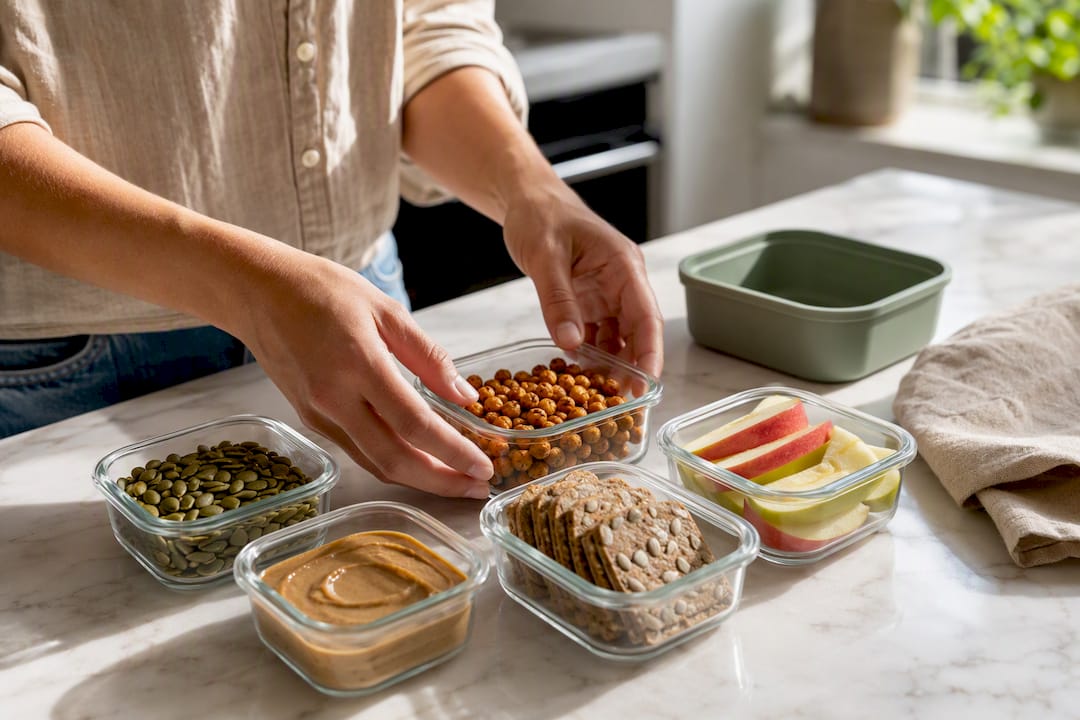
Portioning prevents two problems at once: mindless grazing and soggy, crushed food by the time you land. Pre-measured bags also make TSA screening faster, since a screener can see exactly what’s in each one.
- Portion snacks into small bags or containers before you leave, aiming for single servings rather than a family-size bag you’ll pick at all day.
- Use a soft cooler with a TSA-approved ice pack (frozen solid ones typically pass through security; partially melted ones may not) for anything perishable.
- Layer heavier, sturdier items like nuts and crackers at the bottom of your bag, and put anything crushable, like fruit or crackers, on top.
- Follow the two-hour rule for perishables at room temperature. In a hot car, cut that window down significantly. Closed cars heat up fast, and anything needing refrigeration for more than two hours becomes a real food-safety risk.
Pro Tip: Freeze your yogurt cup or cheese stick the night before. It thaws by snack time and doubles as a makeshift ice pack for everything else in the cooler.
Which Make-Ahead Snacks Are Worth the Prep Time?
A little kitchen time before you leave pays off the moment you’re stuck at a gate with no good options nearby. These five hold up well and cover both shelf-stable and cooler-only needs.
- Energy bites (dates, nuts, seeds, blended and rolled into balls): shelf-stable for several days, no refrigeration required.
- Roasted chickpeas: seasoned and oven-roasted, shelf-stable, and a genuinely satisfying chip replacement.
- Egg muffins or mini frittatas: baked in a muffin tin, portioned, and refrigerated. Eat within four days and keep cold in transit.
- Layered yogurt jars with granola and berries: needs refrigeration and a container under 3.4 oz if it’s going through airport security.
- DIY trail mix: nuts, seeds, and a small amount of dried fruit, portioned into quarter-cup servings. Shelf-stable and easy to make nut-free or fully plant-based by swapping in seeds and dried fruit only.
How Do You Handle Food Allergies and Restrictions While Traveling
Travel days strip away your usual safety net. No familiar kitchen, no ingredient labels you’ve memorized, and often no idea what’s actually in the snack mix at a gas station counter. That makes pre-planning around allergies and dietary restrictions more important on the road than at home, not less.
For gluten-free travelers, stick to whole fruit, plain nuts, seeds, and rice-based crackers with a clearly labeled gluten-free certification, since cross-contamination risk goes up at self-serve snack bars and buffet-style airport kiosks. Read labels closely on flavored nuts and trail mixes. Wheat-based thickeners show up in surprising places, including some seasoned chickpea snacks and flavored jerky.
Nut-free travelers should lean on seed-based alternatives: pumpkin seeds, sunflower seed butter instead of peanut or almond butter, and seed crackers instead of nut-based granola bars. Always check shared-facility warnings on packaged snacks, since cross-contact labeling varies a lot between brands.
Vegan road trip snacks are some of the easiest to source and pack. Roasted chickpeas, whole fruit, seed-based trail mix, hummus (in TSA-compliant portions), and plant-based jerky alternatives all fit without much substitution. Vegan protein bars have improved significantly, but scan the label for honey or whey, which sneak into some “natural” bars.
When you’re packing for a group with mixed restrictions, portion everything separately rather than relying on one shared trail mix. It’s a small step that avoids a lot of confusion, and potential risk, at 30,000 feet.
Where Can You Find Healthy Snacks If You Didn’t Pack Ahead?
Not every trip allows for prep time, and that’s fine. Airports, gas stations, and grocery stores all carry better options than they used to, if you know where to look.
Grocery stores near airports and highway exits almost always beat the convenience store attached to a gas pump. A quick stop at a supermarket on the way to the airport gets you fresh fruit, single-serve nut packs, and yogurt cups for a fraction of what an airport kiosk charges for the same thing.
Inside the terminal, skip the candy aisle at the newsstand and look for the grab-and-go cooler case instead. Most major airports now stock hard-boiled egg packs, hummus and veggie cups, and cheese-and-cracker boxes right alongside the sodas. Convenience stores along highway routes have also expanded their better-for-you sections. Look for the nut aisle, the produce basket by the register, or a cooler case with string cheese and yogurt.
If you’re stuck with limited choices, the pairing rule still applies: grab something with protein (jerky, cheese, nuts) and something with fiber (fruit, a whole-grain option) rather than defaulting to a bag of chips. Even a gas station has a banana and a bag of almonds somewhere on the shelf, usually near the register rather than the snack aisle. It just takes a few extra seconds of looking.
Why This Approach Beats the Usual Travel-Snack Advice
Most travel snack lists read like they were written by someone who’s never actually stood in a TSA line holding a container of hummus they’re about to lose. The advice online tends to split into two useless extremes: rigid meal-prep perfectionism that assumes you have three hours and a dehydrator, or vague “just pack some snacks” hand-waving that ignores the actual friction points, like the fact that peanut butter gets flagged as a gel and yogurt has a shelf life measured in hours, not days.
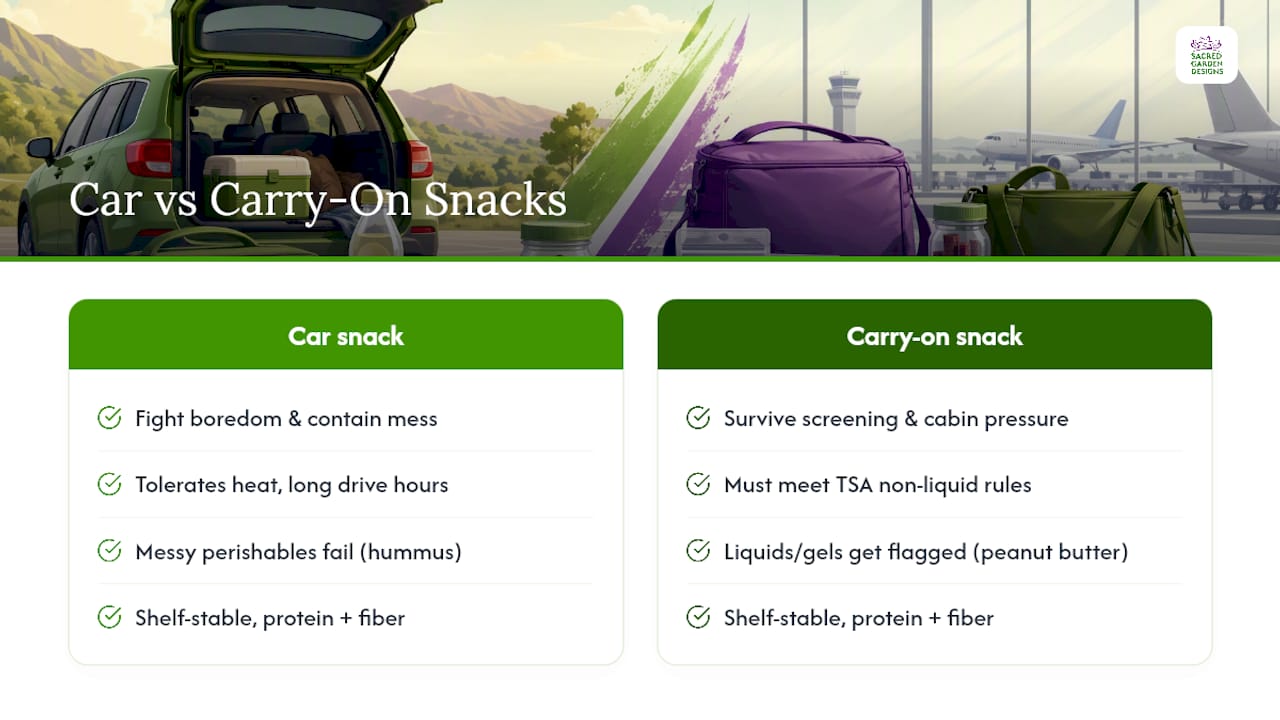
What separates a good travel snack list from a generic one is scenario awareness. A car snack and a carry-on snack solve different problems. One fights boredom and mess on a six-hour drive; the other has to survive a screening checkpoint and a pressurized cabin. Treating them the same is why so many people end up tossing a $6 container of hummus into an airport trash can.
Denise Buchanan has covered food and wellness topics with an eye for the gap between what nutrition advice promises and what actually survives contact with a real travel day. This piece reflects that same standard, built on TSA’s own published guidance and dietitian-backed pairing principles rather than recycled listicle advice. Some companies apply the identical shelf-stability and protein-fiber criteria to their plant-based snack lines, because a snack that fails on a hiking trail fails just as fast on a layover.
— Denise Buchanan
A Ready-Made Option That Already Fits This Checklist
If you’d rather skip the prep entirely, some plant-based chips are built around criteria like shelf-stable, portioned for grab-and-go eating without a cooler or an ice pack in sight.

The chips are packaged for single-serve portions, which means no measuring, no resealable bags, and no guessing about how much is actually in your hand before your flight boards. They’re built for the exact moments this guide covers: tucked into a carry-on for a flight, stashed in the glove box for a road trip, or grabbed on the way out the door for a midday energy dip that would otherwise send you toward a vending machine. As a plant-based product from a company rooted in sustainable practices, Trinity Chips fit naturally alongside the other swaps in this guide, like roasted chickpeas and seed crackers, without asking you to compromise on convenience. Check availability and order Trinity Chips through Sacred Garden Designs before your next trip.