The best groundcover for a Los Angeles slope is usually a deep-rooted California native or a proven drought-tolerant spreader, planted small, set in basins, watered by drip and mulched until it fills in. Pick low, non-woody plants if your hill sits in fire country. On steeper ground, plants alone may not be enough, and a structural fix goes in first. Below: what to plant, how to plant it, how to water it and where a professional earns their fee.
TL;DR
- Native groundcovers and low shrubs such as ‘Pigeon Point’ coyote brush, ‘Bee’s Bliss’ sage, California buckwheat and manzanita cultivars are the core of a Southern California slope planting.
- Plant small plants high on the slope and larger, thirstier ones lower down. Use drip irrigation, a half-moon basin at each plant and a generous mulch layer.
- Expect weekly water while plants establish, then much less once roots are down.
- Avoid woody, spreading species on slopes in wildfire areas, and keep plants low and well spaced near the house.
- Steep or fast-draining slopes may need terracing, wattles or a retaining wall before any planting.
Table of Contents
- What groundcover does on a slope
- Groundcovers and low shrubs that work on Los Angeles slopes
- Fire-smart choices for hillside groundcover
- When plants alone are not enough
- How to prepare and plant a slope
- Watering a new slope
- Maintenance in years one to three
- Our perspective
- Work with us on your slope
- FAQ
- Sources
What groundcover does on a slope
Vegetation holds soil in two ways. Roots bind loose soil, and foliage slows the water that would otherwise carry it downhill. The UN Food and Agriculture Organization describes how root systems reinforce a slope by bonding unstable surface soil to the more stable soil beneath it. A mat of leaves also breaks the force of rain before it hits bare dirt.
That matters in Los Angeles because rain here arrives in short, heavy bursts after long dry spells. Bare, sun-baked soil sheds water instead of absorbing it. A planted slope with mulch and basins gives the same storm somewhere to go.
True groundcovers, though, are only one layer. The strongest hillside plantings combine low spreaders, mid-height shrubs and the occasional bunchgrass, because each has a different root depth. The California Native Plant Society notes that native shrubs hold slopes through deep roots and a blanket of foliage. Think of “groundcover” in this guide as the low, spreading layer of that mix.
Groundcovers and low shrubs that work on Los Angeles slopes
The plants below are the ones named by California horticultural and native-plant sources for Southern California slopes. Pair them with the sun exposure, soil and fire zone of your own lot.
| Plant | Type | Notes for slopes |
|---|---|---|
| ‘Pigeon Point’ coyote brush (Baccharis pilularis) | Native, mounding groundcover | Described by CNPS as an ideal slope holder with deep roots |
| ‘Bee’s Bliss’ sage | Native groundcover sage | Low water needs once established |
| California buckwheat (Eriogonum fasciculatum) cultivars | Native low shrub | Widely used for slope stability in Southern California |
| ‘John Dourley’ and Carmel Sur manzanita | Native, low-growing | Good for sunny, well-drained hillsides |
| White sage (Salvia apiana) | Native shrub | Another effective native for slope stability |
| Chaparral yucca (Yucca whipplei) | Native accent | Suited to slopes with little foot traffic because of its sharp foliage |
CNPS lists coyote brush, ‘Bee’s Bliss’ sage, buckwheat cultivars and ‘John Dourley’ manzanita among the native plants that hold hot, sunny slopes, and says they need water about once a week to establish and can live on less afterward.
Choosing by exposure
South- and west-facing slopes in the Valley, the Santa Monica Mountains foothills or the San Gabriel front take the harshest sun. Buckwheat, white sage, and manzanita are natural fits there. North-facing and coastal-influenced slopes hold moisture longer and suit coyote brush and groundcover sages well. If you are not sure which side of the spectrum you are on, watch where the soil stays damp three days after a rain.
Keep it low-maintenance
A groundcover that needs constant trimming defeats the purpose of planting a hill you can barely walk on. Choose plants whose mature size fits the space, so you are not hacking at them on a slope. For more candidates, our guides to drought-tolerant groundcovers and native trees, shrubs and groundcovers for Los Angeles go deeper on specific species, and our overview of plants that stabilize slopes covers the shrub layer.
Fire-smart choices for hillside groundcover
Most Los Angeles hills sit in or near wildfire country, so the plant list is also a safety decision. The Master Gardener Association of San Diego County advises avoiding woody, spreading species on slopes, naming prostrate acacia and plumbago as plants that can become fire hazards.
Practical rules we follow on hillside projects:
- Keep plants low and spaced, with breaks between clusters rather than one continuous carpet of dense woody growth.
- Remove dead stems and leaf litter regularly, since dry debris is what carries fire.
- Keep the zone closest to the house the leanest, with the most irrigation and the lowest plant mass.
- Haul away pruning debris instead of piling it on the slope.
Hillside lots also come with local rules about what you can build and how. A practical guide to the Baseline Hillside Ordinance explains how the city treats hillside properties, which is useful context if your project includes grading or structures along with planting. For the landscape side of fire planning, see our guide to defensible space landscaping from 0 to 100 feet.
When plants alone are not enough
Groundcover is a slow solution. It takes a season or more to fill in, and during that time bare soil is exposed. Master gardeners also point out that plants are the main erosion tool on slight slopes, but steeper slopes or fast-moving water may need terracing, French drains or retaining walls to manage the flow.
Pacific Northwest National Laboratory’s erosion guidance adds that steep slopes may need terracing or retaining walls, and that straw rolls and silt fences can provide temporary sediment control while vegetation takes hold.
Signs your slope needs more than plants:
- Rills or gullies already cut into the soil after rain.
- Water arriving from a neighbor’s lot, a street or a downspout.
- Soil that slumps or cracks, or a retaining wall that leans.
- A grade steep enough that you cannot stand comfortably while planting.
If you recognize any of these, the plan usually starts with drainage and structure, then planting. Our page on hillside landscaping for slopes over 30% covers how we approach compliance and construction on steeper lots, and our guide to stormwater management landscaping explains swales, basins and other features that move water safely.
How to prepare and plant a slope
1. Clear and weed first
Remove weeds before planting, since weeding between young plants on a steep grade is miserable work. CNPS recommends weeding before planting and mulching between plants. If the slope is covered in lawn or an old planting, our no-dig sheet mulching method can work on gentler grades.
2. Stabilize the surface
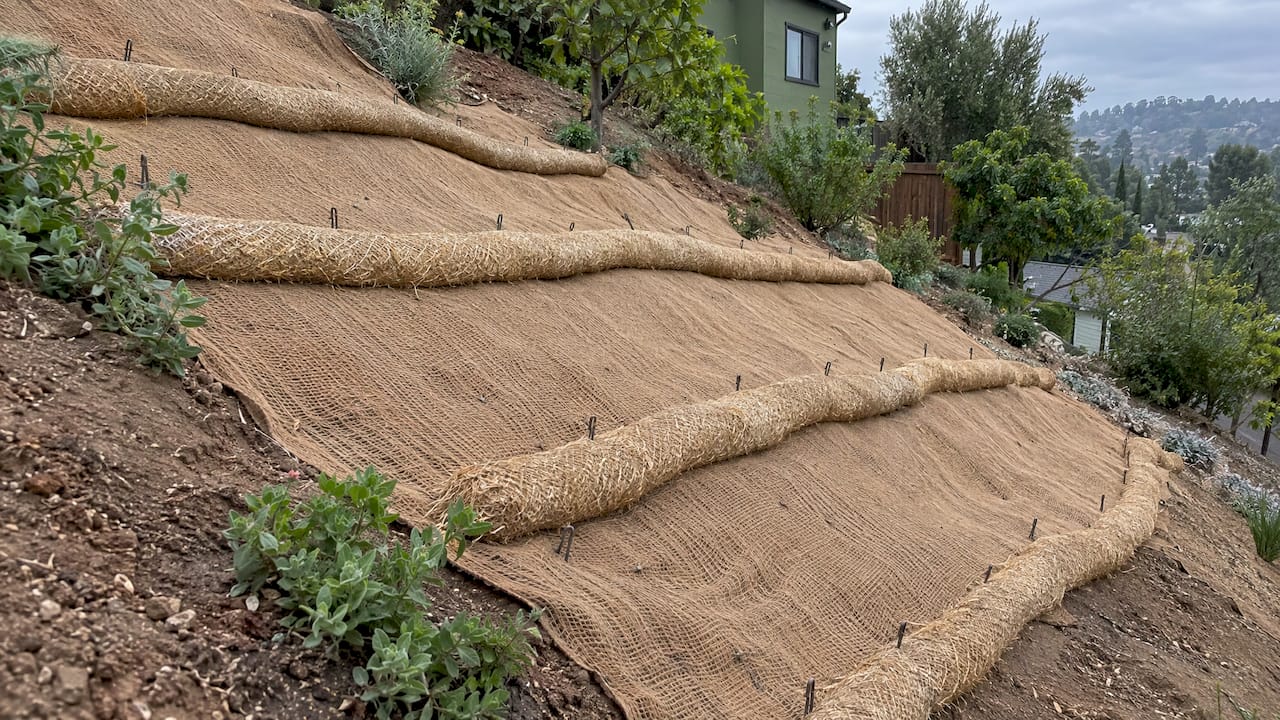
On moderate to steep grades, the Master Gardener Association of San Diego County suggests securing biodegradable fabric with turf staples and using wattles or terraces where needed. The fabric holds the soil during the months before roots take over, then breaks down.
3. Lay out plants by position
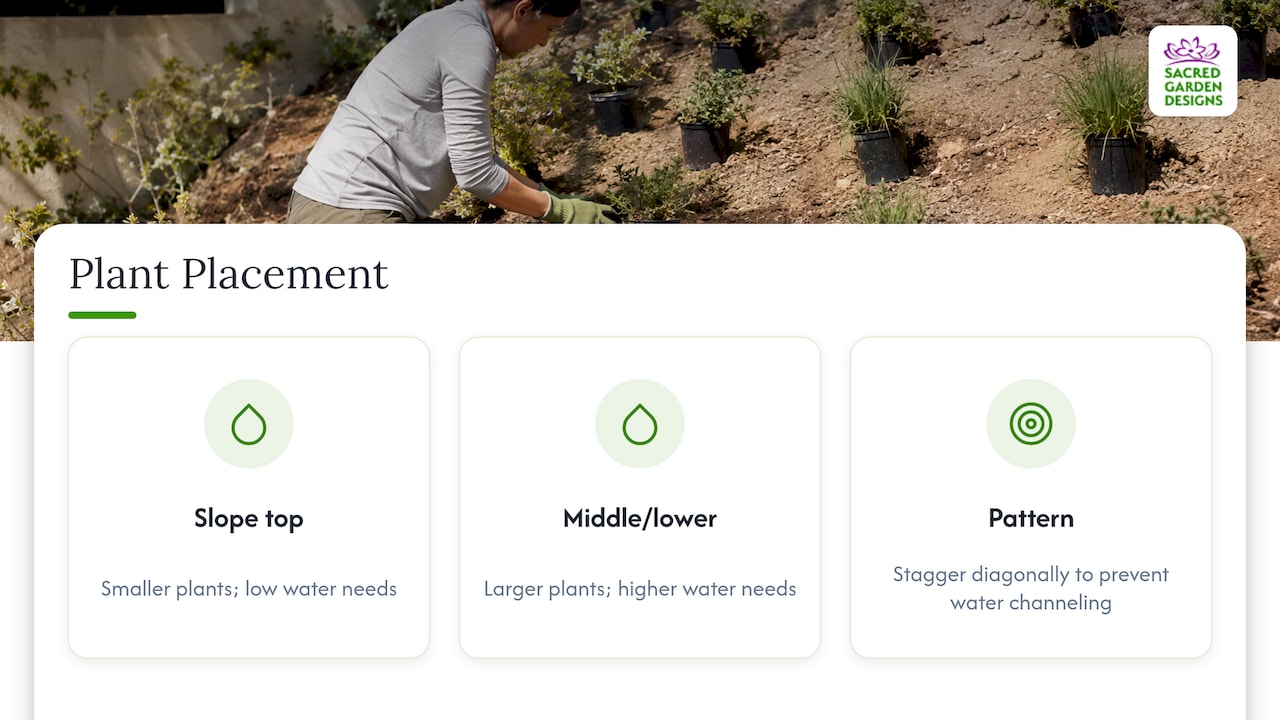
Put smaller plants with low water needs near the top and larger plants with higher water needs in the middle and lower sections, where they benefit from gravity-assisted water flow. Stagger plants in a diagonal pattern instead of straight rows down the fall line, so water cannot channel between them.
4. Dig a basin at each plant
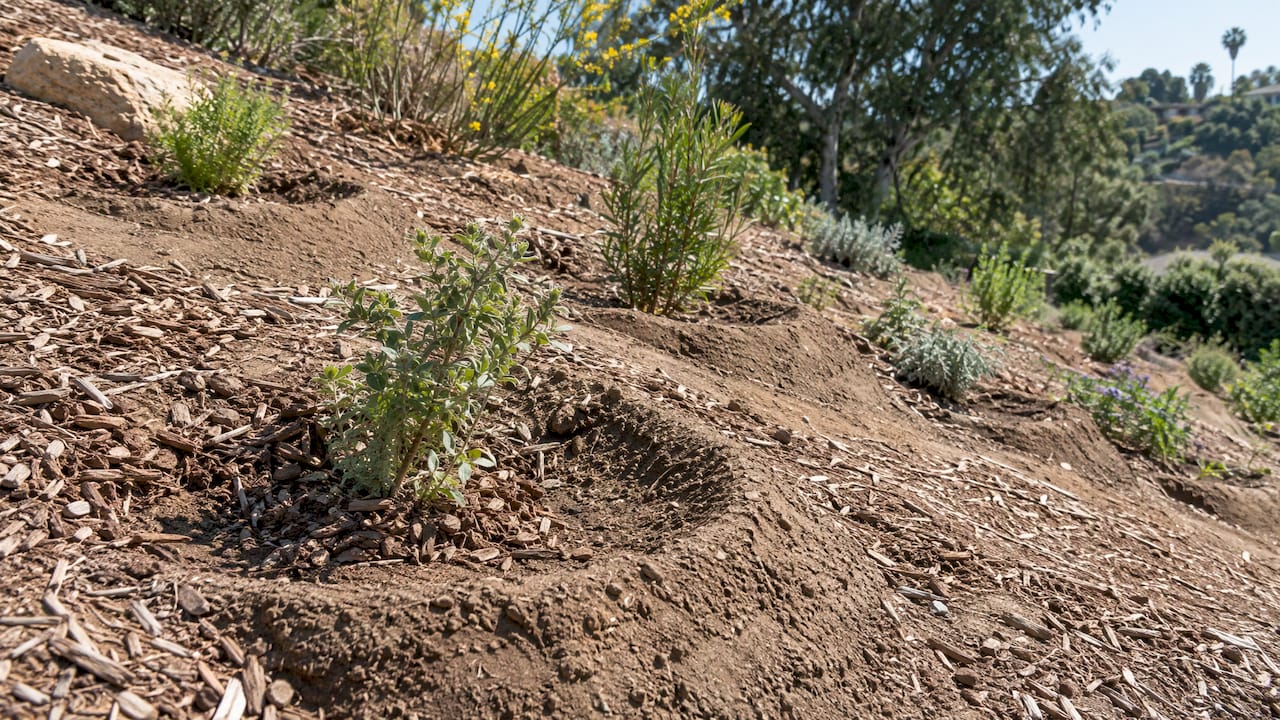
A half-moon well on the downhill side of each plant helps irrigation water soak in at the roots instead of running off. Fine Gardening’s Southern California slope guide recommends forming this half-moon basin around each plant. Keep basins modest and shaped to the slope, and do not cut deep terraces into a steep grade without engineering advice.
5. Plant small
Small container plants (one-gallon or smaller) generally adapt faster than big specimens and are far easier to carry and set on a hillside. They cost less, too, which matters when a slope needs dozens.
6. Mulch
Cover bare soil and drip lines with mulch, leaving a gap at plant crowns. Mulch holds moisture, suppresses weeds and protects soil until the plants close the gaps. Wood chips and coarse arborist mulch stay put better on slopes than fine bark.
Best planting window
In Southern California, fall through winter planting lets roots establish with cooler weather and winter rain. Exact timing shifts with the year’s weather, so use our garden maintenance schedule to plan around frost and seasonal conditions in your area.
Watering a new slope
Drip irrigation is the standard for slopes. The Master Gardener Association of San Diego County notes that on moderate and steep slopes, drip delivers water where it is needed with little waste. Sprinklers on a hill tend to send water running to the bottom before it soaks in.
A typical pattern for native and drought-tolerant plantings:
- First season: about once a week, deeply, per CNPS guidance for establishing these slope natives.
- After establishment: much less, and some natives do best with only occasional summer water. Reduce gradually rather than all at once.
- Timing: Los Angeles County Public Works notes that watering between midnight and 8 a.m. cuts evaporation and wind interference, and can save up to 700 gallons a month.
Check the current watering-day and time-of-day rules for your city before programming a controller. Our guide to Los Angeles irrigation schedules summarizes how the odd/even-day and daytime restrictions apply.
One more thing about water: a leaking line or a clogged drain on a hillside can undermine everything you plant. A homeowner’s explanation of why drainage systems fail helps you spot the early signs, such as soggy patches below a pipe or water pooling where it never used to. If you want the water itself to come from a low-energy source, our solar irrigation setup is built for gardens without easy access to a line.
Maintenance in years one to three
A new slope planting is a three-year project. Here is what the work looks like:
- Weeding: pull weeds in the first two seasons before they seed. Mulch cuts this down sharply.
- Mulch top-ups: replace what washes or breaks down, especially after big storms.
- Checking drip lines: emitters clog and lines shift on slopes. Walk the hill monthly.
- Pruning: shape plants lightly and clear dead wood, especially before fire season.
- Gap filling: replant bare patches in the next planting window rather than leaving soil exposed.
For a deeper look at plant choices that need little water overall, see our guide to drought-tolerant plants for Los Angeles, and for sunny, rocky spots succulents that thrive in Los Angeles can fill the lower-risk zones.
Our perspective
On hillside work, the plant list is rarely the hard part. The hard part is reading the slope: where water enters, where it leaves, and what the soil does in between. We start there because a beautiful planting on a slope that is still moving is a short-lived planting.
For more than 25 years we have designed landscapes in Los Angeles and beyond around drought and climate pressure, and we treat a slope as a system. Native groundcovers and shrubs do the long-term holding. Drip, basins and mulch give them the first two years. Where the grade demands it, terracing or a retaining wall does the structural job so the plants can do theirs.
We also think a hillside should look like it belongs to the place. That is why we combine artistry with ecological thinking: layered texture, seasonal color and a plant palette that supports resilience, not just coverage. A good slope planting should hold the soil, shrug off dry summers and feel good to look at from the kitchen window.
Denise Buchanan
Work with us on your slope
If your hillside needs more than a weekend of planting, we can help at each stage. Our design services are published at $1,500 for yards under 5,000 sq. ft. and $2,500 for a full landscape design. We also offer sustainable landscape installation, irrigation design and installation, slope stabilization, retaining walls and hardscape, tree trimming, clean-up and haul-away and ongoing garden maintenance.

Start with a consultation and site visit through our services page, or see the details of our landscape design packages. If you prefer to learn the craft yourself, we run classes and workshops.
FAQ
What is the best groundcover for a steep slope in Los Angeles?
Deep-rooted California natives are the safest starting point. ‘Pigeon Point’ coyote brush, buckwheat cultivars, groundcover sages and manzanita cultivars are all commonly recommended for Southern California slopes. Match the choice to sun exposure, and pair plants with mulch and drip irrigation.
How long does it take for slope groundcover to start holding soil?
Expect a full season or more for plants to knit together, and longer for the root systems to mature. Until then, biodegradable fabric, wattles and mulch protect the soil. Timing varies with the plants, the grade and the rainfall in a given year.
Is groundcover safe to plant on a slope in a fire zone?
It can be, with the right plants and spacing. Avoid woody, spreading species such as prostrate acacia and plumbago, keep growth low and broken up, and clear dead material regularly. Your local fire department can confirm the clearance rules for your property.
Do I need a retaining wall or terracing before planting?
On gentle slopes, plants may be enough. Steeper slopes or areas with fast-moving water often need terracing, drains or a retaining wall to manage flow. A site visit from a landscape professional is the reliable way to know which category your slope falls into.
Sources
- Hot Sunny Slopes and the Plants That Hold ‘Em, California Native Plant Society
- Five Natives for Slope Retention in Southern California, Fine Gardening
- Key Principles to Planting and Managing Backyard Slopes, Master Gardener Association of San Diego County
- Erosion Control for Slopes, Stream Banks, and Dunes, PNNL
- Surface and Slope Protective Measures, FAO
- Homeowners Guide to Erosion Control, Grayson County Master Gardeners
- Drought Tolerant Plants, Los Angeles County Public Works