For most Los Angeles yards, the best time to trim palm trees is late spring through early summer. That timing gets dead fronds and fruit stalks off the tree before the hottest, driest months and before the next Santa Ana wind season. It is practitioner guidance, not a city rule. Palms are forgiving about timing, so the date matters less than three other things: how much you cut, whether birds are nesting, and whether your property sits in a fire zone with its own requirements.
This guide walks through the timing, the exceptions, the Los Angeles fire rules, and the cuts that hurt palms, so you can plan a trim that is safe for the tree and for whoever stands under it.
TL;DR
- Aim for late spring to early summer for routine trimming in Los Angeles. Los Angeles County’s own crews schedule palm trimming in summer.
- Dead or hazardous fronds do not wait for a season. Remove them as soon as you see them, especially near a house in a fire-prone area.
- Check for nests first. California Fish and Wildlife suggests doing yard pruning outside the nesting season, which for many species runs February through August.
- Remove dead fronds and fruit stalks, and never cut green fronds above the horizontal. Skip climbing spikes and chain saws.
- Tall palms are specialist work. Hire a trained crew with proper lifts or climbing systems.
Table of Contents
- The best time to trim palms in Los Angeles
- When timing does not apply: dead and hazardous fronds
- Check for nesting birds first
- Does the species change the timing?
- What to remove, and how much to leave
- Los Angeles fire rules to check before you trim
- Mistakes that damage palms
- Fitting the trim into your yard calendar
- A simple year for a Los Angeles palm
- Our perspective
- Let us handle the trim
- FAQ
- Sources
The best time to trim palms in Los Angeles
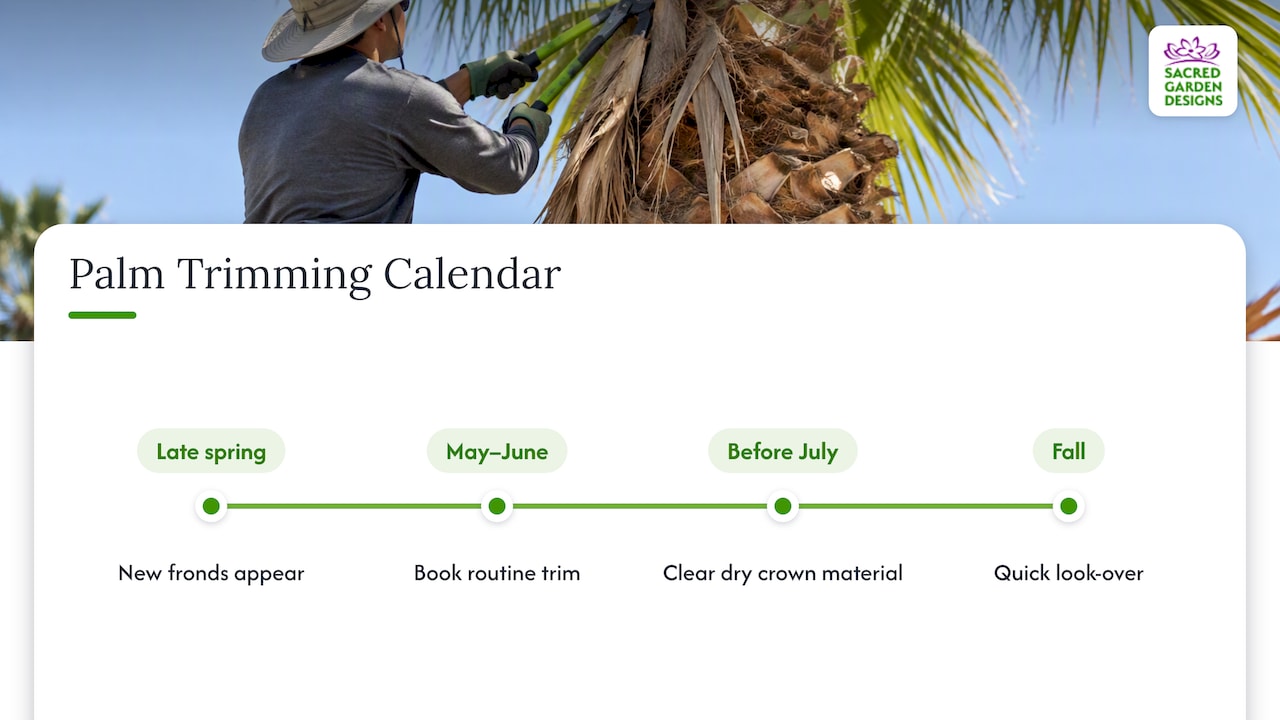
The Los Angeles-specific arborist advice we found points to late spring through early summer as the routine window. The logic is practical. By then, the winter and spring growth cycle has produced its new fronds, the old lower fronds have browned, and flower and fruit stalks are visible. Cleaning them out before July and August reduces the dry material sitting in the crown during the hottest months, and it gets ahead of fall wind events.
Public agencies work the same way. Los Angeles County’s Department of Public Works describes scheduling palm trimming during the summer, with its parkway palms trimmed every two years. A county crew trims on a rotation, so your home palm may need attention more or less often than that, but it shows when professionals in this region tend to do the work.
If you want a simple rule: book your trim for May or June, and do a quick look-over again in the fall.
Why not winter?
Los Angeles winters are mild, so cold is rarely the reason to hold off. The reason to be careful is frost. University of California Agriculture and Natural Resources advises waiting until frost danger has passed and new growth appears before pruning frost-damaged palm foliage. Its example says to wait until the weather warms in March. Brown fronds after a cold snap still help protect the growing point, so leave them until spring.
Why not just any time?
You technically can. The University of Florida’s extension service says palms can be pruned at any convenient time if proper guidelines are followed. That fits what we see: a palm will not collapse because you trimmed it in October. But convenient is not the same as ideal. In Southern California, the case for late spring or early summer rests on fire season, falling-frond risk and your own schedule, not on a biological deadline.
When timing does not apply: dead and hazardous fronds
A season is a guideline for routine work. It is not a reason to leave a dead frond hanging over a walkway or a roof.
The International Society of Arboriculture says routine pruning of dead, weak or diseased growth can generally occur at any time. It also says most palm pruning is done to remove dead or dying fronds, flowers and fruit clusters, particularly those that may put the public at risk.
Fire is the second reason to act early. The Los Angeles Fire Department says many palms are receptive to embers, and that poorly maintained palms can produce larger and more numerous embers that travel farther in wind-driven wildfires. A skirt of dead fronds hanging down the trunk is exactly the kind of fuel that guidance is about.
So take action right away if you see:
- Brown, dry fronds hanging over a roof, driveway, or entry
- A dead palm or one with a collapsed crown
- Fronds that have broken and are hanging by a strand
- A heavy skirt of dead fronds on a palm close to the house
A dead or dying palm usually should come down, not just be trimmed. That is a removal job for a licensed, insured crew.
Check for nesting birds first
Late spring and early summer are also when birds are raising young. California Department of Fish and Wildlife recommends doing yard pruning outside the nesting season, which for many California bird species is February through August. It also warns that nesting varies by location and species and can happen year-round in some areas.
That overlaps with the best trimming window, so you cannot treat the calendar as permission. Before any trim:
- Look at the crown and under the frond bases from a safe distance for nests, droppings and bird activity.
- Watch for a few minutes. Adults flying in and out with food are a clear sign.
- If you find an active nest, postpone that part of the job, or ask your arborist how to work around it.
- Tell your crew about it before they arrive, not after they are on the lift.
A good tree crew checks as a matter of routine. If yours does not mention it, ask.
Does the species change the timing?
It changes what you trim more than when. UC Agriculture and Natural Resources notes that pruning needs of mature palms vary with species and landscape situation. Some examples that matter in Los Angeles:
- Fan palms with a skirt, such as Mexican fan palms: these hold dead fronds against the trunk for years, so they are the ones that need regular cleaning for fire and falling-frond safety.
- Crownshaft palms: University of Florida notes that some crownshaft palms regularly shed older fronds and may need little or no pruning. Do not trim a palm just because the neighbor’s is trimmed.
- Date palms: UC specifies removing flower and fruit stalks in June or July. That is another reason summer works.
- Canary Island date palms: these carry a disease risk that changes how you cut (see below).
If you are not sure what you have, ask an arborist to identify it before you book work. The species decides how often it needs attention.
What to remove, and how much to leave
The most common mistake is cutting too much. A tidy, “pineapple” look with only a small tuft of fronds left is not healthy for the palm.
UC ANR recommends removing dead leaves and fruit stalks and, at most, leaves up to the horizontal. Avoid removing leaves above the horizontal. It also advises being conservative. The International Society of Arboriculture agrees: remove old, dead lower fronds and avoid removing healthy green fronds except where clearance demands it, because over-pruning can slow growth and attract pests.
A practical sequence:
- Fruit and flower stalks: take these first. They are heavy, messy and a common source of litter. If you want to support pollinators, University of Florida suggests waiting until blooms have dropped and fruit growth has begun before removing fruit stalks.
- Dead, fully brown fronds: remove these next.
- Yellowing lower fronds: leave these if they are still green enough to be feeding the tree, unless they block a path or structure.
- Frond bases: UC suggests leaving leaf bases until they are completely dry and easy to remove, rather than tearing them off.
How often to inspect and trim
The International Society of Arboriculture says palm pruning is usually done at least twice yearly, mainly to remove dead or dying fronds, flowers and fruit clusters. For a home palm, a workable rhythm is:
- Spring: a full look and the main trim, in late spring if birds are not nesting.
- Fall: a lighter check, before wind season, for dead fronds that have dried out over summer.
- After wind or storms: a quick walk around for broken or hanging fronds.
The inspection itself takes five minutes with binoculars. Look at the crown for brown fronds, check fruit stalks, and look at the trunk for cracks or soft spots. If the palm is too tall to see into, that is your cue for a professional assessment.
Los Angeles fire rules to check before you trim
Timing gets more specific if your home is in a fire hazard zone.
The Los Angeles Fire Department’s brush clearance rules say properties in the Very High Fire Hazard Severity Zone must maintain year-round clearance under LAMC 57.4906.5.2. That includes removing dead material from trees and hazardous vegetation within the specified areas around structures and roadways. For trees, LAFD requires:
- Trees taller than 18 feet to have lower branches trimmed so foliage is at least 6 feet above the ground
- Foliage at least 10 feet from a chimney outlet
- Roof surfaces kept free of substantial combustible accumulation, which includes palm fronds that land there
Separately, LAFD’s guidance tied to AB 3074 says listed high-hazard palms may need removal or annual pruning and skinning, depending on the zone and whether removal is an option. Proposed plantings also carry specified maintenance requirements. Read the LAFD palm guidance for your address before deciding how often to trim.
The key takeaway: in a high-hazard zone, “once in late spring” may not be enough. Year-round clearance means you check and clean as needed, not just on a set date.
If the palm is on a city parkway, it is not yours to trim on your own. The City of Los Angeles Department of Recreation and Parks publishes a Tree Care Manual that covers its pruning standards, types, cuts and timing. Check with the city before touching a street tree.
Mistakes that damage palms
A bad trim does more harm than a late one. Watch for these.
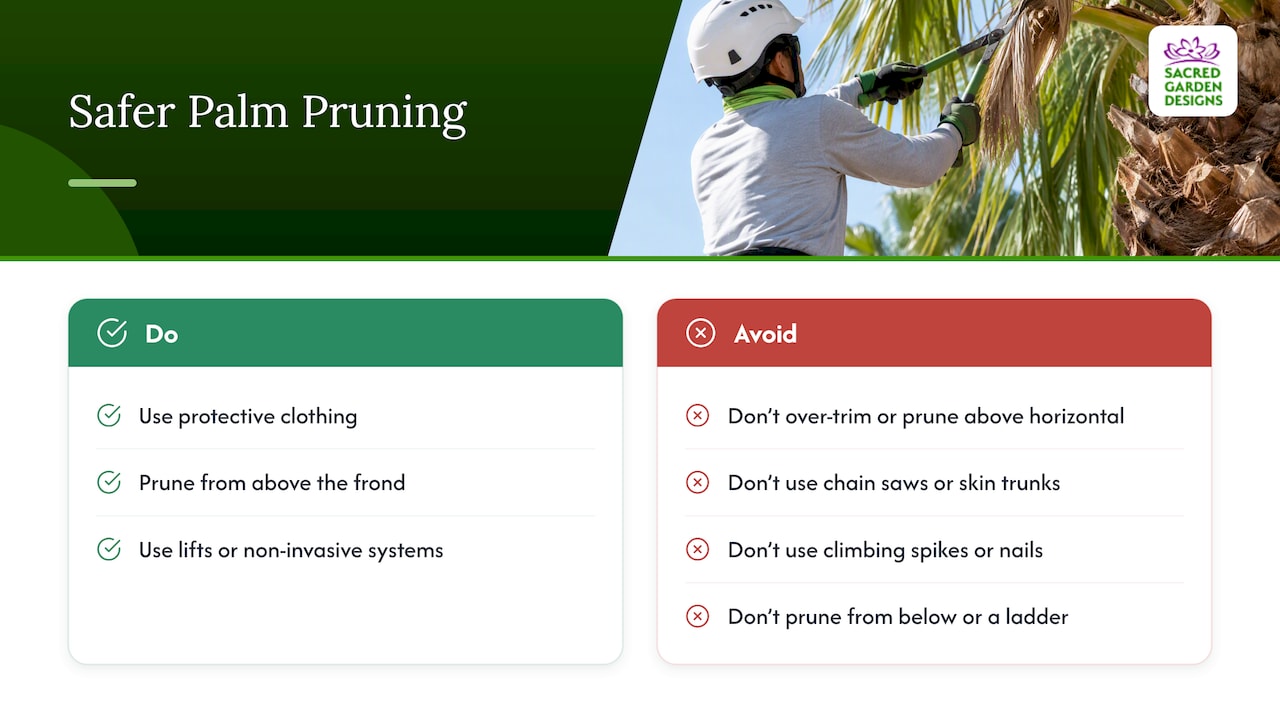
Over-trimming. UC ANR advises against overzealous leaf removal and pruning above the horizontal. Heavy cuts remove fronds that are still feeding the tree.
Chain saws and trunk skinning. UC ANR warns against chain-saw pruning and excessive trunk skinning because they can wound the palm and let in disease that causes decay.
Climbing spikes and nails. UC ANR advises against them because they make permanent trunk wounds. The University of Nevada’s guidance adds that tall-palm pruning is specialized work: spikes damage trunks, topping is fatal or dangerous, and proper lifts or non-invasive climbing systems are preferable.
Working from below. UC warns that pruning from below can be fatal when a bundle of fronds falls on the worker, and recommends protective clothing and pruning from above the frond. This is why we do not suggest a DIY trim of a tall palm from a ladder.
Disease: the Canary Island date palm warning
UC IPM identifies Fusarium wilt as a lethal disease of Canary Island date palms. It has no cure, and it is commonly spread on pruning tools, especially chain saws, through pruning wounds and contaminated sawdust. UC IPM’s advice for these palms:
- Minimize pruning
- Use clean manual saws
- Disinfect tools before working on each palm
- Avoid pruning in windy weather
- Do not recycle or chip infected material as mulch
When you hire a crew, ask whether they disinfect tools between palms. A professional should have a ready answer.
Fitting the trim into your yard calendar
Palm trimming is one item on a Southern California seasonal list. If you are already scheduling a lift or crew for May or June, it is a good moment to look at the rest of the yard. Our guide on when and how to prune water-wise gardens covers the shrubs and perennials around your palm, and our garden maintenance schedule explains why frost dates beat fixed calendar days.
Outdoor fixtures are worth a glance too. Palm fronds and trunks can shift how light falls and where fixtures sit, and a crew working near wiring should know where it runs. A guide to landscape lighting seasonal adjustments is a handy companion for the same seasonal walk-through.
If your palms are part of a bigger plan for drought and fire resilience, our guides to drought tree care and drought-tolerant plants for Los Angeles show how to keep the rest of the landscape healthy through dry years.
A simple year for a Los Angeles palm
| Time | What to do | Why |
|---|---|---|
| Late winter to early spring | Check for frost damage, but wait for new growth before cutting | Frost-damaged fronds still protect the crown |
| Late spring to early summer | Main trim: dead fronds and fruit stalks, after a nest check | Gets ahead of the dry season |
| Summer | Date palms: remove flower and fruit stalks in June or July | UC timing for date palms |
| Fall | Light check for dead fronds, clear roof and gutters | Before wind season |
| After wind or storms | Walk the yard for broken or hanging fronds | Safety and fire risk |
| Any time | Remove dead or hazardous fronds right away | Season does not apply to hazards |
Our perspective
We have spent more than 25 years designing yards in Los Angeles around drought, heat and fire, and palms come up in almost every project. The question we hear most is “when,” but the better question is “how much, and by whom.”
A palm in a fire-prone neighborhood is part of the defensible space around a home. We treat the trim as a safety and resilience task first and a cosmetic one second. That means regular cleaning of dead material, a conservative hand with healthy green fronds, and a check for nests before any saw comes out.
We also think trimming works best when it is planned with the rest of the landscape. When we design or maintain a yard, the palm trim sits in the same calendar as irrigation checks, pruning of nearby shrubs and brush clearance, so nothing is done twice or forgotten. Our tree trimming and garden maintenance work follows UC and ISA guidance: dead fronds and fruit stalks out, green fronds left alone, and clean tools between trees.
If you are not sure what species you have or how tall is too tall to handle yourself, ask for a site visit. It is much cheaper than fixing a bad cut.
Denise Buchanan
Let us handle the trim
We offer expert tree trimming, clean-up and haul-away, and ongoing garden maintenance across Los Angeles, alongside landscape design and irrigation work. If you want your palms assessed, trimmed in the right window and hauled away, start with an initial landscape consultation on our services page. Pricing for tree trimming is not published, so we quote after we see the trees.

If you are planning a larger yard update, our landscape design services start with a design for yards under 5,000 sq. ft. at $1,500, and a full landscape design is $2,500.
FAQ
What time of year should you trim a palm tree in Los Angeles?
Late spring through early summer is the usual routine window. Los Angeles County schedules palm trimming in summer, and it keeps dead material out of the crown before the dry season. Check for nesting birds first, and remove dead or hazardous fronds whenever you see them.
Can I trim palm trees any time of year?
Mostly, yes. University of Florida says palms can be pruned whenever it is convenient if proper guidelines are followed, and the International Society of Arboriculture says dead or diseased growth can be removed at any time. In Los Angeles, nesting season and fire risk are better guides than the calendar.
How much of a palm tree should I cut?
Remove dead fronds and fruit stalks, and at most fronds up to the horizontal, according to UC ANR. Do not cut green fronds above the horizontal. A palm stripped to a small tuft grows more slowly and is more open to pests.
Do I need to trim palms for fire safety in Los Angeles?
If your property is in the Very High Fire Hazard Severity Zone, LAFD requires year-round clearance, including removing dead material from trees. Some listed high-hazard palms may need annual pruning and skinning or removal under the AB 3074 guidance. Check LAFD’s pages for your address.
Should I trim a tall palm myself?
We suggest not. Falling frond bundles can be fatal to a worker below, and climbing spikes injure the trunk. A crew with a lift or a non-invasive climbing system, and clean tools, is the safer choice.
Sources
- Los Angeles County Department of Public Works: Parkway Tree Trimming
- UF/IFAS Gardening Solutions: Pruning Palms
- California Department of Fish and Wildlife: nesting birds
- UC ANR: General Care and Maintenance of Palms
- UC ANR: Valley Landscape Views
- UC ANR Master Gardener Newsletter
- UC IPM: Palm Diseases
- TreesAreGood.org: Pruning Trees
- TreesAreGood.org: Proper Pruning Cuts
- Los Angeles Fire Department: Palms and Wildfires and AB3074
- Los Angeles Fire Department: Brush Clearance Requirements
- University of Nevada: Pruning Palm Trees
- City of Los Angeles Recreation and Parks: Tree Care Manual