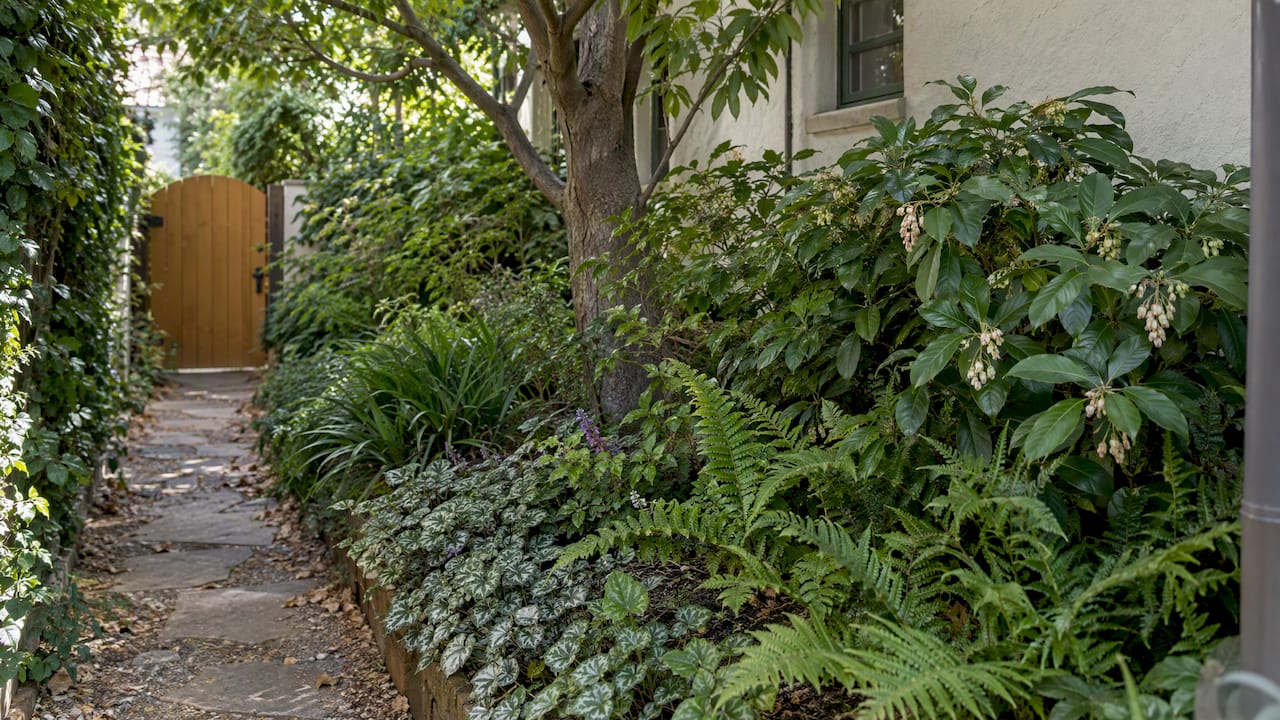
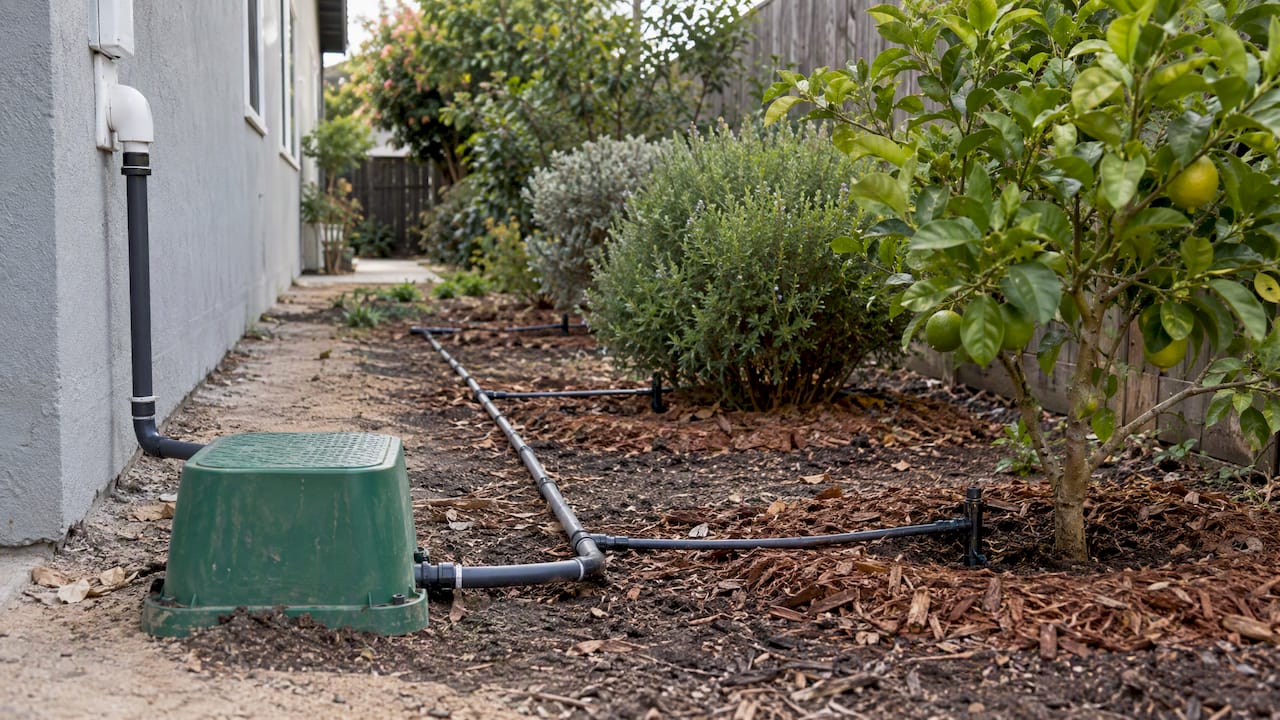
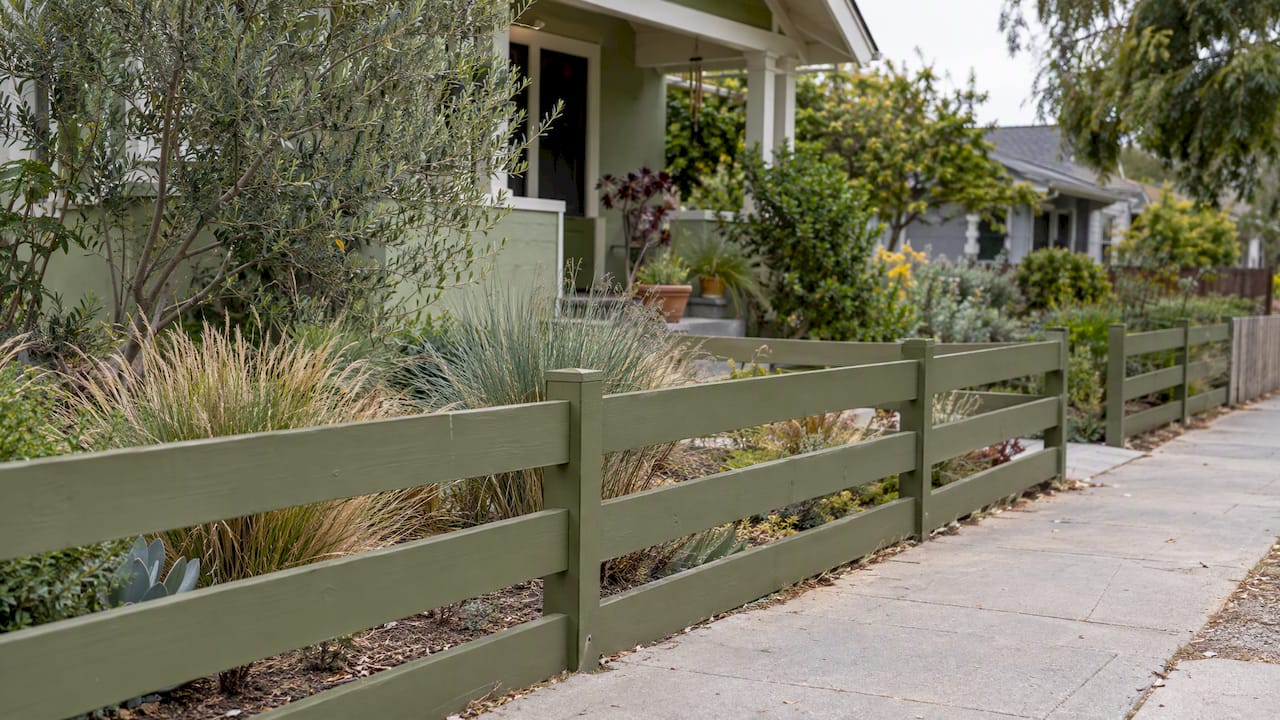
Stormwater management landscaping uses plants, soil, grading and permeable surfaces to slow rainwater down, spread it out and let it soak in, instead of sending it off your property in a pipe. Done well, it cuts puddling and erosion, protects nearby creeks, and gives you a better-looking yard. This guide covers the features that work, how to read your site before you build, how to keep it all working, and where a professional earns their fee.
TL;DR
- Stormwater landscaping works by storing, soaking in or releasing runoff slowly: rain gardens, swales, infiltration trenches, permeable paving and rain barrels are the main tools.
- Start with the site, not the plant list. Soil, slope, groundwater depth and where roof and paving runoff goes decide which feature fits.
- A rain garden without an underdrain generally needs soil that infiltrates at least 0.5 inches per hour, and standing water should clear within days, not weeks.
- These systems need regular upkeep: clearing debris and sediment, replacing dead plants, and checking ponding.
- Complex slopes, retaining walls and large roof areas are worth a professional design. Local rules on impervious surfaces and drainage may apply.
Table of Contents
- What stormwater management landscaping actually does
- Is your property telling you it has a drainage problem?
- Read the site: soil, slope, groundwater and overflow
- The features that work, and when to use each
- Choosing plants
- Keeping it working: installation and maintenance
- Rules that may apply where you live
- Our perspective
- Working with Sacred Garden Designs
- Extra benefits worth planning for
- FAQ
- Sources
What stormwater management landscaping actually does
The EPA describes green infrastructure as plant or soil systems, permeable surfaces, harvest and reuse, or landscaping that stores, infiltrates or evapotranspirates stormwater so less of it reaches sewers and surface waters. That is the whole idea in one sentence.
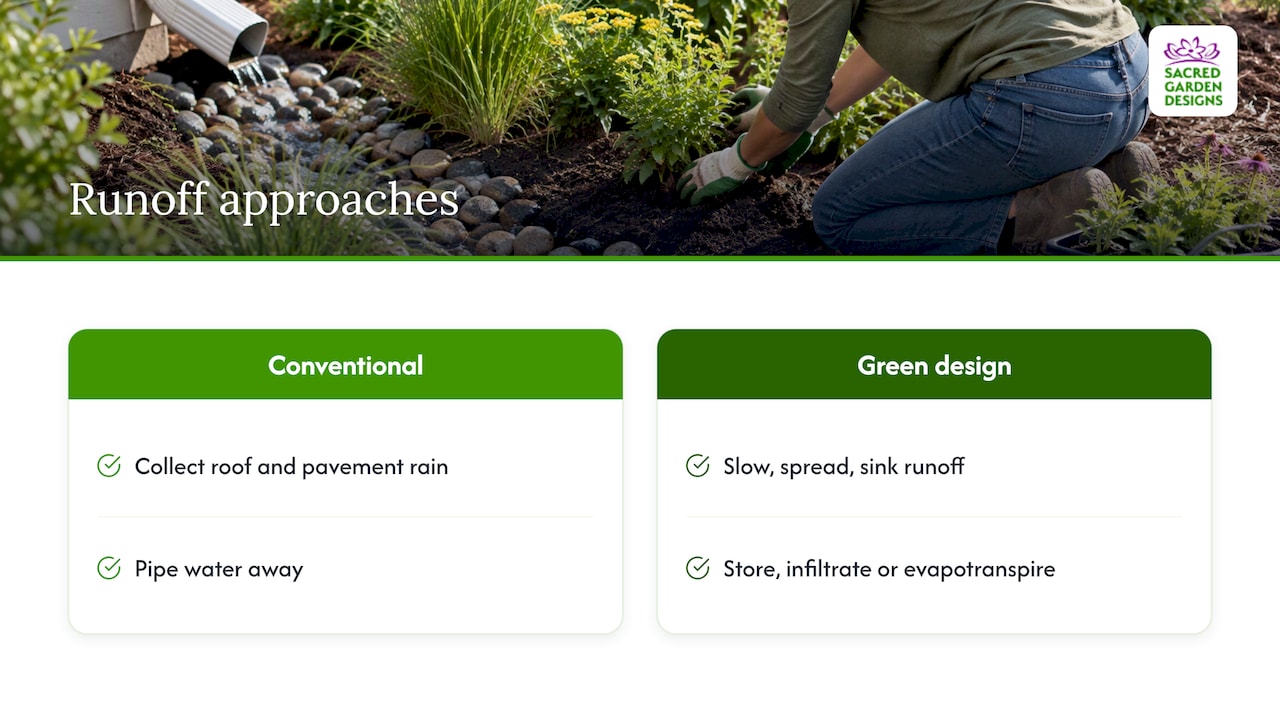
The older approach was to collect rain from roofs and pavement and pipe it away. A USDA NRCS homeowner guide frames the shift as moving away from “pipe it and pave it” toward slowing water down, spreading it out, and sinking it into the land. Those three verbs are a useful design checklist for any yard.
Why it matters beyond your fence line: in most U.S. communities, stormwater moves through separate pipes and empties into streams or rivers without being cleaned, except where combined sewer systems exist. One lot produces little runoff, but the EPA notes that untreated runoff from thousands of households adds up to a major driver of urban stream pollution and erosion. Your yard is a small piece of a large system, and it is the piece you control.
There is a practical payoff too. Oregon State Extension notes that green infrastructure practices are attractive and have been shown to increase real estate values.
Is your property telling you it has a drainage problem?
Before you pick a feature, find out where water goes. Signs worth noting: puddles that last well after rain, bare or washed-out soil below downspouts, mulch drifting downhill, water pooling against a foundation or wall, and soggy lawn areas that never dry.
Walk the property in the rain
The simplest diagnostic is free. University of Arkansas Extension suggests an umbrella survey during a rain event to map how water flows across your property and where it may pick up pollutants. Bring a notepad or phone. Mark where roof water lands, where it runs across paving, where it speeds up on a slope, and where it stops.
Check easements and records
Before you move any water, find out whether someone else has a claim on that ground. A Scottsdale homeowner guide points out that you can review city or county records, title reports or plats to locate drainage easements. Building a garden over an easement can create problems, so check first.
Fix the basics before you plant
Landscape features cannot compensate for a gutter that dumps water at the foundation or a grade that tilts toward the house. If you are dealing with standing water, fixing gutters and grade first is the sensible order of operations, and it tells you how much water your landscape features will actually need to handle.
Read the site: soil, slope, groundwater and overflow
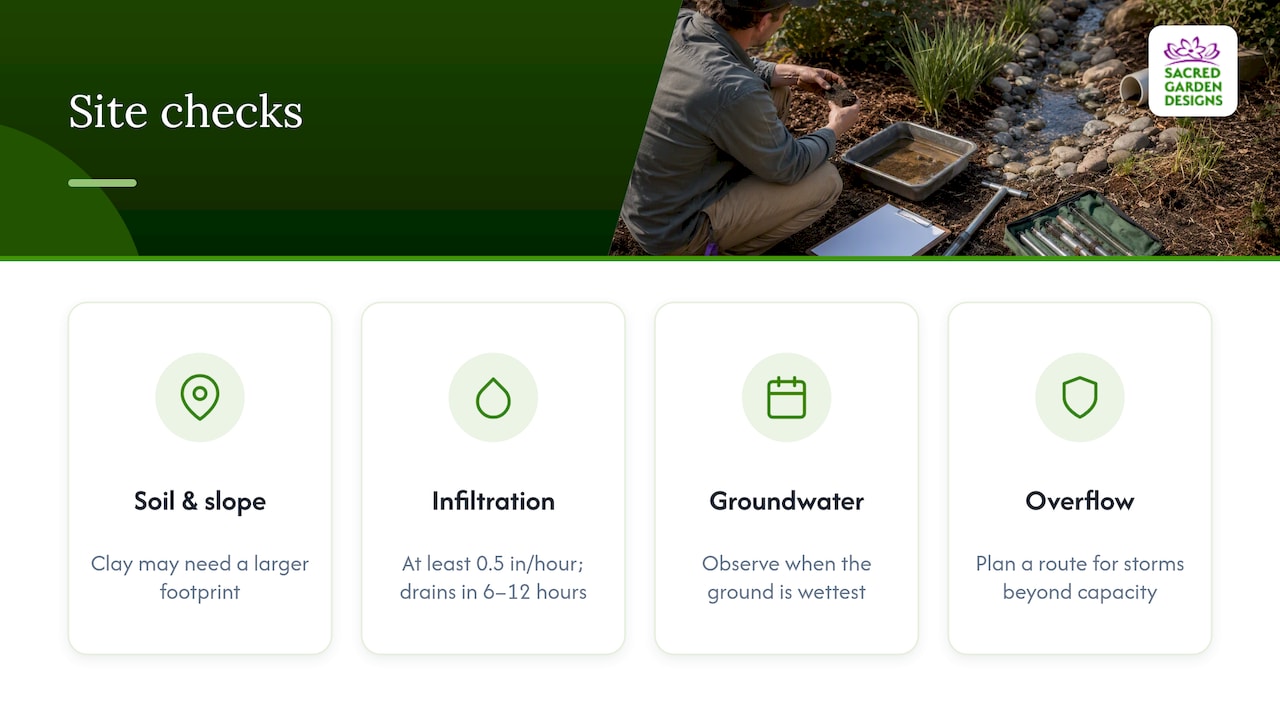
Four site facts shape every stormwater design.
Soil. University of Kentucky Extension notes that soil type, surface slope and proximity to surface water influence where runoff goes and how water moves in a storm. Sandy soil drains fast. Heavy clay does not, and clay sites often need a larger footprint, amended soil media or an underdrain.
Infiltration rate. For rain gardens without underdrains, EPA guidance calls for soil that infiltrates at at least 0.5 inches per hour so the garden drains within 6 to 12 hours after a rain. A simple percolation test, digging a hole, filling it and timing the drop, gives you a rough read before you commit.
Groundwater. Snohomish County, Washington, advises that design should consider soil conditions, slopes, seasonal groundwater depth and where rainwater flows, and that observations are best made in the wet season. Groundwater there is usually closest to the surface from December through April. Your region’s wet season differs, so the principle matters more than the months: look when the ground is at its wettest, not on a dry August afternoon.
Overflow. Every feature needs a planned path for storms bigger than it can hold. That might be a lower lawn area, a spillway lined with stone, or a connection to a second feature. Water that finds its own overflow route usually finds your neighbor’s yard or your foundation.
The features that work, and when to use each
The EPA’s on-lot guidance lists the main residential tools. Here is how they compare in practice.
| Feature | How it works | Best for | Watch out for |
|---|---|---|---|
| Rain garden (bioretention) | Shallow depression with soil media, mulch and native plants that holds and filters runoff | Downspouts, driveway edges, low spots | Needs adequate infiltration or an underdrain |
| Bioswale or grassed swale | Shaped channel that carries and slows water to a pervious area | Long slopes, property edges, driveway runoff | Needs enough fall to flow, not so much it erodes |
| Infiltration trench | Rock-filled trench that slows flow and encourages soak-in | Roof runoff on permeable soils | Works best in highly permeable soil |
| Permeable paving | Surfaces that let water pass through to a base layer | Patios, walkways, driveways | Needs sediment control and proper base |
| Rain barrel or cistern | Captures roof water for later use | Dry-season irrigation | Must be sealed and protected from freeze damage |
The EPA describes bioretention as a shallow depression with soil media, mulch and native vegetation, and grassed swales or filter strips as ways to carry stormwater to a larger pervious area. It also notes that infiltration trenches filled with rock reduce flow rates and are most effective in highly permeable soils.
Rain gardens
A rain garden is a shallow, planted basin that holds runoff temporarily and filters pollutants through vegetation and soil. It is the most flexible feature for a typical yard because it can sit at the end of a downspout or at the low point of a lawn. If you want a detailed design walk-through, our guide to rain garden design for homeowners covers sizing, drainage targets and plant layout.
Bioswales
A swale is a rain garden stretched into a channel. It suits long runs: the edge of a driveway, the toe of a slope, a side yard that carries water from front to back. The details that decide success are slope, cross-section and what lines the channel. Our bioswale design checklist lays those out for builders and homeowners.
Permeable paving
Patios and walkways are impervious surfaces that shed water fast. Swapping some for permeable pavers or gravel-set stone lets that water sink in where it lands. It is one of the easiest ways to reduce runoff without giving up usable space, and it pairs well with a rain garden at the low edge of the patio.
Walls and slopes
Steeper sites bring different risks: erosion, hydrostatic pressure behind walls, and fast-moving sheet flow. Retaining walls in particular fail when water has nowhere to go, which is why we wrote up four-part drainage for new walls and retrofits. For hillside properties in Southern California, see our notes on hillside landscaping in Los Angeles, including fire and water-efficiency rules.
Choosing plants
Plants do real work in a stormwater feature. Their roots keep soil open so water can enter, their leaves intercept rain, and the plants themselves take up and filter runoff. The EPA toolbox describes native plants as absorbing and filtering stormwater and lists species suited to bioretention in the northern plains. That is a regional list, so use it as a model for how to choose, not as a shopping list for your yard.
A reliable approach works anywhere:
- Zone by moisture. The bottom of a basin floods most often and dries last. The sides get occasional wetting. The rim stays mostly dry. Put tolerant plants at the bottom and drought-tolerant ones at the top.
- Pick natives for your region. They are adapted to your rainfall pattern and soil, and they need less after establishment.
- Mix forms. Grasses, sedges, perennials and a few shrubs give structure year-round and keep soil covered.
- Plan for the dry season. In places with long dry summers, a rain garden has to survive months without water. Pair it with drought-tolerant planting so the same space handles both extremes.
If you would rather replace turf than add another bed, lawn alternatives often absorb more water than compacted grass and cut irrigation.
Keeping it working: installation and maintenance
Installation is where most failures start. Compacted soil at the base of a basin, a downspout aimed at the wrong place, an inlet with no stone to stop scour, or a missing overflow will each undermine a good design. The NRCS guide recommends installing stormwater practices in consultation with an experienced professional who can address site-specific conditions.
After installation, upkeep is modest but real. EPA guidance lists removing sediment and debris, maintaining vegetation, and checking rain barrels and cisterns for proper sealing and freeze damage. Virginia Tech Extension adds specifics for rain gardens: clear debris and leaves, replace dead plants, and check that water does not stand for more than four days.
A simple routine:
- After big storms: look at inlets, spillways and the basin for sediment, scour or blockage.
- Seasonally: clear leaves, pull weeds, and top up mulch where it has washed out.
- First two years: water new plants through dry spells and replace any that fail.
- Yearly: check that the basin still drains in the time you designed it to.
Timing of these tasks depends on your climate, so a schedule keyed to local frost dates beats fixed calendar days. Our garden maintenance schedule explains how to set that up.
Rules that may apply where you live
Stormwater is regulated at several levels. The EPA explains that the NPDES program regulates runoff from municipal separate storm sewer systems, industrial activities and construction, and that local officials may use zoning ordinances, overlay districts and other land-use controls to limit impervious surfaces and guide stormwater management.
For a homeowner, that usually means three questions to ask your city or county before major work:
- Is a permit needed for grading, a retaining wall or new paving?
- Are there limits on how much impervious surface the lot can have?
- Are there easements, setbacks or rules on where runoff may be directed?
City stormwater or public works departments are the right first call. Some also publish homeowner drainage guides.
Our perspective
After more than 25 years designing water-wise landscapes in Los Angeles and beyond, we see the same pattern on stormwater jobs. Homeowners usually come to us having been told to “just add a drain.” A drain moves the problem. The better question is where the water should go, and how to make that place useful.
In a drought-prone region, rain is scarce and arrives in a few intense storms. That makes stormwater design a water-supply decision as much as a flood-control one. A basin that soaks in a winter downpour recharges the soil that feeds the trees and shrubs through the dry months. A barrel or cistern turns roof runoff into irrigation. The same yard that sheds water in January can then ask less of the hose in August.
We design these systems alongside the planting, hardscape and irrigation, because they depend on each other. A patio drains into a garden, the garden has plants chosen for both wet feet and dry summers, and the irrigation is sized to what the rain does not cover. Our rule of thumb: slow it, spread it, sink it, then use it.
— Denise Buchanan
Working with Sacred Garden Designs
If your yard needs more than a weekend project, we can design the whole system: grading, rain gardens or swales, permeable surfaces, planting and irrigation. Our landscape design services start at $1,500 for yards under 5,000 square feet and $2,500 for a full landscape design. Installation, hardscape, slope stabilization and irrigation are quoted per project, and you can see everything we offer on our services page. To start with a design, see our landscape design services.

Prefer to learn the craft yourself? We also run classes and workshops on sustainable gardening.
Extra benefits worth planning for
The same features that handle stormwater tend to earn their keep in other ways. The EPA notes that well-designed green infrastructure fits local conditions and can provide cleaner air, heat reduction and habitat. Trees are a good example: they intercept rain and shade paving, and our research summary on trees for urban heat reduction shows how much cooling they can offer. Edible plantings can also sit in the wetter zones of a design, as covered in our edible landscaping guide, as long as you choose plants that suit the moisture and avoid harvesting from areas that collect pollutants from roads or roofs.
FAQ
What is the easiest stormwater feature to add to an existing yard?
A rain barrel or a simple rain garden at the end of a downspout is usually the easiest. Both work with the roof runoff you already have. Check the soil’s infiltration first, and make sure the garden sits well away from the foundation with a clear overflow path.
How long should water stay in a rain garden?
It should drain within hours to a few days, not linger. EPA guidance targets drainage within 6 to 12 hours for gardens without underdrains, and Virginia Tech Extension advises checking whenever water stands longer than four days. If yours holds water longer, the soil may be too slow, or the basin may be clogged with sediment.
Do I need a permit for stormwater landscaping?
It depends on your city or county. Simple plantings usually do not need one, but grading, retaining walls, new paving or changes to how runoff leaves your lot may. Call your local stormwater or public works department before starting.
Can I do this myself or should I hire a designer?
Small features on flat, well-draining ground are realistic DIY projects. Hire a professional when you have slopes, retaining walls, clay soil, large roof or paved areas, or runoff that reaches a neighbor. Mistakes in those cases are costly to reverse.
Sources
- About Green Infrastructure, US EPA
- Slow it. Spread it. Sink it!, USDA NRCS
- Stormwater Management: What Stormwater Management Is, University of Nebraska Extension
- NPDES: Stormwater Best Management Practice, On-Lot Treatment, US EPA
- Stormwater Solutions for Green Infrastructure, Oregon State Extension
- How do I determine the current runoff condition on my property, University of Arkansas Extension
- A Scottsdale Homeowner’s Guide to Drainage
- Residential Stormwater Site Assessment, University of Kentucky Extension
- Semi-Arid Green Infrastructure Toolbox: Rain gardens, US EPA
- Evaluate Your Site, Snohomish County
- Stormwater Management for Homeowners Fact Sheet 5: Rain Gardens, Virginia Tech Extension
- Urbanization and Stormwater Runoff, US EPA
- Fix Gutters and Grade First to Stop Standing Water