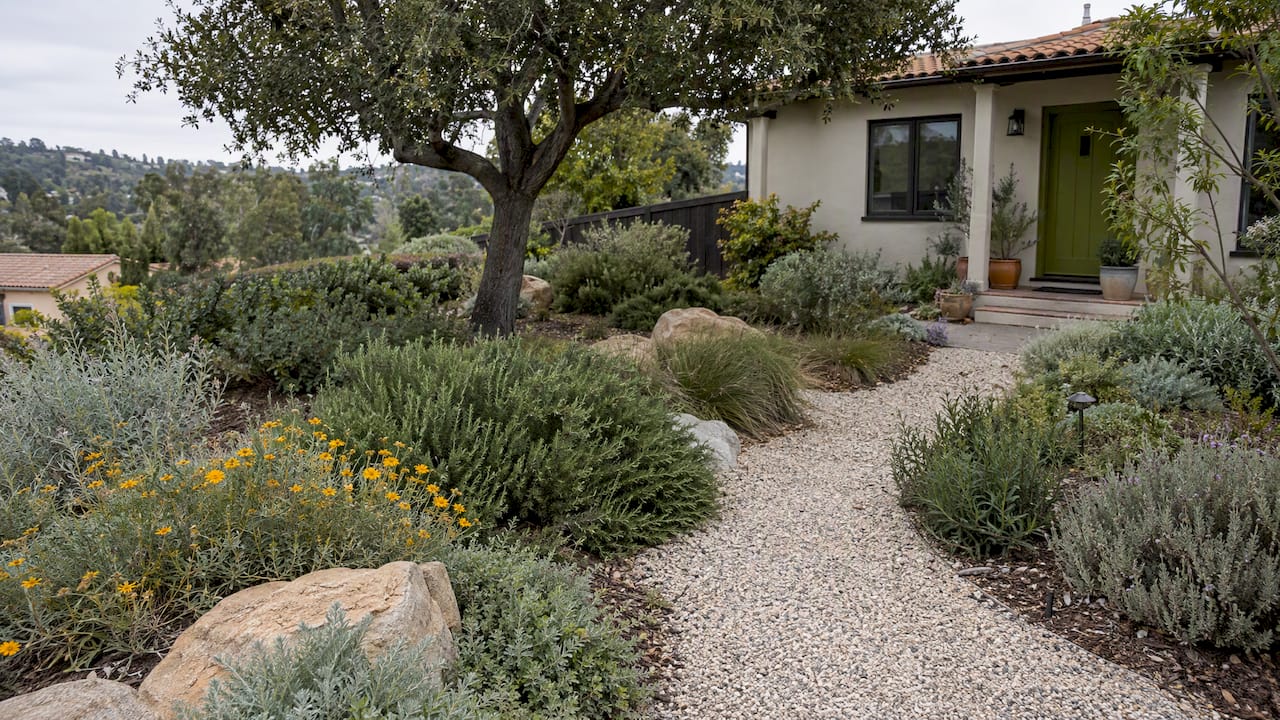
The best shade plants for Los Angeles are low-water natives and Mediterranean-climate shrubs that tolerate dry shade: hummingbird sage, columbine, heuchera, golden currant, sweet box, Australian fuchsia, yerba buena and hellebores. Which one belongs in your yard depends on how much sun the spot really gets, how much water reaches it, and whether a mature oak sits overhead. This guide sorts the choices by those conditions, then covers planting, watering and the mistakes that kill shade gardens here.
TL;DR
- Measure first: full shade means 2 hours or less of direct sun, ideally in the morning. Anything more is part shade, and the plant list changes.
- For dry, deep shade, start with hummingbird sage, sweet box, Australian fuchsia and golden currant. For a groundcover or container, try yerba buena.
- Under a mature oak, plant lightly and skip regular irrigation near the trunk. Oak roots are sensitive to added moisture and disturbance.
- Group plants by water need, water at the drip line, and expect weekly watering in year one before dropping back.
Table of Contents
- Know your shade before you shop
- Best plants for dry shade in Los Angeles
- Planting under oaks
- How to plant and water a shade garden
- Perspective: shade is a design asset, not a problem
- A sample plan for a 10 by 20 foot dry shade bed
- Common mistakes with shade plants
- Let us design your shade garden
- FAQ
- Sources
Know your shade before you shop
Shade in Los Angeles is not one condition. A north-facing side yard in Silver Lake, the dappled light under a jacaranda in Mid-City and the dense dark beneath a coast live oak in Pasadena all call for different plants.
Watch the spot on a sunny day, checking at 9 a.m., noon and 3 p.m. Use the University of California definition: full shade is 2 hours or less of direct sun, preferably morning sun. Part shade gets more than that, or gets filtered light through a canopy.
Then ask three more questions:
- Is the soil dry? Under eaves, fences and thirsty trees, rain rarely reaches the ground. That is dry shade, the hardest case.
- What is overhead? A building wall, a fence and an oak canopy create very different root and moisture conditions.
- How much water will you realistically give it? Los Angeles County’s drought-tolerant plant guide notes that established California natives and drought-tolerant plants need substantially less water and maintenance than traditional landscaping. Pick plants that match your answer, not plants you will have to rescue.
Best plants for dry shade in Los Angeles
These are the workhorses. All of them are listed by UC Agriculture and Natural Resources in its shade plant handout unless noted otherwise.
| Plant | Type | Light it tolerates | Why use it |
|---|---|---|---|
| Hummingbird sage (Salvia spathacea) | Native perennial | Dry shade | Grows very well in dry shade and spreads into a loose groundcover |
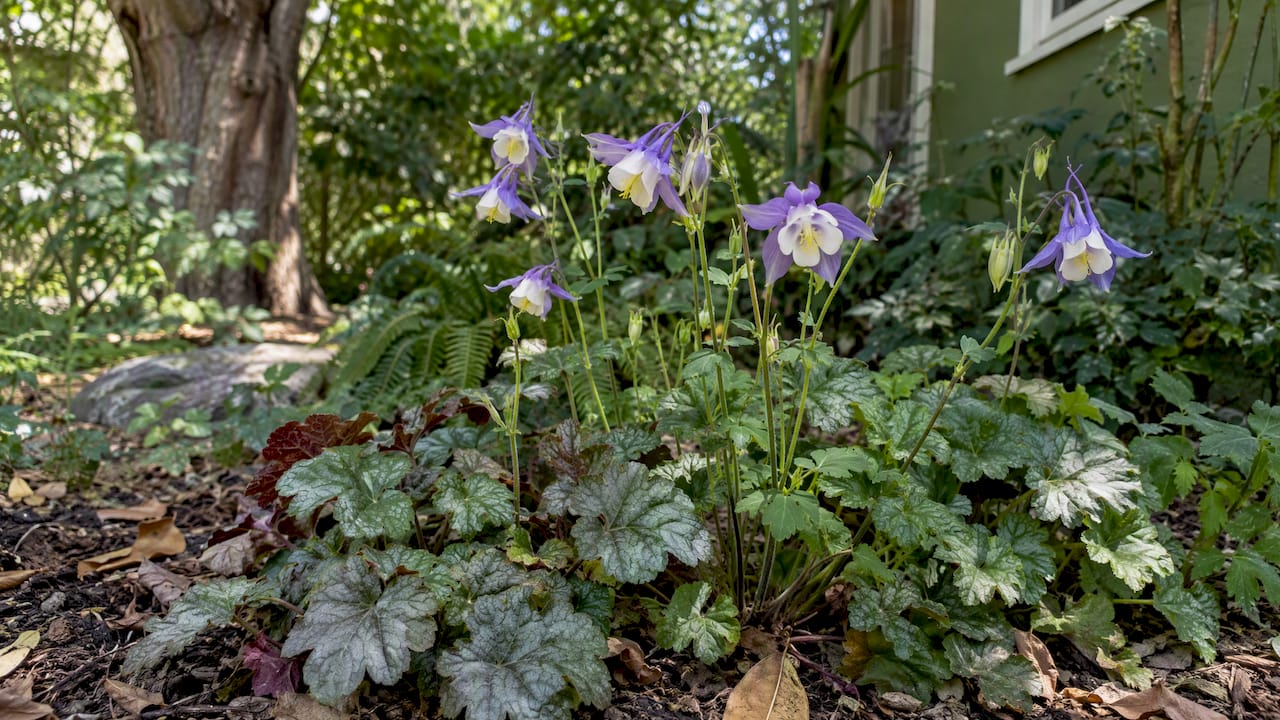
| Columbine (Aquilegia) | Perennial | Filtered shade | Delicate flowers that brighten a dim corner |
| Heuchera maxima (island alumroot) | Native perennial | Shade | Mounding evergreen foliage for edges and under shrubs |
| Golden currant (Ribes aureum) | Native shrub | Sun to partial shade | Flexible, easy shrub for the lighter side of shade |
| Sweet box (Sarcococca) | Evergreen shrub | Partial to full shade | Low water use once established |
| Australian fuchsia (Correa) | Shrub | Partial sun to deep shade | Tolerates deep shade with low water |
| Evergreen currant (Ribes viburnifolium) | Native shrub | Shade | Described as a great shade plant |
| Hellebore | Perennial | Partial sun to deep shade | Handles deep shade, a rarity among flowering plants |
Low perennials and groundcovers
Hummingbird sage is the first plant to try in dry shade. It is native, it grows very well in the conditions most gardeners dread, and as its name suggests, it draws hummingbirds. Plant it where it can spread.
For a softer, woodland look, combine columbine and heuchera. Columbine takes filtered shade, and heuchera gives you evergreen foliage that holds the bed together when columbine dies back.
Yerba buena (Clinopodium douglasii) is a good fit for the shadiest spots and for pots. Calscape says it grows best in full or part shade, works as a creeping evergreen groundcover or container plant, and needs low to moderate moisture with good drainage. That drainage point matters: shade soil stays damp longer, so never let it sit wet.
If you want a larger carpet of low plants, our guide to drought tolerant groundcovers shows how to layer them for texture.
Shrubs for structure
Shade gardens often look flat, and shrubs fix that. Sweet box and Australian fuchsia are both low-water shrubs that tolerate partial to deep shade, so they suit side yards and north walls. Sweet box stays evergreen and tidy. Correa gives you a more relaxed shape.
Golden currant and evergreen currant are the native choices. Golden currant tolerates sun to partial shade, which makes it ideal where shade shifts through the day. Evergreen currant is the one to pick when you want a native shrub for a properly shaded corner.
For nearly full shade beneath trees, Las Pilitas Nursery lists wood rose (Rosa gymnocarpa), a small native rose that grows under trees. It is a reasonable choice for a wild-looking hedge edge.
Small trees that make shade of their own
If you are looking for a tree rather than something beneath one, holly-leaf cherry (Prunus ilicifolia) is a California-native evergreen. UC ANR describes it as a small tree or shrub that can reach 30 feet, though it rarely gets that tall, and it tolerates sun to partial shade. That makes it useful on a lot where you need privacy and some canopy without a giant.
On a tight lot, a tree that stays modest in size is usually a better bet than a fast, large canopy species that will crowd the house and your neighbors’ fence in ten years.
Planting under oaks
Coast live oaks and valley oaks are Southern California’s best natural shade, and they make the trickiest planting sites. The rule is simple: do less.
UC Master Gardeners warn that planting under mature trees risks damaging extensive root systems, and that California live oak roots are extremely sensitive to added moisture or disturbance. In practice:
- Dig by hand, in small holes, and stop when you hit a major root. Never trench or rototill under the canopy.
- Keep new plants well away from the trunk and do not build raised beds against it.
- Favor plants that are happy with little summer water. Hummingbird sage and other natives from the dry-shade list above fit best.
- Use shredded wood mulch, but keep it a few inches off the trunk.
- If an oak needs trimming or has a dead limb, call a certified arborist rather than a general yard crew.
For a bed that sits near a patio or screened enclosure, think about what falls from your plants as well. Shedding flowers and leaves can clog screens and gutters, and this article on low-litter plants near enclosures explains what to look for when you plant next to screened structures.
How to plant and water a shade garden
Group plants by water need
Good shade gardens are planned in hydrozones. UC ANR’s gardening guidance says shade planning should group plants with similar water needs and soil characteristics. Putting a thirsty hellebore next to a sage that wants to stay dry is how gardeners end up killing one of them.
Water the drip line, not the trunk
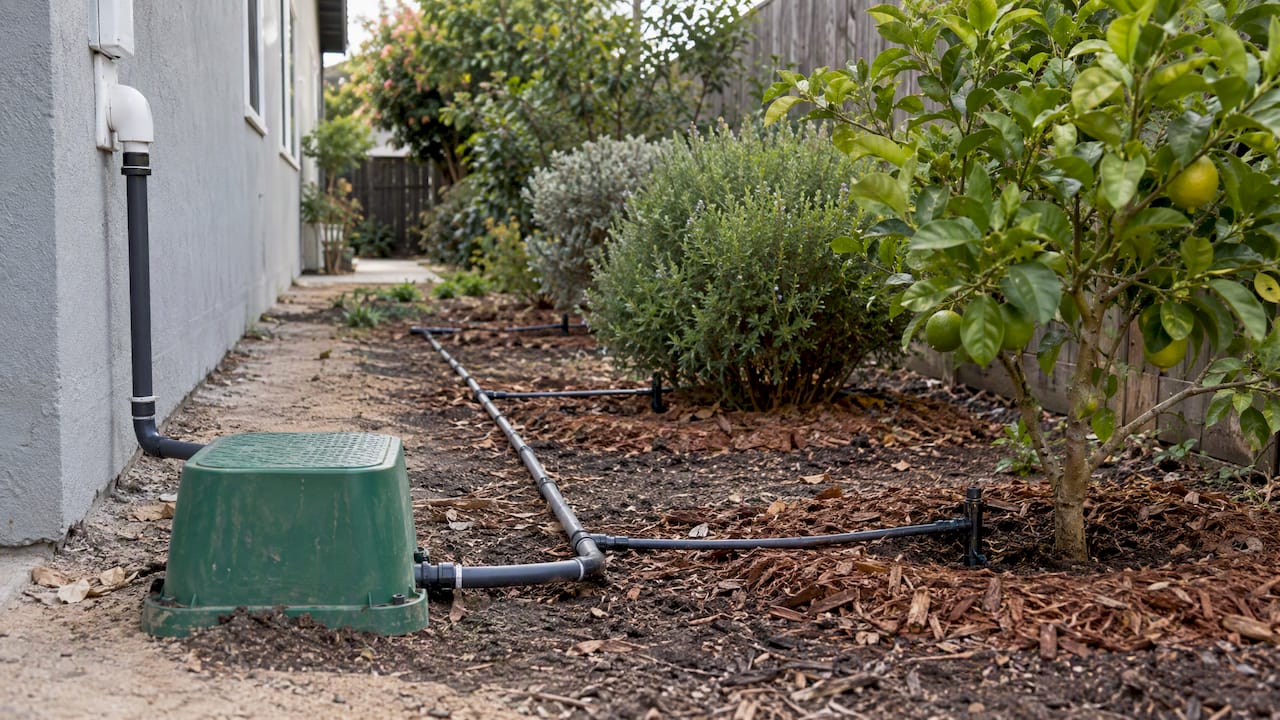
The same UC publication says to apply irrigation at the drip line to prevent crown and root diseases. Shade means less evaporation, so the soil stays wet longer than in sun. Drip lines on a timer, set low, beat overhead spray every time. Our guide to deep root watering explains how to deliver water slowly to the root zone, and the Los Angeles irrigation schedule rules cover the city’s watering days and hours.
Expect a first-year routine
UC ANR says drought-tolerant gardens need weekly watering during the first year, after which many established plants do well on occasional irrigation or natural rainfall. Shade plants follow the same pattern. Do not stop early, since roots need a season to reach deeper soil.
Time your planting
In Los Angeles, fall is the friendliest planting season: the heat has broken and winter rain does part of the work. Our guide to dry shade plants for fall planting covers timing and mulching before summer, and the page on native trees, shrubs and groundcovers in winter covers what else to put in.
Perspective: shade is a design asset, not a problem
We have designed and built landscapes in Los Angeles for more than 25 years, and shade is the condition homeowners apologize for most. We see it the other way. A shaded corner is the coolest room in your yard in August, and it is where a garden can feel most like a retreat.
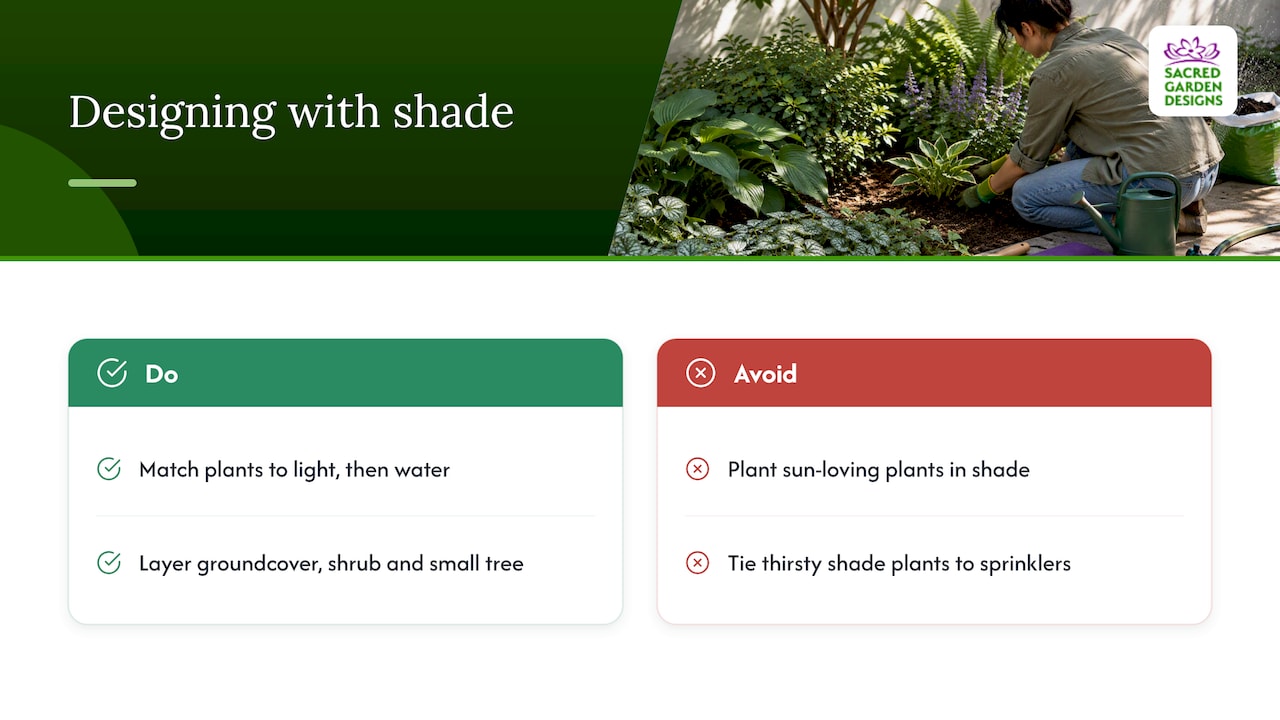
The mistakes we see most often are predictable. People plant sun-loving drought-tolerant plants in shade because they were sold as “low water,” then wonder why they rot. Or they pick lush, thirsty shade plants from another climate and tie them to a sprinkler. The better path is to match the plant to the light first and the water second, then layer groundcover, shrub and small tree so the bed looks finished.
Shade also changes how a yard should be used. A bench, a path of decomposed granite and a few well-chosen pots under an oak do more for stress relief than another lawn ever will. Our work on lawn alternatives that suit play, pets and shade comes from that idea.
— Denise Buchanan
A sample plan for a 10 by 20 foot dry shade bed
Here is a layout that works for a side yard or the strip along a north-facing fence, assuming at least some light reaches the area.
- Back row, against the fence: two sweet box or Australian fuchsia shrubs, spaced to give them room to mature.
- Middle layer: a drift of hummingbird sage in three or four plants, with heuchera clumps at the edge of the drift.
- Front edge: columbine tucked between heuchera for spring flowers, and yerba buena along the path to soften the paving.
- Finish: 2 to 3 inches of shredded mulch, and a single drip line running along the drip line of the shrubs rather than a spray head.
Add a hellebore or two where the shadow is deepest. Install the drip line first, then the plants, then mulch. You will spend most of your effort in year one, and very little afterward.
Common mistakes with shade plants
- Overwatering. Shade soil dries slowly. Yellow, soft leaves usually mean too much water, not too little.
- Calling it “full shade” when it is not. Check the hours of sun. A plant labeled for part shade will sulk in deep shade.
- Planting too densely. Plants look sparse in the first year, but crowding invites fungal problems in damp shade.
- Disturbing oak roots. See the section above. This is the one mistake that cannot be fixed later.
- Mixing water needs. Keep a thirsty plant out of a dry-adapted bed.
- Skipping mulch. Mulch holds moisture, suppresses weeds and helps plants get through their first summer.
Let us design your shade garden
If your shaded area is complicated, such as an oak canopy, a steep slope, a side yard with no irrigation or a mix of all three, a plan saves money. Sacred Garden Designs offers landscape design services: $1,500 for yards under 5,000 square feet and $2,500 for a full landscape design. We can then take the plan through installation, including irrigation, hardscape and slope work.
If you would rather learn to do it yourself, our classes and workshops cover water-wise gardening basics. You can see everything we do on our services page.
FAQ
What plants can grow in full shade in Los Angeles?
Hellebores handle partial sun to deep shade, and sweet box does well in partial to full shade, according to UC ANR. Yerba buena also grows best in full or part shade. Pair them with hummingbird sage for dry spots.
What plants thrive in dry, deep shade?
Sweet box and Australian fuchsia are low-water shrubs that tolerate deep or partial shade. Evergreen currant is another strong native choice. Hummingbird sage is the best low perennial for the dry part of the bed.
What is the best tree for shade in California?
It depends on the space. For a small yard, holly-leaf cherry is a California-native evergreen that can be a small tree or shrub and tolerates sun to partial shade. For a large property, existing native oaks are hard to beat, but protect their roots.
Can I plant under a coast live oak?
Yes, but carefully. Live oak roots are sensitive to extra moisture and disturbance, so hand-dig small holes, avoid regular irrigation near the trunk and choose plants that need little summer water.
How often should I water new shade plants?
Plan on weekly watering during the first year, then reduce as plants establish. Water at the drip line, and follow current Los Angeles watering days and hours.
Sources
- Shade Plants Handout, UC ANR
- Yerba Buena, Calscape
- Full shade plants, Las Pilitas Nursery
- Drought Tolerant Plants, Los Angeles County Public Works
- Shade Gardens: Learning to Love the Darker Side, UC Master Gardeners
- Tips for a Drought-Tolerant Garden, The Real Dirt
- Shady Characters, UC ANR
- Best Plants Around a Pool Cage