Plant-based chips are not one nutritional category. A one-ounce (28 g) serving usually lands in the same calorie range as a regular chip, roughly 150 to 200 calories according to Verywell Fit’s chip comparison. What separates a good bag from an average one is on the label: the first ingredients, the sodium, the fiber and the type of oil. This guide shows you which numbers to look at and how to use them.
TL;DR
- “Plant-based” describes where the food comes from, not how nutritious it is, so judge each bag by its Nutrition Facts panel and ingredient list.
- Compare chips per labeled serving (usually 1 oz, 28 g) and check how many servings are in the bag before you count calories.
- Look for under 140 mg of sodium per serving and at least 1 g of fiber for every 10 g of carbohydrate, the benchmarks the Tufts Health & Nutrition Letter suggests.
- Read the first ingredient. A “veggie” chip can be mostly potato flour colored with vegetable powder.
- Plant-based does not always mean vegan. Check the allergen line if you avoid dairy, egg or honey.
Table of Contents
- What a serving of plant-based chips actually is
- Calories, fat, carbs and protein: what the numbers look like
- Sodium: the number that varies most
- Fiber and the 10-to-1 carbohydrate rule
- Added sugars and saturated fat
- How to read the front of the bag
- Plant-based is not always vegan
- A 30-second label check you can use in the aisle
- Perspective
- Grow your own crunch with Sacred Garden Designs
- FAQ
- Sources
What a serving of plant-based chips actually is
Every number on a Nutrition Facts panel is tied to a serving, and serving sizes are not chosen freely. Under 21 CFR 101.9, the FDA’s nutrition labeling rule, nutrient amounts are declared per serving, and the serving size comes from the reference amounts customarily consumed set out in 21 CFR 101.12(b). For snack chips that works out to about one ounce, or 28 g, which is a small handful.
That is why the first habit worth building is to check “servings per container.” A 5 oz bag is about five servings. If you eat half the bag, you eat two and a half times the calories, fat and sodium printed on the panel. The panel is accurate, but only for the portion it describes.
Two practical ways to keep portions honest:
- Pour one serving into a bowl instead of eating from the bag.
- Pair the chips with something that adds protein or fiber, such as hummus, bean dip or guacamole, so a small portion feels like a snack.
Calories, fat, carbs and protein: what the numbers look like
Plant-based chips come from very different bases: potato, root vegetables, plantain, cassava, corn, chickpeas, lentils, beets, kale. The base changes the profile less than people expect, because frying or baking in oil and adding salt are shared by almost every chip.
Here is a side by side from published, sourced one-ounce style comparisons:
| Snack (per serving) | Calories | Fat | Carbohydrate | Protein | Source |
|---|---|---|---|---|---|
| Regular potato chips | 160 | 10 g | 15 g | 2 g | Verywell Fit |
| Organic beet chips (unflavored) | 150 | 0 g | 32 g | 4 g | Verywell Fit |
| Veggie straws, 1 oz | 130 | 7 g | 17 g | under 1 g | EatingWell |
| Potato chips, 1 oz | 160 | 10 g | 15 g | 2 g | EatingWell |
A few things stand out. The beet chip has no fat but more than double the carbohydrate, so calories end up close to the potato chip. The veggie straw has fewer calories, but it also has no fiber and almost no protein. The EatingWell dietitian who ran the veggie straw comparison concluded that potato chips came out ahead on protein, fiber and sodium in that particular matchup. The lesson is not that one is good and one is bad. It is that the name on the front tells you very little.
Where legume and grain-based chips differ
Chips built on chickpeas, lentils, peas or seed flours tend to be where you see more protein and fiber, because the flour itself carries them. Research supports the principle: a 2024 study of vegetable snacks found that snacks made with quinoa or amaranth flour had higher protein than wheat-flour snacks, and that the flour influenced the nutritional profile more than the vegetable did. Put simply, what the chip is made from matters more than the vegetable pictured on the bag.
Sodium: the number that varies most
Sodium swings more between chips than calories do. The Dietary Guidelines for Americans 2020 to 2025 recommend adults keep sodium under 2,300 mg a day. A single serving of chips can be a modest or a sizeable share of that, depending on the brand and the flavor.
The Tufts Health & Nutrition Letter suggests looking for chips with less than 140 mg of sodium per serving. Flavor is a big driver. Seasoned varieties, such as garlic, cheese-style or lime, often carry more salt than the plain version of the same chip, and some makers publish a separate figure for each flavor.
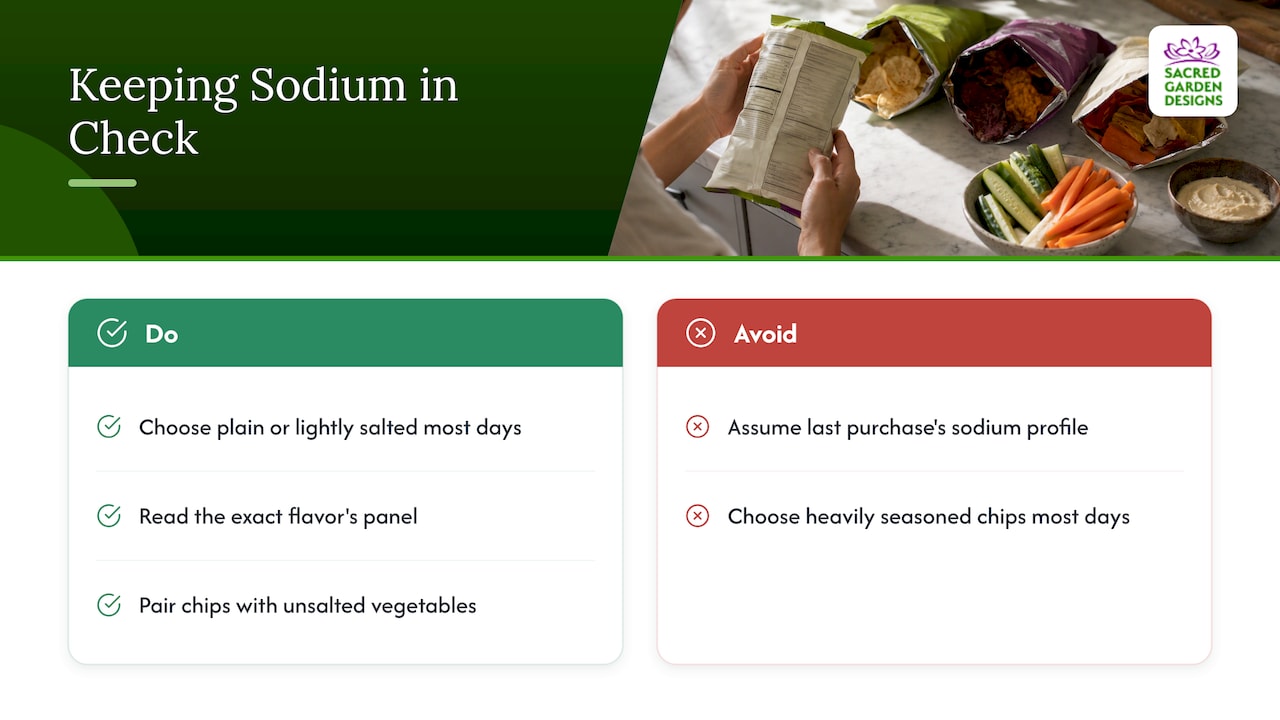
Oil can matter too. Some makers sell the same chip in more than one oil, and the sodium and fat profile can shift with the recipe, so it pays to read the panel of the exact flavor in your hand rather than assuming the one you bought last time.
A quick way to keep sodium in check: choose the plain or lightly salted flavor most days, and save the heavily seasoned ones for when you want them. Pairing chips with unsalted fresh vegetables, such as cucumber or sweet pepper, gives you crunch with less salt.
Fiber and the 10-to-1 carbohydrate rule
Fiber is where well-made plant-based chips can shine, and it is also where many fall short. Tufts suggests looking for more than one gram of dietary fiber for every 10 grams of total carbohydrate.
Here is a worked example with made-up numbers, just to show the math. Say a label lists 16 g of total carbohydrate per serving. Divide by 10 and you get 1.6, so you want at least about 2 g of fiber. If the label shows 3 g of fiber, it passes comfortably. If it shows 0 g, it does not, even if the bag has a leafy picture on it.
The same quick test works for any chip:
- Find total carbohydrate per serving.
- Divide by 10.
- Check that dietary fiber is higher than that number.
Added sugars and saturated fat
Most savory chips are low in sugar, but some seasoned and sweet-coated varieties are not. The Dietary Guidelines advise keeping added sugars and saturated fat each under 10 percent of daily calories from age 2 onward. The panel lists “Includes Added Sugars” separately, so you can see at a glance whether the sugar comes from the vegetables or from the recipe. Tufts also advises avoiding chips with added sugars.
For saturated fat, look at the oil. The panel will list it, and the ingredient list names the oil used. You will see sunflower, safflower, canola, avocado, coconut or palm oil, and the saturated fat per serving shifts accordingly.
How to read the front of the bag
Front-of-pack words are marketing, and they are not all equal. The Tufts letter points out that “All Natural” has no legal definition and no link to healthfulness, “Multigrain” does not mean whole grain, and “Sea Salt” is still salt. It also notes that some veggie chips contain few real vegetables and are often potato-flour-based chips colored with vegetable powder or extract.
A dietitian at the University of Colorado Anschutz Health and Wellness Center makes the same point about plant-based labeling: plant-based simply means food from plants, so nearly every chip qualifies, and a beet chip whose first ingredient is potato with beet coloring may not be what you expect. Her advice is to read the Nutrition Facts and compare ingredients.
This is useful in your favor. It means you can pick a chip on its merits:
- Short ingredient list. A base ingredient you can name, an oil and salt is a good sign.
- The base comes first. If you want beet or kale chips, the beet or kale should lead the list, not potato flour.
- Whole food base. Whole vegetables, legumes, plantain or cassava give the chip its character.
Plant-based is not always vegan
If you avoid animal products, the label needs a second look. The FDA’s draft guidance on plant-based alternative labeling, issued in January 2025, notes that plant-based alternatives do not have established definitions or standards of identity, and that FDA regulations do not currently define “vegetarian” or “vegan.” The term “vegan” is commonly used to say a food contains no animal-derived products.
Dietitians writing for Northwell’s The Well explain that plant-based typically means mostly from plants, and a product may still contain egg, honey, milk powder or whey. Their advice is to use the label as a clue and double-check the ingredients, starting with the allergen line.
This matters most for flavored chips. Plain potato chips made from potatoes, vegetable oil and salt are vegan, but many flavored varieties contain dairy or honey, and some salt and vinegar chips use buttermilk or lactose. Scan for whey, casein, honey, gelatin and similar terms, and look for a certified vegan mark if it is important to you.
A 30-second label check you can use in the aisle
- Serving size and servings per bag. Decide how much you will really eat.
- First ingredient. Does it match what the bag promises?
- Sodium. Aim for under 140 mg per serving for everyday snacking.
- Fiber versus carbohydrate. Look for more than 1 g of fiber per 10 g of carbohydrate.
- Added sugars. The lower, the better.
- Allergen line. Confirm there is no dairy, egg or honey if you eat vegan.
If a bag passes most of these, it is a solid choice. If you are choosing for travel, our guides on what to pack and what to skip in plant-based travel snacks and on healthy travel snacks that survive TSA and hot cars cover how chips and other snacks hold up on the road.
Perspective
We came to snacks through gardens. After more than 25 years of designing water-wise, edible and climate-resilient landscapes, we think about food the way we think about a planting plan: start with real plants, keep the list of ingredients short, and let the quality of the base do the work.
That is the idea behind Trinity Chips, our plant-based snack line for travel retail. When we talk about plant-based snacking, we encourage people to look past the front of the bag. The label that matters is the Nutrition Facts panel and the ingredient list, and we welcome shoppers reading both on any snack they buy, ours included.
Eating from a garden changes how you read food. You notice what a vegetable looks like when it is the first ingredient, and you notice when it is not. If you want to take that further, our edible gardening classes and workshops teach you to grow the crunchy, snackable things yourself, from kale to beans to root vegetables.
Denise Buchanan
Grow your own crunch with Sacred Garden Designs
If reading chip labels has you curious about where good snacks start, the answer is the soil. We design and build edible and water-wise gardens in Los Angeles and beyond, and we teach people to grow their own food through Sacred Garden classes and workshops.

If you would rather have the garden built for you, our landscape design services start at $1,500 for yards under 5,000 sq. ft. and $2,500 for a full landscape design. You can also see the rest of what we do on our services page or explore Sacred Garden Designs.
FAQ
Are plant-based chips healthier than regular chips?
Not automatically. Because plant-based only means the food comes from plants, nearly every chip qualifies, and the University of Colorado Anschutz dietitian cited above notes the label can make a chip seem healthier than the same chip without it. Compare the Nutrition Facts for sodium, fiber and added sugars instead of relying on the claim.
How many calories are in a serving of plant-based chips?
Most traditional snack chips provide 150 to 200 calories per serving, according to Verywell Fit, and plant-based versions generally fall in a similar range. The serving is typically one ounce (28 g), so check how many servings the bag holds.
What should I look for on the label?
Start with the first ingredient, then check sodium (under 140 mg per serving is the Tufts benchmark), fiber (more than 1 g for every 10 g of carbohydrate) and added sugars. If you eat vegan, read the allergen line as well.
Are plant-based chips always vegan?
No. Plant-based products can still contain ingredients such as milk powder, whey, egg or honey, and the FDA does not currently define vegan. Flavored chips are the most likely to include dairy, so read the ingredients or look for a certified vegan mark.
Are veggie chips made from real vegetables?
Sometimes, but not always. Tufts notes that some veggie chips are potato-flour-based chips colored with vegetable powder or extract. If vegetables are the point for you, make sure they appear first in the ingredient list.
Sources
- eCFR, 21 CFR 101.9, Nutrition labeling of food
- Dietary Guidelines for Americans, 2020 to 2025
- Verywell Fit, Best and Worst Snack Chips: Calories and Nutrition
- EatingWell, Are Veggie Straws and Veggie Chips Healthier Than Potato Chips?
- Determination of nutritional signatures of vegetable snacks, 2024 study
- Tufts Health & Nutrition Letter, “Healthy” Chips?
- University of Colorado Anschutz, Dietitian Gets to the Meat of the Plant-Based Diet Trend
- FDA, Draft Guidance for Industry: Labeling of Plant-Based Alternatives to Animal-Derived Foods
- Northwell The Well, Is It Vegan? A Dietitian’s Guide to Decoding Food Labels
- Treehugger, Are Potato Chips Vegan?