A small backyard can be designed for drought with a handful of decisions made in the right order: sketch the space and group plants by water need, choose plants suited to your climate zone, use permeable surfaces for paths and patios, cover bare soil with mulch, and put everything on drip irrigation. Done well, a compact yard is easier to make water-wise than a large one, because every square foot is visible and every plant can be placed on purpose.
This guide walks through that order, with figures from university extension services, the EPA and Los Angeles County, and notes from our own work designing dry-climate gardens.
TL;DR
- Draw a site plan first, then group plants by water, sun and soil needs so nothing gets extra water it does not need.
- Pick plants by your USDA hardiness zone and local conditions, favoring water conservers that keep their foliage through dry spells.
- Use permeable paving and grading so rain soaks in rather than running off.
- Mulch with 2 to 4 inches of gravel or wood chips, and water new plants deeply but infrequently with drip lines.
- Weed, prune and re-tune your irrigation each season; that is most of the upkeep.
Table of Contents
- Start with a plan, not a plant list
- Divide the yard into water zones
- Choose plants for your climate
- Paths, patios and hardscape that let water in
- Soil and mulch
- Irrigation: drip, deep and temporary
- A sample layout for a 20 by 30 foot yard
- Keeping it attractive over time
- Perspective: why we design small yards first
- Get help with your design
- FAQ
- Sources
Start with a plan, not a plant list
The most common small-yard mistake is buying plants first. A drought-tolerant plant in the wrong spot still struggles. The Los Angeles County drought-tolerant garden handbook suggests adapting its model plant design to your own garden using a site plan, then setting the potted plants out on the ground to work out the layout before anyone digs.
For a yard under about 1,000 square feet, a simple plan is enough:
- Measure the yard and draw it to scale on graph paper, marking fences, walls, doors, windows and any trees.
- Note where the sun falls in the morning, at midday and in late afternoon. Reflected heat from a south or west wall changes what survives.
- Mark where water goes when it rains or when you run a hose. Low spots and downspouts matter.
- Mark what the space must do: seating, a dog run, a vegetable bed, a path to a side gate.
- Only then place plants and surfaces.
Colorado State University Extension makes a point worth remembering here: a design should match the site’s intended use instead of defaulting to high-input lawn, and water-wise does not have to mean no turf at all. If your family uses a small patch of grass every day, a tiny, well-placed lawn can earn its water. If nobody walks on it, it is a candidate for replacement. Our guide to matching lawn alternatives to play, pets and shade covers that decision in depth.
Divide the yard into water zones
In a small space, zoning is the single biggest design tool. New Mexico State University describes dividing a landscape into an oasis with the highest water use, a moderate-water transition zone, and a low-water zone further out. In a compact yard this might look like:
| Zone | Where it goes | What lives there | Water |
|---|---|---|---|
| Oasis | Next to the back door or seating area | Herbs, a few containers, a small vegetable bed, or a small lawn patch | Highest |
| Transition | Between the patio and the edges | Moderate-water perennials and shrubs | Moderate |
| Dry edge | Fences, far corners, slopes, hot walls | Succulents, native shrubs, ornamental grasses | Lowest, once established |
The same extension publication notes that the irrigation system is part of the plan and that zones should be separate and managed independently. In practice, that means the oasis and the dry edge sit on different valves or different drip lines, so you can cut back one without starving the other.
The LA County handbook adds the payoff: plants grouped by soil, water and sunlight needs do not require extra water. Mixing a thirsty hydrangea into a bed of lavender is how a drought garden ends up needing a sprinkler.
Choose plants for your climate
“Drought tolerant” means different things in Phoenix, Charleston and Portland. The EPA’s WaterSense program advises gardeners to find their USDA plant hardiness zone and choose plants rated low-water-use or drought-tolerant for their area. Regional differences are real even within one state: Clemson’s Home & Garden Information Center, for example, lists trees and palms adapted to specific regions of South Carolina. Your county extension office is the best place to get a list matched to your zone.
Look for water conservers, not just survivors
Penn State Extension separates two strategies. Drought evaders go dormant, which can leave a bare patch in midsummer. Water conservers hold attractive foliage, and Penn State recommends conservers for gardens meant to look good in dry periods. In a small yard you see every plant every day, so conservers earn the space.
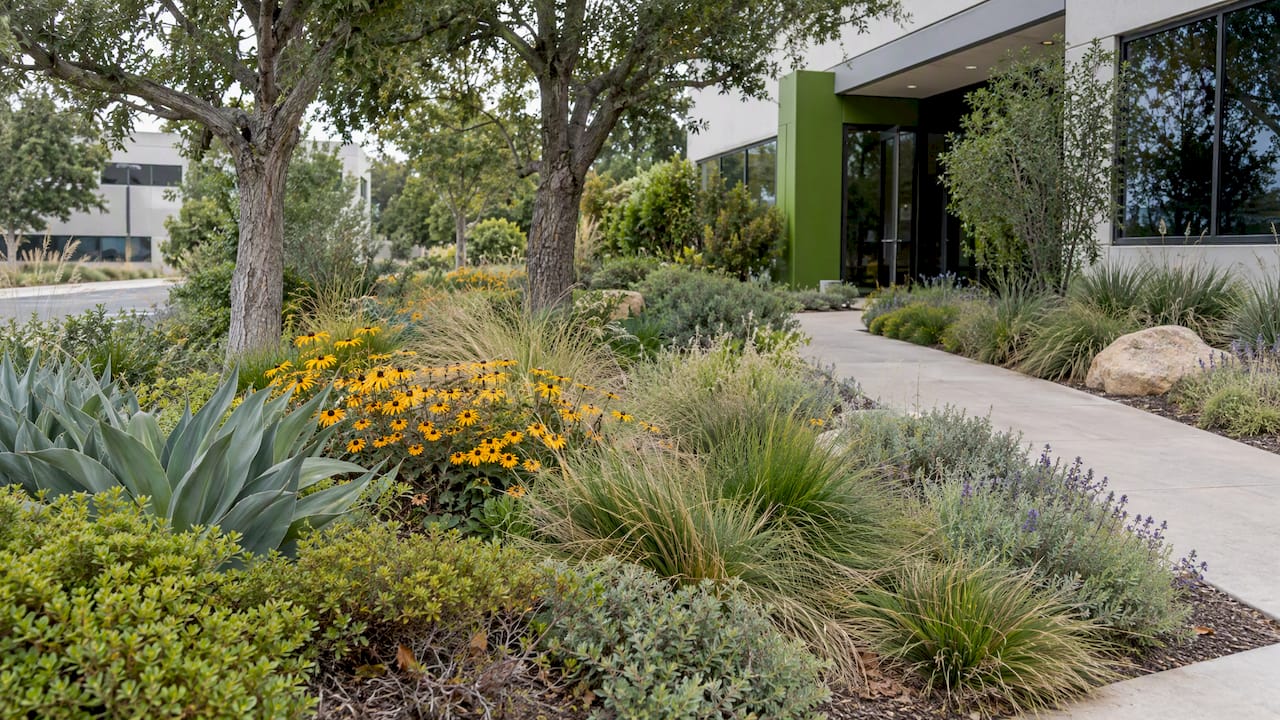
The same page gives you visual clues: deep taproots, succulent leaves, and silvery-gray foliage that reflects sunlight and cuts evaporation from the leaf. Think lavender, sage, yarrow, agave and many native shrubs.
Build layers in a small footprint
Compact yards look larger and richer when planted in layers:
- Structure: one small tree or large shrub for shade and height, sized for the yard at maturity.
- Mid layer: two or three shrubs or grasses repeated for rhythm.
- Groundcover: a low carpet that fills gaps and shades soil. See our guide to drought-tolerant groundcovers.
- Accents: a few sculptural plants or pots for focal points.
Repeat three or four plant types rather than collecting one of everything. A restrained palette reads as designed and is easier to irrigate.
If you garden in Southern California, our list of drought-tolerant plants for Los Angeles and our piece on succulents that thrive in Los Angeles are tuned to that climate. For a shady side yard, try dry shade plants.
Paths, patios and hardscape that let water in
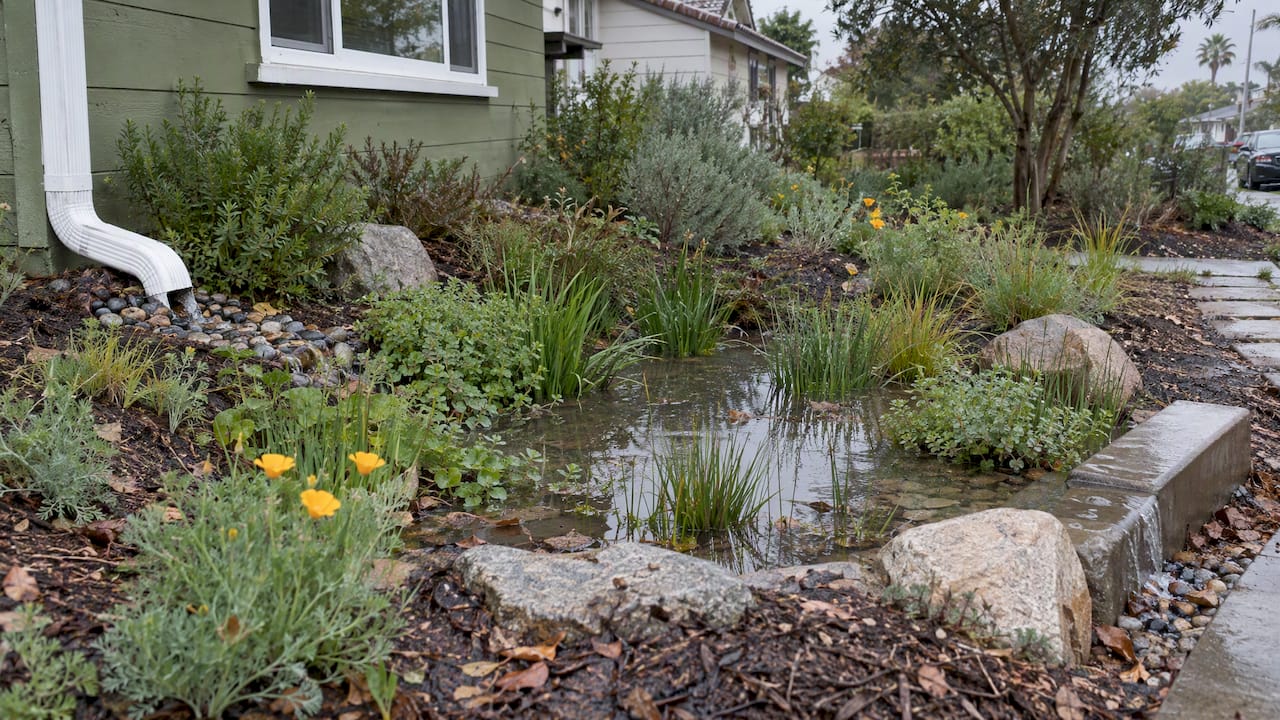
In a small yard, hard surfaces can easily take up half the area, so how you build them matters. Oregon State University Extension recommends permeable materials such as stone or open-cell concrete pavers for walkways and patios, and grading the site to send runoff to features like a rain garden. The LA County handbook agrees that paving stones, brick and flagstone set on a thick gravel base let water soak through, and grading can capture rainfall in the garden.
A few layout ideas that suit tight spaces:
- Stepping stones through planting instead of a solid path. Set them with gaps for groundcover.
- A small gravel or flagstone patio just big enough for a table and two chairs, placed in the oasis zone.
- Grade gently so a downspout or patio edge drains into a shallow planted basin instead of the street. Our guide to stormwater management landscaping explains the features and upkeep.
- Use vertical space. A trellis or wall planters add greenery without adding irrigated ground.
If you like the look of decomposed granite underfoot, see our notes on fixing weak edging on a decomposed granite patio, since edging is where most DIY installs fail.
Soil and mulch
You do not need to enrich soil for everything. The University of Arizona’s guidance says desert-adapted plants do not need soil amendments, while annuals, vegetables and turf may. So amend the vegetable bed in your oasis zone, and leave the dry edge alone.
The same publication recommends two to four inches of gravel or wood chips to reduce evaporation, suppress weeds and help keep the ground cool. Some practical points for a small yard:
- Gravel suits succulents and desert plants and does not break down. Wood chips suit shrubs and perennials and feed the soil as they decompose.
- Keep mulch a few inches back from trunks and crowns so stems stay dry.
- Refresh organic mulch as it thins. Bare patches are where weeds and evaporation return.
Our guide to mulch types for drought compares options in more detail.
Irrigation: drip, deep and temporary
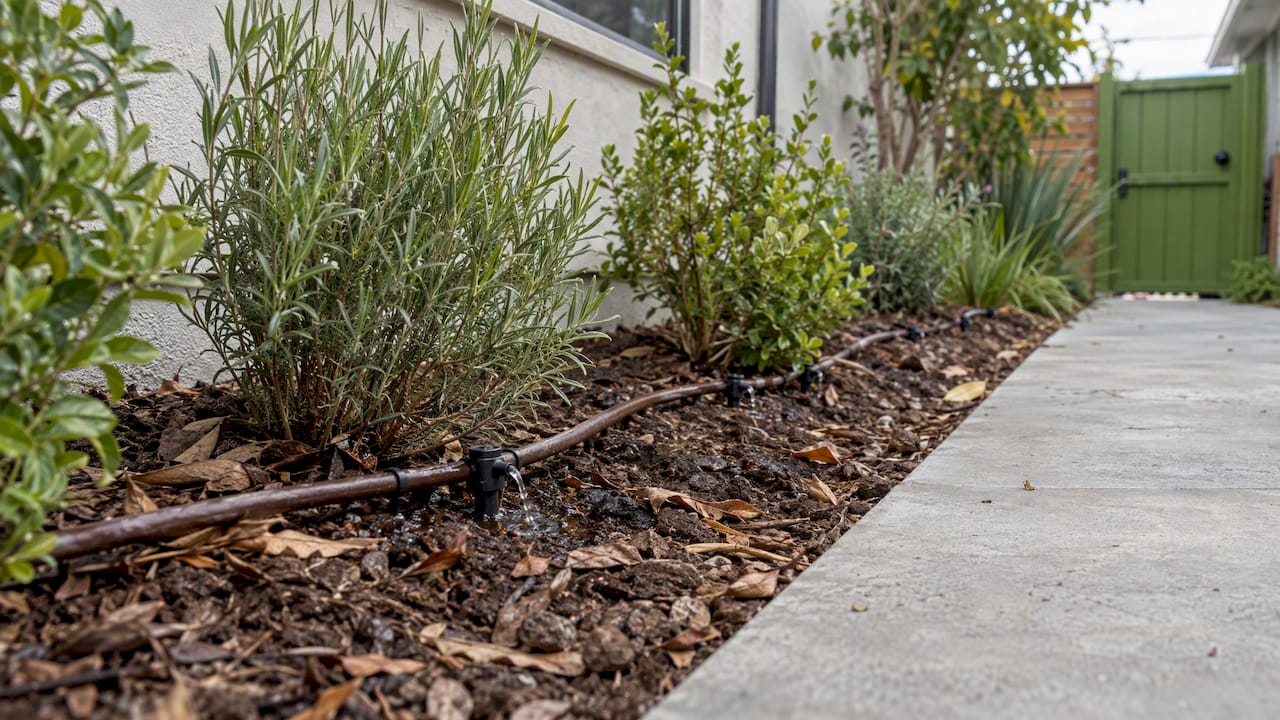
UMass Extension advises drip irrigation or soaker hoses to conserve water, and regular water for drought-tolerant plants until they are established. Penn State says these plants need sufficient water for at least their first growing season to build a strong root system.
How to water new plants
The goal is deep roots. UMass describes applying about 1 inch of water to a depth of 4 to 6 inches as encouraging deeper roots than frequent, shallow sprinkling. A simple routine:
- Run drip lines long enough to wet the root zone, not just the surface.
- Let the top layer dry between waterings.
- Over the first season, stretch the interval as plants settle in.
- After the first season, test how long a plant can go before it shows stress, and set the controller accordingly.
UMass also notes that frequent watering raises maintenance, cost and demand on limited water supplies, which is one more reason to separate zones and avoid a single sprinkler schedule for the whole yard.
If you are in Los Angeles, check the local watering days and hours in our Los Angeles irrigation schedule guide. If you grow vegetables in the oasis zone, our guide to vegetable garden irrigation and the walkthrough for drip irrigation for raised beds cover the details.
A sample layout for a 20 by 30 foot yard
This is an illustration, not a prescription, and plant choices must come from your zone.
- Back door to patio (oasis): a flagstone patio on a gravel base, two large pots of herbs, and a small raised bed on its own drip line.
- Along the sunny fence (dry edge): a row of repeated silver-leaved shrubs with a gravel mulch of 2 to 4 inches, and a few sculptural succulents as accents.
- Shaded corner (transition): a small tree or large shrub, with a groundcover beneath it and a bench.
- Path to the side gate: stepping stones set in gravel, with groundcover between them.
- Drainage: the downspout empties into a shallow, planted basin rather than onto pavement.
The layout uses one small tree, three repeated shrub types, one groundcover and a handful of accents. That restraint keeps the planting plan simple and the irrigation straightforward.
Keeping it attractive over time
A drought garden is low-water, not no-care. UMass recommends regular weeding and pruning, and adjusting automatic irrigation to soil moisture and plant needs. A seasonal routine for a small yard:
- Spring: check drip lines for leaks and clogged emitters, refresh mulch, prune after flowering where needed.
- Summer: watch for stress on new plants, and weed before seeds set.
- Fall: a good planting season in many regions, since plants root while soil is still warm and rain returns.
- Winter: reduce irrigation, clean up dead growth and plan changes.
Timing varies by climate, so use your local frost dates rather than fixed calendar days; our garden maintenance schedule explains how. If you have a mature tree in the yard, its water needs in dry years are different from the understory plants; see our guide to drought tree care.
Perspective: why we design small yards first
We have spent over 25 years designing water-wise landscapes in Los Angeles and beyond, and small yards are where good design shows most. There is nowhere to hide a poor layout. Every plant, path and irrigation line is seen daily, so the decisions have to be deliberate.
Our approach combines artistry with environmental responsibility. We start by reading the site: sun, slope, soil, drainage and how you actually live in the space. A yard that looks beautiful but ignores those things will not thrive through a dry year. A yard that respects them can be lush, layered and calm, and it asks far less of you.
We also believe a small garden should do more than save water. It should be a place you want to sit in, whether that means a quiet corner for stress relief, a few edible plants by the kitchen door, or a habitat that brings in pollinators. Water-wise design is the framework; the experience of the space is the point.
Denise Buchanan
Get help with your design
If you would rather not sort out zones, plant lists and drip layouts alone, we can do it with you. Our published design fee is $1,500 for yards under 5,000 sq. ft. and $2,500 for a full landscape design, and we also offer installation, irrigation design, hardscape and ongoing garden maintenance. You can see what is included on our landscape design services page, or browse all our services.
Prefer to learn first? Our classes and workshops teach the basics hands-on, and our site analysis for design consultations shows what we look at before drawing a plan.
FAQ
How much of a small backyard should be lawn?
Only as much as you actually use. Colorado State University Extension notes that water-wise design is about fitting the landscape to the site’s use, not removing every bit of turf. A small play or pet patch in the highest-water zone can make sense, while unused lawn is a good candidate for groundcover or planting beds.
When should I plant a drought-tolerant garden?
The right season depends on your region. In many areas, fall is a good window because roots establish before the hottest weather, but check with your county extension office for local timing. Whatever the season, expect to water regularly through at least the first growing season.
Do drought-tolerant plants need any water at all?
Yes, at the start. They need regular watering until established, and many still benefit from occasional deep watering in extended dry spells. UMass advises drip irrigation or soaker hoses to deliver it efficiently.
What is the best mulch for a small drought garden?
Gravel or wood chips, applied two to four inches deep. Gravel suits desert-style plantings, and wood chips suit shrub and perennial beds. Keep either away from trunks and crowns.
Can a drought-tolerant yard still look lush?
Yes. Layering shrubs, grasses and groundcovers, repeating a few plants, and choosing water conservers that keep their foliage all help. The look comes from the design, not from heavy watering.
Sources
- Drought-Tolerant Garden Handbook, Los Angeles County
- Landscape Water Conservation: Principles of Xeriscape, New Mexico State University
- Water-Wise Landscape Design: Steps, Colorado State University Extension
- What to Plant, US EPA WaterSense
- Plants that Tolerate Drought, Clemson Home & Garden Information Center
- Designing the Home Garden for Drought Resilience, Penn State Extension
- Conserving Water in Your Yard and Garden, Oregon State University Extension
- Water Wise, University of Arizona Extension
- Drought Tolerant Annuals and Perennials, UMass Amherst
- Landscaping to Conserve Water, UMass Amherst