The pruning mistakes that do the most damage are topping, flush cuts, stub cuts, removing too much of the crown at once, pruning at the wrong time of year, and coating cuts with paint. Topping is the worst of them. It is the opposite of pruning: it cuts a tree back to a set height or limb size with no regard for its structure. Each mistake below has a proper alternative, and most are easy to avoid once you know where to cut and how much to take. If a branch is large, high or near a power line, our expert tree trimming team can take the job on.
TL;DR
- Never top a tree. Topping creates large wounds, fast weak regrowth and a more hazardous tree. Use crown reduction or thinning cuts instead.
- Cut just outside the branch collar, the swollen ring where a branch meets its parent. No flush cuts, no stubs, no wound paint.
- Take no more than about 20 to 25 percent of the leaf area in a year. Spread heavy work across several years.
- Prune most trees in late winter dormancy, adjust for the species, and keep tools sharp.
- Large limbs, climbing and anything near utility lines are not do-it-yourself work.
Table of Contents
- Topping vs. pruning: the mistake that matters most
- Cutting mistakes: flush cuts, stubs and torn bark
- Taking too much: over-pruning and lion-tailing
- Timing mistakes: pruning when the tree is most vulnerable
- Choosing the wrong branches
- Tool mistakes
- Mistakes that look like pruning but are really tree damage
- When the job is too big or too close to a hazard
- A short checklist before you cut
- Our perspective
- Get the right cuts from the start
- FAQ
- Sources
Topping vs. pruning: the mistake that matters most
Topping, also called heading, stubbing or hat-racking, means cutting off all the parts of a tree above a certain height or limb size. West Virginia University Extension calls it a common and harmful technique. It leaves big wounds that close slowly, which gives decay, disease and insects an open door. Its effects are hard or impossible to reverse.
Proper pruning works the other way. It removes specific branches for specific reasons and keeps the tree’s natural shape. The two cuts to know are:
- Heading cuts shorten a branch and leave a stub or a bud. Virginia Cooperative Extension notes that heading cuts reduce height and stimulate the buds closest to the cut. It advises against them on branches more than a year old.
- Thinning cuts remove a branch back to its point of origin, or back to a side branch. They keep the tree’s form and are usually the better choice.
Why topping backfires
Cutting the canopy wakes dormant buds. Illinois Extension explains that these produce dense, fast-growing shoots, and that the tree ends up more hazardous and no shorter in the long term. West Virginia University Extension adds that the regrowth is crowded and weakly attached. It catches wind like an open umbrella and traps bark, which creates pockets of decay. The dense limbs then need an expensive, recurring trimming cycle that proper pruning from the start avoids.
The Nebraska Forest Service also points out that a topped tree becomes more hazardous over time, and the property owner is liable for damage it causes.
What to do when a tree is too big
If you want a smaller tree, you have two honest options:
- Crown reduction. Cut branches back to a side branch that is at least one-third the diameter of the branch being removed, leave no stubs, and keep the natural form. Illinois Extension describes this as the alternative to topping.
- Replace it. UNH Extension puts it plainly: if heading cuts are needed to make a plant fit its spot, it is the wrong species for the site.
The second option is where planning pays off. In a small yard, choosing a tree whose mature size fits the space avoids the problem for good. Our guide to shade trees for small yards in Los Angeles covers species that stay in scale.
Cutting mistakes: flush cuts, stubs and torn bark
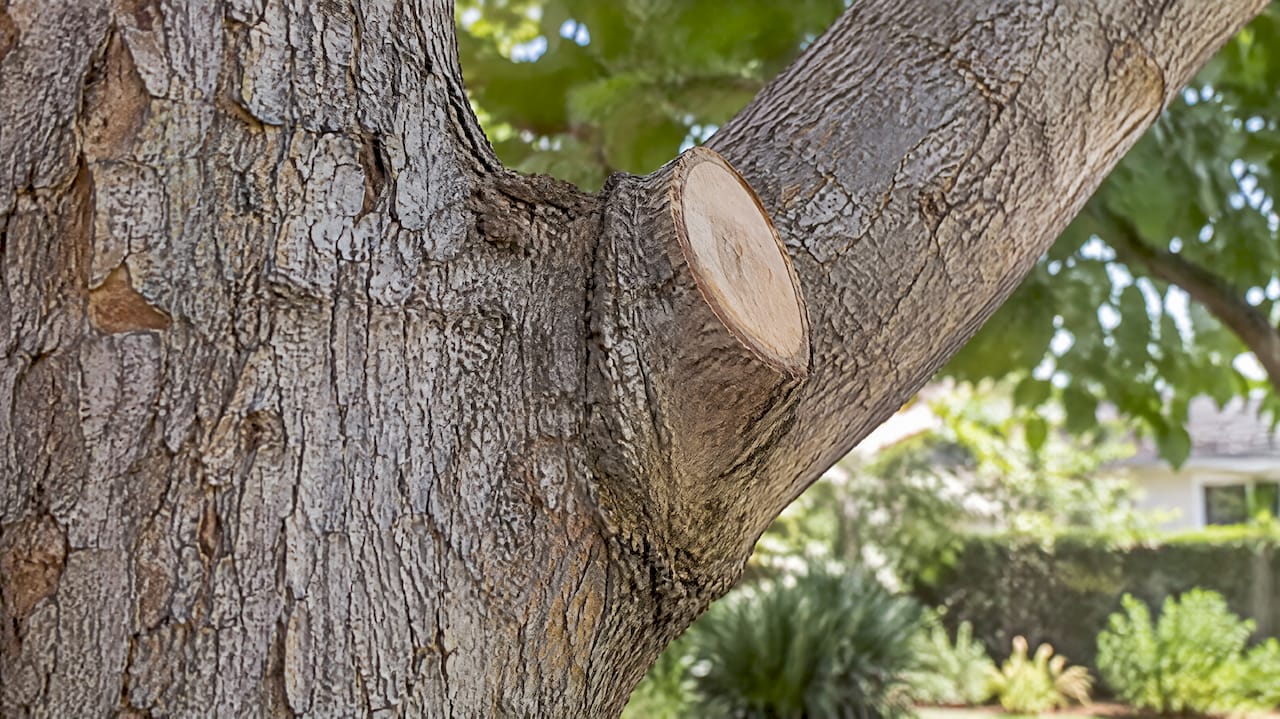
Where you make the cut matters as much as which branch you choose. Two landmarks tell you. The branch bark ridge is the raised line of bark in the crotch above the branch. The branch collar is the slightly swollen ring at the base of the branch. The cut goes just outside both, on the branch side.
Flush cuts
A flush cut slices the branch off level with the trunk and removes the collar. Washington State University explains that these wounds seal over much more slowly and are prone to decay. NMSU Extension adds that cutting into trunk tissue interferes with the tree’s protective mechanisms and lets disease and insects in.
Stub cuts
The opposite error leaves too much branch behind. A stub gives the tree dead tissue it must grow over, which takes longer and invites decay. The Pacific Northwest chapter of the International Society of Arboriculture calls flush cuts and stub cuts the two most common pruning errors. Both usually happen on the final cut of the three-cut method. The fix is to cut back to a lateral branch or to the collar, never in the middle of a branch.
Skipping the three-cut method on heavy limbs
A heavy branch that is cut from the top alone will fall under its own weight and strip a long tear of bark down the trunk. Utah State University Extension describes the sequence:
- Make an undercut one-third of the way through the branch, one or two feet out from the trunk, to stop the bark from stripping.
- Make a top cut a little farther out to remove most of the weight.
- Make the final natural target cut just outside the collar to remove the stub.
Wisconsin Extension applies this three-cut procedure to branches 3 inches or larger. It also advises hiring a commercial arborist for large-branch removal or for climbing tall trees. Which branches are too large to cut safely yourself is covered in the section on when to bring in a professional.
Pruning large branches when small ones would have done
The Pacific Northwest ISA warns against putting off pruning until limbs get big: large limbs mean large wounds that are harder for a tree to close. Riverbend-style advice from tree services says the same thing about branches over 3 or 4 inches. The practical lesson is to prune young trees lightly and often. Remove rubbing branches and weak competing leaders early, when each cut is small.
Painting or sealing the cut
Wound paint feels like first aid, but Virginia Cooperative Extension lists coating pruning cuts with paint or sealer among the common mistakes. The Nebraska Forest Service agrees that wound dressing interferes with healing. Make a clean cut in the right place and leave it open.
Taking too much: over-pruning and lion-tailing
Every leaf is a food factory, and wound repair costs energy. Remove too many leaves and the tree has less energy to heal the wounds you just made.
- The 20 to 25 percent rule. Utah State University Extension advises against removing more than 20 to 25 percent of a tree’s leaf area in a year. The Nebraska Forest Service puts the limit at about 20 percent of the crown’s total leaf area. Younger, vigorous trees tolerate more than mature or stressed ones.
- Spread it out. Heavy pruning belongs across two or more years. Raising the crown over a driveway or walkway, for example, can be staged over several seasons.
- Keep the crown. WSU’s pruning guide says to keep at least three-quarters of the tree as live crown.
- Foliage on a single branch. The Pacific Northwest ISA says not to remove more than one-quarter of the foliage from a branch unless you are removing the whole branch.
Lion-tailing is a related mistake. It strips the inner branches so that foliage sits in tufts at the branch ends. WSU notes that this overthinning leaves live tissue only at the tips and raises the risk of breakage under stress. The Nebraska Forest Service adds that thinning the crown for air can leave trees open to summer heat stress. Most pruning, it advises, should be limited to removing broken, rubbing, damaged or dead branches.
A quick worked example
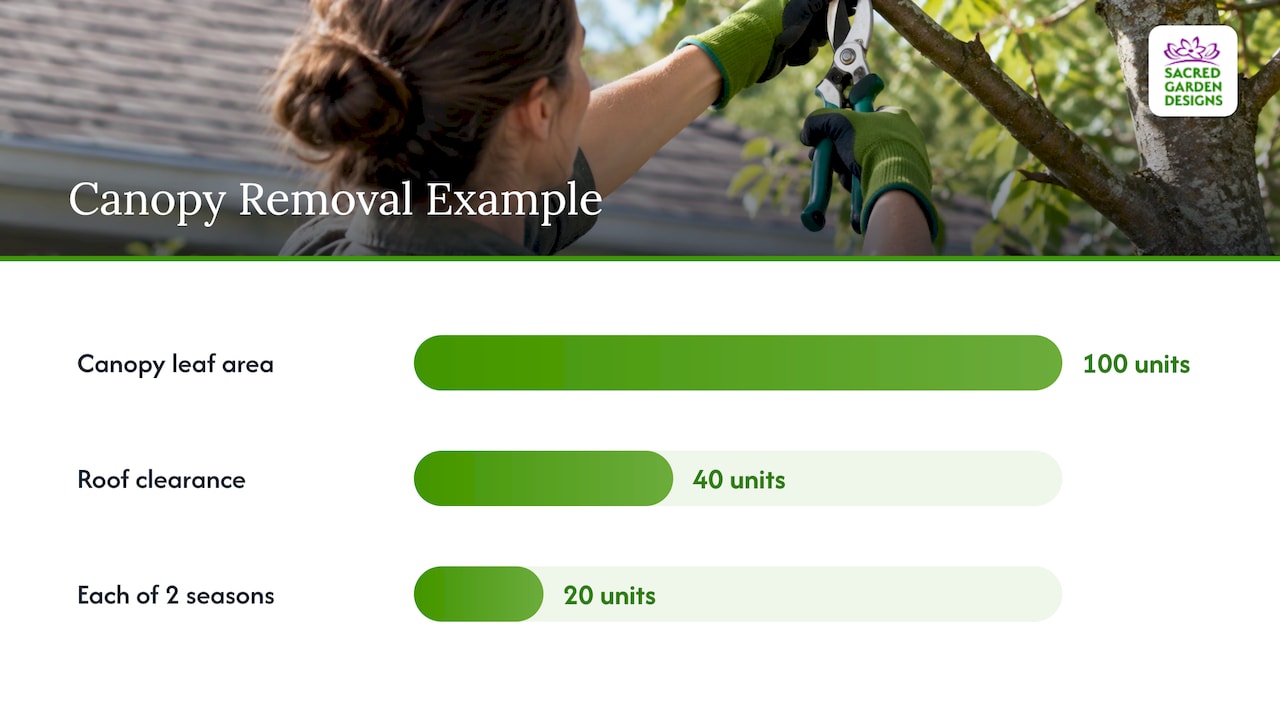
Say a mature shade tree has a canopy you estimate at 100 units of leaf area. Staying within the 20 percent guideline means removing roughly 20 units in a season. If the tree needs 40 units gone to clear a roof, plan two seasons of work, not one. Each cut is a clean thinning cut outside a collar. The result is a tree that keeps its shape and has the energy to recover.
Timing mistakes: pruning when the tree is most vulnerable
The right season depends on the tree and your climate, so treat these as general patterns and check what suits your species.
- Late dormant season. Iowa State Extension says most trees should be pruned in late winter, February to March. Early summer is also acceptable, especially for sap-bleeding species such as maple, birch and elm.
- Spring flush. The Nebraska Forest Service advises curtailing pruning during the active spring growth flush, when tender bark tears easily, and during fall coloration, when decay risk is highest.
- Sap bleeding. UMN Extension notes that some trees bleed sap after late winter or early spring pruning. This is harmless, though it worries some owners.
- Spring and summer disease risk. UMN also notes that spring or summer pruning raises the chance of fireblight infection and spread. Autumn or early winter pruning is more likely to cause dieback at the cut.
- Late summer and early fall. WSU warns that late summer cuts can stimulate tender growth, and that September to early October cuts can produce growth too soft to survive winter.
- Oaks. In areas with oak wilt, the Nebraska Forest Service says to restrict oak pruning from April through June. Wisconsin Extension advises avoiding oaks from May to August, because sap on fresh wounds attracts disease-carrying insects.
- Flowering shrubs. WSU says spring bloomers such as lilac, forsythia and spirea should be pruned right after they flower. Summer and fall bloomers on current-year growth are pruned in winter.
Timing in Southern California
The patterns above come from colder states. In a mild, dry climate like Los Angeles, the calendar shifts. We cover it in our guides on tree trimming season in Los Angeles, trimming palms, pruning citrus and pruning water-wise gardens without losing spring blooms.
Time of day matters too. Pruning in extreme heat adds stress to a plant already under pressure. In dry years, a stressed tree tolerates even less cutting, so see our advice on drought tree care.
Choosing the wrong branches
Good pruning is mostly a matter of selecting what to remove. UMN Extension lists the usual targets:
- Dead, dying or broken branches
- Rubbing or crossing branches
- Stubs left from earlier cuts
- Downward-growing branches
- Branches larger in diameter than the trunk
- Root suckers and watersprouts
Virginia Cooperative Extension’s list of 24 tree-care mistakes adds two selection errors. One is leaving co-dominant leaders, two upright stems that compete and tend to split in storms. Choose one while the tree is young. The other is leaving crossing branches that rub bark. The same publication notes that few residential trees die of old age. Mechanical damage and improper care kill more of them than insects or disease.
A related mistake is cutting a branch in the middle with no destination. Cut back to a bud, a twig or a lateral branch that points where you want growth to go, as NMSU recommends.
Tool mistakes
Dull, rusty or the wrong tools produce ragged, crushed cuts that heal poorly. NMSU Extension matches tools to branch size:
| Branch size | Tool |
|---|---|
| Small twigs | Hand shears |
| Up to about 1½ inches | Loppers |
| Limbs up to 6 inches | Pruning saw |
| Limbs over 3 inches | Chainsaw, not for small limbs because of its shredding effect |
| Branches several feet overhead | Pole pruner, with goggles and a hard hat |
UNH Extension is more conservative on loppers: bypass pruners make the cleanest cuts on living branches up to half an inch. Loppers suit branches up to 1 inch, and larger cuts with them can damage bark. It also says anvil pruners crush stems and are not recommended for live wood. Keep every blade sharp.
One more habit is worth building. When cutting diseased or dead wood, disinfect tools between cuts. Virginia Tech suggests products such as Lysol, Listerine or rubbing alcohol. Its tests found that Pine Sol and household bleach are highly corrosive to metal tools.
Mistakes that look like pruning but are really tree damage
Some of the worst harm comes from the lawn, not the saw. Purdue Extension warns that annual “shaping” of a tree hastens its death. It also warns that a mower or string trimmer that rubs the bark permanently damages the growth layer under it, with no cure. A mulch ring around the base is a simple way to keep equipment away from the trunk.
When the job is too big or too close to a hazard
Some work is not worth the risk, whatever your skill level. Utah State University Extension says to bring in an insured, well-trained professional when removing large branches or whole trees, when climbing is involved, or when you are unsure of your abilities. The Pacific Northwest ISA adds that a tree that cannot be pruned from the ground, or one already identified as hazardous, is a professional job.
Power lines are a hard stop. Utah State University says pruning near utility lines should only be done by certified line-clearance professionals, and that you should call your electric company. Do not prune any branch that is touching or near a line.
Ladders are a common source of injury. Cutting overhead from a ladder with a saw in one hand is how pruning jobs turn into accidents. If you do work at height around the house, a refresher on ladder safety basics is worth the few minutes.
Branches over a roof carry their own risk, both to the person cutting and to the shingles below. If limbs hang over your house, tree branches over your roof is a good primer on the damage they cause. Removing the limbs themselves is work for our expert tree trimming crew.
In fire-prone areas, trimming also ties into defensible space. Our guide to brush clearance requirements in Los Angeles explains how it fits with pruning, and yard waste disposal in Los Angeles covers what to do with the cuttings.
A short checklist before you cut
- Name the goal. Dead wood, clearance, structure or light? If you cannot name it, do not cut.
- Check the season for the species and your region.
- Check the size. Is the branch small enough to cut safely from the ground?
- Look up. No power lines, no roofline, no weak or hanging limbs.
- Find the collar and plan the cut just outside it.
- Count the leaf area you are removing against the 20 to 25 percent guideline.
- Use sharp, clean tools sized to the branch.
Our perspective
Most of the trees we are called to rescue were not harmed by neglect. They were harmed by a well-meant, heavy-handed cut. Topping is the classic case: the tree looks smaller for one season, then returns as a dense thicket of weak shoots that needs cutting again every year.
We design landscapes around the tree the site can hold at maturity, and we think that is the real answer to most topping requests. A tree that fits its space needs light, structural pruning, not a drastic cut. In dry climates this matters even more, because a water-stressed tree has less energy to recover from big wounds.
For more than 25 years we have built sustainable, water-wise landscapes in Los Angeles and beyond. Pruning is part of that work, because trees are the backbone of cooling, shade and resilience in a yard. When we plan a garden, we plan how its trees will be kept healthy for decades.
Denise Buchanan
Get the right cuts from the start
If a tree needs more than a light tidy-up, our expert tree trimming service is built for that work. We also offer an initial landscape consultation, clean-up and haul-away, and ongoing garden maintenance, so cuttings leave with the crew. If you are planning a new yard or replacing a tree that has outgrown its spot, our landscape design services cover yards under 5,000 sq. ft. for $1,500 and full landscape design for $2,500.

See our landscape design services or the full list of services to get started. Homeowners curious about doing more of their own garden care can also look at our classes and workshops.
FAQ
What is an example of bad pruning?
Topping is the textbook example. It cuts a tree’s canopy back to a certain height with no regard for its natural structure. West Virginia University Extension says it creates large wounds that close slowly and invite decay, and that its effects can be hard to reverse. Flush cuts, stub cuts and removing too much of the crown at once are the other common examples.
Is there a wrong way to prune a tree?
Yes, several. Cutting into the branch collar, leaving long stubs, pruning at the wrong time of year, using dull tools and removing more than about 20 to 25 percent of the leaf area in a year all harm the tree. Virginia Cooperative Extension lists 24 common tree-care mistakes. Most come down to cutting in the wrong place, cutting too much, or cutting without a reason.
What is the difference between tree topping and pruning?
Pruning removes selected branches, usually with thinning cuts, so the tree keeps its natural form and the wounds stay small. Topping cuts everything above a set point, which triggers dense, weakly attached regrowth. Illinois Extension notes that topping does not reduce a tree’s height in the long term. If a tree is too large, crown reduction cuts back to side branches at least one-third the diameter of the cut branch.
Can I paint the cut so the tree heals faster?
No. Virginia Cooperative Extension lists coating cuts with paint or sealer as a mistake, and the Nebraska Forest Service says wound dressing interferes with healing. A clean cut just outside the branch collar is what lets the tree close the wound on its own.
When should I not prune a tree myself?
Leave it to a professional when limbs are large or high, when climbing is needed, or when the tree is damaged or hazardous. Anything near power lines is for the utility company or certified line-clearance crews. If you are unsure, get a consultation before you cut.
Sources
- Correctly Pruning a Tree, West Virginia University Extension
- A Guide to Successful Pruning, Virginia Cooperative Extension (SPES-403)
- How NOT to Kill a Tree: 24 Common Tree Care Mistakes, Virginia Cooperative Extension (SPES-835)
- Tree topping is never a good option, Illinois Extension
- Pruning Trees, Nebraska Forest Service
- The Basics of Pruning Trees and Shrubs, UNH Extension
- Pruning Woody Landscape Plants, Washington State University Extension
- Keys to Good Pruning, Washington State University Extension
- Tree Pruning Techniques, NMSU Extension
- Pruning Landscape Trees: An Overview, Utah State University Extension
- Pruning, Pacific Northwest ISA
- Caring for your established shade trees, Wisconsin Extension
- Pruning trees and shrubs, UMN Extension
- Proper Time to Prune Trees and Shrubs, Iowa State Extension
- Ten Ways to Kill a Tree, Purdue Extension