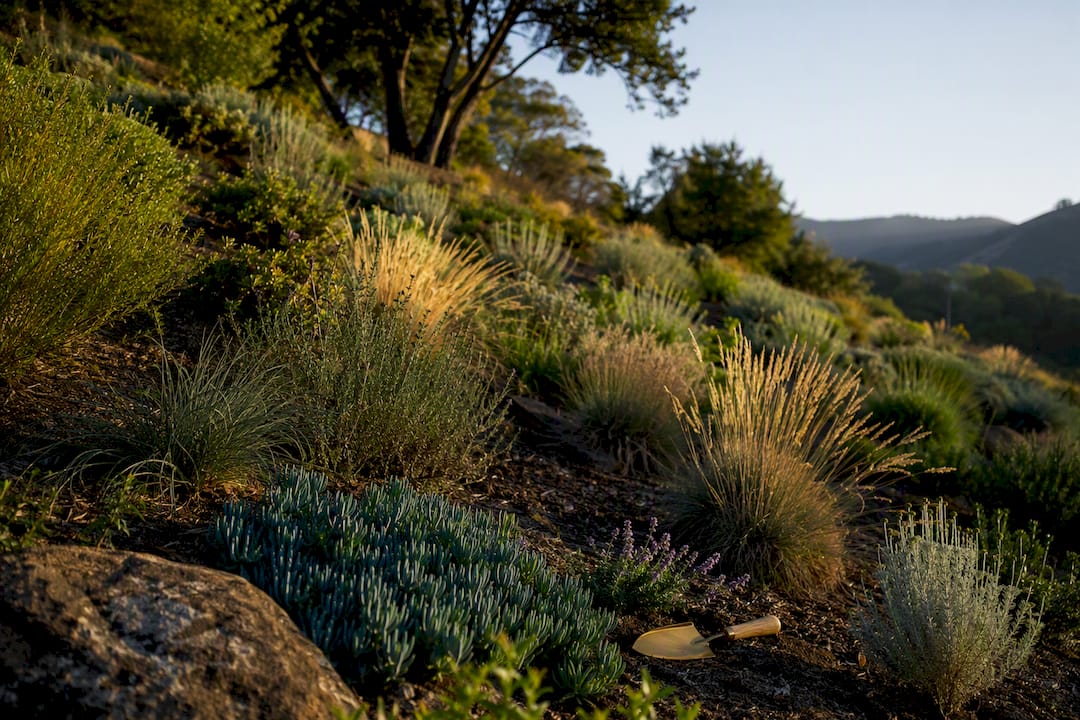
Yes, LADWP customers can get paid to remove their lawn. Through SoCal Water$mart, Los Angeles Department of Water and Power residential customers can earn $5 per square foot (LADWP contributes $3, the Metropolitan Water District of Southern California adds $2) up to 5,000 square feet, capping out at $25,000. Before you touch a shovel, reserve pre-approval on SoCalWater$mart. Skip that step and the entire rebate disappears.
TL;DR:
- The rebate covers $5 per square foot for turf removal, up to 5,000 square feet and a maximum of $25,000, with a minimum of 250 square feet required.
- Pre-approval must be obtained before starting work, and all work must match approved plans, including plant density, rain-capture features, and no artificial turf.
- Funding is limited and distributed on a first-come, first-served basis, making early reservation critical before the season’s funds run out.
- Proper documentation, including detailed photos, measurements, and adherence to design rules, is essential to avoid claim denial.
- Hiring experienced landscape professionals can significantly reduce the risk of paperwork errors and ensure your project meets all rebate requirements.
Table of Contents
- How Much Is the LADWP Turf Replacement Rebate?
- How Do You Apply for the LADWP Turf Replacement Rebate?
- What Design Rules Does Your New Landscape Have to Follow?
- When Should You Apply, and What If Funding Runs Out?
- What Will This Actually Cost You After the Rebate?
- Which Landscaping Changes Actually Qualify?
- Do You Have to Maintain the New Landscape After Getting Paid?
- Where Can You Get Help With Your Application?
- How Sacred Garden Designs Helps You Protect Your Rebate
- Get a Compliant Turf Replacement Plan Without the Paperwork Headaches
- Official Program Pages and Where to Apply
- Sources
- FAQ
How Much Is the LADWP Turf Replacement Rebate?
The rate depends on who owns the property and how big the project is. Residential customers qualify for $5 per square foot, but commercial, multi-family, and public agency properties often see different tiers, generally scaling up per square foot for larger installations since those projects deliver bigger water savings across the system.
Here’s how the numbers break down for most homeowners:
- Residential rate: $5 per square foot ($3 LADWP + $2 MWD), capped at 5,000 square feet and $25,000 total.
- Minimum project size: 250 square feet of turf removed.
- Application limit: one turf replacement application per household per year.
- Commercial and multi-family: higher per-square-foot incentives for larger properties, since LADWP has periodically raised commercial rebate levels, in part to help owners get ahead of AB 1572, which starts phasing out potable irrigation of purely decorative turf in 2027.
Not every project qualifies. LADWP disqualifies work that started before pre-approval was granted, turf that was already removed prior to applying, and any installation of artificial or synthetic turf. That last one trips people up constantly. Homeowners assume “turf replacement” means swapping grass for anything low-maintenance, including plastic turf. It doesn’t. The program exists to restore natural ground cover and reduce potable water demand, not to pave over dirt with synthetic fiber.
How Do You Apply for the LADWP Turf Replacement Rebate?
Getting paid requires following the sequence exactly. Skip a step or do them out of order and you risk forfeiting the rebate entirely.
- Reserve your rebate on SoCal Water$mart before removing any turf. You’ll need five photos of the existing lawn, the first page of your LADWP bill, precise square-footage measurements, and a landscape plan showing your California Friendly® plant selections and rain-capture feature.
- Wait for pre-approval confirmation. Do not remove grass, order plants, or hire a crew until you have written approval. Projects completed or started beforehand are automatically ineligible.
- Complete the installation within the allowed window, typically 180 days from approval. Keep every invoice, receipt, and plant tag along the way.
- Photograph the finished project from the same angles as your original submission so inspectors can compare before and after.
- Submit your final claim on SoCal Water$mart, including completion photos and proof of purchase. LADWP may schedule an onsite inspection, though the program has at times eased this to phone or photo verification rather than an in-person visit.
Pro Tip: Take your “before” photos on a clear day with the entire lawn visible in each frame, including the parkway strip. Inspectors compare these against your final submission, and blurry or partial shots are one of the most common reasons claims get delayed.
The most frequent denial reasons: starting work before approval, missing measurement documentation, and submitting fewer than the required photos. Slow down on paperwork. It’s the cheapest insurance you’ll ever buy on a $25,000 rebate.
What Design Rules Does Your New Landscape Have to Follow?
LADWP isn’t paying you to replace grass with gravel. The program has firm design requirements, and missing even one can cost you the entire rebate at final inspection.
Plant selection and density matter most. Your new landscape needs California Friendly® or native plants at a density of at least three plants per 100 square feet. That’s not a suggestion. Inspectors count.
- Plant density: minimum 3 plants per 100 square feet of converted area.
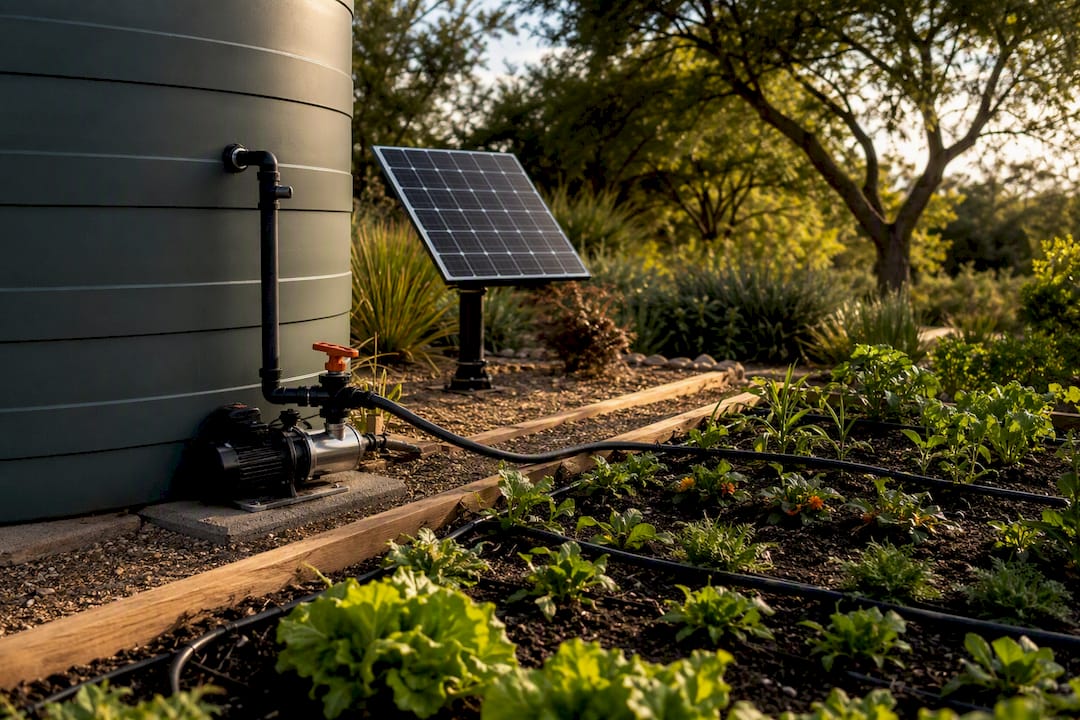
- Rain capture: at least one feature is required, such as a rain barrel, rain garden, cistern, dry river bed, infiltration trench, or vegetated swale.
- No overhead irrigation is allowed within the converted project area once the lawn is gone.
- No artificial turf anywhere in the qualifying square footage.
- Parkway restrictions limit how much permeable rock or gravel you can use between the sidewalk and street, since bare rock offers none of the water absorption or habitat value the program is designed to encourage.
A dry river bed or a planted rain garden tends to satisfy the rain-capture requirement more convincingly at inspection than a single rain barrel bolted to a downspout, since it does double duty as both function and design. Think of the rain-capture rule less as a box to check and more as a design opportunity. The best-looking yards we’ve seen turn their swale or dry creek bed into the visual centerpiece of the whole front yard.
When Should You Apply, and What If Funding Runs Out?
Timing matters more than most homeowners realize. LADWP and MWD fund this rebate on a strict first-come, first-served basis, and pools of money have run dry mid-year before. Reserving your spot on SoCal Water$mart the moment you decide to move forward, before you’ve even finalized your plant list, protects your place in line.
Fall and winter, roughly October through March, tend to be the smartest windows to install. Cooler temperatures reduce transplant stress on new California Friendly® plants and cut down on the extra watering you’d otherwise need during establishment. Once approved, you’re working against that 180 day completion clock regardless of season, so plan your contractor availability before you submit.
- Reserve early. Funding allocation doesn’t wait for you to finish designing.
- Target an October through March installation for better plant survival rates.
- If funds are exhausted, ask about a waitlist before assuming you’re out of options.
- Check eligibility for the Landscape Efficiency Assistance Program (LEAP), which provides free design and installation services to qualifying households in disadvantaged communities.
LADWP has also periodically increased commercial rebate rates as owners prepare for the 2027 AB 1572 restrictions on nonfunctional turf irrigation, a signal that program terms shift over time and waiting rarely pays off.
What Will This Actually Cost You After the Rebate?
The $5 per square foot rebate offsets a real chunk of installation cost, but it rarely covers everything. Sod removal, soil amendment, new plants, mulch, and the mandatory rain-capture feature all add up, and your actual out-of-pocket cost depends heavily on your existing irrigation setup and local water rates. A yard with a functioning drip-ready irrigation system converts more cheaply than one that needs a full sprinkler-to-drip overhaul.
Several smaller incentives stack on top of the base rebate:
- An extra $100 per tree planted as part of the project, up to five trees.
- Separate rebates for rain barrels, cisterns, and weather-based irrigation controllers.
- LEAP’s free services for qualifying disadvantaged-community households, covering design and installation costs entirely in some cases.
Budget for the rain-capture feature and any irrigation conversion up front. Homeowners who forget these mandatory elements often find their rebate check absorbed almost entirely by requirements they didn’t anticipate, leaving little left over for the plants themselves.
Which Landscaping Changes Actually Qualify?
Qualifying and non-qualifying work often looks similar from the curb, but the details decide whether your claim gets approved or denied.
A front yard that swaps thirsty fescue for California Friendly® plants like manzanita, deer grass, and California poppy, arranged at the required density with a gravel-lined dry river bed to catch runoff, is a textbook qualifying project. So is a backyard where a homeowner removes a patchy lawn, installs drip irrigation, and adds a small rain garden that collects roof runoff during winter storms.
What doesn’t qualify trips up plenty of well-meaning homeowners. Replacing real grass with artificial turf is automatically disqualified, no matter how water-efficient the marketing claims. A yard converted to plain decomposed granite or gravel with no plants at all fails the density requirement and misses the point of the program entirely. Removing turf and then leaving the area bare while you “figure out plants later” won’t pass inspection either, since the completed project has to match your approved landscape plan.
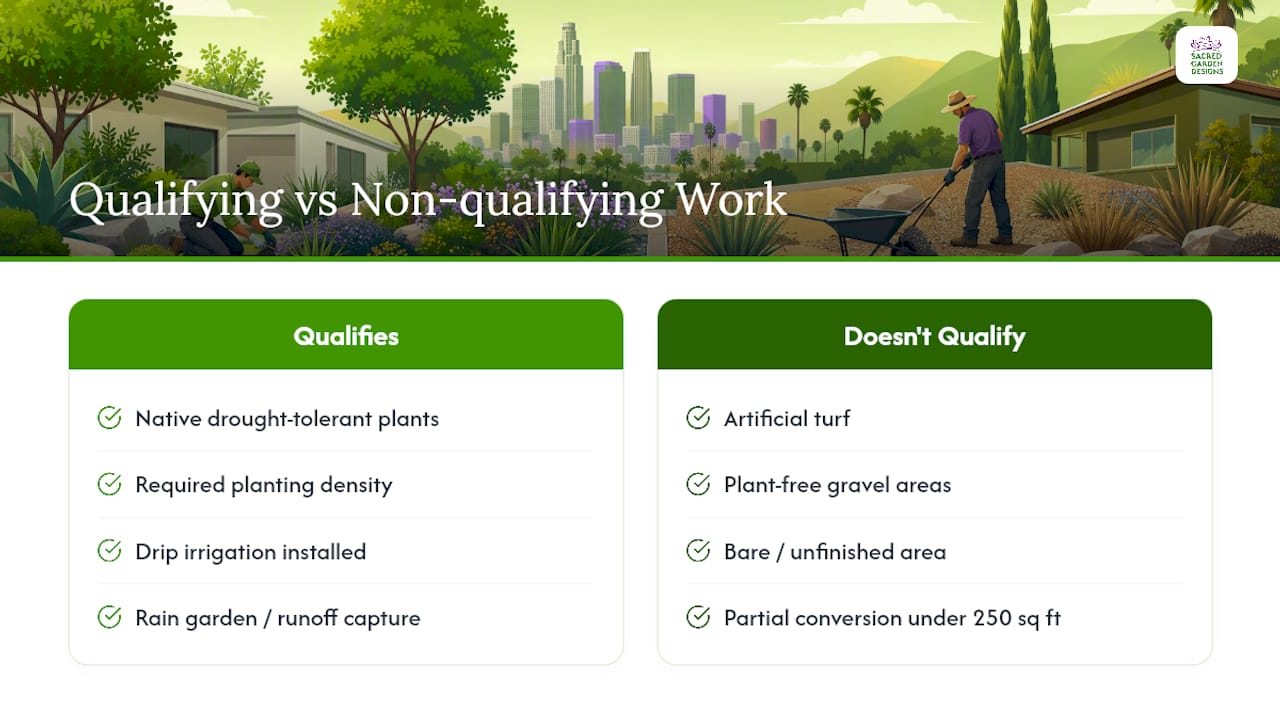
Partial conversions raise questions too. If you only replace half your lawn and leave the rest as grass, you can still apply, but only the converted square footage counts toward your rebate, and it still needs to hit the 250 square foot minimum on its own. Side and backyard turf counts the same as front yard turf, as long as it’s visible and irrigated potable turf being replaced with a qualifying landscape.
Do You Have to Maintain the New Landscape After Getting Paid?
LADWP doesn’t send inspectors back every year to check on your plants, but the rebate isn’t a one-and-done transaction either. Your property still falls under Los Angeles’s standard watering restriction schedule, and the entire point of the rebate is reduced long-term water use, so reverting to a thirsty landscape defeats the purpose you were paid for.
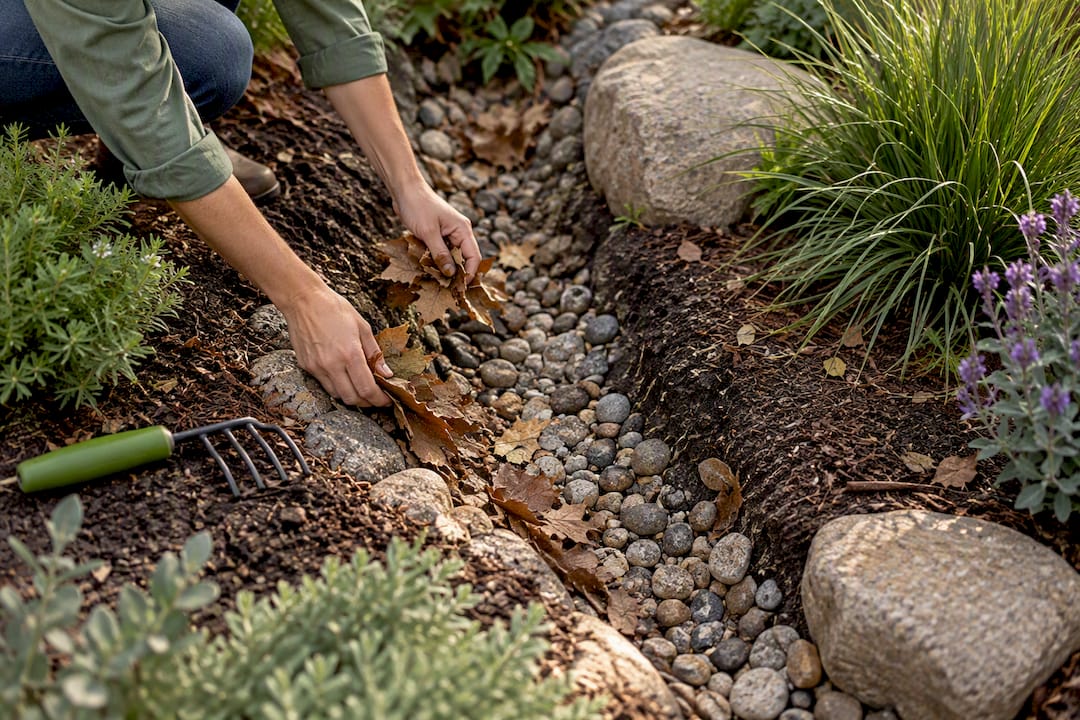
Practically, that means keeping your new plants alive with appropriate drip irrigation rather than reintroducing sprinklers or overhead watering in the converted area, since overhead irrigation was disallowed in your original design. If your rain-capture feature is a swale or infiltration trench, keeping it clear of debris preserves both its function and your yard’s drainage during winter rains.
There’s also a documentation angle worth remembering. If you ever sell the home or a dispute arises about work done under the rebate, having your original approved plan, your completion photos, and your final claim paperwork on hand protects you. Some homeowners keep this in the same folder as home improvement records for insurance and resale purposes.
Nothing in the program requires replanting if a shrub dies years later, but maintaining reasonable plant density and functioning irrigation is consistent with what you agreed to when you accepted the rebate. Think of it less as an obligation with teeth and more as protecting the investment you already made, both the rebate money and the labor that went into the install.
Where Can You Get Help With Your Application?
Questions come up at every stage of this process, and LADWP built in real support channels rather than leaving homeowners to guess. The program’s phone line, (888) 376-3314, connects you with staff who can answer questions about pre-approval status, documentation requirements, and inspection scheduling.
The SoCal Water$mart portal itself is where you’ll spend most of your time. It handles the reservation, the upload of your required photos and bill, and eventually your final claim submission. If you’re stuck on a technical step in the application, that’s the first place to look for guidance before calling in.
For households in qualifying disadvantaged communities, LEAP staff can walk you through eligibility and, if you qualify, handle much of the design and installation process for you at no cost. That’s a different track from the standard rebate, so it’s worth a phone call to LADWP to find out which category applies to your address before you start.
Local landscape professionals who work regularly with the program, including firms like Sacredgardendesigns, can also answer practical questions about what inspectors typically flag, since that kind of pattern recognition comes from handling multiple applications rather than just one.
How Sacred Garden Designs Helps You Protect Your Rebate
Getting the design right the first time saves you from resubmitting paperwork or losing your reservation window. The company has extensive experience building sustainable, water-wise landscapes across Los Angeles and has earned industry recognition and media features.
That experience translates directly into rebate compliance. Plant selection that hits the required density, irrigation design that meets the no-overhead-watering rule, and rain-capture features that double as real design elements rather than an afterthought bolted onto a downspout, all of it matters at inspection time. Sacredgardendesigns handles the documentation side too, from photo requirements at pre-approval through the final claim submission, reducing the odds a homeowner gets denied over a paperwork gap rather than the landscape itself.
Get a Compliant Turf Replacement Plan Without the Paperwork Headaches
Handling the LADWP rebate process solo is entirely possible, but it puts every measurement, photo, and design decision on your shoulders, with real money on the line if something’s off. Sacredgardendesigns offers a different path: a landscape design consultation built specifically around water-wise conversions like this one, where a site assessment identifies your rain-capture options, your plant density plan, and your irrigation conversion needs before you ever submit a pre-approval application.

A consultation typically covers a full site walk, a design that satisfies California Friendly® plant and density requirements, and support pulling together the photo and measurement documentation SoCal Water$mart requires. For homeowners tackling larger properties or slope-adjacent yards, Sacredgardendesigns also handles irrigation conversion and installation so the drip system going in matches what inspectors expect to see. Hiring a professional is optional. It’s not required to get the rebate. But it meaningfully cuts your risk of a denied claim over a documentation error or a missed design rule. If you’re ready to start, book an initial consultation and get your compliance plan in place before your pre-approval clock starts ticking.
Official Program Pages and Where to Apply
Start your application directly through the official channels rather than a secondhand summary, since rebate levels and terms shift over time.
- SoCal Water$mart: reserve your rebate, upload required documents, and submit your final claim.
- LADWP Turf Replacement Rebate page: current residential rates and program overview.
- Transform Your Lawn flyer: plant density and rain-capture design requirements.
- Landscape Efficiency Assistance Program: free design and installation for qualifying households.
Check these pages directly before applying. Rebate caps, deadlines, and design rules have changed before and will likely change again.
Sources
- Turf Replacement Rebate | Los Angeles Department of Water and Power
- SoCal Water$mart
- Transform Your Lawn flyer (LADWP)
FAQ
How Much Is the LADWP Turf Replacement Rebate Worth?
Residential customers can earn $5 per square foot removed, up to 5,000 square feet and a $25,000 maximum per household. Commercial and multi-family properties often qualify for different tiers based on project size.
Do I Need Approval Before Removing My Lawn?
Yes. You must reserve pre-approval on SoCal Water$mart before any turf comes out, and projects started early are automatically disqualified from the rebate.
Can I Replace My Lawn With Artificial Turf and Still Qualify?
No. The program specifically excludes artificial or synthetic turf and requires living California Friendly® or native plants at a set density instead.
How Long Do I Have to Finish the Project?
Most approved applicants have 180 days from pre-approval to complete installation and submit their final claim with photos and receipts.
What Happens if the Rebate Funding Runs Out?
Funding is first-come, first-served, so applying early matters. If funds are exhausted, ask LADWP about a waitlist or check eligibility for LEAP, which offers free landscape services to qualifying disadvantaged-community households.
Can a Professional Help Me With the Application?
Yes. Firms like Sacredgardendesigns design compliant landscapes and help assemble the photo and measurement documentation LADWP requires, which reduces the risk of a denied claim.