For most trees in Los Angeles, the best time to trim is the dormant stretch from leaf fall through the end of winter, roughly late fall to February. The calendar has exceptions. Evergreens, spring bloomers, nesting birds, fire clearance and drought-stressed trees can each move your date. Dead, broken or hazardous limbs can come off at any time of year.
Below, you get the season month by month, the reasons behind it, the rules that apply near power lines and protected oaks, and a clear line between a job you can do and one that needs a certified arborist.
TL;DR
- Dormant-season pruning (after leaf drop through late winter) suits most deciduous trees in Los Angeles, and late winter suits most evergreens.
- Prune early-spring bloomers right after they flower. Dead, diseased or hazardous branches can be removed any time.
- Many birds nest from March through August, and county guidance extends caution through September, so schedule routine trimming between fall and February where you can.
- Never trim near high-voltage lines yourself, and check for protected oaks before you cut.
- Fire clearance is a separate job with its own deadlines. Do not mix it up with routine pruning.
Table of Contents
- The Los Angeles tree trimming calendar at a glance
- Why dormant-season pruning works
- How species and purpose change the date
- Nesting season: the other calendar
- Fire season changes the job, not just the date
- Rules that apply before you cut
- Drought and tree health: when to adjust the schedule
- When to call a certified arborist
- Our perspective
- Plan your tree work with Sacred Garden Designs
- FAQ
- Sources
The Los Angeles tree trimming calendar at a glance
Los Angeles has mild winters, so “dormancy” is softer here than in colder states. Many trees slow down rather than stop. The guidance below still holds, and it comes from the city and the U.S. Forest Service.
| Window | What fits | What to hold off on |
|---|---|---|
| Late fall to early winter (Oct to Dec) | Structural pruning of most deciduous trees once leaves drop; clearing dead wood | Heavy cuts on frost-tender subtropicals |
| Late winter (Jan to Feb) | Most deciduous trees; evergreens, which the city says are set back least when pruned now | Spring bloomers you want to see flower |
| Spring (Mar to May) | Pruning spring-flowering trees right after bloom; dead or broken limbs | Broadleaf pruning, which Los Angeles guidance says to avoid in early to late spring |
| Summer (Jun to Aug) | Safety work only | Routine trimming in peak nesting season, and big cuts on trees under heat stress |
| Early fall (Sep) | Start planning; inspect for nests first | Large canopy reductions before leaves drop |
The City of Los Angeles tree guidelines say that for most deciduous plants, the dormant period from leaf fall through the end of winter is appropriate, and evergreens are set back least if pruned in late winter. The same document says hazardous trees and dying, diseased, broken, rubbing or dead limbs may be pruned any time.
You will see other windows online. Some local sources say August through December, others say January through March. They are not as far apart as they look. The overlap is late fall into winter, and that is where most trees do well.
Why dormant-season pruning works
Three practical reasons keep coming up in official guidance.
Wounds close in the growing season. Cut a tree in winter and it has the entire next growing season to seal and compartmentalize the wound. The Los Angeles guidelines say dormant pruning also can reduce pest problems associated with fresh wounds.
You can see what you are doing. The U.S. Forest Service notes that dormant pruning improves visibility of branch structure, supports wound closure, reduces disease transmission risk and discourages excessive sap flow. With leaves off, you can spot crossing branches, weak unions and deadwood far more easily.
The tree is not spending reserves on new growth. Cuts made just before a flush of growth can push a tree into stress, which matters in a region where many trees already live on limited water.
How species and purpose change the date
A single “trimming season” is a useful default, not a rule. Match the date to the tree and the goal.
Deciduous shade and street trees
Maples, sycamores, ashes, crape myrtles and similar trees are best structured during dormancy. The Forest Service says hardwoods without showy flowers are generally best pruned during dormancy. Aim for November through February.
Evergreens and conifers
The city guidance points to late winter for evergreens. For conifers, the Forest Service says they may be pruned any time, though dormant-season pruning may minimize sap and resin flow. So pines and cedars give you more flexibility, but late winter still keeps the mess down.
Flowering trees
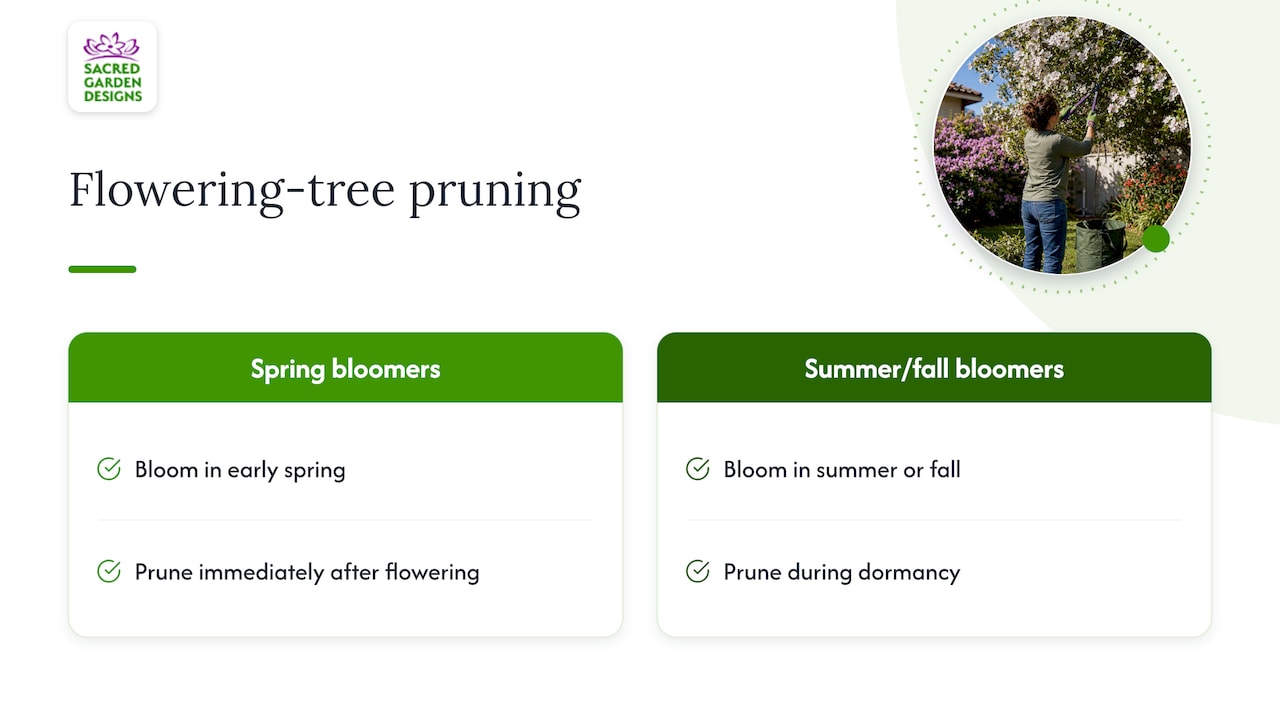
Timing here depends on when the tree blooms, not on the calendar. The Forest Service advises that early-spring-flowering trees be pruned immediately after flowering, while summer- or fall-flowering trees are pruned during dormancy. Prune a spring bloomer in January and you cut off this year’s flowers. Our guide to when and how to prune water-wise gardens without losing spring blooms walks through the same logic for shrubs and small trees.
Fruit and citrus trees
Backyard citrus has its own rhythm, tied to frost risk and sunscald rather than leaf drop. See our note on pruning citrus from February to April. Deciduous fruit trees depend on your local chill hours, which we cover in our guide to fruit trees for Los Angeles homeowners.
Dead, broken and dangerous limbs
These do not wait for a season. The Los Angeles guidelines and the Forest Service both allow removal of dead branches at any time. If a limb is cracked, hanging or over a roof, handle it now and do the cosmetic work later.
Nesting season: the other calendar
The tree’s calendar is only half the picture. Birds have their own. The Los Angeles Audubon guide to bird-friendly trimming says many species nest between March 1 and August 31, and that the best window for trimming is September through February, with an inspection of the area before work begins.
Los Angeles County’s urban forestry manual is a little broader. It treats bird-nesting season as generally March through September, and as early as January for tall trees hosting raptors, and requires nest checks and precautions before trimming in that period.
What this means in practice:
- Schedule routine trimming for late fall and winter and you avoid most of the conflict.
- If you must cut between March and September, look first. Watch the tree for a few minutes for birds carrying material or food, and check for nests in the canopy.
- If you find an active nest, delay the work on that part of the tree. Nests with eggs or chicks are not worth disturbing for a cosmetic cut.
- Ask any contractor how they check for nests. A good crew has an answer.
Fire season changes the job, not just the date
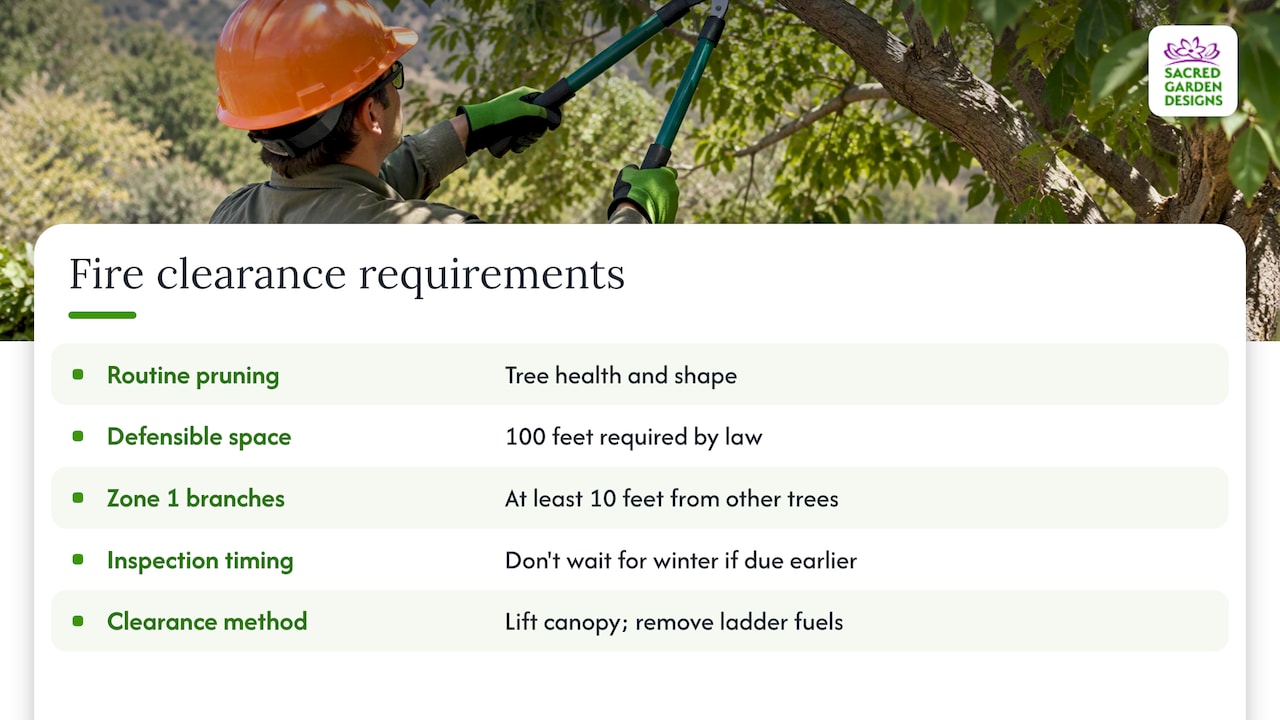
Routine pruning and wildfire clearance are different tasks. Pruning is about the tree’s health and shape. Clearance is about keeping fire from moving between trees and to your house, and it follows legal deadlines.
CAL FIRE explains that under PRC 4291, 100 feet of defensible space is required by law, and in Zone 1 trees should be trimmed regularly to keep branches at least 10 feet from other trees. Local brush clearance rules can be stricter or more specific, and we keep an overview in our guide to brush clearance requirements in Los Angeles. For a plan that handles all zones around the house with plants that use less water, see defensible space landscaping.
Two practical points. First, do not wait for winter if your clearance inspection is due before then. Safety and legal compliance outrank the ideal pruning month. Second, limit the damage: clearance does not mean scalping the tree. Lift the canopy and remove ladder fuels, but keep the tree’s structure intact.
Rules that apply before you cut
Power lines
This is the one place where DIY stops. The Los Angeles Department of Water and Power states that the California Public Utilities Commission requires a minimum clearance of 18 inches between trees and high-voltage lines at all times, increasing to 4 feet in high fire areas, and that residents should not trim trees around these lines themselves. LADWP keeps a pruning cycle of about 12 months for trees near its lines, and the utility asks you to contact it for an inspection rather than hiring an untrained person to work near high-voltage wires. If a branch is touching a line, stay away and call the utility.
Protected oaks
In unincorporated Los Angeles County, an Oak Tree Permit is required for development that involves pruning branches or roots over 2 inches in diameter on protected oak trees. Cities inside the county have their own tree ordinances, and some protect native oaks, sycamores and other species. Before cutting anything large on a native tree, call your city’s planning or urban forestry office and ask whether the tree is protected.
Street and parkway trees
In most Los Angeles neighborhoods, the tree in the parkway strip belongs to the city, even though it sits in front of your house. Do not prune it yourself. Request service through the city.
How much is too much
Public agencies treat removing more than 25% of a tree’s canopy in one operation as excessive. San Dimas’s community forest plan, citing the city’s and LA Recreation and Parks’ standards, calls this detrimental to tree health and generally prohibited for public trees. It is a sensible ceiling for your own trees, too. If a tree needs more than a quarter of its canopy removed, spread the work across seasons, or ask whether the tree is in the wrong place.
Drought and tree health: when to adjust the schedule
Los Angeles Recreation and Parks advises evaluating each tree individually before pruning, since tree health and disease factors may require changing the schedule. In a dry year, that advice matters more.
- Water-stressed trees have fewer reserves to heal. Prune lightly, remove deadwood, and avoid heavy canopy reduction in the hottest months.
- Pruning is not a substitute for water. A tree dropping leaves in August may need a deep soak, not a saw. Our guide to drought tree care explains how to keep trees alive through dry years.
- Recently planted trees need only corrective cuts for the first couple of years.
- Diseased trees may need to be pruned out of season. Ask an arborist before cutting, and clean your tools between cuts so you do not spread problems.
A simple habit helps: walk your trees each fall, after leaves drop. Note crossing limbs, deadwood, rubbing branches and anything near a roof, wire or fence. That list is your winter work order.
When to call a certified arborist
A homeowner with a pole pruner and a stepladder can handle small formative cuts on young trees. Call a certified arborist when:
- A limb is larger than you can control with one hand or sits above a roof, driveway, car or play area.
- Any part of the tree is near a power line. Contact the utility first.
- The tree shows signs of trouble: mushrooms at the base, sudden dieback, cracks, a lean that is new, or large dead sections in the canopy.
- The tree is a native oak, sycamore or another species that your city may protect.
- You need a large canopy reduction, a structural cabling job or a removal.
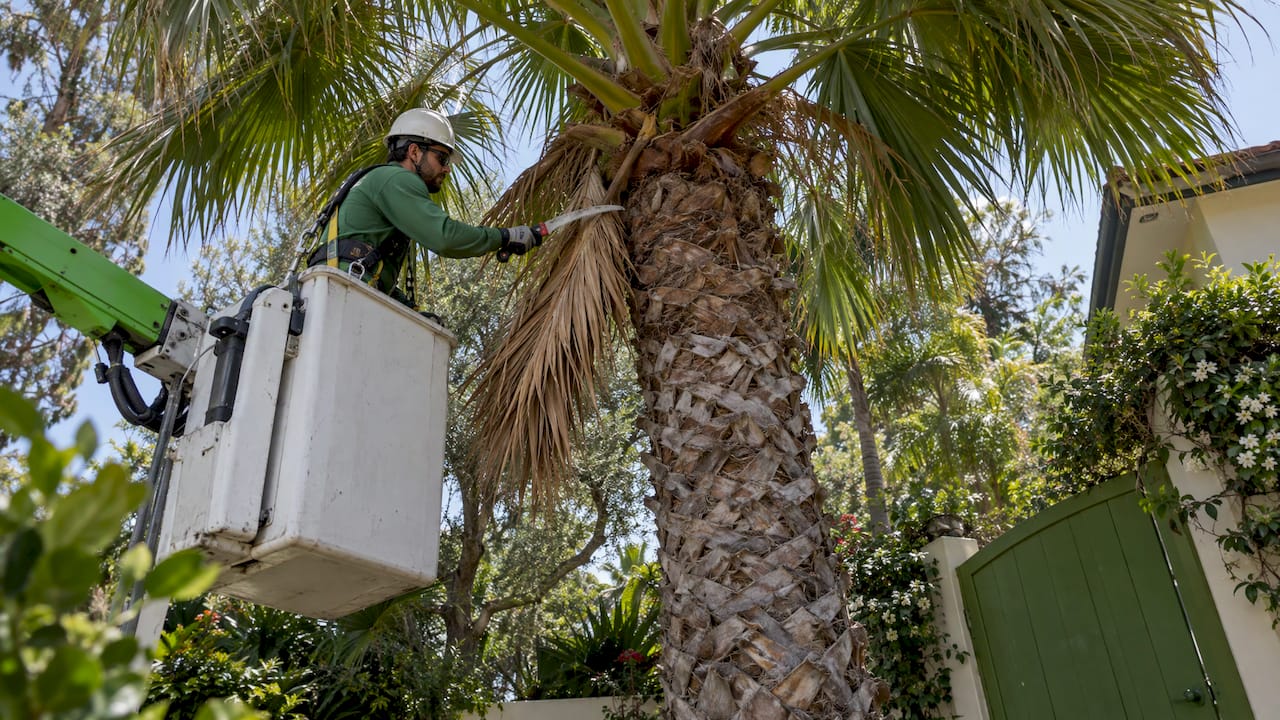
Some situations are urgent. A cracked or hanging limb, a tree leaning after wind or rain, or a branch resting on a roof should be dealt with right away, and the area beneath kept clear until a professional arrives. Ask for credentials and proof of insurance before work begins. The International Society of Arboriculture runs the Certified Arborist credential, and you can ask any contractor for their certification number.
Our perspective
We have worked on Los Angeles landscapes for more than 25 years, and the most common tree mistake we see is the same one every year: a heavy cut at the wrong moment, made to fix a problem the tree never had. A homeowner worries about fire, or a neighbor complains, or a crew arrives in May and offers a bargain, and a healthy tree loses a third of its canopy in a heat wave.
Our approach is to treat a tree as part of a whole landscape, not as a line item. We look at the species, the irrigation it gets, the slope it sits on, the structures near it and the fire zone it falls in. Then we set a schedule: structural work in the dormant months, bloom-timed cuts for flowering trees, and clearance work timed to the legal deadline. In drought years we pair pruning with watering and mulch, because a pruned, thirsty tree struggles to recover.
Good trimming is quiet work. When it is done right, nobody notices the cuts. They notice a tree that is healthier, safer and better looking in three years. That is the standard we hold ourselves to on every project.
Denise Buchanan
Plan your tree work with Sacred Garden Designs
If your trees are part of a larger yard that needs rethinking, we can help with the whole picture. Our team offers expert tree trimming, clean-up and haul-away, garden maintenance and irrigation design, alongside sustainable landscape design and installation for Los Angeles properties.

For a yard under 5,000 square feet, our landscape design service is published at $1,500, and a full landscape design is $2,500. Tree trimming and maintenance are quoted per project, so start with an initial consultation. See our landscape design services or the full list of tree, maintenance and installation services. For seasonal upkeep beyond trees, our garden maintenance schedule shows how to follow frost dates rather than fixed calendar days.
FAQ
What is the best month to trim trees in Los Angeles?
For most deciduous trees, late fall through February is the best window, after leaves drop and before spring growth. Evergreens do well in late winter. Spring bloomers should be pruned right after they flower, and dead or hazardous limbs can come off any time.
Can I trim trees in spring or summer in Los Angeles?
Yes, for safety work and for trees that bloom in spring, but it is not the best time for routine pruning. City guidance advises avoiding broadleaf pruning in spring, and many birds nest from March through August. If you need to cut in those months, check for nests first.
Do I need a permit to trim a tree on my property?
Often not, but it depends on the tree and the location. Protected oaks in unincorporated Los Angeles County can require an Oak Tree Permit for pruning branches or roots over 2 inches in diameter when development is involved. City trees in the parkway belong to the city. Call your local planning or urban forestry office before cutting anything large.
How much can I cut off a tree at once?
Public agencies treat removing more than 25% of the canopy in a single operation as excessive, and it is a sound limit for private trees too. If a tree needs a bigger reduction, spread the work over more than one season and talk to a certified arborist.
Who trims trees near power lines?
Not you. State rules require at least 18 inches of clearance from high-voltage lines, and 4 feet in high fire areas. LADWP asks residents to contact the utility for an inspection instead of hiring someone untrained to work near the lines.
Sources
- 3.0 Tree Maintenance Guidelines, City of Los Angeles Recreation and Parks
- How to Prune Trees, U.S. Forest Service
- Guide to Bird-Friendly Tree and Shrub Trimming and Removal, Los Angeles Audubon
- Urban Forestry Program Manual, Los Angeles County
- Defensible Space, CAL FIRE
- Tree Trimming, Los Angeles Department of Water and Power
- Oak Tree Permit Ordinance FAQs, Los Angeles County
- Community Forest Management Plan, City of San Dimas