In most residential zones in the City of Los Angeles, a fence, wall or hedge in the front yard can be no taller than 3.5 feet (42 inches). Side and rear yards generally allow up to 6 feet, and up to 8 feet on wider lots outside hillside areas. Masonry or concrete over 3.5 feet needs a building permit. Taller than those limits means a separate approval from City Planning.
Those are the headline numbers. The details decide whether your project passes: where your lot sits, how the city measures height, whether your “fence” is really a hedge, and where your property line actually is. This guide walks through each one, then shows how to get the privacy you want inside the rules.
TL;DR
- Front yard: 3.5 feet (42 inches) in most City of Los Angeles residential zones. Properties in A and RA zones may be allowed up to 6 feet.
- Side and rear yards: up to 6 feet in general, and up to 8 feet when the lot is 40 feet wide or more and not in a designated Hillside Area.
- Permits: any masonry or concrete fence taller than 3.5 feet needs a building permit, in any yard.
- Hedges count: thick shrubs and trees planted as a barrier face the same height limits as a solid fence.
- Want taller? Apply through the Department of City Planning. Expect notice to neighbors and possibly a hearing.
Table of Contents
- Which Los Angeles are you in?
- Fence height limits by yard
- How the city measures height
- Hedges, trees and lattice count too
- When you need a permit
- Property lines and the public right-of-way
- Going taller: the planning approval route
- Getting privacy inside the limits
- Fire safety and your fence
- Our perspective
- Plan the fence with the garden
- Before you build: a checklist
- FAQ
- Sources
Which Los Angeles are you in?
The numbers above apply to the City of Los Angeles. Los Angeles County is a different jurisdiction, and dozens of cities inside the county (Pasadena, Santa Monica, Burbank and others) write their own fence codes.
In unincorporated Los Angeles County, the county’s building and safety division says a freestanding fence or block wall may be built up to 6 feet without a permit, though the Department of Regional Planning has its own requirements. If your address says Los Angeles but you are not sure whether you are in the city, check your parcel on the city’s zoning lookup or call the building department before you buy materials.
Everything below is about the City of Los Angeles, using the LADBS information bulletin on fence heights in residential zones and the municipal code as the baseline.
Fence height limits by yard
| Location | Typical limit | Notes |
|---|---|---|
| Front yard, R and RW zones | 3.5 ft (42 in) | Applies to fences, walls, hedges and trees |
| Front yard, A and RA zones | Up to 6 ft may be allowed | Confirm your zone first |
| Side and rear yard, lot under 40 ft wide or in a Hillside Area | 6 ft | |
| Side and rear yard, lot 40 ft wide or more, not Hillside | Up to 8 ft | |
| Masonry or concrete over 3.5 ft, any yard | Building permit required | Plans must show every component’s height |
The front-yard and side/rear figures, and the lot-width and hillside conditions, come from the Los Angeles Department of Building and Safety. The masonry permit rule is in the LADBS bulletin.
Front yard fences
This is where most people get caught. You see tall front fences all over the city, so it is natural to assume 6 feet is fine. Many of them predate the current rules, sit in zones with different standards, or were built without approval.
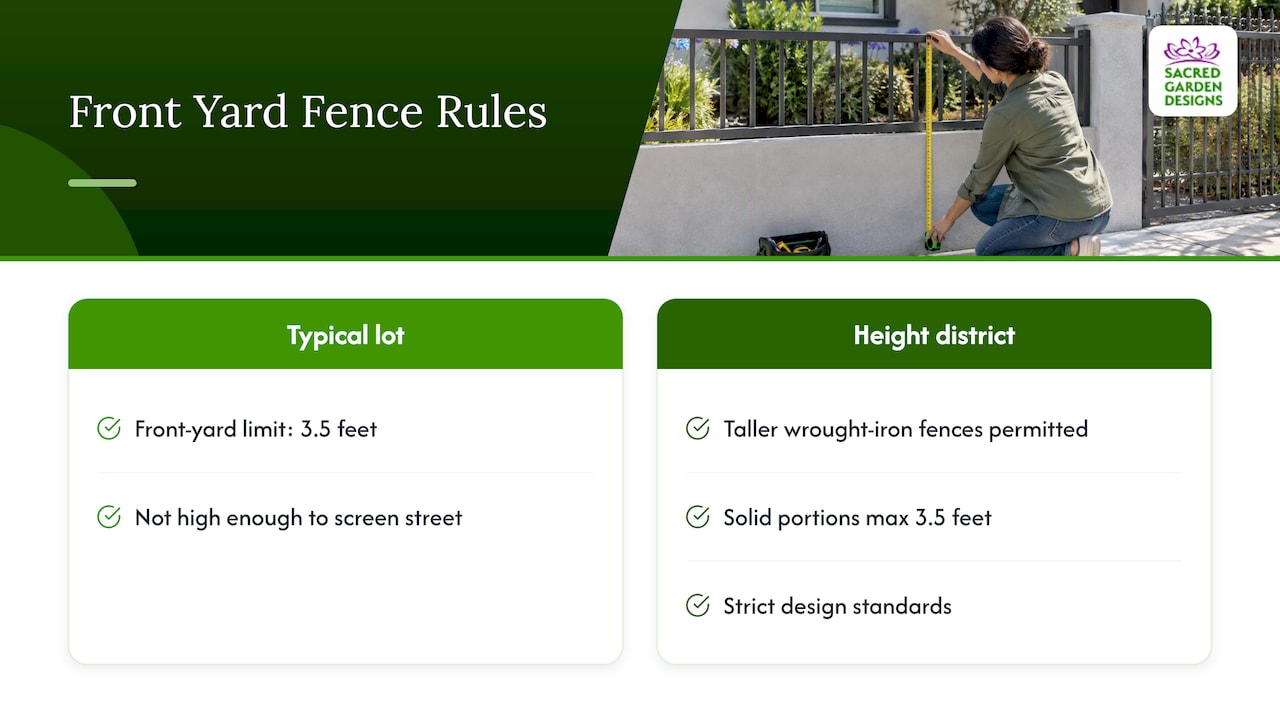
For a typical single-family lot, the front yard limit is 3.5 feet. That is high enough to mark a boundary, keep a small dog in and frame a garden. It is not high enough to screen the street.
If you want a see-through look, there is one more tool. Some neighborhoods are designated Fence Height Districts. The municipal code’s Fence Heights District section lets those areas permit taller wrought-iron front fences under strict design standards, with a 3.5-foot maximum on any solid portion. Check whether your street is one.
Side and rear yards
Behind the front setback you get more room. Six feet is the general limit. If your lot is at least 40 feet wide and not in a Hillside Area, you may build to 8 feet. Hillside lots stay at 6 feet, and so do narrow lots.
Most older Los Angeles lots are 40 to 50 feet wide, so lot width is worth measuring from your survey rather than guessing. A lot that looks 40 feet wide from the sidewalk may be 38 on paper.
Corner lots
Corner lots are the trickiest. City officials describe safety and visibility as the main reasons for these limits, particularly the visibility triangle at intersections. A fence that blocks a driver’s line of sight at the corner will be turned down however well designed it is, per the municipal code provisions on fence heights. If you live on a corner, treat the corner as a front yard in two directions and ask the city before you plan anything tall.
How the city measures height
Height is not simply how tall the panel is. Three details change the number.
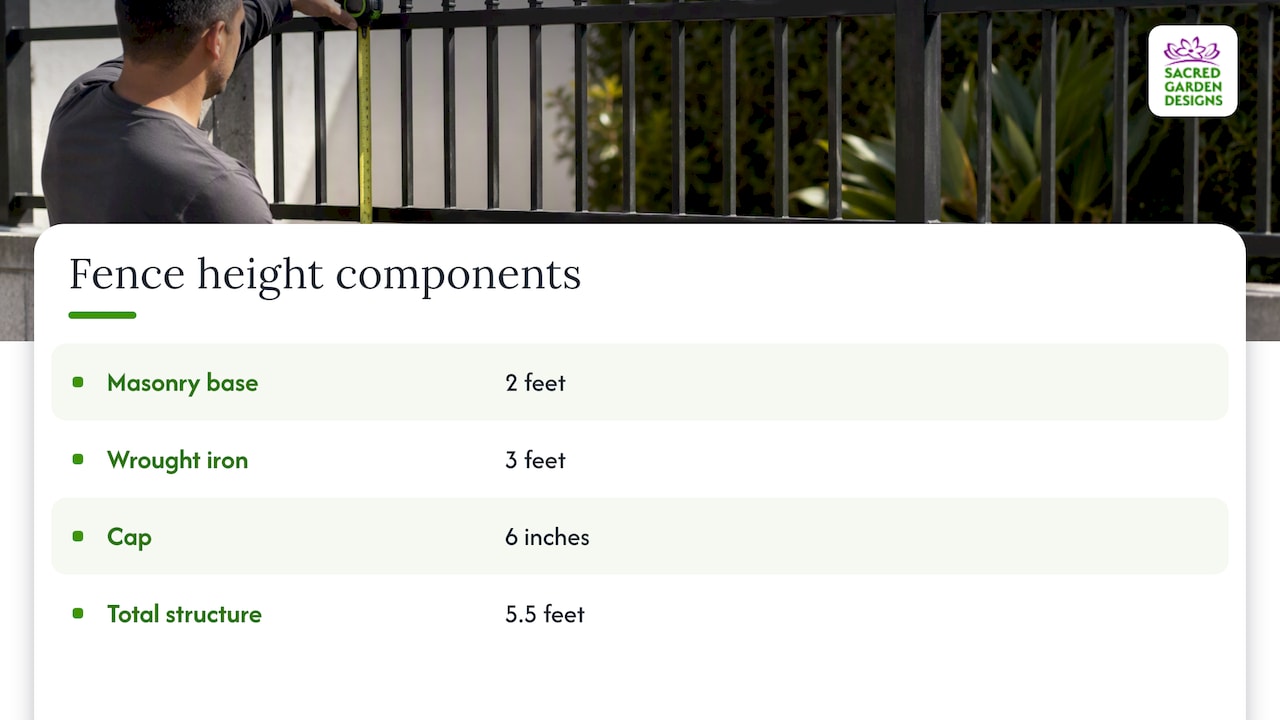
Every component counts. A wall with a 2-foot masonry base, 3 feet of wrought iron and a 6-inch cap is a 5.5-foot structure. Where a permit is required, the elevation plans must show the height of each material. Leaving out a component is a common reason the initial application is rejected, according to the LADBS bulletin.
Slopes follow their own method. On sloping ground the limit is not necessarily measured from natural grade at every point. The city has approved methods for calculating height on slopes, and the bulletin suggests speaking with a plan check supervisor at a local LADBS office before you finalize the design. If your yard steps down a hillside, do this early. Retaining walls and fences on top of them are a frequent trap, and hillside landscaping on slopes over 30% comes with its own set of rules.
Raised soil is not free height. Building a berm or planter and then fencing from the top defeats the purpose. Plan on the height from the adjacent ground, and confirm with the city if you are grading.
Hedges, trees and lattice count too
The City of Los Angeles defines “fence” and “wall” broadly. Hedges, thick shrubs and even ornamental latticework fall under the same rules, per the LADBS bulletin. Homeowners often believe a wall of tall shrubs sidesteps the limit. It does not.
That matters for garden design. A 6-foot privacy hedge of Italian cypress or bamboo along the front property line is subject to the same 3.5-foot cap as a wooden fence in a standard front yard. The same logic applies to a row of columnar trees planted tight as a screen.
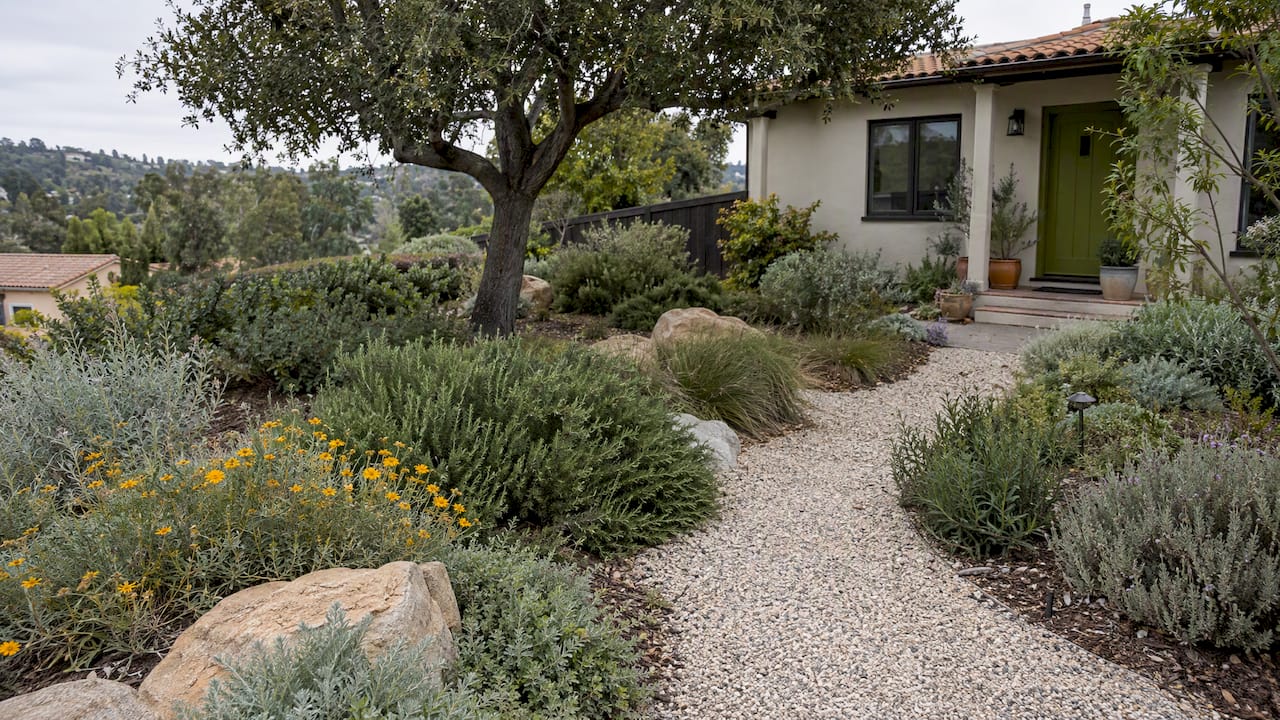
It also means your landscape design should think in layers. A low hedge or fence at the front line, with taller planting set back where the front-yard rules no longer apply, is both legal and often better looking.
When you need a permit
Two systems apply at once: zoning rules on how tall a fence may be, and building rules on when you need a permit. Passing one does not satisfy the other.
- Masonry or concrete over 3.5 feet: a building permit is required in any yard, front, side or rear, according to the LADBS bulletin.
- Taller than the standard limit: additional permits or City Planning approval may be needed, and that can involve a public hearing and notice to abutting owners.
- Anything in the public right-of-way: a separate encroachment approval, covered below.
Because published summaries of exact permit thresholds for wood or vinyl fences vary from site to site, rely on LADBS itself. Call or visit before you build, and ask for the answer in writing or note the staff member’s name. The cost of a phone call is small next to tearing out a fence.
Property lines and the public right-of-way
Many homeowners assume the property line is the inside edge of the sidewalk. Often it is not. The city may hold different records for your boundary, and building on that assumption can lead to enforcement for encroachment, per the LADBS bulletin. Hire a licensed surveyor if your fence will sit near the line.
If any part of the fence, even a footing, extends into the public right-of-way, you need a Revocable Permit from the Bureau of Engineering. That is separate from a building permit and has its own technical requirements and fees. The Bureau’s front yard fence and wall procedure also states that the right-of-way should not be used to get around private property height requirements.
Going taller: the planning approval route
If the standard limits do not work, you can ask. The Department of City Planning can approve fences and walls up to 8 feet in places the standard code would not allow. The planning department’s page on fences and walls up to 8 feet explains that a Zoning Administrator can approve these applications.
Expect to show:
- How the project improves the neighborhood.
- How it fits with adjacent properties.
- That it follows the General Plan.
Neighbors are notified and a hearing may be held. This takes time, and approval is not guaranteed. Projects that compromise visibility for drivers are routinely turned down. Treat this route as realistic for a specific need, such as noise or security on a busy street, rather than a way to get a privacy screen you simply prefer.
Getting privacy inside the limits
Most people asking about fence height want one of three things: privacy, security or sound control. You can often get them without a variance.
- Build to the limit at the back and sides. Where 6 or 8 feet is allowed, use all of it. Lay out the tall elements there.
- Layer the front. Keep the front line low, then plant a screen of shrubs and small trees set back from the line. Verify that anything near the sidewalk stays within the height rules.
- Use texture, not height. Climbing vines on a 3.5-foot open fence soften the view from the street and still count as part of the fence, so keep the total under the limit.
- Screen the windows. If the real issue is people looking into the house, decorative window film for privacy solves it from the inside without adding any structure outside.
- Choose plants that earn their place. In a dry climate, a low, water-wise planting looks intentional. See our guide to drought-tolerant plants for Los Angeles for choices that stay within height and water budgets.
If you are also pulling out lawn at the front, the LADWP turf replacement rebate requires preapproval, so settle the plan for fence and planting together.
Fire safety and your fence
In wildfire-prone neighborhoods, the fence is part of the fire plan. Solid wood fences that touch the house can carry flame to the structure. Think about the material, the gap at the house and the plants beside it. Our guides on defensible space landscaping and brush clearance requirements in Los Angeles cover how to lay out those zones, and a fence that meets height rules should still fit with them.
Our perspective
We have designed landscapes in Los Angeles for over 25 years, and fence height comes up on almost every project that touches the street. Our view is simple: start with the rules, then design the space that the rules allow. We do not treat limits as the enemy of a good garden.
The yards that work best are layered. A low, handsome front boundary. A planted buffer behind it. Full-height privacy where the code allows it. Water-wise plants that fill in without needing a hedge trimmed every few weeks. When we see a client’s heart set on a 6-foot front wall, the better question is usually what they want to feel when they step outside, and we can often get there with soil, planting and structure placed in the right spot.
We also ask clients to confirm the property line and the zoning before we draw anything. Those two checks prevent most of the expensive surprises we hear about. Where a project does need City Planning approval, we would rather tell you early than let you build and find out later.
— Denise Buchanan
Plan the fence with the garden
If you are redoing a yard, the fence, patio, planting and irrigation should be designed as one. We offer landscape design services: $1,500 for yards under 5,000 sq. ft. and $2,500 for a full landscape design. Our design and installation services also cover hardscape such as patios, decks and retaining walls, so the structures around your garden are planned with the rules in mind.
Before you build: a checklist
- Confirm you are inside the City of Los Angeles and note your zone.
- Order or find a survey that shows your property line and lot width.
- Check whether you are in a Hillside Area or a Fence Height District.
- Measure each component of the design and add the heights.
- Identify corner-lot visibility areas.
- Decide on the material: masonry over 3.5 feet means a permit.
- Talk to LADBS, and to City Planning if you want to exceed the limits.
- Tell your neighbors. It is courteous, and it avoids complaints later.
The city responds to complaints, including construction without permits, as the LADBS code enforcement page notes. A neighbor who hears about your project from you is less likely to report it.
FAQ
What is the maximum height allowed for a residential fence in Los Angeles?
In most City of Los Angeles residential zones it is 3.5 feet in the front yard and 6 feet in side and rear yards. Side and rear fences can reach 8 feet on lots 40 feet wide or more that are not in a Hillside Area. Taller needs City Planning approval.
Can I build a 6-foot fence in my front yard?
Not in most residential zones, where the front yard limit is 3.5 feet. Properties in A and RA zones may be allowed up to 6 feet, and Fence Height Districts allow taller wrought-iron designs under strict standards. Confirm your zone before you plan.
Do hedges have to follow the same height limits?
Yes. The city treats hedges, thick shrubs and trees planted as barriers like fences and walls. A tall front hedge is subject to the same cap as a solid fence in the same location.
Do I need a permit for a fence in Los Angeles?
Yes for any masonry or concrete fence taller than 3.5 feet, in any yard. Fences that exceed the standard height limits may need additional permits or planning approval. Contact LADBS to confirm the requirement for your material and height.
Sources
- LADBS information bulletin: heights of fences in residential zones
- LADBS: What is the allowable fence height?
- Los Angeles Municipal Code, Fence Heights District
- City Planning: fences and walls up to 8 feet
- Bureau of Engineering: front yard fences, walls and gates
- Los Angeles County Building and Safety FAQ
- LADBS code enforcement